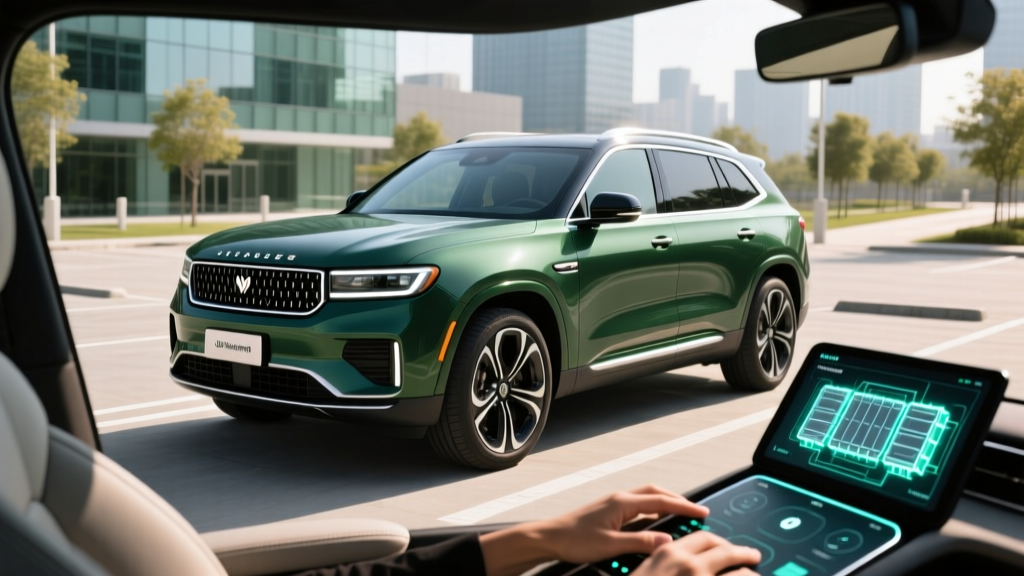
Quick Verdict: Is the Wagoneer S Worth Leasing in 2026?
The 2026 Jeep Wagoneer S is Stellantis's first ground-up battery-electric vehicle built on the STLA Large platform, and it arrives with serious numbers: an EPA-estimated 300 miles of range, 600 horsepower, and a peak DC fast-charge rate of up to 500 kW. For shoppers searching for competitive Wagoneer S lease deals, the value proposition hinges on whether you prioritize luxury-crossover performance and Stellantis's new 800-volt architecture over the broader charging-network reliability that Tesla or Hyundai currently offer.
Leasing the Wagoneer S can be an especially smart move in 2026 because it sidesteps some of the federal tax credit's battery-sourcing complexities — the dealer can apply the $7,500 §30D credit as a point-of-sale reduction on qualifying leases (via the commercial clean vehicle credit pathway under §45W), effectively lowering your capitalized cost. Let's dig into exactly what you're getting, what the real-world driving looks like, and how to evaluate current Wagoneer S lease offers against key rivals.
Range, Battery & Efficiency: Beyond the EPA Sticker
The Wagoneer S is equipped with a 100 kWh (usable) lithium-ion battery pack using NMC (nickel-manganese-cobalt) chemistry, chosen for its higher energy density suited to this 5,500-pound luxury SUV. The EPA estimates the Wagoneer S at 300 miles of combined range, with efficiency rated at approximately 3.0 kWh/mile (100 MPGe combined).
EPA Estimate: 300 miles combined
Highway (70-75 mph): Expect 250–270 miles in moderate temperatures. The Wagoneer S's boxy SUV profile and weight work against it at sustained highway speeds.
Cold Weather (below 30°F): Range drops 20–30%, putting realistic winter range at 210–240 miles. The standard heat pump helps mitigate cabin heating losses.
Mixed Commuting: City and suburban driving with regenerative braking can match or slightly exceed the 300-mile EPA figure.
| Specification | Value |
|---|---|
| Battery Capacity (Usable) | 100 kWh |
| Battery Chemistry | NMC (Nickel-Manganese-Cobalt) |
| Architecture | 800-volt |
| EPA Range (Combined) | 300 miles |
| EPA Efficiency | ~100 MPGe / 3.0 kWh/mile |
| Thermal Management | Active liquid cooling + heat pump |
NMC chemistry provides the energy density needed for a large SUV, but it requires more careful state-of-charge management than LFP (lithium iron phosphate). Stellantis recommends daily charging to 80% for routine use and reserving 100% fills for road trips — a practice that preserves long-term battery health. The battery management system includes a buffer above and below the stated 100 kWh usable capacity.
Charging Speed: 800-Volt Architecture in Practice
The Wagoneer S's 800-volt electrical architecture is its most forward-looking technical feature, enabling DC fast-charge rates that rival the Porsche Taycan and Hyundai Ioniq 5. On a compatible 350+ kW charger, the Wagoneer S peaks at approximately 500 kW, delivering a 10–80% charge in roughly 18 minutes under optimal conditions.
| Charging Level | Power (kW) | Speed | Notes |
|---|---|---|---|
| Level 1 (120V Household) | ~1.4 kW | ~4 miles/hour | Emergency/top-up only |
| Level 2 (240V Home) | 11.5 kW (max) | ~34 miles/hour | Full charge in ~9 hours |
| DC Fast Charge (CCS2/NACS) | Up to 500 kW peak | 10–80% in ~18 min | Requires 350+ kW station; rate tapers above 80% |
| DC Fast Charge (50 kW station) | 50 kW | 10–80% in ~90 min | Common older-station speed |
Charging curve reality: The 500 kW peak rate is sustained only between approximately 10% and 35% state of charge. From 35% to 60%, the rate steps down to around 250–300 kW, and from 60% to 80% it tapers further to roughly 150 kW. This is normal for high-power packs — peak kW numbers never represent the full session. On a road trip, plan your stops around the 10–80% window where the Wagoneer S performs best.
The Wagoneer S comes with a NACS (North American Charging Standard) port for native Tesla Supercharger access, plus a CCS adapter for Electrify America, EVgo, and other networks. Home charging at the 11.5 kW maximum Level 2 rate requires a 60-amp dedicated circuit — expect $800–$2,500 for a professional Level 2 installation depending on your electrical panel's proximity to the garage and whether a panel upgrade is needed.
Performance, Drivetrain & Ride Quality
The Wagoneer S Launch Edition and its successors use a dual-motor all-wheel-drive powertrain producing 600 horsepower and 617 lb-ft of torque. The 0–60 mph sprint takes 3.4 seconds — putting this 5,500-pound SUV in sports-sedan territory.
| Specification | Value |
|---|---|
| Powertrain | Dual-motor AWD |
| Horsepower | 600 hp |
| Torque | 617 lb-ft |
| 0–60 mph | 3.4 seconds |
| Top Speed | 120 mph (electronically limited) |
| Drive Modes | Sand, Snow, Auto, Sport, Eco, Valet |
| Air Suspension | Standard (adjustable ride height) |
| Towing Capacity | Not yet rated (not recommended for heavy towing) |
The standard air suspension provides up to 2.4 inches of adjustable ride height, which aids both aerodynamics on the highway (lowered) and ground clearance on light off-road terrain (raised). Jeep includes the brand's traditional Selec-Terrain drive modes, though this is a unibody crossover — not a body-on-frame Wrangler. Think of it as a luxury performance SUV with light trail capability, not a rock crawler.
Pricing, Trims & Evaluating Wagoneer S Lease Deals
The 2026 Wagoneer S starts at a base MSRP of approximately $70,295 (including destination) for the Launch Edition. Higher trims and option packages can push the as-tested price toward $80,000. Here's how the pricing breaks down and how federal incentives factor in:
| Trim | Base MSRP | Federal Credit Eligibility | Effective Price (if credit applies) |
|---|---|---|---|
| Launch Edition | $70,295 | Qualifies if sourced/leased (§45W) | ~$62,795 |
| Limited (expected) | ~$65,000 (est.) | Subject to MSRP cap rules | ~$57,500 |
| Overland (expected) | ~$75,000 (est.) | Subject to MSRP cap rules | ~$67,500 |
- MSRP Cap: SUVs/vans/pickups must be ≤$80,000 MSRP. The Wagoneer S qualifies under the SUV category.
- Buyer Income Cap: AGI must not exceed $150,000 (single), $225,000 (head of household), or $300,000 (joint filers).
- Battery Sourcing: Critical minerals and battery components must meet phased-in domestic/free-trade sourcing thresholds. Verify current-year compliance on the vehicle's window sticker and at IRS.gov.
- Lease Loophole (§45W): When you lease, the lessor (dealership/finance company) claims the $7,500 commercial clean vehicle credit and typically passes it through as a capitalized-cost reduction. This bypasses buyer income limits and battery-sourcing restrictions — making leasing a powerful strategy for the Wagoneer S.
- Point-of-Sale Transfer: If purchasing and eligible, you can transfer the credit to the dealer for an immediate price reduction rather than waiting until tax filing.
Evaluating Wagoneer S lease deals: A competitive 2026 Wagoneer S lease in the current market should target a monthly payment in the $650–$850 range for 36 months with 10,000–12,000 miles/year, assuming the $7,500 credit is applied as a cap-cost reduction and a reasonable money factor (roughly 0.0025 or lower). Always ask the dealer for the full lease breakdown: capitalized cost, residual value, money factor, and any mandatory fees. Compare the Wagoneer S lease against BMW iX, Audi Q8 e-tron, and Tesla Model X lease offers to confirm you're getting fair value.
Interior, Cargo & Technology
The Wagoneer S seats five passengers across two rows. Interior materials and tech are a significant step up from previous Jeep products, targeting the luxury-crossover segment directly.
| Dimension | Value |
|---|---|
| Front Headroom | 40.1 inches |
| Front Legroom | 41.4 inches |
| Rear Headroom | 38.6 inches |
| Rear Legroom | 39.2 inches |
| Cargo Volume (behind 2nd row) | 30.5 cu ft |
| Cargo Volume (seats folded) | 61.0 cu ft |
| Front Trunk (Frunk) | Not available |
The infotainment system runs Stellantis's latest Uconnect 5 on a 12.3-inch center touchscreen, paired with a 12.3-inch digital instrument cluster and an available 10.25-inch passenger display. Wireless Apple CarPlay and Android Auto are standard, along with a 9-speaker Alpine audio system (19-speaker McIntosh available on higher trims). A head-up display and digital rearview mirror round out the driver-facing tech.
Driver assistance: The Wagoneer S includes Active Driving Assist with lane-centering and adaptive cruise control — this is an SAE Level 2 system requiring the driver to remain engaged at all times. It is not self-driving. Hands-free highway assist is available on select divided highways, similar to GM's Super Cruise in concept but with more limited route coverage at launch. Always keep your hands on the wheel and eyes on the road.
Pros, Cons & Who the Wagoneer S Suits Best
- 500-kW peak DC fast charging — among the fastest in the luxury SUV class
- 600 hp dual-motor AWD with a 3.4-second 0–60 time
- 800-volt architecture future-proofs charging capability
- NACS port provides native Tesla Supercharger access
- $7,500 lease credit effectively lowers monthly payments
- Air suspension with adjustable ride height
- Premium interior with triple-screen layout
- Starting MSRP above $70,000 — premium pricing for a first-gen EV platform
- No third-row seating (two-row only, five-passenger)
- Real-world highway range closer to 250–270 miles
- No frunk, reducing total cargo versatility
- Stellantis's first BEV on STLA Large — limited long-term reliability data
- Hands-free driving assist coverage is limited at launch
- Insurance premiums may be higher than ICE Wagoneer counterparts
Best for: Performance-oriented luxury SUV buyers who want rapid DC charging, Jeep brand identity, and AWD capability without going full off-road. The Wagoneer S makes a strong daily commuter and road-trip vehicle for couples or small families. Its fast charging makes highway travel practical, and the lease structure keeps monthly costs competitive.
Not ideal for: Large families needing three rows (consider the Kia EV9 or Rivian R1S), heavy towing applications, or buyers who prefer maximum proven reliability from a long-established EV maker like Tesla or Hyundai. If your daily commute is under 40 miles and you have reliable home charging, the Wagoneer S's full range and charging capabilities may be more than you need — a smaller, less expensive EV might serve just as well.
How the Wagoneer S Compares to Key Rivals
| Spec | Wagoneer S | BMW iX xDrive50 | Tesla Model X | Audi Q8 e-tron |
|---|---|---|---|---|
| EPA Range | 300 mi | 324 mi | 335 mi | 285 mi |
| Battery (kWh) | 100 | 111.5 | 100 | 114 |
| Peak DC Charge | 500 kW | 150 kW | 250 kW | 170 kW |
| 10–80% Time | ~18 min | ~35 min | ~25 min | ~31 min |
| Horsepower | 600 hp | 516 hp | 670 hp | 402 hp |
| 0–60 mph | 3.4 sec | 4.4 sec | 2.5 sec | 5.5 sec |
| Base MSRP | $70,295 | $87,250 | $79,990 | $74,400 |
| Seating Rows | 2 | 2 | 2 or 3 | 2 |
The Wagoneer S's standout advantage is its 500-kW peak charging speed, which outpaces every competitor listed. Its pricing also undercuts the BMW iX significantly while matching or exceeding its performance. The Tesla Model X offers more range, available third-row seating, and access to the most reliable charging network, but at a higher starting price and with a notably different interior-quality philosophy. The Audi Q8 e-tron is a refinement benchmark but charges slower and offers less range.
Warranty & Long-Term Ownership
Stellantis backs the Wagoneer S with a competitive warranty package:
- Basic Vehicle Warranty: 3 years / 36,000 miles
- Powertrain Warranty: 5 years / 60,000 miles
- Battery Pack Warranty: 8 years / 100,000 miles (capacity retention guaranteed above 70% of original capacity)
- Roadside Assistance: 5 years / 60,000 miles
The 8-year/100,000-mile battery warranty aligns with the federal minimum standard and matches most competitors. The 70% capacity retention threshold is industry-typical. For a leased vehicle, the battery warranty will almost certainly outlast your lease term, making degradation a non-issue during ownership. If you plan to purchase and keep the Wagoneer S long-term, NMC batteries generally retain 85–90% capacity at 100,000 miles when properly managed (avoiding frequent 100% charges and deep discharges). Monitor your battery's State of Health (SoH) through the Uconnect system's battery health display.
Frequently Asked Questions
What is the real-world range of the 2026 Wagoneer S?
The EPA estimates 300 miles combined, but expect 250–270 miles at highway speeds in moderate temperatures and 210–240 miles in cold weather below 30°F. City driving with regenerative braking can match or slightly exceed the EPA number. Source: fueleconomy.gov.
How fast does the Wagoneer S charge at home and on the road?
At home on a Level 2 (240V) charger, the Wagoneer S accepts up to 11.5 kW, adding roughly 34 miles of range per hour — a full charge takes about 9 hours. On a 350+ kW DC fast charger, it peaks at 500 kW and charges from 10–80% in approximately 18 minutes, though the charge curve tapers significantly above 80%.
How much does the Wagoneer S cost after tax credits?
The Launch Edition starts at $70,295 MSRP. When the $7,500 federal credit is applied (most reliably through a lease under §45W), the effective starting price drops to approximately $62,795. Verify current eligibility rules at IRS.gov, as battery-sourcing and income requirements change.
Does the Wagoneer S qualify for the federal EV tax credit?
When leased, the Wagoneer S generally qualifies for the $7,500 credit through the commercial vehicle (§45W) pathway, which bypasses buyer income limits and battery-sourcing restrictions. For direct purchases, eligibility depends on meeting §30D requirements: buyer AGI below applicable caps, MSRP under $80,000 (SUV category), and current-year critical-mineral/battery-component sourcing thresholds. Always confirm on the window sticker and with your tax professional.
Is the Wagoneer S worth buying vs. leasing?
For most buyers in 2026, leasing the Wagoneer S is the stronger financial play. The $7,500 credit is more reliably applied through the lease pathway, monthly payments remain manageable ($650–$850/month), and you avoid long-term battery depreciation risk on a first-generation EV platform. Purchasing makes sense if you drive fewer than 10,000 miles/year, qualify for §30D directly, and plan to keep the vehicle past the 8-year battery warranty period.
Is the Wagoneer S self-driving?
No. The Wagoneer S's Active Driving Assist is an SAE Level 2 driver-assistance system. It provides lane-centering and adaptive cruise control but requires the driver to remain fully engaged, with hands on the wheel and eyes on the road. It does not replace the driver.
How competitive are Wagoneer S lease deals compared to rivals?
Wagoneer S lease deals are competitive against the BMW iX (which starts $17,000 higher) and the Audi Q8 e-tron. The Tesla Model X offers more range and seating flexibility but at a premium. The Wagoneer S's combination of 500-kW charging, 600 hp, and sub-$71,000 MSRP makes it a strong value proposition in the luxury electric SUV segment — provided the two-row, five-seat layout meets your needs.