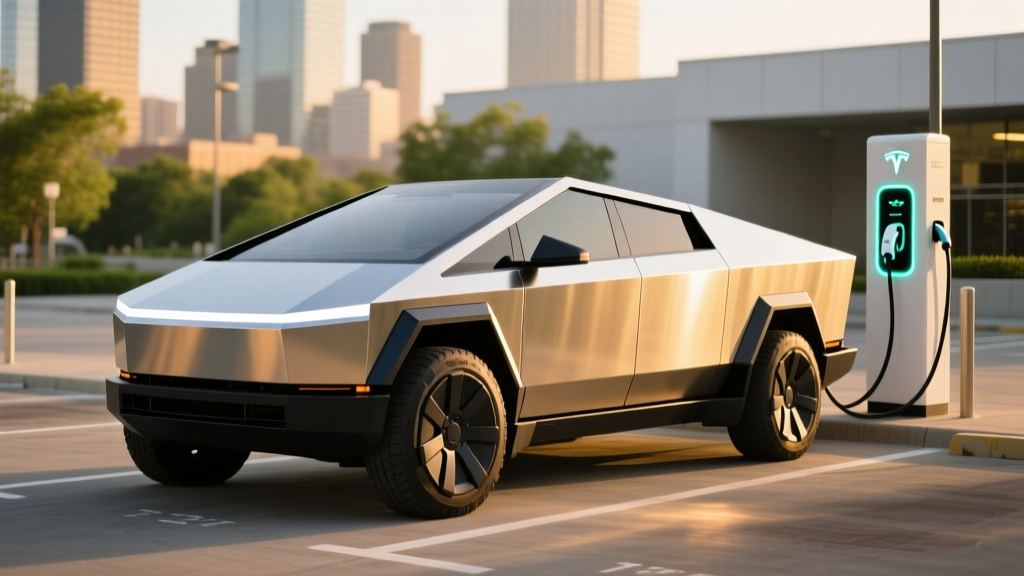
Quick Verdict: What Does the Cybertruck Actually Cost in 2025?
If you've been tracking the Tesla Cybertruck cost 2025 headlines, you already know the sticker price tells only part of the story. After multiple price adjustments since its late-2023 launch, Tesla has settled the Cybertruck lineup into three trims that position it squarely against the Ford F-150 Lightning, Rivian R1T, and Chevrolet Silverado EV. The base Rear-Wheel Drive model — long promised at a lower entry point — remains in limited availability, making the dual-motor AWD the de facto starting point for most buyers at $79,990 before destination. At the top end, the tri-motor Cyberbeast commands $99,990.
But the Cybertruck cost equation goes well beyond MSRP. Federal tax credit eligibility under IRS §30D, state incentives, insurance premiums that run 20-40% higher than comparable trucks, and charging economics all reshape the real number on the garage floor. This profile breaks down every dollar, every mile of range, and every kilowatt-hour you need to evaluate whether the Cybertruck earns a spot in your driveway.
Cybertruck Pricing by Trim: 2025 MSRP and Out-the-Door Cost
| Trim | Drivetrain | Base MSRP | Destination | Est. Out-the-Door |
|---|---|---|---|---|
| Rear-Wheel Drive (Limited) | RWD, Single Motor | $60,990 | $1,995 | ~$62,985 |
| All-Wheel Drive | AWD, Dual Motor | $79,990 | $1,995 | ~$81,985 |
| Cyberbeast | AWD, Tri-Motor | $99,990 | $1,995 | ~$101,985 |
Destination fees apply across all trims. Tesla no longer charges the "Foundation Series" premium that inflated early build prices by $20,000 — that package has been retired for 2025 model-year orders. Options remain minimal: paint colors (ranging from $0 Stealth Grey to $3,000 for Satin Chrome), 20-inch vs. 22-inch wheel choices, and the Full Self-Driving (Supervised) software at $8,000 or $99/month. Accessories like the tonneau cover, bed mat, and range extender battery pack (when available) add $500–$5,000.
Does the Cybertruck Qualify for the Federal EV Tax Credit?
Here's where the Cybertruck cost story gets complicated. Under current IRS §30D rules, the Cybertruck AWD and Cyberbeast trims face a significant hurdle: the federal new clean vehicle credit imposes an MSRP cap of $80,000 for trucks, vans, and SUVs. The Cyberbeast at $99,990 exceeds this cap and is categorically ineligible. The AWD trim at $79,990 sits exactly at the threshold — adding destination or any factory option pushes it over, meaning most AWD configurations will not qualify for the full $7,500 credit.
Beyond MSRP, buyers must also satisfy:
- Income caps: Modified AGI must not exceed $150,000 (single), $225,000 (head of household), or $300,000 (joint filers)
- Battery sourcing: Critical minerals and battery component requirements phase up annually — check the latest DOE/FuelEconomy eligible vehicle list for current Cybertruck status
- Point-of-sale transfer: Eligible buyers can apply the credit toward the down payment at purchase, reducing financed amount
The RWD trim at $60,990 clears the MSRP cap comfortably but remains in extremely limited production. Consult a tax professional for your specific situation — credit rules shift and state-level incentives may fill gaps.
| Trim | MSRP | Max §30D Credit | Effective Price (if eligible) |
|---|---|---|---|
| RWD | $60,990 | $7,500 | ~$53,490 |
| AWD | $79,990 | $0–$7,500* | ~$72,490–$79,990 |
| Cyberbeast | $99,990 | $0 (over MSRP cap) | $99,990 |
*AWD eligibility depends on exact configuration staying at or below $80,000 MSRP before destination. Verify with IRS guidance.
Range, Battery, and Efficiency: Beyond the EPA Sticker
| Spec | AWD | Cyberbeast |
|---|---|---|
| EPA Estimated Range | 340 miles | 320 miles |
| Battery Capacity (usable) | ~123 kWh | ~123 kWh |
| Battery Chemistry | NMC (Nickel Manganese Cobalt) | NMC |
| Efficiency (MPGe) | ~67 MPGe combined | ~63 MPGe combined |
| Energy Consumption | ~50 kWh/100 mi | ~53 kWh/100 mi |
Tesla's 4680-format NMC cells prioritize energy density for the Cybertruck's heavy stainless-steel exoskeleton (curb weight exceeds 6,600 lbs on the Cyberbeast). Unlike the LFP batteries Tesla uses in some Model 3/Y Standard Range variants, NMC chemistry offers superior energy density but benefits from keeping state of charge between 20–80% for daily driving to minimize degradation. Reserve 100% charges for road trips.
Charging Speed: DC Fast Charging and Home Level 2
| Charging Level | Max Power | Rate / Time | Connector |
|---|---|---|---|
| Level 1 (120V household) | ~1.4 kW | ~3–4 miles/hour | NACS (Tesla native) |
| Level 2 (240V home/public) | 11.5 kW (48A) | ~34 miles/hour | NACS |
| DC Fast Charge (V3 Supercharger) | ~250 kW peak | 10–80% in ~28 minutes | NACS |
| DC Fast Charge (V4 Supercharger) | ~325 kW peak | 10–80% in ~22 minutes | NACS |
The Cybertruck uses Tesla's NACS connector natively — no adapter needed at Superchargers. Its ~250 kW peak on V3 stalls is respectable but not class-leading; the Hyundai Ioniq 5 and Kia EV9 accept higher sustained rates relative to pack size. The critical detail is the charge curve: the Cybertruck holds near peak kW between 10–40% state of charge, then tapers progressively. From 60–80%, expect rates closer to 80–100 kW, which is why the 10–80% time stretches to roughly 28 minutes on a V3 stall.
For home charging, the onboard 11.5 kW AC charger means a full 0–100% charge on a 48-amp Level 2 wall connector takes approximately 11–12 hours. Most owners who plug in nightly never need a full charge — a typical 50-mile daily commute replenishes in under two hours. Tesla's Mobile Connector with a NEMA 14-50 outlet delivers roughly 29 miles/hour at 32A/7.7 kW if a hardwired wall connector isn't feasible.
Access to non-Tesla DC fast chargers (Electrify America, EVgo, ChargePoint) requires a CCS-to-NACS adapter, which Tesla provides or sells separately. As the broader industry adopts NACS through 2025–2026, adapter dependency decreases — but for now, road-trip planning should account for station compatibility.
Performance: 0-60, Towing, and Drivetrain Specs
| Metric | RWD | AWD | Cyberbeast |
|---|---|---|---|
| 0–60 mph | ~6.5 sec | 4.1 sec | 2.6 sec |
| Horsepower | ~315 hp | ~600 hp | ~845 hp |
| Torque (lb-ft) | ~430 | ~740 | ~740 |
| Top Speed | 112 mph | 112 mph | 130 mph |
| Max Towing | 7,500 lbs | 11,000 lbs | 11,000 lbs |
| Payload Capacity | ~2,500 lbs | ~2,500 lbs | ~2,500 lbs |
The Cyberbeast's 2.6-second 0–60 time is supercar territory in a truck body — genuinely startling on first launch. But the AWD's 4.1-second run covers 95% of real-world passing and merging needs. Towing at the 11,000-pound maximum will slash range by roughly 40–50%, so a 340-mile EPA truck towing heavy becomes a 170–200-mile truck. Plan charging stops accordingly on any trailer haul exceeding 100 miles.
The steer-by-wire system eliminates the mechanical connection between steering wheel and rack, enabling the Cybertruck's yoke-style wheel and variable ratio (fewer turns lock-to-lock at low speeds). Adaptation takes most drivers 2–3 days. Four-wheel steering tightens the turning circle to 37.5 feet — competitive with midsize trucks despite the Cybertruck's 223.7-inch overall length.
Interior, Cargo, and Practicality
The Cybertruck's cabin seats five across two rows with a minimalist design anchored by an 18.5-inch front touchscreen and a 9.4-inch rear display. Front legroom measures 41.5 inches; rear legroom comes in at 38.2 inches — adequate for adults but tighter than a Ford F-150 SuperCrew. Rear headroom is compromised by the sloping roofline; taller passengers will notice.
| Dimension | Measurement |
|---|---|
| Bed Length | 72 inches (6 ft) |
| Bed Volume | 67 cu ft (bed) + 17 cu ft (frunk) |
| Frunk Volume | 17 cu ft (lockable, drainable) |
| Cargo Width (between wheel wells) | 50.5 inches |
| Bed Payload | ~2,500 lbs |
| Tonneau Cover | Power-operated, included on Cyberbeast, optional on AWD |
The 6-foot bed is shorter than a standard F-150's 6.5-foot box, and the angled bed walls (dictated by the roofline) limit stacking of rectangular cargo. The power-operated tonneau cover is robust and supports distributed loads, but it's an option on the AWD trim (~$2,500). The 17 cu ft frunk is genuinely useful for groceries, charging cables, or gear you want sealed from the elements.
Notable tech includes Tesla's full infotainment suite (navigation, streaming, Sentry Mode dashcam recording), the HEPA air filtration system, adaptive air suspension with 16 inches of travel and up to 17.4 inches of ground clearance in Off-Road mode, and Armor Glass — laminated composite panels that resist impacts better than conventional tempered glass, though not indestructible.
Driver Assistance and Autonomy: What FSD Actually Delivers
Tesla Autopilot and Full Self-Driving (Supervised) are Level 2 driver-assistance systems. The driver must remain fully engaged, hands on the yoke, eyes on the road at all times. These systems do not make the Cybertruck self-driving. Only Level 4 services like Waymo operate without a human driver in defined zones.
The Cybertruck ships with Tesla's basic Autopilot (Traffic-Aware Cruise Control and Autosteer) as standard. The $8,000 FSD (Supervised) upgrade adds automatic lane changes, Navigate on Autopilot for highway interchanges, Autopark, Smart Summon, and traffic light/stop sign recognition. As of 2025, FSD (Supervised) has improved substantially in urban environments but still requires active supervision — expect occasional disengagements in construction zones, faded lane markings, and complex unprotected left turns.
Standard safety features include automatic emergency braking, blind-spot monitoring, lane departure warning, and 360-degree camera views. The Cybertruck has not yet been fully crash-tested by NHTSA or IIHS at time of writing — a notable gap for a vehicle in this price range. Tesla cites extensive internal testing and the structural rigidity of the stainless-steel exoskeleton, but independent validation is pending.
Warranty Coverage and Long-Term Battery Outlook
| Coverage | Term |
|---|---|
| Basic Vehicle Limited Warranty | 4 years / 50,000 miles |
| Battery & Drive Unit Warranty | 8 years / 120,000 miles |
| Battery Capacity Retention Threshold | 70% minimum over warranty period |
Tesla's 8-year/120,000-mile battery and drive unit warranty is competitive with the Ford F-150 Lightning (8yr/100,000mi) and Rivian R1T (8yr/175,000mi — the segment leader). The 70% capacity retention threshold means Tesla will repair or replace the battery if it degrades below 70% of original capacity within the warranty window. Real-world data from Tesla's 4680 cells is still maturing, but NMC chemistry in a thermally managed pack typically sees 10–15% degradation over 150,000 miles based on fleet data from Model 3/Y vehicles.
A full battery replacement outside warranty currently costs an estimated $15,000–$20,000 based on service center reports — a significant long-term ownership variable. The stainless-steel body panels resist dents and corrosion but are expensive to repair if creased; collision insurance claims on the Cybertruck trend higher than aluminum-body competitors.
Cybertruck vs. Key Competitors: Is It Worth Buying?
- You want maximum acceleration and towing in an electric truck (Cyberbeast is unmatched at 2.6s / 11,000 lbs)
- You have reliable Supercharger access for road trips and towing routes
- Range extender options and off-road ground clearance (17.4 in) matter for your use case
- You prefer Tesla's software ecosystem, OTA updates, and Sentry Mode security
- You need a proven crash-test rating before purchasing (F-150 Lightning, Silverado EV have NHTSA data)
- You want a longer bed (F-150 Lightning offers 6.5 ft; Rivian R1T has a gear tunnel + 54-in bed)
- Insurance cost is a primary concern — Cybertruck premiums average 25–40% higher than the F-150 Lightning
- You need a commercial/fleet truck with upfitter support (Lightning Pro is purpose-built for this)
| Metric | Cybertruck AWD | F-150 Lightning (Ext. Range) | Rivian R1T Dual-Motor |
|---|---|---|---|
| MSRP | $79,990 | ~$73,990 | ~$75,900 |
| EPA Range | 340 mi | 320 mi | 352 mi (Max Pack) |
| 0–60 mph | 4.1 sec | ~5.0 sec | ~4.5 sec |
| Max Towing | 11,000 lbs | 10,000 lbs | 11,000 lbs |
| Bed Length | 72 in | 67 in (5.5 ft) | 54 in + gear tunnel |
| DC Fast Charge Peak | ~250 kW | ~150 kW | ~200 kW |
| Battery Warranty | 8yr/120k mi | 8yr/100k mi | 8yr/175k mi |
The Cybertruck wins on raw acceleration, peak charging speed, and ground clearance. The F-150 Lightning wins on crash-test data, dealer service network breadth, and lower insurance. The Rivian R1T wins on adventure versatility (gear tunnel, Max Pack range, camp kitchen options) and warranty mileage. None of these trucks is objectively "best" — the right answer depends on whether you prioritize performance, practicality, or proven reliability.
Who the Cybertruck Suits Best
Best for: Tech-forward buyers who want a high-performance electric truck for daily driving, light-to-moderate towing, and off-road capability. The Cybertruck's air suspension, stainless body, and Supercharger network access make it a strong road-trip and recreation platform. The Cyberbeast specifically appeals to enthusiasts who value acceleration bragging rights above all else.
Not ideal for: Commercial fleet operators (limited upfitter ecosystem), buyers in regions with sparse Supercharger coverage, anyone who needs independent crash-test validation before a six-figure purchase, or budget-conscious buyers who need the federal tax credit to make the math work. The RWD trim would have addressed the budget segment, but its limited production makes it largely unavailable.
Pros and Cons at a Glance
- Class-leading 0–60 acceleration (Cyberbeast: 2.6s)
- 340-mile EPA range (AWD) — competitive with longest-range EV trucks
- 250 kW+ DC fast charging on Tesla Supercharger network
- 11,000-lb towing capacity with integrated trailer brake controller
- 17.4 inches of ground clearance in Off-Road mode
- Stainless-steel exoskeleton resists dents and corrosion
- OTA software updates continuously add features
- Large, lockable frunk (17 cu ft)
- Cyberbeast ineligible for §30D tax credit (over $80K MSRP cap); AWD eligibility marginal
- No NHTSA/IIHS crash-test ratings published yet
- Insurance premiums 25–40% above comparable electric trucks
- 6-foot bed is shorter than most full-size competitors
- Steep learning curve for steer-by-wire and yoke steering
- Rear headroom limited by roofline slope
- High repair costs for stainless-steel body damage
- Real-world range drops significantly when towing (40–50%)
Frequently Asked Questions
What is the real-world range of the Tesla Cybertruck?
The AWD is EPA-rated at 340 miles; the Cyberbeast at 320 miles. In real-world highway driving at 75 mph, expect 270–290 miles for the AWD and 250–270 for the Cyberbeast. Cold weather (below freezing) reduces range by 20–30%. Towing at max capacity cuts range roughly in half.
How fast does the Cybertruck charge?
On a Tesla V3 Supercharger, the Cybertruck peaks at approximately 250 kW, achieving a 10–80% charge in about 28 minutes. V4 Supercharger stalls can push peak rates to ~325 kW, reducing 10–80% to roughly 22 minutes. Home Level 2 charging at 11.5 kW (48A) adds about 34 miles per hour, with a full charge taking 11–12 hours.
How much does the Cybertruck cost after tax credits?
The Cyberbeast ($99,990) is ineligible for the $7,500 federal §30D credit due to the $80,000 MSRP cap for trucks. The AWD ($79,990) sits at the threshold — adding destination or options pushes it over the cap, making credit eligibility unlikely in most configurations. The RWD ($60,990) would qualify if available, reducing effective cost to approximately $53,490. State incentives vary; check IRS.gov for current rules.
Is the Cybertruck worth buying vs. the F-150 Lightning or Rivian R1T?
It depends on priorities. The Cybertruck leads in acceleration, peak charging speed, and ground clearance. The F-150 Lightning has established crash-test data, a broader dealer network, and lower insurance. The Rivian R1T offers superior adventure versatility and the longest battery warranty. Test-drive all three and weigh your specific needs — towing frequency, off-road use, daily commute distance, and budget — before deciding.
Does the Cybertruck qualify for the federal EV tax credit?
Partially. The RWD trim qualifies based on MSRP but has very limited availability. The AWD is at the $80,000 MSRP cap and likely ineligible once destination or options are added. The Cyberbeast is definitively ineligible. All trims are also subject to buyer income caps ($150K single / $300K joint) and battery critical-mineral sourcing requirements. Verify current eligibility on fueleconomy.gov before purchasing.
What are the biggest Cybertruck ownership costs beyond MSRP?
Insurance is the largest variable — expect annual premiums of $3,500–$5,500 depending on your profile and location, significantly above the F-150 Lightning. Home Level 2 charger installation runs $800–$2,500 depending on electrical panel capacity. Electricity costs vary by region but average $0.13–$0.16/kWh nationally, translating to roughly $0.065–$0.08 per mile — about half the per-mile cost of a gas F-150 at $3.50/gallon.
What is the Cybertruck's battery warranty?
Tesla covers the Cybertruck battery and drive unit for 8 years or 120,000 miles, whichever comes first, with a minimum 70% capacity retention guarantee. If the battery degrades below 70% within the warranty period, Tesla will repair or replace it. Out-of-warranty replacement is estimated at $15,000–$20,000.