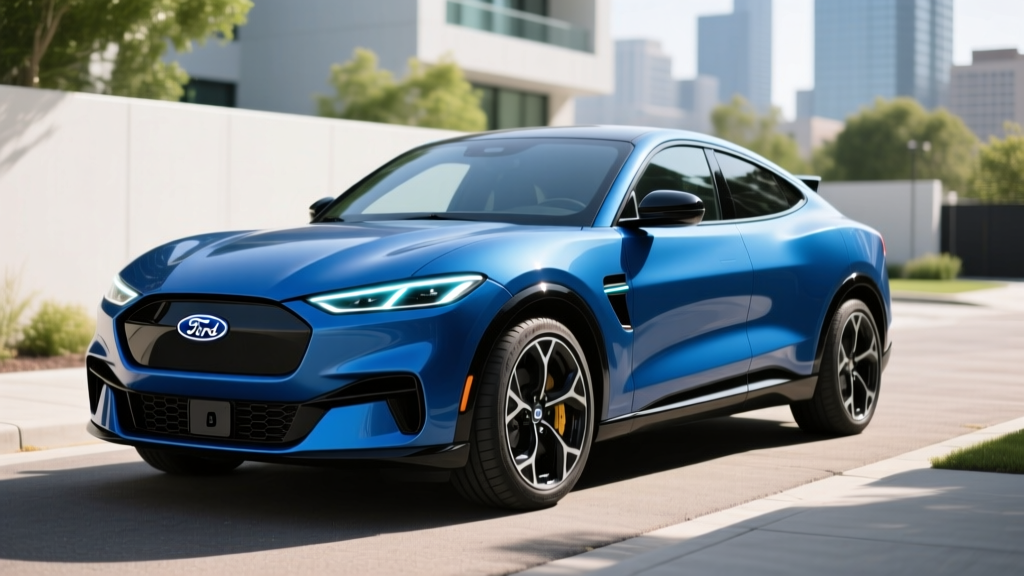
Quick Verdict: The Mach-E Fastback in 2026
Ford's Mustang Mach-E continues into 2026 as one of the most well-rounded electric crossovers on the market, and the fastback roofline remains its defining design feature. With up to 320 miles of EPA-estimated range on the Extended Range RWD configuration, DC fast charging that peaks at 150 kW, and a starting MSRP around $39,995, the Mach-E occupies a competitive middle ground between the Tesla Model Y and the Hyundai Ioniq 5. It's not the fastest-charging EV in its class, nor the longest-range, but its blend of driving dynamics, BlueCruise hands-free capability, and Ford dealer serviceability make it a pragmatic pick for buyers who want an electric daily driver without stepping into the Tesla ecosystem.
This review covers the 2026 Mustang Mach-E in its fastback body style across all trims, with precise data on range, charging curves, battery chemistry, pricing, and current federal tax credit eligibility under IRS §30D rules.
Range and Efficiency: EPA Sticker vs. Real-World Miles
| Configuration | Battery (Usable kWh) | Chemistry | EPA Range (mi) | MPGe (City/Hwy/Combined) | kWh/100 mi |
|---|---|---|---|---|---|
| Select SR RWD | 70 kWh | NMC (nickel manganese cobalt) | 250 | 105 / 92 / 99 | 34 |
| Premium ER RWD | 91 kWh | NMC | 320 | 111 / 96 / 104 | 32 |
| Premium ER AWD (eAWD) | 91 kWh | NMC | 290 | 101 / 88 / 95 | 35 |
| GT ER AWD | 91 kWh | NMC | 280 | 93 / 81 / 87 | 38 |
The Mach-E's NMC (nickel manganese cobalt) lithium-ion cells prioritize energy density over cycle life compared to LFP (lithium iron phosphate) chemistries found in some Tesla Model Y Standard Range variants. This means you get more range per kilogram of battery, but Ford recommends keeping the state of charge between 20% and 80% for daily use to minimize long-term degradation — only charging to 100% before road trips.
According to EPA fueleconomy.gov, the 2025 model year (carrying over into 2026 with minimal changes) achieves its best efficiency in the ER RWD configuration at 32 kWh per 100 miles — competitive with the Ioniq 5's 30 kWh/100mi and slightly behind the Model Y Long Range's 28 kWh/100mi.
Charging Speed: DC Fast Charge, Level 2, and the Curve
| Charging Level | Power (kW) | Connector | Speed / Time |
|---|---|---|---|
| Level 1 (120V household) | ~1.4 kW | J1772 / NACS (adapter) | ~3 mi/hr |
| Level 2 (240V home/public) | 10.5 kW (48A) | J1772 / NACS (adapter) | ~26 mi/hr; full charge ~10 hr (ER) |
| DC Fast Charge (peak) | 150 kW | CCS1 / NACS (adapter) | 10–80% in ~40 min |
| DC Fast Charge (sustained avg.) | ~110 kW avg. | CCS1 / NACS | 10–80% real-world ~40–45 min |
The Mach-E's 150 kW peak DC fast-charge rate is its most debated spec. While competitors like the Hyundai Ioniq 5 (240 kW peak, 10–80% in ~18 minutes) and the Tesla Model Y Long Range (~250 kW peak, 10–80% in ~25 minutes) charge significantly faster, the Mach-E's charge curve is relatively flat — meaning it holds closer to its peak rate for longer before tapering above 80%.
In practice, expect 10–80% in roughly 40 minutes at a functioning 150+ kW charger. The taper above 80% is aggressive: going from 80% to 100% can add another 25–30 minutes. This is standard behavior for NMC cells with conservative thermal management, but it means you should plan to charge to 80% and go, rather than topping off.
For home charging, the Mach-E comes with a Ford Mobile Power Cord that handles both 120V (Level 1) and 240V (Level 2 with appropriate outlet). Most buyers should budget $500–$1,500 for a dedicated 48-amp Level 2 wall connector installation (equipment plus electrician labor) to achieve the full 10.5 kW charge rate, which adds roughly 26 miles of range per hour — enough to replenish a full day's commute overnight. Always have a licensed electrician assess your panel capacity before installation.
Performance and Drivetrain
| Trim | Drivetrain | Horsepower | Torque (lb-ft) | 0–60 mph |
|---|---|---|---|---|
| Select SR RWD | Rear-Wheel Drive | 266 hp | 317 | 6.1 sec |
| Premium ER RWD | Rear-Wheel Drive | 290 hp | 317 | 5.8 sec |
| Premium ER eAWD | Dual-Motor AWD | 346 hp | 428 | 5.1 sec |
| GT ER eAWD | Dual-Motor AWD | 480 hp | 634 | 3.5 sec |
The GT trim's 3.5-second 0–60 mph time puts it in genuine sports-car territory, rivaling the Tesla Model Y Performance (3.5 sec) and well ahead of the Ioniq 5 AWD (5.2 sec). The standard RWD models prioritize efficiency over acceleration but still deliver responsive, torque-rich launches from a stop — the instant torque characteristic of electric motors makes the 266 hp Select feel quicker in city driving than its 0–60 number suggests.
Ford's eAWD system uses independent front and rear motors with no mechanical connection, allowing precise torque vectoring. In wet or snowy conditions, the dual-motor setup provides confident traction without the drivetrain losses of a traditional mechanical AWD system. The GT also includes MagneRide adaptive dampers and a specially tuned suspension that manages the vehicle's ~4,800-pound curb weight surprisingly well through corners.
Pricing, Trims, and Federal Tax Credit Eligibility
| Trim | Base MSRP | As-Tested (Typical Options) | §30D Credit Eligible? |
|---|---|---|---|
| Select SR RWD | $39,995 | $41,500 | Up to $7,500 (subject to sourcing & income rules) |
| Premium ER RWD | $48,995 | $52,000 | Up to $7,500 |
| Premium ER eAWD | $51,995 | $55,500 | Up to $7,500 |
| GT ER eAWD | $59,995 | $65,000 | Up to $7,500 |
- MSRP Cap: The Mach-E qualifies as an SUV/crossover under IRS vehicle classification, so the MSRP cap is $80,000 — all trims clear this.
- Buyer Income Cap: Modified AGI must not exceed $150,000 (single), $225,000 (head of household), or $300,000 (joint filers).
- Battery Sourcing: Critical minerals and battery components must meet escalating domestic/free-trade-partner percentages. Ford has been working to secure compliant supply chains, but the exact credit amount ($3,750 partial vs. $7,500 full) can change by model year and production batch.
The credit can now be transferred to the dealer at point of sale under §30D(g), reducing your purchase price directly. Always verify current eligibility on IRS.gov and consult a tax professional before relying on the credit in your purchase decision.
Interior, Cargo, and Technology
The Mach-E's fastback roofline gives it a sportier silhouette than boxier competitors, but it does cost some rear cargo volume compared to the Model Y. Here's how the numbers break down:
| Measurement | Mach-E | Model Y (for comparison) |
|---|---|---|
| Cargo (behind 2nd row) | 29.7 cu ft | 30.2 cu ft |
| Cargo (2nd row folded) | 59.7 cu ft | 72.1 cu ft |
| Front legroom | 43.3 in | 41.8 in |
| Rear legroom | 38.9 in | 35.2 in |
| Front trunk (frunk) | 4.7 cu ft (drainable) | 4.1 cu ft |
The Mach-E actually outperforms the Model Y in rear legroom — a meaningful advantage for families with tall teenagers or adults who regularly ride in back. The drainable frunk is a standout feature: it doubles as a cooler for tailgating and has a built-in drain plug.
Infotainment: The 15.5-inch vertically oriented touchscreen runs Ford's latest SYNC 4A system with wireless Apple CarPlay and Android Auto. The interface is responsive, though some buyers find the heavy reliance on touchscreen controls (climate, seat heaters) less intuitive than physical buttons. An 10.2-inch digital instrument cluster behind the wheel handles speed, range, and navigation at a glance.
Driver Assistance: Ford Co-Pilot360 2.0 is standard across all trims, including adaptive cruise control with stop-and-go, lane centering, blind-spot monitoring, and rear cross-traffic braking. The available BlueCruise system enables hands-free driving on pre-mapped divided highways (over 130,000 miles of compatible roads in the US and Canada). BlueCruise uses a driver-facing camera to ensure your eyes remain on the road — this is SAE Level 2 driver assistance, not autonomous driving. You must remain alert and ready to take over at any time.
Warranty and Long-Term Ownership
| Component | Coverage |
|---|---|
| Basic (bumper-to-bumper) | 3 years / 36,000 miles |
| Powertrain | 5 years / 60,000 miles |
| EV Battery (capacity retention) | 8 years / 100,000 miles (retains ≥70% of original capacity) |
| Electric Components | 8 years / 100,000 miles |
| Corrosion (perforation) | 5 years / unlimited miles |
Ford's 8-year/100,000-mile battery warranty with a 70% capacity retention threshold is standard for the segment, matching Hyundai and Tesla. NMC batteries in the Mach-E have shown moderate degradation in real-world fleet data — most owners report losing 5–8% of total capacity over the first 100,000 miles, which keeps them well within warranty parameters.
One ownership advantage the Mach-E holds over Tesla: Ford's established dealer network. Over 600 Ford EV-certified dealerships across the US can handle warranty repairs, recalls, and maintenance. This is a significant factor for buyers in rural areas or those who distrust Tesla's service-center model.
Pros and Cons
Pros
- Strong real-world range (270+ mi highway on ER RWD)
- Best-in-class rear legroom vs. Model Y
- BlueCruise hands-free highway driving included on most trims
- Drainable frunk — unique utility
- Ford dealer service network nationwide
- Engaging driving dynamics, especially GT
- All trims under $80K MSRP cap for §30D credit
Cons
- 150 kW DC charging is slowest in class (Ioniq 5: 240 kW)
- NMC chemistry requires 20–80% SoC management for longevity
- Touchscreen-heavy interior lacks physical climate controls
- Cargo volume (59.7 cu ft max) trails Model Y by 12+ cu ft
- Battery sourcing may limit §30D credit to $3,750 for some builds
- Base Select trim uses smaller 70 kWh battery (250 mi range)
Who Should Buy the 2026 Mustang Mach-E Fastback?
Choose the Mach-E if:
- You want a comfortable, well-built EV crossover with strong dealer support and don't need the fastest charging in the segment.
- Rear-seat space for adults or older children is a priority (it beats the Model Y here).
- You value hands-free highway driving (BlueCruise) without Tesla's ecosystem lock-in.
- You commute 40–80 miles daily and can charge at home overnight on Level 2.
Look elsewhere if:
- You road-trip frequently and need the fastest possible DC charging — the Ioniq 5 or Model Y will save you 15–20 minutes per stop.
- Maximum cargo capacity is critical — the Model Y's 72 cu ft with seats folded is significantly more versatile.
- You want LFP chemistry for simpler 100% daily charging without degradation concerns — consider the Model Y Standard Range.
Frequently Asked Questions
What is the real-world range of the 2026 Mustang Mach-E?
The EPA rates the Extended Range RWD at 320 miles, but sustained highway driving at 75 mph yields roughly 270–285 miles. In cold weather below 30°F, expect 240–250 miles. The GT trim delivers approximately 235–250 miles in mixed real-world use.
How fast does the Mach-E charge at home and on the road?
At home on a 240V Level 2 charger (48 amps), the Mach-E charges at 10.5 kW, adding about 26 miles of range per hour — a full overnight charge for most commutes. On DC fast chargers, it peaks at 150 kW, reaching 10–80% in approximately 40 minutes. This is slower than the Ioniq 5 (~18 min) and Model Y (~25 min).
How much does the Mach-E cost after the federal tax credit?
The base Select SR RWD starts at $39,995. If you qualify for the full $7,500 §30D credit (subject to income caps, MSRP caps, and battery-sourcing rules), the effective price drops to approximately $32,495. Higher trims like the Premium ER RWD ($48,995) would fall to ~$41,495 after the full credit. Verify current sourcing eligibility on IRS.gov before purchasing.
Does the Mustang Mach-E qualify for the $7,500 federal EV tax credit?
It may qualify for the full $7,500 or a partial $3,750 credit depending on battery-component and critical-mineral sourcing in your specific vehicle's production batch. All trims fall under the $80,000 SUV MSRP cap. Buyer income must not exceed $150K (single) / $300K (joint). The credit can be transferred at point of sale. Always check the latest IRS guidance for current eligibility.
Is the Mach-E worth buying vs. the Tesla Model Y or Hyundai Ioniq 5?
The Mach-E wins on rear legroom, dealer serviceability, and BlueCruise availability. The Model Y wins on cargo space, Supercharger network access, and charging speed. The Ioniq 5 wins on DC charging speed and available LFP-like warranty confidence. If you prioritize driving feel and dealer support over charging speed, the Mach-E is a strong choice. If road-trip charging speed is your top concern, the Ioniq 5 or Model Y are better fits.
What are the biggest drawbacks of the Mach-E?
The 150 kW peak DC charging rate is the Mach-E's most significant competitive disadvantage, adding roughly 15–20 minutes to a 10–80% charge versus the fastest rivals. The touchscreen-reliant interior also frustrates some buyers who prefer physical buttons for climate and seat controls. Finally, NMC battery chemistry requires more careful state-of-charge management (20–80% daily) compared to LFP alternatives.