The Short Answer on the Mustang SUV Electric
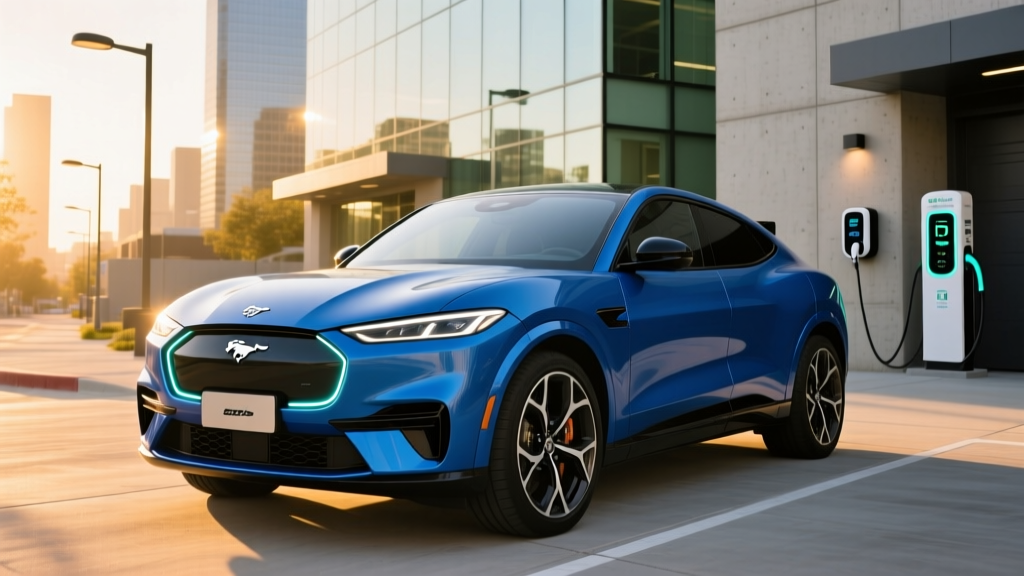
The 2026 Ford Mustang Mach-E is a battery-electric crossover SUV with EPA range from 250 to 320 miles, a starting MSRP of $39,995, and DC fast charging from 10-80% in roughly 26 minutes at up to 150 kW. It qualifies for a portion (or all) of the $7,500 federal §30D tax credit depending on battery sourcing, buyer income, and point-of-sale transfer rules. Real-world highway range typically lands 10-15% below the EPA sticker, and cold climates can shave another 20-30%. For buyers with home Level 2 charging and mostly sub-250-mile daily routes, the Mach-E delivers lower per-mile fueling costs than a comparably equipped gas SUV — but public-charging dependence and higher insurance premiums remain real trade-offs.
Range, Battery, and Efficiency: What the Numbers Actually Mean
The 2026 Mustang Mach-E lineup offers two battery packs across Select, Premium, and GT trims. The Standard Range pack is a 75.7 kWh usable lithium-ion (NMC chemistry) unit, while the Extended Range pack bumps capacity to 91 kWh usable. Ford pairs these with single-motor RWD or dual-motor AWD configurations.
| Trim / Config | Battery (kWh usable) | EPA Range (mi) | MPGe (city/hwy/combined) | HP / Torque | 0-60 mph |
|---|---|---|---|---|---|
| Select RWD | 75.7 | 250 | 111 / 94 / 103 | 266 / 317 lb-ft | 5.8 s |
| Premium RWD (ER) | 91 | 320 | 104 / 89 / 97 | 290 / 317 lb-ft | 5.5 s |
| Premium AWD (ER) | 91 | 300 | 100 / 86 / 93 | 346 / 428 lb-ft | 4.8 s |
| GT AWD | 91 | 280 | 93 / 80 / 87 | 480 / 600 lb-ft | 3.5 s |
Real-World Range Reality Check
EPA sticker: 320 miles (Premium RWD Extended Range).
Expect in practice: ~270-285 miles on a mixed highway commute at 70 mph; ~220-240 miles in sustained sub-30°F weather with cabin heat. The GT trim's 280-mile EPA figure drops closer to 230-240 miles under aggressive driving or cold conditions. Always plan road trips around 80% of the EPA number to preserve a safety buffer.
The Mach-E's efficiency is competitive but not class-leading. The Hyundai Ioniq 5 achieves up to 318 EPA miles on a 77.4 kWh pack with slightly better MPGe, while the Tesla Model Y Long Range AWD posts 320 miles on roughly 75 kWh. Where the Mach-E wins is ride comfort, interior material quality, and Ford dealer service accessibility.
Charging Speeds: Home Level 2 and DC Fast Charging
Understanding the difference between kW (power — how fast energy flows) and kWh (energy — how much the battery stores) is critical. A 150 kW charger delivers energy quickly; a 91 kWh battery is how much the Mach-E holds total.
| Level | Power (kW) | Miles Added per Hour | Typical Use Case |
|---|---|---|---|
| Level 1 (120V) | 1.4 kW | ~3-4 mi/hr | Overnight trickle, emergency |
| Level 2 (240V, 48A) | 11.5 kW | ~30-35 mi/hr | Home wall charger, workplace |
| DC Fast Charge | Up to 150 kW peak | ~180 mi in 26 min (10-80%) | Road trips, Electrify America |
The Mach-E's 150 kW peak DC fast-charge rate means a 10-80% session takes approximately 26 minutes under ideal battery-preconditioned conditions. However, the charge curve tapers significantly above 80% — expect 80-100% to add another 20-25 minutes. On road trips, plan stops at 10-80% for the best time-to-miles ratio.
Home charging reality: The Ford Mobile Power Cord ships with the vehicle and delivers ~20 miles per hour of charge on a 240V/30A outlet. For faster home replenishment, Ford's Connected Charge Station Pro (48A, $799 hardware) fills the Extended Range pack overnight in roughly 8 hours. A licensed electrician will charge $500-$2,000 for a NEMA 14-50 outlet install, or $1,200-$3,500 for a hardwired Level 2 station, depending on panel capacity and conduit runs. If your home has a 100A panel, budget an additional $1,500-$3,000 for a 200A upgrade.
Mustang Mach-E vs Gas SUV: The Cost Comparison That Matters
Buyers cross-shopping the Mach-E against the gas Ford Edge or Toyota RAV4 need a clear-eyed cost picture. The EV wins on fuel and maintenance, but loses on upfront price and potentially insurance.
| Category | 2026 Mach-E Premium AWD (ER) | 2026 Ford Edge ST-Line AWD |
|---|---|---|
| Base MSRP | $48,995 | $42,795 |
| Fed. Tax Credit (§30D est.) | -$3,750 to -$7,500* | $0 |
| Effective Purchase Price | $41,495 - $45,245 | $42,795 |
| Fuel/Energy (5 yr, 75k mi) | $3,600 (home L2 @ $0.14/kWh) | $9,375 (25 MPG avg @ $3.75/gal) |
| Maintenance (5 yr) | $1,800 (tire rotations, cabin filter, wipers) | $4,200 (oil, brakes, filters, fluids) |
| Insurance (5 yr avg) | $10,500 ($2,100/yr avg) | $8,250 ($1,650/yr avg) |
| Total 5-Year Cost | $57,395 - $61,145 | $64,620 |
*§30D credit eligibility depends on buyer AGI limits ($150K single / $300K joint), MSRP cap ($80K for SUVs), and battery critical-mineral sourcing requirements. The Mach-E's credit amount varies by model year and assembly. Confirm current eligibility at IRS.gov §30D and use the point-of-sale transfer option at the dealer to reduce your out-of-pocket at purchase.
The Mach-E breaks even or pulls ahead of the gas Edge within 3-4 years for most drivers charging primarily at home. The gap widens if electricity rates stay below $0.18/kWh and you avoid exclusive reliance on DC fast charging (which can cost $0.40-$0.55/kWh at Electrify America or EVgo stations).
Real-World Ownership: What First-Time EV Buyers Must Know
Owning the Mach-E daily for 18+ months reveals patterns that spec sheets don't capture:
Home charging is non-negotiable for convenience. If you lack a garage, driveway, or workplace charger, the Mach-E's ownership experience degrades significantly. Public DC charging adds 30-45 minutes per session and costs 2-3x more than home electricity. Before buying, confirm your living situation supports a Level 2 install.
Cold-weather range loss is physics, not a defect. LFP and NMC batteries both lose efficiency below freezing. The Mach-E's heat pump (standard on Extended Range trims) mitigates this to roughly 20-25% loss at 20°F, compared to 30-40% for EVs without heat pumps. Preconditioning the battery while plugged in — using FordPass to schedule departure times — preserves range by warming the pack using grid power instead of battery power.
Regenerative braking changes your driving. The Mach-E offers one-pedal driving mode, which recaptures energy aggressively when you lift off the accelerator. Most owners adapt within a week and report less brake-pad wear — the friction brakes may last 100,000+ miles.
Insurance premiums run 15-30% higher than equivalent gas SUVs due to repair costs and battery replacement risk. Get quotes from Geico, Progressive, and State Farm before committing — some insurers offer EV-specific discounts.
Battery degradation is modest. Ford warranties the Mach-E battery for 8 years / 100,000 miles against dropping below 70% capacity. Real-world data from 2021-2024 Mach-E owners shows roughly 5-8% degradation at 60,000 miles — well within warranty. Avoid habitual DC fast charging and routine 100% SoC storage to maximize longevity.
| Myth | Fact |
|---|---|
| "The battery will need a $20,000 replacement in 5 years" | Mach-E batteries show 5-8% loss at 60k miles; replacement is rarely needed under warranty. Out-of-warranty pack cost: $12,000-$18,000 installed. |
| "It charges as fast as a Tesla Supercharger" | Tesla V3/V4 Superchargers peak at 250-350 kW; the Mach-E peaks at 150 kW. Expect ~26 min (10-80%) vs ~15-18 min for a Tesla Model Y. |
| "I'll save $7,500 no matter what" | §30D credit phases based on battery sourcing rules, buyer income caps, and MSRP limits. Some Mach-E configurations may qualify for only $3,750 or $0 depending on model year. |
| "It's a real Mustang" | It's a battery-electric crossover wearing the Mustang badge. No mechanical relation to the gas Mustang coupe. Ford markets it as an EV SUV with Mustang-inspired styling. |
Decision Framework: Is the Electric Mustang SUV Right for You?
Choose the Mach-E If:
- You have home Level 2 charging access (garage or driveway with 240V circuit)
- Your daily commute is under 150 miles round-trip
- You value a quiet, smooth ride and strong acceleration over maximum cargo space
- You want Ford dealer serviceability within 20 miles of your home
- You qualify for at least a partial §30D tax credit based on income and sourcing rules
Look at a Hybrid or Gas SUV Instead If:
- You live in an apartment with no charging access and no workplace charger
- You regularly tow over 2,000 lbs (Mach-E max towing: 2,300 lbs with towing package)
- You drive 400+ miles between stops frequently and cannot tolerate 25-30 min charging breaks
- You live in extreme cold (-20°F regularly) and have no garage for preconditioning
- Your budget is strictly under $35,000 and you cannot wait for used-EV market depreciation
Consider the Tesla Model Y or Hyundai Ioniq 5 If:
- Charging speed is your top priority (Tesla: 250 kW; Ioniq 5: 240 kW vs Mach-E: 150 kW)
- You want access to Tesla's Supercharger network natively (Mach-E uses NACS adapter or CCS networks)
- You need maximum cargo volume (Model Y: 76 cu ft; Mach-E: 59.7 cu ft behind rear seats)
Pricing, Trims, and Tax-Credit Eligibility for 2026
| Trim | MSRP | Est. §30D Credit | Effective Price |
|---|---|---|---|
| Select RWD (SR) | $39,995 | Up to $7,500 | ~$32,495 |
| Select AWD (SR) | $42,995 | Up to $7,500 | ~$35,495 |
| Premium RWD (ER) | $46,995 | Up to $7,500 | ~$39,495 |
| Premium AWD (ER) | $48,995 | Up to $7,500 | ~$41,495 |
| GT AWD | $57,995 | Up to $7,500 | ~$50,495 |
All trims fall below the §30D $80,000 SUV MSRP cap. Buyer income limits apply: modified AGI cannot exceed $150,000 (single), $225,000 (head of household), or $300,000 (joint). The credit is available as a point-of-sale transfer — meaning the dealer reduces your purchase price directly and claims the credit from the IRS. Confirm current battery-sourcing compliance at fueleconomy.gov before signing.
Frequently Asked Questions
Does the Mustang Mach-E qualify for the full $7,500 federal tax credit?
It depends on the model year's battery sourcing compliance. Ford has worked to shift critical-mineral and battery-component sourcing to qualify, but the exact credit amount ($3,750 or $7,500) can change by production batch. Check the latest eligibility at IRS.gov or ask your dealer for the current §30D qualification letter before purchase.
Can I charge the Mach-E at Tesla Superchargers?
Yes. Starting in 2024, Ford EVs gained access to Tesla's NACS Supercharger network using a Ford-provided NACS adapter (included with new vehicles or available as an accessory). You'll use the FordPass app to initiate sessions. The adapter supports up to 150 kW at V3 Superchargers — matching the Mach-E's native peak charge rate.
What does the Mach-E cost to charge at home per month?
At the US average electricity rate of $0.16/kWh (per EIA data), charging the 91 kWh Extended Range pack from 10% to 90% costs approximately $11.65. If you drive 1,200 miles per month at 3.0 mi/kWh efficiency, you'll use ~400 kWh, costing about $64/month — compared to $180/month in gasoline for a 25 MPG SUV at $3.75/gallon.
Is the Mach-E reliable compared to gas Fords?
Early Mach-E model years (2021-2022) had software and 12V battery issues. The 2024-2026 models have improved significantly. Consumer Reports and J.D. Power now rate the Mach-E at or slightly above average for electric SUVs. The powertrain has fewer moving parts than a gas engine, reducing long-term failure points — but EV-specific repairs (electronics, thermal management) can be costly out of warranty.
How does the Mach-E handle on road trips with DC fast charging?
On a 600-mile trip, expect 2 charging stops of roughly 25-30 minutes each (10-80% sessions). Preconditioning the battery via the navigation system's DC-routing feature warms the pack for faster charging upon arrival. Total added travel time versus a gas SUV: approximately 50-60 minutes on a 10-hour drive. Plan stops around Electrify America, EVgo, or Tesla Supercharger locations using the FordPass or A Better Routeplanner apps.
What's the battery replacement cost if it fails outside warranty?
An out-of-warranty Mach-E battery pack replacement runs $12,000-$18,000 installed at a Ford dealer. However, real-world degradation data shows most packs retain 85-92% capacity at 100,000 miles. The 8-year/100,000-mile warranty covers defects and capacity loss below 70% — making full replacement rare for typical ownership cycles.