If you're searching for "B&W Auto Electric," you're likely weighing whether an electric vehicle from this dealer or brand fits your budget, commute, and lifestyle. The short answer: an EV makes financial and practical sense if you have access to Level 2 home charging, drive under 250 miles daily, and qualify for federal or state incentives. But the real decision depends on exact numbers — not marketing promises.
Quick Verdict: Is B&W Auto Electric Right for You?
Yes, if: You can install a 240V Level 2 charger at home, your daily round-trip commute is under 80% of the vehicle's EPA range, and you qualify for up to $7,500 in federal tax credits under IRS §30D rules.
Think twice if: You rely exclusively on public DC fast charging, regularly drive in sub-20°F winters without a garage, or need to tow heavy loads over long distances.
What "B&W Auto Electric" Actually Means for Buyers
The term "B&W Auto Electric" typically refers to electric vehicles sold through B&W-affiliated dealerships or regional EV specialists. In 2026, the EV market includes dozens of mainstream models — from the Chevrolet Equinox EV (EPA 319 miles, starting ~$33,600) to the Hyundai Ioniq 5 (EPA 318 miles, peak 240 kW DC charging) and Tesla Model Y (EPA 308 miles, NACS connector standard). The specific inventory at a B&W location will vary by region, but the buying framework remains the same.
Before visiting any dealer, arm yourself with three data points:
- EPA range vs. real-world range: The EPA sticker is tested under ideal conditions. Expect 10-20% less range on highway trips at 75+ mph, and 20-40% loss in freezing temperatures without a heat pump.
- Battery chemistry: LFP (lithium iron phosphate) batteries tolerate daily 100% charging and offer longer cycle life but lower energy density. NMC (nickel manganese cobalt) packs deliver more range per kWh but prefer 20-80% daily charging windows.
- Charging connector: As of 2026, most non-Tesla automakers have adopted the NACS (North American Charging Standard) port, granting access to Tesla Superchargers. CCS1 remains on some older inventory and certain commercial models.
EV vs. Gas vs. Hybrid: The Real Cost Comparison
Let's compare a typical compact EV (similar to models you'd find at a B&W Auto Electric lot) against a gas sedan and a hybrid alternative over 5 years and 75,000 miles.
| Category | Compact EV (2026) | Gas Sedan (2026) | Hybrid (2026) |
|---|---|---|---|
| Base MSRP | $34,000 | $28,000 | $31,500 |
| Federal Tax Credit (§30D) | Up to $7,500* | $0 | Up to $7,500 (PHEV)* |
| Effective Purchase Price | ~$26,500 | $28,000 | ~$24,000 |
| Fuel/Energy Cost (5yr/75k mi) | $3,750 (home charging) | $9,375 (gas @ $3.75/gal, 30 MPG) | $5,625 (50 MPG combined) |
| Maintenance (5yr) | ~$1,200 | ~$3,500 | ~$2,800 |
| Estimated Insurance (5yr) | ~$8,500 | ~$6,500 | ~$7,000 |
| Total 5-Year Cost | ~$39,950 | ~$47,375 | ~$41,225 |
*Federal tax credit eligibility depends on buyer income caps ($150K single / $300K joint), vehicle MSRP caps ($55K cars / $80K SUVs/trucks), battery sourcing requirements, and point-of-sale transfer availability. Verify current rules at IRS.gov.
The EV saves roughly $7,400 over five years compared to gas, but notice the insurance premium gap — EV insurance averages 15-25% higher due to repair costs and battery replacement risk. That's a real ownership factor many buyers overlook.
Charging Costs and Infrastructure: The Numbers That Matter
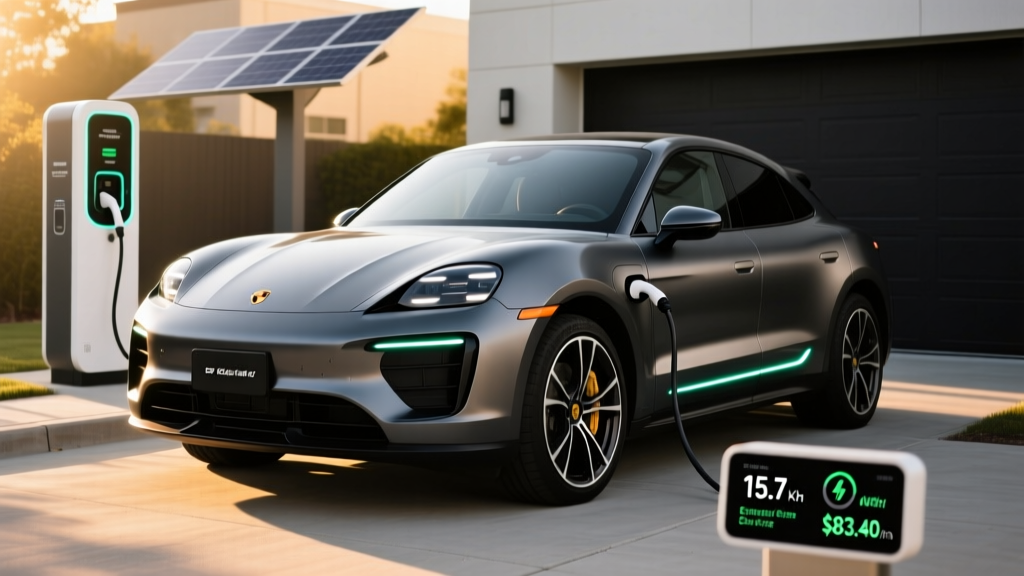
Understanding the difference between kW (power — how fast you charge) and kWh (energy — how big the battery is) is essential. A 75 kWh battery charged at a 10 kW Level 2 home charger takes roughly 7.5 hours from empty to full.
| Charging Level | Power (kW) | Miles Added/Hour | Cost Per Full Charge (75 kWh) | Typical Use Case |
|---|---|---|---|---|
| Level 1 (120V outlet) | 1.4 kW | 3-5 miles | $9.75 (home, $0.13/kWh) | Overnight trickle, emergencies |
| Level 2 (240V home) | 7-11 kW | 25-40 miles | $9.75 (home, $0.13/kWh) | Daily charging, ideal setup |
| DC Fast Charging | 50-350 kW | 150-1,000+ miles | $22-38 (public, $0.30-0.50/kWh) | Road trips, no home charging |
Home charging installation reality check: A Level 2 home charger (like a ChargePoint Home Flex or Tesla Wall Connector) costs $500-$750 for the unit. Professional installation by a licensed electrician runs $800-$2,500 depending on panel capacity and conduit length. If your home has a 100-amp panel and you need a 200-amp upgrade, add $1,500-$3,000. Total budget: $1,300-$5,500.
Charging curve reality: No EV sustains peak charging speed from 10% to 80%. A vehicle advertising "240 kW peak" may only hold that rate from 10-30% state of charge, then taper to 150 kW, then 80 kW, then 40 kW above 70%. Real-world 10-80% charging times are typically 18-35 minutes at a compatible DC fast charger — not the "15 minutes" some marketing implies.
Real-World Ownership: What First-Time EV Buyers Must Know
Before signing any purchase agreement at a B&W Auto Electric location or any other dealer, walk through this checklist:
EV Readiness Decision Framework
- Can you charge at home? If yes → EV is strongly viable. If no → consider a PHEV (plug-in hybrid) with 30-40 miles of electric range plus a gas engine, or verify reliable public charging within 0.5 miles of your residence.
- Is your daily drive under 200 miles round-trip? If yes → any modern EV with 250+ EPA miles covers you comfortably. If no → target 300+ EPA miles or plan mid-route DC fast charging.
- Do you experience winters below 25°F? If yes → prioritize EVs with a heat pump (Hyundai Ioniq 5, Tesla Model Y, BMW iX) and expect 20-30% range reduction. If no → range loss is minimal.
- Do you tow or haul frequently? If yes → EV towing range drops 40-60% under load. A diesel or hybrid may be more practical for heavy towing. If no → EV cargo space and instant torque are excellent.
- Do you qualify for the §30D tax credit? Check income limits, MSRP caps, and battery sourcing at IRS.gov. Point-of-sale transfer lets you apply the credit as a down payment reduction at the dealer.
Common EV Misconceptions — Fact vs. Fiction
| Myth | Fact (with data) |
|---|---|
| "EV batteries need replacing every 5 years" | Federal law mandates battery warranties of at least 8 years/100,000 miles. Real-world degradation data shows most EVs retain 85-92% capacity after 100,000 miles. Replacement costs $8,000-$20,000 but is rarely needed within the first decade. |
| "Charging takes too long for road trips" | At a 250 kW DC fast charger, a compatible EV (like the Ioniq 5 or F-150 Lightning) adds 150-200 miles in 15-20 minutes. Combined with rest stops, this is comparable to gas-car travel rhythm. |
| "EVs are worse for the environment because of electricity generation" | Per the Union of Concerned Scientists and EPA analysis, EVs produce fewer lifecycle emissions than gas cars in every US grid region — even coal-heavy grids — due to electric motor efficiency (85-90%) vs. internal combustion (20-35%). |
| "You can't drive an EV in the cold" | You can, but range drops. A 300-mile EPA EV may deliver 210-240 miles at 10°F without preconditioning. Using a heat pump and preconditioning while plugged in recovers 10-15% of that loss. |
| "All EVs qualify for the $7,500 tax credit" | As of 2026, many popular EVs qualify for $3,750 or $0 due to battery sourcing and critical mineral requirements. Always verify per-model eligibility on fueleconomy.gov before purchasing. |
Battery Longevity and Warranty: Protecting Your Investment
EV battery health is measured in State of Health (SoH) — the percentage of original capacity remaining. Most manufacturers warranty the battery at 70% SoH over 8 years/100,000 miles. Here's what real-world data shows:
- Year 1-2: 2-5% degradation (initial settling)
- Year 3-5: 1-2% per year (linear phase)
- Year 6-10: 1% or less per year (plateau)
- Typical 10-year SoH: 85-92% for liquid-cooled NMC packs; 90-95% for LFP packs
To maximize battery life: avoid frequent DC fast charging above 80% state of charge, don't leave the vehicle at 100% SoC for extended periods (unless it's an LFP battery, which tolerates 100% better), and use preconditioning features in extreme temperatures.
Frequently Asked Questions
What should I look for when buying an EV from a B&W Auto Electric dealer?
Verify the exact EPA range, battery capacity in kWh, DC fast-charge peak kW rating, 10-80% charging time, battery warranty terms, and current federal tax credit eligibility for that specific VIN. Ask for a vehicle history report if it's a used EV, and check the battery SoH through the vehicle's diagnostics or a third-party scan tool.
How much does it cost to charge an EV at home vs. public stations?
Home Level 2 charging averages $0.10-$0.18 per kWh depending on your utility rate, translating to roughly $0.03-$0.05 per mile. Public DC fast charging costs $0.30-$0.55 per kWh, or about $0.09-$0.16 per mile. For a 250-mile range, that's $7.50-$12.50 at home versus $22-$40 at a public fast charger.
Do I need to upgrade my home electrical panel for EV charging?
Not always. A Level 2 charger drawing 32 amps (7.7 kW) requires a dedicated 40-amp circuit. If your panel has spare capacity, installation is straightforward ($800-$1,500). If your panel is already near capacity (common in older homes with 100-amp service), a panel upgrade to 200 amps adds $1,500-$3,000. Always get a load calculation from a licensed electrician before committing.
Is an EV or a plug-in hybrid (PHEV) better for my situation?
Choose an EV if you have home charging, drive under 250 miles daily, and want minimal maintenance. Choose a PHEV if you lack reliable home charging, take frequent 400+ mile road trips, or want electric-only commuting (30-40 miles) with gas-engine flexibility for longer drives. PHEVs like the Toyota RAV4 Prime (42 miles electric, 38 MPG gas) bridge both worlds.
How do I check if an EV qualifies for the federal tax credit?
Visit fueleconomy.gov and search by make, model, and year. The credit amount depends on battery sourcing and critical mineral requirements. You must also meet income caps ($150K single / $225K head of household / $300K joint) and vehicle MSRP caps ($55K for cars, $80K for SUVs/trucks/vans). As of 2026, the credit can be transferred to the dealer at point of sale, reducing your purchase price directly.