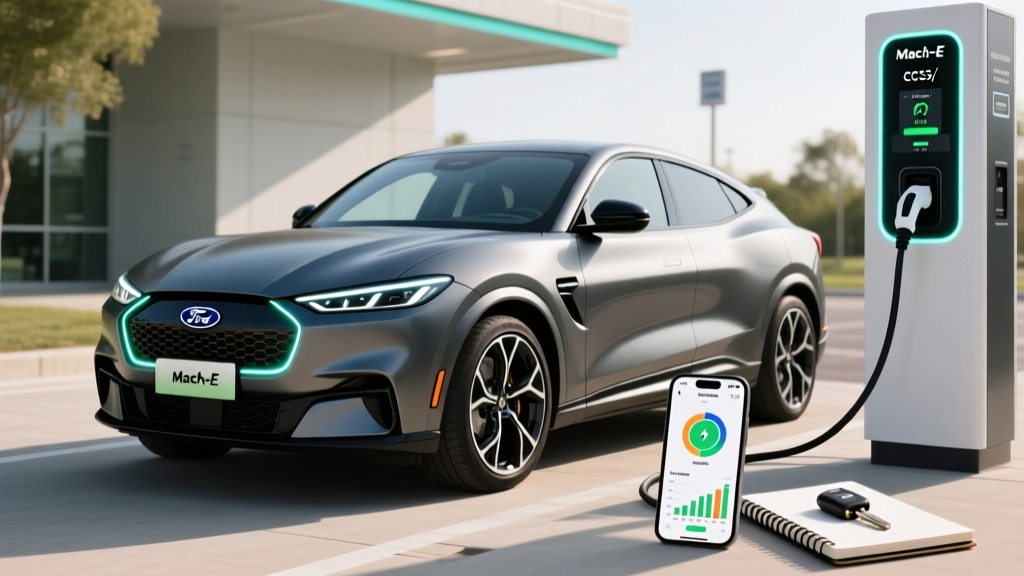
The Ford Mustang Mach-E remains one of the most compelling electric SUVs on the market in 2026, blending recognizable Mustang styling with practical crossover utility and a maturing Blue Oval charging ecosystem. After multiple model-year refreshes since its 2021 debut, the Mach-E now offers NACS-native charging access to the Tesla Supercharger network, improved battery thermal management, and a lineup that spans efficient rear-wheel-drive to the 480-horsepower GT. This review breaks down exactly what you get, what it costs after federal incentives, and where the Mach-E falls short compared to rivals like the Tesla Model Y, Hyundai Ioniq 5, and Chevrolet Blazer EV.
Quick Verdict: Who the Mustang Mach-E Electric Is For
The 2026 Mustang Mach-E is best suited for buyers who want a sporty-driving electric crossover with strong Supercharger network access, BlueCruise hands-free highway driving, and a starting price that — after the §30D federal tax credit — undercuts many competitors. It's a strong pick for daily commuters and weekend road-trippers who value driver engagement. It is not the best choice if you need maximum cargo volume (the Model Y wins there), the absolute fastest DC charging (Hyundai/Kia's 800V architecture charges faster), or three-row family seating.
EPA Range vs. Real-World Miles: What to Actually Expect
EPA Estimated: Up to 320 miles (Select RWD with Extended Range battery)
Expect in practice: ~260–290 miles on mixed highway driving at 70 mph; ~200–230 miles in sustained sub-30°F winter conditions with cabin heat. City/regenerative driving can match or slightly exceed EPA figures.
The 2026 Mach-E lineup offers several battery and drivetrain combinations, each with a distinct EPA range rating. The efficiency leader is the Select trim with rear-wheel drive and the Extended Range pack, rated at 320 miles by the EPA on fueleconomy.gov. Premium and GT trims with dual-motor AWD drop to between 270 and 290 miles depending on wheel size and equipment.
Ford equips the Extended Range models with a 91 kWh usable lithium-ion NMC (nickel manganese cobalt) battery pack. The Standard Range battery, available on the Select trim, provides 70 kWh usable. Both use NMC chemistry rather than LFP, meaning Ford recommends daily charging to 80–90% for longevity and reserving 100% sessions for road trips. This is a meaningful distinction: unlike LFP-equipped competitors (such as the Tesla Model Y RWD), the Mach-E's NMC pack benefits from not being held at full state of charge for extended periods.
| Trim | Drivetrain | Battery (kWh usable) | EPA Range (mi) | MPGe (combined) | kWh/100 mi |
|---|---|---|---|---|---|
| Select SR | RWD | 70 | 250 | 101 | 33 |
| Select ER | RWD | 91 | 320 | 105 | 32 |
| Premium ER | AWD | 91 | 290 | 98 | 34 |
| GT ER | AWD | 91 | 270 | 88 | 38 |
Charging Speed: DC Fast Charging and Home Level 2
Ford's decision to adopt the NACS (North American Charging Standard) connector natively on the 2026 Mach-E is one of its strongest competitive advantages. You plug directly into any Tesla Supercharger V3 or V4 stall without an adapter, accessing the most reliable DC fast-charging network in North America. Ford also maintains compatibility with Electrify America, EVgo, and ChargePoint stations via the NACS connector.
| Charging Level | Power / Rate | Speed / Time | Notes |
|---|---|---|---|
| Level 1 (120V household) | ~1.4 kW | ~3–4 mi/hr | Emergency/trickle only |
| Level 2 (240V home) | 10.5 kW (48A) | ~30 mi/hr; full charge ~9 hrs (ER) | Ford Mobile Power Cord or wall connector |
| DC Fast Charge (NACS) | Peak 150 kW | 10–80% in ~36 min (ER) | Curve tapers significantly above 80% SoC |
The Mach-E Extended Range peaks at approximately 150 kW on a compatible DC fast charger. In real-world testing, the charge curve holds near peak output from roughly 10% to 50% state of charge, then progressively tapers. A 10–80% session takes around 36 minutes at a 150 kW+ station. This is competent but not class-leading: the Hyundai Ioniq 5 with its 800V architecture achieves 10–80% in approximately 18 minutes at a 350 kW charger. If DC fast-charge speed is your top priority, the Mach-E is a step behind the E-GMP platform vehicles.
At home, the onboard 10.5 kW charger (48 amps) is the practical sweet spot. A full overnight session from 20% to 100% on the Extended Range battery takes roughly 9 hours — well within the window of a typical overnight parking window. Preconditioning the battery via the FordPass app before a scheduled DC fast-charge session is essential for hitting peak charge rates, particularly in cold weather. Skip preconditioning in winter and you may see peak rates capped at 50–70 kW until the pack warms up.
Performance: 0–60, Horsepower, and Drivetrain Options
The Mach-E's driving dynamics remain a highlight. Ford engineered this EV to honor the Mustang badge, and the steering weight, chassis tuning, and low center of gravity deliver a genuinely engaging experience for a crossover.
| Trim | Drivetrain | Horsepower | Torque (lb-ft) | 0–60 mph |
|---|---|---|---|---|
| Select SR | RWD | 266 | 317 | 6.3 sec |
| Select ER | RWD | 290 | 317 | 5.8 sec |
| Premium ER | AWD (dual motor) | 346 | 428 | 4.8 sec |
| GT ER | AWD (dual motor) | 480 | 634 | 3.5 sec |
The GT trim with its 480 horsepower and 634 lb-ft of torque is genuinely quick, rivaling sports sedans in straight-line acceleration. The standard AWD dual-motor Premium offers a compelling balance: 346 hp, sub-5-second 0–60, and 290 miles of range. For most buyers, the Premium AWD hits the best balance of performance, range, and price.
Towing capacity is rated at 1,500 pounds with the Standard Range battery and up to 2,300 pounds with the Extended Range AWD configuration when equipped with the factory tow package. This is adequate for a small utility trailer or a couple of dirt bikes, but it trails the Tesla Model Y's 3,500-pound rating.
Interior Space, Cargo, and Technology
The Mach-E's cabin is driver-focused with a 15.5-inch vertical touchscreen running Ford's SYNC 4A system. Wireless Apple CarPlay and Android Auto are standard across all trims. The large portrait display handles navigation, climate controls, and vehicle settings, though some owners note that burying climate adjustments in the touchscreen rather than offering physical knobs can be distracting while driving.
Passenger space is competitive but not class-leading:
- Front legroom: 43.3 inches
- Rear legroom: 38.9 inches
- Cargo (behind rear seats): 29.7 cu ft
- Cargo (rear seats folded): 59.7 cu ft
- Front trunk (frunk): 4.7 cu ft (drainable, useful for wet gear)
The Tesla Model Y offers roughly 76 cu ft of total cargo volume with seats folded, a significant advantage for families hauling bulky items. The Mach-E's 59.7 cu ft is closer to a traditional compact crossover and may feel limiting for large Costco runs or camping gear.
BlueCruise is Ford's SAE Level 2 hands-free driver-assistance system, operational on over 130,000 miles of pre-mapped divided highways in North America. It uses a driver-facing camera to monitor eye attention — you can take your hands off the wheel but must remain attentive. BlueCruise is a strong competitor to GM's Super Cruise and generally more widely available than Tesla's FSD (Supervised) in terms of hands-free zone coverage. Note: this is not self-driving. It is a Level 2 system requiring continuous driver supervision.
BlueCruise operates only on pre-mapped divided highways (not surface streets or construction zones). It is an SAE Level 2 system — the driver must remain alert and ready to take over at any time. Lane changes require driver initiation. Performance degrades in heavy rain, fog, or when lane markings are obscured.
Pricing, Trims, and Federal Tax Credit Eligibility
| Trim | Base MSRP | §30D Credit (est.) | Effective Price |
|---|---|---|---|
| Select SR RWD | $39,995 | Up to $7,500 | ~$32,495 |
| Select ER RWD | $45,995 | Up to $7,500 | ~$38,495 |
| Premium ER AWD | $51,495 | Up to $7,500 | ~$43,995 |
| GT ER AWD | $57,995 | Up to $7,500 | ~$50,495 |
All 2026 Mach-E trims fall under the $80,000 MSRP cap for SUVs under IRS §30D rules. However, the full $7,500 credit is not guaranteed for every buyer. Eligibility depends on several factors that change periodically, including:
- Buyer income caps: Modified AGI must not exceed $150,000 (single), $225,000 (head of household), or $300,000 (joint filers)
- Battery critical mineral sourcing: A percentage of critical minerals must be sourced from the US or a free-trade-agreement country (threshold increases annually)
- Battery component manufacturing: Battery components must be manufactured or assembled in North America (threshold increases annually)
- Point-of-sale transfer: The credit can be applied at the dealer as a down-payment reduction, subject to dealer participation
As of the current tax year, the Mach-E qualifies for the full $7,500 for eligible buyers, but battery sourcing rules tighten each January. Always verify current eligibility on IRS.gov's Clean Vehicle Credit page before purchasing, and consult a tax professional for your specific situation.
Warranty Coverage and Battery Longevity
Ford backs the Mach-E with a competitive warranty package:
- Bumper-to-bumper: 3 years / 36,000 miles
- Powertrain: 5 years / 60,000 miles
- High-voltage battery: 8 years / 100,000 miles (retains ≥70% capacity)
The 70% capacity retention threshold is standard for the industry. Real-world degradation data from Mach-E owners suggests NMC packs lose approximately 5–8% capacity over the first 50,000 miles before leveling off. Ford's liquid-cooled thermal management system helps mitigate degradation, particularly in hot climates. Avoiding repeated 100% charges and frequent DC fast-charging sessions will extend pack life. Most owners report the battery is not a practical concern within the first decade of typical use.
Pros, Cons, and How It Compares
- Native NACS connector — direct Supercharger access without adapter
- Engaging driving dynamics; GT trim is genuinely quick
- BlueCruise hands-free highway driving on 130,000+ miles of roads
- Competitive pricing after §30D credit (Select ER from ~$38,500)
- Drainable frunk adds practical utility
- DC fast charging peaks at 150 kW — slower than Ioniq 5 / EV6
- Cargo volume (59.7 cu ft max) trails Model Y significantly
- NMC battery not ideal for habitual 100% daily charging
- No third-row option for larger families
- Climate controls buried in touchscreen — no physical knobs
Is the 2026 Mustang Mach-E Worth It vs. Competitors?
The Mach-E occupies a distinct niche. Compared to the Tesla Model Y, it offers a more conventional crossover feel, BlueCruise (which many drivers find more intuitive than Autopilot for hands-free highway use), and native Supercharger access. The Model Y wins on cargo space, charging speed (250 kW peak on V3 stalls), and the lowest cost-per-mile in the segment.
Against the Hyundai Ioniq 5, the Mach-E trades faster DC charging and 800V architecture for better highway driver assist coverage and a more traditional driving position. The Ioniq 5's 10–80% time of ~18 minutes at a 350 kW charger is nearly half the Mach-E's ~36 minutes — a significant advantage for frequent road-trippers.
The Chevrolet Blazer EV undercuts the Mach-E on price in some trims but has faced software reliability concerns since launch. The Mach-E's SYNC 4A platform is more mature and has received fewer complaints for stability.
- You want Supercharger access without carrying an adapter
- BlueCruise hands-free highway driving is a priority
- You value sporty handling in a crossover form factor
- Your daily commute is under 80 miles round-trip
- Maximum cargo volume is essential (Model Y)
- You road-trip frequently and want the fastest DC charging (Ioniq 5 / EV6)
- You need three rows (Kia EV9)
- You prefer LFP chemistry for daily 100% charging (Model Y RWD)
Frequently Asked Questions
What is the real-world range of the 2026 Mustang Mach-E?
The EPA rates the Extended Range RWD Select at 320 miles. In real-world highway driving at 70 mph, expect 260–290 miles. In cold weather below 30°F with cabin heating, plan for 200–230 miles. City driving with regenerative braking can match or slightly exceed the EPA figure.
How fast does the Mach-E charge at home and on the road?
At home on a 240V Level 2 charger (48A/10.5 kW), the Extended Range battery charges at roughly 30 miles per hour, with a full charge taking about 9 hours. On DC fast chargers, it peaks at 150 kW and achieves 10–80% in approximately 36 minutes. Preconditioning the battery via FordPass before DC charging is critical for achieving peak rates, especially in cold weather.
How much does the Mustang Mach-E cost after tax credits?
With the full $7,500 §30D federal credit, the Select SR RWD starts at approximately $32,495 and the popular Select ER RWD at around $38,495. Eligibility depends on buyer income limits, battery sourcing requirements, and MSRP caps. Always confirm current eligibility on IRS.gov before purchase.
Does the 2026 Mach-E qualify for the federal EV tax credit?
Yes, as of the current tax year, the Mach-E qualifies for up to $7,500 under IRS §30D for eligible buyers. The SUV MSRP cap is $80,000 (all trims qualify). Buyer income must be under $150K single / $300K joint. Battery sourcing rules tighten annually — verify current-year eligibility before purchasing.
Is BlueCruise the same as self-driving?
No. BlueCruise is an SAE Level 2 driver-assistance system. It allows hands-free driving on pre-mapped divided highways, but the driver must remain attentive and ready to take control at all times. A driver-monitoring camera enforces eye attention. It does not navigate surface streets, handle complex construction zones, or operate without driver supervision.
How does the Mach-E compare to the Tesla Model Y for families?
The Model Y offers significantly more cargo space (76 cu ft vs. 59.7 cu ft) and available third-row seating for small children. The Mach-E offers a more traditional crossover interior layout, BlueCruise for highway commuting, and native NACS Supercharger access. For families prioritizing cargo and passenger flexibility, the Model Y has a practical edge. For driving engagement and highway comfort, the Mach-E is competitive.
What is the battery warranty on the Mustang Mach-E?
Ford covers the high-voltage battery for 8 years or 100,000 miles, whichever comes first, against capacity loss below 70% of original capacity. Real-world data suggests NMC packs in the Mach-E degrade approximately 5–8% in the first 50,000 miles under normal use patterns.