The $300-a-Month EV Lease: What's Actually Available in 2026
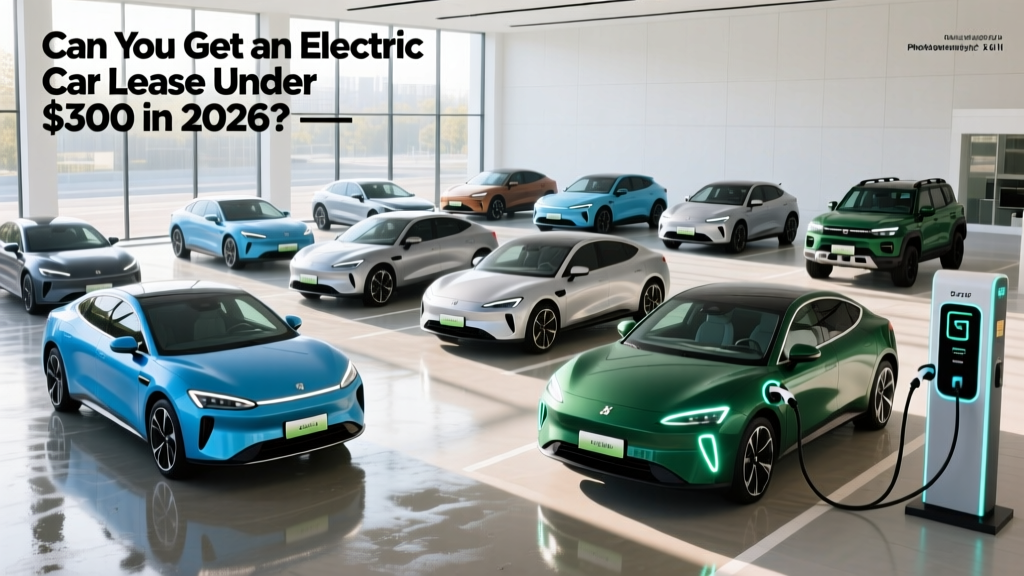
Search for an "electric car lease under $300" and you'll find a mix of expired deals, teaser rates on discontinued trims, and fine-print traps. The reality in 2026: genuine sub-$300/month EV leases are rare but not impossible — they typically require a specific combination of model, lease term, down payment, and regional incentive stacking. This guide cuts through the marketing to show you what's achievable, what the true 5-year ownership cost looks like, and where the hidden expenses live.
A realistic electric car lease under $300 in 2026 targets compact or midsize models like the Chevrolet Equinox EV (base MSRP ~$33,600), Hyundai Kona Electric (~$32,975), or Nissan LEAF (~$28,140). Lease offers in the $250-$320 range typically assume 36-month terms, 10,000 miles/year, and $2,000-$3,500 due at signing. The advertised monthly payment is only part of the equation — the real question is whether the total cost of leasing plus operating an EV beats a comparable gas vehicle over the ownership period.
5-Year Total Cost of Ownership: EV vs. Gas Baseline
To evaluate whether that sub-$300 lease actually saves money, we need a full 5-year/60,000-mile cost model. The table below compares a representative 2026 compact EV (e.g., Hyundai Kona Electric, 261 miles EPA range, 65 kWh battery) against a comparable gasoline compact SUV (e.g., Hyundai Tucson, 29 MPG combined).
| Category | EV (Kona Electric) | Gas (Tucson) | Difference |
|---|---|---|---|
| Purchase/Lease (5-yr equivalent) | $18,600 ($310/mo × 60) | $17,400 ($290/mo × 60) | +$1,200 |
| Fuel / Electricity | $3,960 (at $0.14/kWh, 3.5 mi/kWh) | $7,241 (at $3.20/gal, 29 MPG) | −$3,281 |
| Maintenance | $1,800 | $3,200 | −$1,400 |
| Insurance (5 yr) | $9,600 ($160/mo avg) | $7,800 ($130/mo avg) | +$1,800 |
| Federal Tax Credit (if eligible) | −$7,500 | $0 | −$7,500 |
| Depreciation / Residual | ~$14,500 retained | ~$13,200 retained | −$1,300 |
| Net 5-Year Cost | ~$26,460 | ~$32,441 | EV saves ~$5,981 |
Sources: EPA fueleconomy.gov for efficiency data; insurance averages from industry data; electricity at national residential average of ~$0.14/kWh. Your actual costs will vary by state, utility rate, driving pattern, and credit tier.
The EV wins on operating costs — fuel and maintenance savings total roughly $4,681 over five years. But insurance premiums and the upfront price premium partially offset that advantage. The federal tax credit, when available, is the single largest variable and the primary lever for making an electric car lease under $300 economically compelling.
Federal Tax Credit: §30D Eligibility Rules for 2026
The IRS §30D Clean Vehicle Credit provides up to $7,500 for qualifying new EVs. However, eligibility is not universal — it depends on buyer income, vehicle MSRP, and battery component/mineral sourcing requirements that tighten annually. Here is the current checklist:
- Income caps (modified AGI): $150,000 single filer / $225,000 head of household / $300,000 joint filers
- MSRP caps: $55,000 for sedans; $80,000 for SUVs, vans, and pickup trucks
- Battery component manufacturing: Increasing percentage of battery components must be manufactured or assembled in North America (threshold rises each year through 2029)
- Critical minerals sourcing: Increasing percentage of critical minerals must be sourced from the U.S. or a free-trade-agreement partner
- Foreign entity of concern (FEOC) exclusion: Vehicles with battery components or critical minerals from designated FEOCs are disqualified
- Point-of-sale transfer: As of 2024, buyers can transfer the credit to the dealer at purchase, reducing the sale price directly — this applies to leases as well, where the lessor typically captures the credit and may pass it through as a capitalized-cost reduction
- One credit per buyer per year: Limited to one new-vehicle credit and one used-vehicle credit annually
Lease-specific nuance: Under a lease, the vehicle is technically purchased by the leasing company (the lessor). The lessor claims the §30D credit (or the commercial clean vehicle credit under §45W) and may — but is not required to — pass the savings to you as a lower monthly payment or reduced amount due at signing. Always confirm with the dealer whether the advertised lease price already factors in the federal credit. Many 2026 lease deals on models like the Equinox EV and Ioniq 5 do pass through the full $7,500 as a cap-cost reduction, which is what makes a sub-$300 payment achievable.
Always verify current eligibility on IRS.gov and consult a tax professional. Rules change annually, and battery-sourcing requirements disqualify some trims that were eligible in prior years.
Charging Cost vs. Gasoline: The Per-Mile Math
The strongest economic case for EV ownership is fuel cost. Here's the concrete math using 2026 national averages:
| Metric | EV (e.g., Kona Electric) | Gas (e.g., Tucson) |
|---|---|---|
| Energy efficiency | 3.5 miles/kWh (119 MPGe) | 29 MPG combined |
| Energy cost | $0.14/kWh (home, nat'l avg) | $3.20/gallon (nat'l avg) |
| Cost per mile | $0.04/mile | $0.11/mile |
| Annual cost (12,000 mi) | $480 | $1,324 |
| 5-year cost (60,000 mi) | $2,400 | $6,620 |
Home charging at residential electricity rates delivers a roughly 64% per-mile fuel savings. The picture shifts if you rely heavily on public DC fast charging, where rates of $0.35-$0.55/kWh push EV fuel cost to $0.10-$0.16/mile — comparable to or exceeding gasoline. This is why an electric car lease under $300 makes the most financial sense for buyers with reliable home or workplace Level 2 charging access.
Cold-weather efficiency note: In sub-freezing temperatures, expect 15-30% range and efficiency loss due to battery thermal management demands and cabin heating. A 261-mile EPA-rated EV may deliver 185-220 real-world miles in sustained 20°F weather, which also increases per-mile electricity cost proportionally. Models with a heat pump (standard on the Kona Electric, Ioniq 5, and most 2026 Hyundai/Kia EVs) reduce this penalty to roughly 10-15%.
Maintenance Savings: What You Actually Skip
EVs eliminate several routine maintenance items inherent to internal combustion engines. Over 60,000 miles, the savings are measurable but not as dramatic as some marketing suggests:
| Service Item | EV | Gas Vehicle |
|---|---|---|
| Oil changes (synthetic, every 7,500 mi) | Not required | ~8 changes × $65 = $520 |
| Transmission fluid | Typically sealed/no service | $150-$250 at 60k mi |
| Brake pads (front) | $0-$200 (regen braking reduces wear; often 80k+ mi life) | $300-$500 at 30-40k mi |
| Spark plugs | Not applicable | $200-$400 at 60k mi |
| Engine air filter | Not applicable | $40-$80 (2-3 replacements) |
| Cabin air filter | $30-$60 (every 15-20k mi) | $30-$60 (same interval) |
| Tire rotation | $25-$50 every 7,500 mi | $25-$50 every 7,500 mi |
| Coolant service | $100-$150 at ~50k mi (battery thermal loop) | $100-$150 at ~50k mi |
| Estimated 5-yr total | ~$1,200-$1,800 | ~$2,800-$3,500 |
Regenerative braking is the biggest maintenance advantage: by using the electric motor to decelerate, friction brakes see far less use, often lasting 80,000-100,000+ miles. However, EVs are heavier (the Kona Electric weighs ~3,750 lbs vs. the Tucson at ~3,400 lbs), which can increase tire wear. Budget for tire replacement at 35,000-45,000 miles rather than the 50,000-60,000 miles typical for lighter gas vehicles.
Insurance Reality: The Cost EV Owners Often Overlook
EV insurance premiums run 15-25% higher than equivalent gas vehicles on average. For a compact EV like the Kona Electric or Equinox EV, expect $140-$180/month for full coverage (depending on state, driving record, and coverage limits) versus $115-$150/month for a gas compact SUV. Over five years, that's an additional $1,500-$2,200 in insurance costs.
The reasons are structural, not arbitrary:
- Higher repair costs: EV-specific components (battery packs, power electronics, thermal management systems) are expensive to replace. A minor rear-end collision that damages a battery cooling line can total a vehicle that a gas car would survive with a $2,000 repair.
- Specialized labor: High-voltage system repairs require certified technicians, and fewer shops have that certification.
- Vehicle price premium: Collision and comprehensive coverage scale with vehicle value. Even at a ~$33,000 MSRP, EVs carry a premium over gas equivalents in the same segment.
- Total-loss thresholds: Insurers are more likely to declare an EV a total loss after battery-adjacent damage due to the cost and safety complexity of battery inspection.
Before signing any electric car lease under $300, get an insurance quote on the exact VIN. Premiums vary dramatically by ZIP code, and some insurers (like Progressive and State Farm) have begun offering EV-specific discounts that partially close the gap.
Depreciation and Resale Value Trends
EV depreciation has been volatile. In 2023-2024, Tesla's aggressive price cuts triggered a wave of used-EV value declines, with some models losing 40-50% of value in the first two years. By 2026, the market has partially stabilized, but EVs still depreciate faster on average than comparable gas vehicles in the first three years:
- Average 3-year EV retention: 50-58% of MSRP (varies heavily by brand and model)
- Average 3-year gas vehicle retention: 58-65% of MSRP
- Best EV holdouts: Toyota bZ4X (limited supply), Hyundai Ioniq 5, Rivian R1T retain 58-63%
- Worst performers: Older Nissan LEAF (passive-cooled battery concerns), luxury sedans like the Mercedes EQS (55-60%+ loss at 3 years)
For a lessee, depreciation matters less directly — the leasing company absorbs residual-value risk, and your lease payment is based on the agreed-upon residual at signing. However, aggressive depreciation inflates your monthly payment because the gap between the negotiated price and the residual is larger. This is why leasing an EV with a strong residual forecast (Ioniq 5, Model Y) can paradoxically yield a lower monthly payment than leasing a cheaper EV with poor projected resale value.
If you plan to purchase at lease-end or keep the vehicle long-term, the battery warranty is your depreciation safety net. Federal law mandates at least 8 years/100,000 miles of battery coverage (10 years/150,000 miles in CARB states), with most manufacturers warranting against capacity loss below 70% of original. Check the specific warranty terms — they vary.
State, Local, and Utility Incentives
Important: State and local incentives vary significantly by jurisdiction and change frequently. Always verify current programs through your state energy office, utility provider, and AFDC (Alternative Fuels Data Center). The figures below are representative examples, not guarantees.
Beyond the federal §30D credit, many buyers can stack additional incentives:
- State rebates: California's Clean Fuel Reward (up to $1,000 at point of sale, income-dependent), Colorado's $5,000 state EV tax credit, Massachusetts MOR-EV rebate ($1,500-$3,500 based on income)
- Utility rebates: Many utilities offer $250-$1,000 for home Level 2 charger purchase/installation, plus off-peak charging rates that can reduce electricity cost to $0.06-$0.08/kWh
- HOV lane access: California, Colorado, Virginia, and others grant single-occupant carpool lane access for EVs — a significant time and fuel savings in congested metros
- Registration fee offsets: Some states charge higher annual EV registration fees ($100-$225) to compensate for lost gas-tax revenue; others waive them. Factor this into your 5-year model.
When stacking federal, state, and utility incentives, the effective cost of a $33,000 EV can drop to $22,000-$25,000 in favorable jurisdictions — which is what makes an electric car lease under $300/month genuinely achievable for qualified buyers in states like Colorado, California, and Massachusetts.
Decision Framework: Is a Sub-$300 EV Lease Right for You?
Choose the EV lease if:
- You have home or workplace Level 2 charging access (essential for the fuel-cost advantage)
- You meet §30D income caps and the vehicle qualifies under current battery-sourcing rules
- Your annual mileage fits the lease terms (typically 10,000-12,000 mi/yr; excess-mile penalties are $0.15-$0.25/mi)
- You live in a state with additional rebates that stack with federal incentives
- You plan to keep the lease for the full term (early termination fees are steep)
Stick with gas or hybrid if:
- You rely entirely on public DC fast charging at $0.40-$0.55/kWh (fuel savings evaporate)
- Your insurance quotes come in more than 30% above your current gas vehicle
- You regularly exceed 15,000 miles/year (lease overage penalties compound quickly)
- You live in an area with extreme cold (below 0°F sustained) and no garage charging — range and efficiency losses are substantial
Frequently Asked Questions
How much does it really cost to own an EV over 5 years?
Based on our model using a 2026 compact EV at ~$33,000 MSRP with the $7,500 federal credit applied, 5-year total cost of ownership is approximately $26,000-$28,000 including lease payments, electricity, insurance, and maintenance. A comparable gas SUV runs $31,000-$34,000 over the same period. The EV saves $4,000-$7,000 net, with the exact figure determined by your electricity rate, insurance premium, and tax-credit eligibility.
Do I qualify for the federal EV tax credit?
You may qualify for up to $7,500 under IRS §30D if your modified adjusted gross income is below $150,000 (single) / $300,000 (joint), the vehicle MSRP is under $55,000 (sedan) or $80,000 (SUV/truck), and the vehicle meets current-year battery component and critical-mineral sourcing requirements. Eligibility changes annually as sourcing thresholds increase. Always check the current list on fueleconomy.gov and confirm with a tax professional.
How much do I save on fuel and maintenance?
At national averages ($0.14/kWh home electricity, $3.20/gallon gasoline), a typical compact EV saves approximately $800-$900/year on fuel and $250-$350/year on maintenance versus a comparable gas vehicle. Over 5 years and 60,000 miles, combined savings are roughly $5,000-$6,500. These savings shrink significantly if you rely on expensive public DC fast charging.
Are EVs more expensive to insure?
Yes, typically 15-25% more expensive for full coverage. The higher premiums reflect costlier repairs (especially battery-adjacent damage), specialized labor requirements, and the vehicle's higher MSRP. For a compact EV, expect $140-$180/month versus $115-$150/month for a gas equivalent. Always get a VIN-specific quote before committing to a lease.
How well do EVs hold their value?
EVs retain approximately 50-58% of MSRP after 3 years on average, compared to 58-65% for gas vehicles. The gap has narrowed since 2024 but persists due to rapid technology advancement, battery-degradation concerns, and price competition. For lessees, this matters mainly through the lease residual calculation — a lower projected residual means a higher monthly payment. Brands with strong demand and proven battery longevity (Hyundai, Tesla, Toyota) currently offer the best residual protection.
Can I transfer the federal tax credit to reduce my lease payment?
Under a lease, the lessor (financing company) technically claims the credit. Many major lessors — including Hyundai Motor Finance, GM Financial, and Ford Credit — pass the full credit through as a capitalized-cost reduction, directly lowering your monthly payment. This is what makes an electric car lease under $300 possible on models like the Equinox EV and Kona Electric. Always confirm in writing with the dealer that the advertised payment includes the credit pass-through.