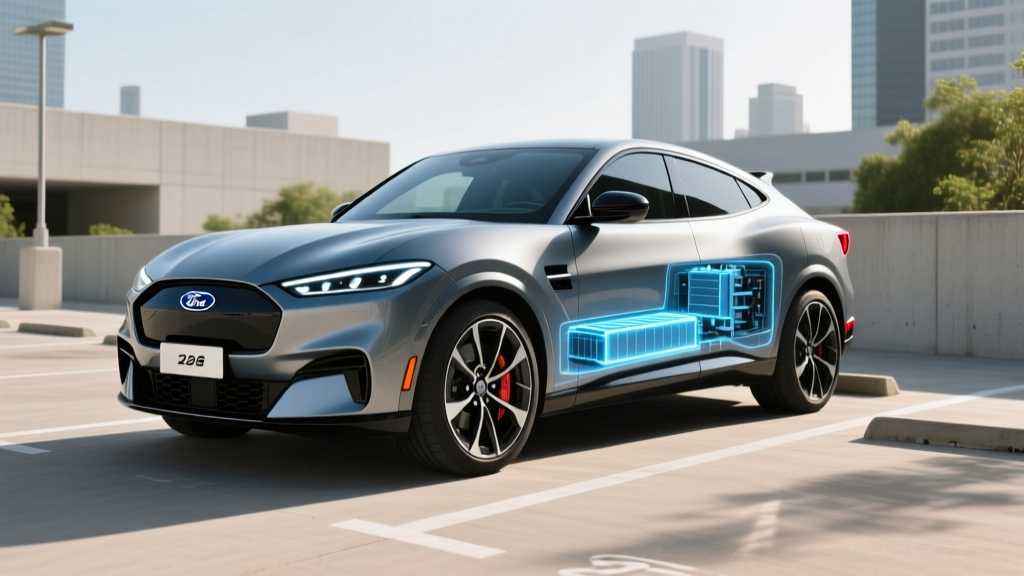
The Ford Mustang Mach-E occupies a distinct niche in the electric SUV segment: sportier than a Tesla Model Y, more practical than a Hyundai Ioniq 5, and wrapped in packaging that bridges muscle-car nostalgia with EV reality. For buyers researching Mustang Mach-E dimensions, cargo capacity, and real-world usability, this guide breaks down every measurement that matters — alongside the range, charging, and pricing data you need to make an informed purchase.
Exterior and Interior Dimensions Breakdown
The Mach-E rides on Ford's dedicated EV platform (GE1), which pushes wheels to the corners for a surprisingly spacious cabin despite its coupe-like roofline. Here are the exact measurements for the 2026 model year:
| Measurement | Value |
|---|---|
| Wheelbase | 117.5 in |
| Overall Length | 185.6 in |
| Overall Width (excl. mirrors) | 74.1 in |
| Overall Height | 63.9 in |
| Ground Clearance | 5.7 in |
| Curb Weight (Select RWD) | ~4,070 lbs |
| Curb Weight (GT AWD) | ~4,920 lbs |
Compared to the Tesla Model Y (187.0 in long, 113.8 in wheelbase), the Mach-E is slightly shorter overall but uses its longer wheelbase to carve out generous rear legroom. At 185.6 inches, it fits comfortably in standard garage bays and tight urban parking spots where full-size electric SUVs struggle.
Cargo Space and Passenger Volume
Dimensional practicality is where the Mach-E earns its crossover credentials. Ford quotes the following cargo figures:
- Behind second row: 29.7 cu ft
- Seats folded: 59.7 cu ft
- Front trunk (frunk): 4.7 cu ft (drainable, useful for wet gear or groceries)
- Total max cargo: 64.4 cu ft
Passenger space is competitive for the midsize electric SUV class:
- Front headroom: 40.4 in
- Front legroom: 43.3 in
- Rear headroom: 38.9 in (the sloping roofline does cut into taller passengers' space)
- Rear legroom: 38.1 in
- Total passenger volume: 104.5 cu ft
The frunk is a genuine differentiator. Unlike many EVs that have sealed or tiny front trunks, the Mach-E's 4.7 cu ft unit includes a drain plug — practical for tailgating with ice or stowing muddy hiking boots. That said, rear cargo at 29.7 cu ft trails the Model Y's 30.2 cu ft, and the difference widens with seats folded (Model Y: 72.1 cu ft vs. Mach-E: 59.7 cu ft).
EPA Range and Real-World Expectations
Range is where buyers need honesty, not marketing. The 2026 Mach-E lineup offers two battery options across multiple drivetrains:
Select (Standard Range, RWD): EPA 250 mi — expect ~210–225 mi highway, ~175–195 mi in cold weather (below 32°F)
Premium (Extended Range, RWD): EPA 320 mi — expect ~270–290 mi highway, ~230–250 mi in cold weather
GT (Extended Range, AWD): EPA 280 mi — expect ~240–260 mi highway, ~200–220 mi in cold weather
The Extended Range pack delivers its best efficiency in city and suburban driving, where regenerative braking recovers energy. Sustained highway speeds above 70 mph increase consumption noticeably, and winter conditions with cabin heating can reduce range by 20–30% depending on severity. According to fueleconomy.gov, the Extended Range RWD achieves 101 MPGe combined (33 kWh/100 mi), while the GT AWD drops to 84 MPGe combined (40 kWh/100 mi).
| Trim | Battery (usable) | Chemistry | Drivetrain | EPA Range | MPGe (combined) |
|---|---|---|---|---|---|
| Select | 70 kWh | NMC (Lithium-ion) | RWD | 250 mi | 101 |
| Premium ER | 91 kWh | NMC | RWD | 320 mi | 101 |
| GT | 91 kWh | NMC | AWD | 280 mi | 84 |
Ford uses NMC (nickel manganese cobalt) chemistry across the Mach-E lineup. NMC offers higher energy density than LFP, which is why the Extended Range pack fits 91 kWh usable in the same physical footprint. The trade-off is that NMC batteries benefit from daily charging limits around 80–90% to maximize longevity, whereas LFP packs tolerate regular 100% charges.
Charging Speed: DC Fast and Home Level 2
Charging performance is a top buyer concern, and the Mach-E's capabilities are solid but not class-leading. Here's what to expect across charging scenarios:
| Charging Level | Power | Speed / Time |
|---|---|---|
| Level 1 (120V household) | ~1.4 kW | ~3–4 mi/hr added |
| Level 2 (240V home) | 10.5 kW (48A) | ~28–32 mi/hr added; full charge ~9–10 hrs (ER) |
| DC Fast Charge (peak) | 150 kW | 10–80% in ~45 minutes |
| DC Fast Charge (sustained avg) | ~100–115 kW | ~200 mi added in 30 min |
The 150 kW peak DC fast-charge rate is the Mach-E's most notable limitation versus competitors. The Hyundai Ioniq 5 peaks at 240 kW (on 800V architecture), and the Tesla Model Y can sustain 250 kW on V3 Superchargers. Ford's charge curve tapers meaningfully above 60% state of charge — you'll see the rate drop from ~150 kW to under 80 kW in the 60–80% window, which is why the 10–80% time stretches to roughly 45 minutes rather than the sub-20-minute times some rivals achieve.
For home charging, the onboard 10.5 kW charger is a strong point. On a 48-amp Level 2 circuit (requiring a 60-amp breaker), you'll add roughly 30 miles of range per hour. Overnight charging from 20% to 80% takes about 5–6 hours for the Extended Range pack — easily handled while you sleep.
Performance: 0-60, Horsepower, and Drivetrain
The Mach-E lineup spans efficient commuter to genuine performance SUV:
- Select (RWD): 266 hp, 317 lb-ft torque, 0–60 mph in ~6.1 seconds
- Premium (ER RWD): 290 hp, 317 lb-ft torque, 0–60 mph in ~5.8 seconds
- Premium (ER AWD): 346 hp, 428 lb-ft torque, 0–60 mph in ~4.8 seconds
- GT (AWD): 480 hp, 600 lb-ft torque, 0–60 mph in ~3.5 seconds
The GT variant's 3.5-second sprint puts it in sports-car territory, and the instant torque delivery makes even the base RWD model feel quicker than its numbers suggest. All trims use a single-speed reduction gear — no multi-speed transmission complexity. The GT includes MagneRide adaptive dampers and a sport-tuned suspension that noticeably sharpens handling without making the ride punishing on rough pavement.
Towing capacity is rated at 1,500 lbs across the lineup with the factory tow package. That's adequate for a small utility trailer or a pair of dirt bikes but rules out most camper trailers — buyers needing serious towing should look at the Ford F-150 Lightning or Rivian R1S.
Pricing, Trims, and Federal Tax Credit Eligibility
The 2026 Mach-E starts at a competitive price point, and federal incentives can significantly reduce out-of-pocket cost for eligible buyers:
| Trim | Base MSRP | Est. As-Tested* | §30D Credit Eligible? |
|---|---|---|---|
| Select (SR RWD) | $39,995 | $42,500 | Yes — up to $7,500 |
| Premium (ER RWD) | $46,495 | $50,200 | Yes — up to $7,500 |
| Premium (ER AWD) | $49,495 | $53,500 | Yes — up to $7,500 |
| GT (ER AWD) | $59,995 | $63,800 | Yes — up to $7,500 |
*As-tested includes destination charge and common option packages.
The federal EV tax credit under IRS §30D offers up to $7,500 for qualifying new EVs, but eligibility depends on several conditions that change periodically:
- MSRP cap: SUVs must be priced at or below $80,000 (all Mach-E trims qualify)
- Buyer income cap: AGI must not exceed $150,000 (single), $225,000 (head of household), or $300,000 (joint)
- Battery sourcing: Critical minerals and battery components must meet phased-in domestic/free-trade sourcing thresholds that tighten each year
- Point-of-sale transfer: Eligible buyers can apply the credit as an upfront discount at the dealership rather than waiting for tax filing
As of the 2026 model year, the Mach-E has maintained eligibility for the full $7,500 credit, but battery-sourcing rules are subject to change. Always verify current eligibility on the IRS website or with your dealer before finalizing a purchase. The credit is non-refundable — you need sufficient tax liability to claim it, unless you opt for the point-of-sale transfer.
Tech, Driver Assists, and Ownership Experience
The Mach-E's cabin centers on a large 15.5-inch portrait touchscreen running Ford's SYNC 4A infotainment system. Wireless Apple CarPlay and Android Auto are standard. The screen handles climate controls (including a secondary touch strip below the main display), navigation, and vehicle settings — there are very few physical buttons, which some buyers love and others find distracting while driving.
Ford's BlueCruise hands-free driving system is available on mapped divided highways (over 130,000 miles of compatible roads in the US and Canada). This is an SAE Level 2 system — it handles steering, acceleration, and braking on compatible roads while monitoring driver attention via an infrared camera, but the driver must remain alert and ready to take over at all times. It is not autonomous driving.
Standard safety tech includes automatic emergency braking with pedestrian detection, blind-spot monitoring, rear cross-traffic alert, lane-keeping assist, and evasive steering assist. The Mach-E has earned strong crash-test ratings from NHTSA (5-star overall) and the IIHS (Top Safety Pick).
Warranty coverage:
- Bumper-to-bumper: 3 years / 36,000 miles
- Powertrain: 5 years / 60,000 miles
- EV battery: 8 years / 100,000 miles (minimum 70% capacity retention)
The 8-year/100,000-mile battery warranty is industry-standard and matches what most competitors offer. Ford guarantees the battery will retain at least 70% of its original capacity during that period. Real-world degradation data from early Mach-E owners (2021–2023 models) suggests NMC packs are holding up well, with most reporting less than 5% loss over the first 40,000 miles — though long-term data beyond five years is still accumulating.
- Sporty driving dynamics, especially GT trim
- Generous rear legroom (38.1 in)
- Drainable frunk adds real utility
- BlueCruise is one of the better L2 systems
- Strong 10.5 kW Level 2 onboard charging
- All trims under the $80K MSRP cap for tax credit
- 150 kW DC peak lags behind Hyundai/Tesla rivals
- 45-min 10–80% time slows road trips
- Cargo space trails Model Y with seats folded
- NMC chemistry benefits from 80% daily charge limit
- Touchscreen-heavy cabin can distract while driving
- 1,500-lb towing capacity is low for the class
Who the Mustang Mach-E Suits Best
The Mach-E is strongest as a daily-driver crossover for singles, couples, or small families who value engaging driving dynamics and don't regularly need maximum cargo volume. The 250–320 mile range envelope handles commuting, errands, and weekend trips comfortably if you have home charging. The GT trim appeals to buyers who want sports-sedan acceleration in a practical SUV body.
It's less ideal for frequent long-distance road trippers (the 150 kW charge curve adds time versus Ioniq 5 or Model Y), large families needing three rows, or anyone who regularly tows. Cold-climate buyers should budget for the Extended Range pack and preconditioning discipline to offset winter range loss.
Frequently Asked Questions
What is the real-world range of the Mustang Mach-E?
The EPA rates the Extended Range RWD at 320 miles, but real-world highway driving at 70+ mph typically yields 270–290 miles. In winter conditions with heating, expect 230–250 miles. The base Standard Range RWD delivers roughly 210–225 miles in mixed real-world use versus its 250-mile EPA sticker.
How fast does the Mach-E charge at home and on the road?
At home on a 240V Level 2 charger (48A circuit), the onboard 10.5 kW charger adds roughly 30 miles of range per hour — a full overnight charge handles most needs. On DC fast chargers, it peaks at 150 kW but takes approximately 45 minutes for a 10–80% session due to charge-curve tapering above 60%.
How much does the Mach-E cost after the federal tax credit?
The base Select starts at $39,995 MSRP. Eligible buyers who qualify for the full $7,500 §30D credit (meeting income, sourcing, and tax-liability requirements) can bring the effective price to roughly $32,495 via the point-of-sale transfer option. Higher trims see proportionally larger effective discounts.
Does the Mustang Mach-E qualify for the federal EV tax credit?
Yes — all current Mach-E trims fall under the $80,000 SUV MSRP cap. However, buyer eligibility depends on adjusted gross income limits ($150K single / $300K joint), and the vehicle must meet battery critical-mineral and component sourcing thresholds that phase in over time. Always confirm current eligibility at irs.gov or with your Ford dealer.
Is the Mach-E worth buying versus the Tesla Model Y or Hyundai Ioniq 5?
It depends on your priorities. Choose the Mach-E if you prefer Ford's build quality, want BlueCruise, value the drainable frunk, and don't mind slower DC charging. Choose the Model Y for maximum cargo space and Supercharger network access. Choose the Ioniq 5 if fast charging (240 kW, ~18 min 10–80%) is your top road-trip priority. The Mach-E holds its own on driving dynamics and interior comfort but concedes charging speed to its Korean and Californian rivals.
What are the Mustang Mach-E's exact cargo dimensions?
Behind the second row: 29.7 cu ft. With rear seats folded: 59.7 cu ft. Front trunk (frunk): 4.7 cu ft with a drain plug. Total maximum cargo: 64.4 cu ft. Rear legroom measures 38.1 inches, and front legroom is 43.3 inches.