Why Lucid's Saudi Arabia Connection Matters for EV Buyers
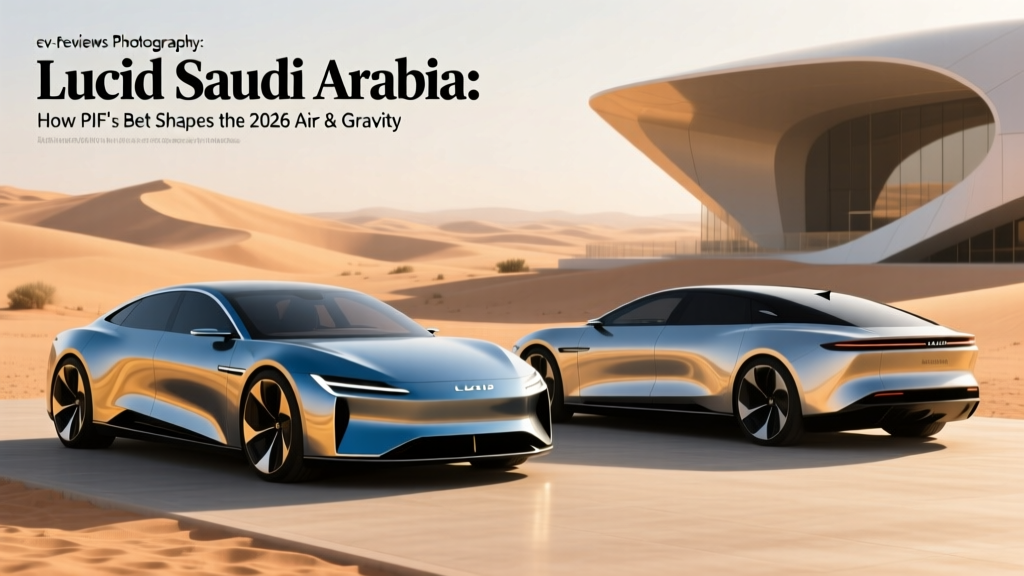
Search for "Lucid Saudi Arabia" and you'll find the story behind one of the most well-funded EV startups in the world. Saudi Arabia's Public Investment Fund (PIF) has injected over $5 billion into Lucid Group since 2018, transforming a Silicon Valley engineering outfit into a company with a manufacturing plant in King Abdullah Economic City (KAEC) and the financial runway to bring the Gravity SUV to market for 2025-2026. For US buyers, the Saudi Arabia connection translates to two practical realities: Lucid isn't going bankrupt mid-warranty, and the company has the capital to iterate its powertrain technology faster than most rivals.
As of early 2026, Lucid sells the Air sedan (Pure, Touring, Grand Touring, and Sapphire trims) and the newly launched Gravity SUV. Both vehicles share Lucid's in-house electric motors, 900V+ electrical architecture, and some of the highest efficiency figures ever recorded by the EPA. This profile covers what you need to know before buying, with exact numbers on range, charging, pricing, and the federal tax credit landscape.
Lucid Air 2026: Range, Battery, and Real-World Efficiency
The Lucid Air lineup offers four trims in 2026, each with distinct range and performance profiles. Lucid's powertrain engineering — developed in-house at their Newark, California facility and scaled with PIF capital — achieves efficiency numbers that embarrass competitors twice the Air's weight.
| Spec | Air Pure | Air Touring | Air Grand Touring | Air Sapphire |
|---|---|---|---|---|
| EPA Range | 419 mi | 425 mi | 516 mi | 427 mi |
| Battery (usable) | 88 kWh (NMC) | 112 kWh (NMC) | 112 kWh (NMC) | 118 kWh (NMC) |
| Drivetrain | RWD, single motor | AWD, dual motor | AWD, dual motor | AWD, tri-motor |
| Horsepower | 430 hp | 620 hp | 819 hp | 1,234 hp |
| 0-60 mph | 5.0 sec | 3.4 sec | 3.0 sec | 1.89 sec |
| EPA Efficiency | 146 MPGe / 23 kWh/100mi | 131 MPGe / 26 kWh/100mi | 131 MPGe / 25 kWh/100mi | 109 MPGe / 31 kWh/100mi |
| Base MSRP (2026) | $69,900 | $87,400 | $125,600 | $249,000 |
Lucid uses NMC (nickel manganese cobalt) lithium-ion cells across the Air lineup. The battery pack is structural — it's integrated into the vehicle floor as a stressed member, reducing weight and improving torsional rigidity. The 900V+ architecture (Lucid runs approximately 924V nominal) is key to both efficiency and charging speed, allowing lower current for the same power delivery, which reduces resistive heat losses in the wiring and motors.
Charging Speed: DC Fast Charge and Home Level 2
Lucid's 900V platform enables charging speeds that rank among the fastest in production EVs. Here's the complete charging picture for the 2026 Air lineup:
| Charging Method | Power / Rate | Time / Miles Added | Connector |
|---|---|---|---|
| DC Fast Charge (peak) | Up to 300 kW | 10-80% in ~20 min (Grand Touring) | NACS (native 2025+); CCS via adapter |
| DC Fast Charge (sustained avg 10-80%) | ~180-220 kW avg | Adds ~200 miles in 15 min | NACS |
| Level 2 Home (19.2 kW onboard) | 19.2 kW max | ~55-60 miles per hour of charging | NACS / J1772 adapter |
| Level 2 Home (typical 11.5 kW) | 11.5 kW | ~35 miles per hour of charging | NACS / J1772 adapter |
| Level 1 (120V) | ~1.4 kW | ~4 miles per hour | Standard outlet |
The 300 kW peak figure applies to the Grand Touring and Sapphire with their larger packs. The Pure and Touring peak around 200-220 kW. Critical context: no EV sustains its peak charge rate. The Air's charge curve holds above 200 kW from roughly 10% to 50% state of charge, then tapers gradually. The 10-80% time of approximately 20 minutes for the Grand Touring is competitive with the Hyundai Ioniq 5 and Porsche Taycan, though the Air adds more total miles in that window thanks to superior efficiency.
For home charging, the Air's 19.2 kW onboard charger is among the most powerful available. To utilize it fully, you need a 100-amp dedicated circuit and a hardwired Level 2 EVSE rated for 80 amps continuous. Most homes will install a 60-amp circuit (48 amps continuous) delivering 11.5 kW, which still adds a full battery overnight. Expect home installation costs of $1,200-$3,500 depending on panel capacity and run length — a 200-amp panel upgrade can add $2,000-$4,000 if your home needs one.
As of 2025, Lucid transitioned to the NACS (North American Charging Standard) connector on all new vehicles, giving Air and Gravity owners native access to Tesla Supercharger stations. CCS adapters are included for legacy Electrify America, EVgo, and ChargePoint networks.
Lucid Gravity 2026: The SUV Built on Saudi Capital
The Gravity is the second vehicle born from Lucid's PIF-funded expansion. It's a three-row luxury SUV that targets the Tesla Model X, BMW iX, and Rivian R1S buyer. Key 2026 Gravity specs:
- EPA Range: 440 miles (Grand Touring AWD, 112 kWh pack)
- 0-60 mph: 3.5 seconds (dual motor AWD, ~800 hp)
- Base MSRP: $79,900 (Pure RWD, ~370-mile range) / $94,900 (Touring) / $119,900 (Grand Touring)
- DC Fast Charge: Up to 300 kW peak, 10-80% in ~22 minutes
- Seating: Up to 7 passengers, 42 cu ft cargo behind 2nd row, 100+ cu ft with seats folded
- Towing: 6,000 lbs rated
The Gravity's real-world highway range lands around 350-380 miles for the Grand Touring — excellent for a 5,500+ lb three-row SUV. Cold-weather towing will reduce that to approximately 220-260 miles depending on trailer weight and terrain. The Gravity's 6,000-lb tow rating is adequate for a boat or small camper but falls short of the Rivian R1S (7,700 lbs) and F-150 Lightning.
Pricing, Tax Credits, and Total Cost of Ownership
Lucid's pricing places the Air and Gravity firmly in the luxury segment. The federal EV tax credit under IRS §30D has specific eligibility requirements that affect Lucid vehicles:
- MSRP Cap: Sedans (Air) must be under $55,000 — no Lucid Air trim qualifies
- MSRP Cap: SUVs/pickups/vans (Gravity) must be under $80,000 — only the Gravity Pure at $79,900 potentially qualifies
- Buyer Income Cap: AGI ≤ $150,000 (single) / $300,000 (married filing jointly)
- Battery Sourcing: Critical minerals and battery components must meet escalating domestic-content thresholds (increasingly restrictive through 2026)
- Point-of-Sale Transfer: Eligible buyers can apply the credit at purchase rather than waiting for tax filing
Because the Air is classified as a sedan, its $55,000 MSRP cap eliminates every trim from credit eligibility. The Gravity Pure, classified as an SUV, squeaks under the $80,000 cap at $79,900, but battery-sourcing rules may reduce or eliminate the credit depending on the specific build month's supply chain compliance. Always verify current eligibility with your tax professional and the IRS's updated vehicle list at fueleconomy.gov before purchase.
| Model / Trim | MSRP | Est. §30D Credit | Effective Price | Destination |
|---|---|---|---|---|
| Air Pure | $69,900 | $0 (MSRP cap) | $69,900 | $1,200 |
| Air Touring | $87,400 | $0 (MSRP cap) | $87,400 | $1,200 |
| Air Grand Touring | $125,600 | $0 (MSRP cap) | $125,600 | $1,200 |
| Gravity Pure | $79,900 | Up to $7,500* | ~$72,400* | $1,500 |
| Gravity Grand Touring | $119,900 | $0 (MSRP cap) | $119,900 | $1,500 |
*Gravity Pure credit eligibility depends on battery-sourcing compliance and buyer income. Confirm with IRS before purchase.
Despite the tax credit limitations, Lucid ownership costs benefit from low maintenance (no oil changes, minimal brake wear due to regenerative braking), electricity costs averaging $0.13-$0.16/kWh nationally, and strong projected residual values for the Grand Touring trims. Insurance premiums run 15-25% higher than comparable ICE luxury sedans, a factor worth quoting before purchase.
Interior, Tech, and Driver Assistance
The Air's cabin centers on a 34-inch curved glass canopy display spanning the dashboard, running Lucid's custom infotainment OS. The system supports wireless Apple CarPlay and Android Auto, OTA updates, and integrated route planning with charge-stop optimization. Build quality on 2025-2026 models has improved notably over early 2022-2023 units, with tighter panel gaps and more consistent leather stitching.
Standout tech features:
- DreamDrive Pro ADAS suite: 32 sensors including lidar, cameras, and radar
- Highway assist with lane-centering and adaptive cruise (SAE Level 2 — driver must remain engaged)
- Over-the-air updates adding features post-purchase
- ProPILOT-style hands-on-wheel monitoring with capacitive sensing
- Regenerative braking adjustable from low to near-one-pedal driving
- Heat pump standard on all trims (improves cold-weather range by 10-15%)
Notable drawbacks: Rear-seat headroom is tight for passengers over 6'2" due to the sloping roofline. The infotainment system, while visually impressive, has drawn criticism for burying climate controls in touchscreen menus rather than physical buttons. Service center availability remains limited outside major metro areas — Lucid relies on mobile service vans and a growing but still sparse network of physical locations. Trunk space (32 cu ft combined trunk + frunk) trails the Mercedes EQS and Tesla Model S.
Warranty and Long-Term Battery Outlook
| Coverage | Term |
|---|---|
| Basic Vehicle Warranty | 4 years / 50,000 miles |
| Battery & Powertrain | 8 years / 100,000 miles |
| Battery Capacity Retention | ≥70% SoH over 8 yr / 100,000 mi |
| Roadside Assistance | 4 years / 50,000 miles |
Lucid's 8-year/100,000-mile battery warranty guarantees at least 70% state of health, matching industry norms from Tesla, Hyundai, and BMW. Lucid's NMC cells use a proprietary cell format and thermal management system that early data suggests degrades well — the company's taxi and ride-hail fleet partnerships in Saudi Arabia (via the KAEC plant) are generating high-mileage data that informs ongoing pack engineering. Full battery replacement, if ever needed out of warranty, is estimated at $20,000-$30,000 depending on pack size, though costs are trending downward annually.
Lucid vs. Competitors: Air and Gravity Compared
The Air competes with the Tesla Model S, Mercedes EQS, BMW i5, and Porsche Taycan. The Gravity targets the Model X, BMW iX, Rivian R1S, and Kia EV9. Here's how the Air Grand Touring stacks up against key rivals:
| Spec | Lucid Air GT | Tesla Model S LR | Mercedes EQS 580 | Porsche Taycan 4S |
|---|---|---|---|---|
| EPA Range | 516 mi | 402 mi | 371 mi | 288 mi |
| Price | $125,600 | $89,990 | $127,350 | $107,400 |
| Efficiency | 131 MPGe | 124 MPGe | 97 MPGe | 83 MPGe |
| DC Fast Charge Peak | 300 kW | 250 kW | 200 kW | 320 kW |
| 0-60 mph | 3.0 sec | 3.1 sec | 4.1 sec | 3.8 sec |
The Air Grand Touring wins on range and efficiency by a wide margin. The Tesla Model S offers better Supercharger network access (though Lucid now has NACS Supercharger compatibility) and a lower price. The Taycan charges faster but sacrifices range. The EQS offers a more traditional luxury experience but trails on every efficiency metric.
- Best-in-class EPA range (516 mi Grand Touring)
- Exceptional efficiency — lowest kWh/100mi in luxury sedan segment
- 300 kW DC fast charging with strong sustained curve
- Refined ride quality, quiet cabin at highway speed
- PIF backing provides financial stability rare among EV startups
- NACS native connector for Supercharger access (2025+)
- No federal tax credit for Air (sedan MSRP cap)
- Limited service center footprint outside major metros
- Rear headroom constrained for tall passengers
- Infotainment lacks physical climate controls
- Brand recognition and resale data still limited vs. Tesla/Porsche
- Gravity pricing pushes well past $100K for desirable trims
Who Should Buy a Lucid — And Who Shouldn't
- You want maximum range and don't want to compromise on luxury
- You commute 60+ miles daily and want to charge only 1-2 times per week
- You value engineering efficiency over badge prestige
- You have home Level 2 charging and access to DC fast chargers on road trip routes
- You need a federal tax credit and can't stretch past $55K (sedan) or $80K (SUV)
- You live in a rural area far from Lucid's service network
- You prioritize brand cachet and dealer experience (Porsche, Mercedes)
- You need hands-free highway driving like GM Super Cruise or Ford BlueCruise
Lucid's Saudi Arabia-backed stability means buyers can commit to the brand without the bankruptcy risk that sank Fisker and hounded early Tesla. The Air remains the efficiency and range benchmark in the luxury EV sedan segment heading into 2026, and the Gravity extends that engineering advantage to the three-row SUV market. The main barriers are price, tax credit ineligibility for most trims, and a service network that's still catching up to the company's ambitions.
Frequently Asked Questions
What is the real-world range of the Lucid Air?
The Air Grand Touring delivers 420-450 miles on the highway in moderate temperatures, down from its 516-mile EPA sticker. The Air Pure achieves 370-395 highway miles real-world. Cold weather (below 32°F) reduces range 15-25% across all trims.
How fast does the Lucid Air charge?
The Air Grand Touring peaks at 300 kW DC fast charging, reaching 10-80% in approximately 20 minutes. The Pure and Touring peak around 200-220 kW with 10-80% times of 22-25 minutes. Home Level 2 charging at 11.5 kW adds about 35 miles per hour.
Does the Lucid Air or Gravity qualify for the federal EV tax credit?
The Lucid Air (sedan) does not qualify — all trims exceed the $55,000 sedan MSRP cap under IRS §30D. The Gravity Pure at $79,900 may qualify as an SUV (under the $80,000 cap), but eligibility depends on battery-sourcing rules and buyer income limits. Always verify at irs.gov.
Is Lucid a safe investment vs. Tesla or legacy luxury brands?
Lucid's PIF backing ($5B+ invested) provides financial stability that most EV startups lack. However, service infrastructure, brand recognition, and long-term resale values remain less proven than Tesla, BMW, or Mercedes. The KAEC manufacturing plant and Saudi fleet partnerships give Lucid revenue diversification beyond US consumer sales.
Where are Lucid vehicles manufactured?
Lucid assembles US-market vehicles at its AMP-1 factory in Casa Grande, Arizona. A second facility in King Abdullah Economic City (KAEC), Saudi Arabia, serves Middle Eastern markets and supports global production capacity — a direct result of PIF's investment.