Quick Answer: Mustang Mach-E Crash Safety & Repair Costs
The 2026 Ford Mustang Mach-E carries a 5-star overall NHTSA safety rating and earns IIHS Top Safety Pick status. However, EV crash repairs typically cost 20-40% more than equivalent gas-car damage due to high-voltage system protocols, specialized technician requirements, and battery-pack inspection mandates. Average collision claims for the Mach-E run $4,800-$7,200 versus $3,200-$4,500 for a comparable gas Mustang EcoBoost. Insurance premiums reflect this gap: expect $2,400-$3,100 annually for the Mach-E versus $1,800-$2,300 for the gas model.
Mustang Mach-E Crash Test Performance: IIHS & NHTSA Data
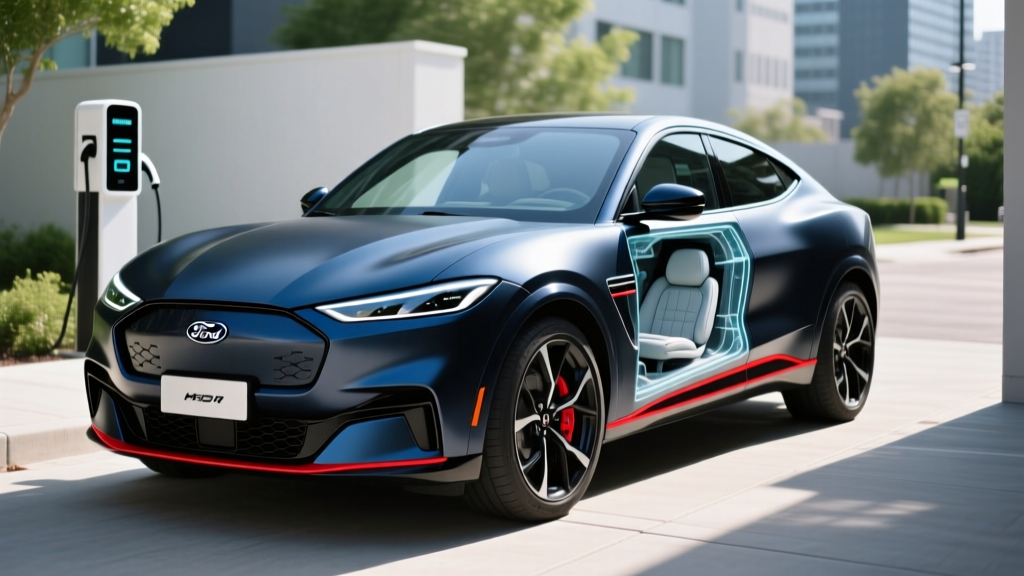
The 2026 Mustang Mach-E benefits from Ford's Global Electrified Platform (GE2), which positions the battery pack low in the chassis, creating a lower center of gravity and substantial front crumple zones unencumbered by a heavy engine block. This architecture translates directly into crash-test performance.
| Test | Mach-E Rating | Gas Mustang EcoBoost |
|---|---|---|
| NHTSA Overall | 5 Stars | 5 Stars |
| NHTSA Frontal Crash | 5 Stars | 5 Stars |
| NHTSA Side Crash | 5 Stars | 5 Stars |
| IIHS Moderate Overlap Front | Good | Good |
| IIHS Side Impact | Good | Good |
| IIHS Roof Strength | Good | Acceptable |
| IIHS Headlights | Acceptable/Good (trim-dependent) | Marginal |
The Mach-E's roof strength rating surpasses the gas Mustang coupe, a direct result of the reinforced structure required to protect the battery enclosure. According to IIHS testing, the Mach-E withstood 4.75 times its curb weight in the roof-strength test, well above the 4.0x threshold for a "Good" rating.
Real-World Note: Crash safety ratings reflect controlled test conditions. In real-world collisions involving EVs, the primary safety advantage is structural — the absence of an engine block allows more crush space forward of the cabin. However, post-crash fire risk, while statistically lower than gas vehicles per NHTSA data, requires specific first-responder protocols for high-voltage system isolation.
EV Repair Costs After a Crash: Why the Mach-E Costs More to Fix
When a Mustang Mach-E sustains collision damage, the repair invoice tells a different story than a gas Mustang. This isn't speculation — it's documented in insurance industry data from CCC Intelligent Solutions and Mitchell International, both of which track that EV collision claims average 20-40% higher than internal combustion equivalents.
| Repair Scenario | Mach-E (EV) | Mustang EcoBoost (Gas) | Cost Delta |
|---|---|---|---|
| Minor front-end (bumper, sensors) | $2,800-$4,200 | $1,600-$2,400 | +60-75% |
| Moderate front collision | $6,500-$9,800 | $4,200-$5,800 | +55-70% |
| Side-impact door/quarter panel | $3,800-$5,500 | $2,800-$3,600 | +35-50% |
| Rear collision (hatch, sensors) | $3,200-$4,800 | $2,000-$3,200 | +50-60% |
| Battery pack involvement | $12,000-$28,000+ | N/A | EV-only risk |
Several factors drive these premiums:
- High-voltage safety protocols: Any repair near the battery enclosure or orange-cable high-voltage wiring requires a certified EV technician to de-energize and verify the system. This adds 1-3 labor hours at $150-$200/hour before physical repair begins.
- Sensor density: The Mach-E's Co-Pilot360 2.5 suite includes radar, ultrasonic sensors, and cameras embedded in bumpers and mirrors. A front bumper replacement requires sensor recalibration — a $400-$800 procedure the gas Mustang also needs, but the Mach-E has more sensors per square foot of body panel.
- Battery inspection mandates: If collision force reaches the battery enclosure, Ford requires a full high-voltage diagnostic and potentially individual module replacement. While the 91 kWh usable battery (extended range) is designed with crash-protection armor, any deformation triggers mandatory inspection. A single module replacement runs $2,500-$4,000; full pack replacement is $18,000-$24,000.
- Parts availability: Mach-E body panels and EV-specific components have longer supply chains than the ubiquitous Mustang EcoBoost parts. Wait times of 2-6 weeks for specific panels are common, during which rental-car costs accumulate.
Insurance Premiums: The Mach-E vs. Gas Mustang Breakdown
The higher repair costs translate directly into insurance premiums. Based on 2026 average rates for a 35-year-old driver with a clean record, here's what to budget:
| Factor | 2026 Mach-E Premium | 2026 Mustang EcoBoost |
|---|---|---|
| Annual Full Coverage (national avg) | $2,400-$3,100 | $1,800-$2,300 |
| Collision Deductible (typical) | $500-$1,000 | $500-$1,000 |
| Comprehensive (theft/weather) | $380-$520/yr | $420-$600/yr |
| Gap Insurance (recommended Yr 1-2) | $40-$80/yr | $35-$70/yr |
| 5-Year Insurance Total (est.) | $12,000-$15,500 | $9,000-$11,500 |
The Mach-E's comprehensive insurance is actually slightly lower than the gas Mustang's — EVs have lower theft rates and no catalytic converter to steal. But collision coverage, which accounts for 60-70% of a full-coverage premium, runs higher due to the repair-cost delta documented above.
Tax credit offset: The 2026 Mach-E Select (base MSRP ~$39,995) and Premium (~$46,995) may qualify for the §30D federal tax credit up to $7,500, subject to income caps ($150k single / $300k joint), battery sourcing requirements, and the $80,000 SUV MSRP cap. Verify current eligibility at IRS.gov before purchase. This credit can partially offset the 5-year insurance premium gap.
Total Cost of Ownership: Mach-E vs. Gas Mustang (5-Year)
Higher insurance and repair costs don't exist in a vacuum. The Mach-E's fuel savings and lower maintenance requirements shift the ownership math. Here's a 5-year, 75,000-mile comparison:
| Category | Mach-E (Extended Range AWD) | Mustang EcoBoost Coupe |
|---|---|---|
| Purchase Price (base MSRP) | $42,995 | $32,895 |
| Federal Tax Credit (§30D est.) | -$3,750 to -$7,500* | $0 |
| Effective Purchase | $35,495-$39,245 | $32,895 |
| Energy/Fuel (75k miles) | $3,200-$5,400** | $7,800-$9,200 |
| Maintenance (5 yr) | $1,200-$1,800 | $3,400-$4,200 |
| Insurance (5 yr) | $12,000-$15,500 | $9,000-$11,500 |
| Estimated Depreciation | $18,000-$22,000 | $12,000-$15,000 |
| 5-Year Total Cost | $61,895-$74,945 | $53,095-$62,795 |
*Credit eligibility depends on battery critical-mineral sourcing, buyer income, and point-of-sale transfer rules. Consult a tax professional.
**Electricity cost assumes $0.14/kWh home charging and occasional DC fast charging at $0.35-$0.48/kWh. Gas assumes $3.40/gallon at 25 MPG combined (EPA). Source: fueleconomy.gov.
The Mach-E narrows the gap through energy savings (~$4,000-$5,000 over 5 years) and maintenance savings (~$2,000-$2,500 — no oil changes, fewer brake replacements due to regenerative braking, no transmission fluid). But the higher insurance, steeper depreciation, and elevated purchase price mean the gas Mustang still wins on pure 5-year cost for most buyers. The break-even point typically arrives around year 7-8, assuming stable electricity and gas prices.
Common Misconceptions About EV Crashes and Safety
| Myth | Fact |
|---|---|
| "EVs catch fire more often in crashes than gas cars." | NHTSA and NFPA data show EVs have a lower fire incidence rate per 100,000 vehicles sold. Gas vehicles experience ~1,530 fires per 100k vehicles; EVs experience ~25 per 100k. However, EV battery fires are harder to extinguish and require more water and time. |
| "Any crash totaling the Mach-E means a $24,000 battery replacement." | Minor collisions rarely affect the battery. Ford's pack is housed in a reinforced enclosure with impact-absorbing rails. Battery damage occurs primarily in severe undercarriage impacts or high-speed side intrusions. Most Mach-E collision claims involve body panels and sensors, not the pack. |
| "Insurance companies won't cover EV battery damage." | Comprehensive and collision coverage includes the battery pack. However, insurers may declare the vehicle a total loss at a lower damage threshold than a gas car, because battery-replacement cost can exceed the vehicle's residual value. |
| "The Mach-E is less safe than the gas Mustang because it's heavier." | At ~4,800 lbs (extended range AWD), the Mach-E is heavier, but crash physics favor mass in multi-vehicle collisions. Its 5-star NHTSA rating and IIHS Top Safety Pick status confirm structural integrity. Heavier vehicles also protect occupants better in crashes with lighter vehicles. |
| "EV repair shops are impossible to find." | Ford has certified over 3,200 EV-trained collision repair facilities in the U.S. through its Certified Collision Network. Availability varies by region — rural areas may require towing 50-100 miles to a certified shop, adding to repair timelines. |
Decision Framework: Should Crash Repair Costs Change Your EV Buying Decision?
Choose the Mach-E (or another EV) if:
- You have home Level 2 charging and drive 12,000+ miles/year, making energy savings meaningful ($800-$1,100/yr)
- You prioritize crash safety ratings and want a 5-star NHTSA vehicle with standard AWD traction
- You carry full-coverage insurance with a $1,000 deductible, absorbing minor repair costs out-of-pocket
- You plan to own the vehicle 6+ years, reaching the cost break-even point
- You live in an area with at least one Ford-certified EV collision center within 30 miles
Choose the gas Mustang EcoBoost (or wait on EV ownership) if:
- Your annual mileage is under 8,000 miles, making the energy savings negligible ($300-$400/yr)
- You lack home charging access and would rely entirely on public DC fast charging ($0.35-$0.48/kWh eliminates most fuel savings)
- You plan to keep the vehicle 3 years or less, never reaching the cost break-even
- You live in a region with limited EV-certified repair facilities and cannot tolerate 4-8 week repair timelines
- Insurance quotes in your area exceed $3,500/year for the Mach-E, erasing ownership savings
First-Time EV Buyer Checklist: Beyond the Crash Data
Safety is one input in a larger ownership equation. Before purchasing a Mach-E or any EV, verify these practical realities:
- Home charging feasibility: A Level 2 home charger (240V, 40-amp circuit) adds ~25-30 miles of range per hour and costs $800-$2,200 installed, depending on panel capacity and conduit runs. Without home charging, EV ownership friction increases significantly.
- Real-world range: The 2026 Mach-E Extended Range AWD carries an EPA rating of 305 miles. Expect 240-270 miles at sustained highway speeds (70-80 mph), and 200-230 miles in sub-freezing temperatures. Plan road trips around these numbers, not the sticker.
- DC fast charging reality: The Mach-E peaks at 150 kW on DC fast chargers, reaching 10-80% in approximately 38-45 minutes. The charge curve tapers significantly above 80%, adding another 25-30 minutes to reach full. This is slower than competitors like the Hyundai Ioniq 5 (240 kW peak, ~18 min 10-80%).
- Battery warranty: Ford covers the Mach-E battery for 8 years / 100,000 miles, retaining at least 70% of original capacity. This is industry-standard but means a 30% degradation is considered "acceptable" under warranty.
- Tax credit timing: If purchasing in 2026, the §30D point-of-sale transfer allows you to apply the credit directly to the purchase price at the dealer, reducing your out-of-pocket cost immediately. However, the credit is subject to annual battery-sourcing requirements that tighten each year. Confirm the specific VIN's eligibility before signing.
Does the Mustang Mach-E hold up well in rear-end collisions?
Yes. The Mach-E's rear crash structure is reinforced to protect the battery pack, which sits forward of the rear axle. NHTSA side and rear tests show good occupant protection. However, rear hatch and bumper repairs are costly ($3,200-$4,800) due to integrated sensor arrays for the Co-Pilot360 system and the power liftgate mechanism.
How does Mach-E insurance compare to other EVs like the Tesla Model Y or Hyundai Ioniq 5?
The Mach-E's insurance premiums are mid-pack among EVs. The Tesla Model Y typically costs 5-10% more to insure due to higher repair complexity and parts pricing. The Ioniq 5 is comparable to the Mach-E, sometimes 3-5% less. All EVs carry a 15-30% insurance premium over equivalent gas vehicles.
Will a fender bender affect the Mach-E's battery or range?
No. Minor cosmetic damage to bumpers, fenders, and doors does not affect the battery enclosure or high-voltage systems. Ford's battery pack is housed in a separate reinforced structure beneath the floor. Only significant undercarriage impacts or structural deformation near the pack triggers mandatory battery inspection.
Is the Mach-E more expensive to insure than a Tesla Model 3?
Comparable. The Model 3 sedan and Mach-E SUV carry similar premiums ($2,300-$3,200/yr depending on region and driver profile). Tesla's direct insurance program in some states can be 5-15% cheaper than third-party insurers, but availability varies. Always compare quotes from at least three carriers.
What happens to the battery in a total-loss crash?
If the vehicle is declared a total loss, the insurance company takes possession. The battery is either salvaged by a certified recycler (if damaged) or resold to a secondary-market buyer (if undamaged). You are not responsible for battery disposal costs. The insurance payout reflects the vehicle's actual cash value, which factors in battery state-of-health at the time of the crash.