Quick Verdict: A Practical EV SUV With Room to Prove It
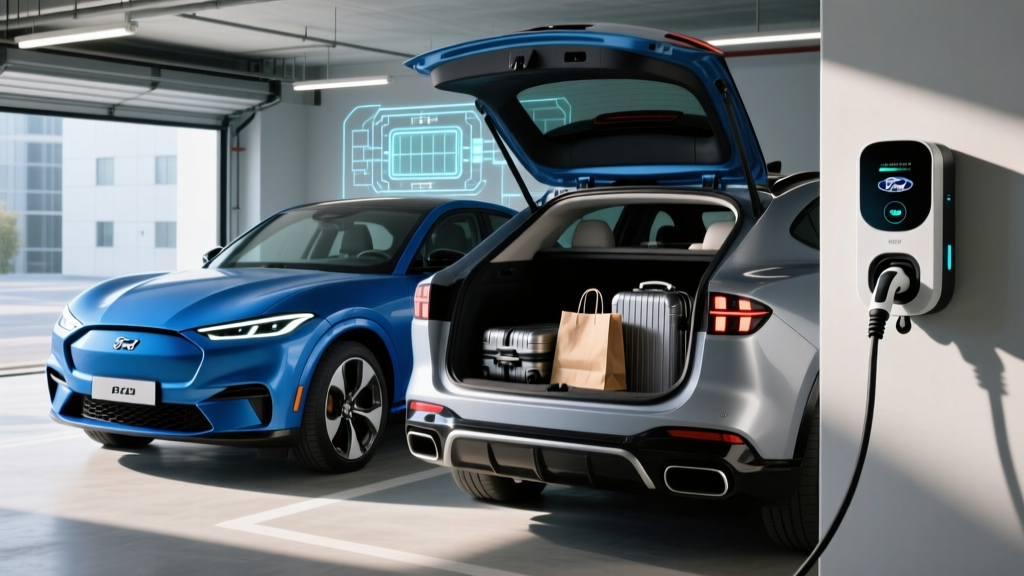
The Ford Mustang Mach-E enters the 2026 model year as one of the most established electric crossovers on the market, and buyers searching for Mustang Mach-E cargo space figures will find a competitive package: 29.7 cubic feet behind the rear seats and 59.7 cubic feet with the 60/40 split folded flat. Add a 4.7-cubic-foot front trunk (frunk) with a drain plug, and the Mach-E delivers genuine utility for a midsize electric SUV — enough for a week of groceries, two large suitcases, or a full set of golf clubs with room to spare.
But cargo volume is only part of the ownership equation. This review covers the full spec sheet — EPA range, real-world highway and cold-weather expectations, DC fast-charging curves, battery chemistry, pricing across all trims, and federal tax-credit eligibility under current IRS §30D rules — so you can decide whether the Mach-E earns a spot in your driveway.
Mustang Mach-E Cargo Space & Interior Dimensions
Ford designed the Mach-E on its dedicated Global Electrified Platform (GE1), which pushes the wheels to the corners and frees up cabin volume that rivals gas-powered midsize SUVs. Here is how the numbers break down:
| Measurement | Specification |
|---|---|
| Cargo volume (rear seats up) | 29.7 cu ft |
| Cargo volume (rear seats folded) | 59.7 cu ft |
| Front trunk (frunk) | 4.7 cu ft (drainable, lockable) |
| Total max cargo | 64.4 cu ft |
| Front headroom | 40.4 in |
| Rear headroom | 38.9 in |
| Front legroom | 43.3 in |
| Rear legroom | 38.1 in |
| Passenger volume (total) | 104.5 cu ft |
The 29.7 cu ft behind the second row outpaces the Hyundai Ioniq 5 (27.2 cu ft) and sits close to the Tesla Model Y's rear area (roughly 30.2 cu ft behind the second row, though the Model Y's optional third row compresses that figure). The Mach-E's frunk is smaller than the F-150 Lightning's massive front box, but its drainable design makes it useful for wet gear, ice, or tailgate coolers.
A hands-free power liftgate is standard on Premium and GT trims, and the cargo floor sits flat when the rear seats fold — no load lip to fight when sliding in heavy items. Ford includes a reversible cargo mat on higher trims, and the 60/40 split allows long items like skis or lumber to extend through while one rear passenger seat remains upright.
EPA Range, Battery Chemistry & Real-World Expectations
The 2026 Mach-E is offered with two lithium-ion NMC (nickel-manganese-cobalt) battery packs. Ford rates them as follows:
| Battery Pack | Usable Capacity | Drivetrain | EPA Range | EPA Efficiency |
|---|---|---|---|---|
| Standard Range | 72 kWh (NMC) | RWD | 250 mi | 101 MPGe (33 kWh/100 mi) |
| Standard Range | 72 kWh (NMC) | AWD (eAWD) | 230 mi | 93 MPGe (36 kWh/100 mi) |
| Extended Range | 91 kWh (NMC) | RWD | 320 mi | 103 MPGe (33 kWh/100 mi) |
| Extended Range | 91 kWh (NMC) | AWD (eAWD) | 290 mi | 95 MPGe (35 kWh/100 mi) |
| GT Extended Range | 91 kWh (NMC) | AWD (dual-motor) | 280 mi | 88 MPGe (38 kWh/100 mi) |
The EPA's 320-mile Extended Range RWD figure assumes a mixed city/highway cycle at moderate temperatures. In sustained 70-mph highway driving, expect roughly 270–285 miles before the low-battery warning. In cold weather (below 30°F), cabin heating and battery thermal management can reduce usable range by 20–30%, bringing a 320-mi rated pack down to approximately 225–255 miles. Preconditioning the battery while plugged in mitigates some of this loss and is essential before DC fast charging in winter.
Ford does not currently offer an LFP (lithium iron phosphate) pack in the Mach-E lineup, meaning all trims use NMC chemistry. NMC provides higher energy density — critical for maximizing range in a crossover footprint — but requires more careful charge management. Ford recommends setting a daily charge limit of 80–90% for NMC batteries and only charging to 100% before long trips to minimize long-term degradation.
Charging Speed: DC Fast, Level 2 & Home Setup
Charging speed is where Mach-E buyers need to understand the difference between kW (power — the rate of energy transfer) and kWh (energy — the battery's total capacity). The Mach-E's peak DC fast-charge rate tells you how quickly it can accept energy, but the charge curve tapers significantly above 80% state of charge.
| Charging Level | Power / Rate | Time / Speed |
|---|---|---|
| DC Fast Charge (Extended Range) | Peak 150 kW | 10–80% in ~38 minutes |
| DC Fast Charge (Standard Range) | Peak 115 kW | 10–80% in ~36 minutes |
| Level 2 Home (240V, 48A) | 10.5 kW | ~30 miles of range per hour; full charge in ~9–10 hours (Extended Range) |
| Level 2 Home (240V, 32A) | 7.7 kW | ~22 miles of range per hour; full charge in ~12–13 hours |
| Level 1 (120V, 12A) | 1.4 kW | ~3–4 miles of range per hour |
The Mach-E uses the CCS1 connector for DC fast charging and the J1772 connector for Level 2 AC charging. Ford provides access to the BlueOval Charge Network, which aggregates public chargers from Electrify America, EVgo, and ChargePoint through the FordPass app. Electrify America stations are the most common source of 150 kW+ charging for Mach-E owners on road trips.
At home, the Ford Mobile Power Cord (included) can deliver up to 32A on a 240V NEMA 14-50 outlet, but for the full 48A / 10.5 kW rate, you will need a hardwired Level 2 station such as the ChargePoint Home Flex or Ford Connected Charge Station installed on a dedicated 60A circuit. Budget $500–$1,500 for a quality Level 2 charger and $800–$2,500 for professional electrical installation depending on your panel capacity and conduit run distance. A 200A electrical panel is typically sufficient; older homes with 100A service may require a panel upgrade ($1,500–$3,000).
Performance: 0-60, Horsepower & Drivetrain Options
| Trim | Drivetrain | Horsepower | Torque (lb-ft) | 0–60 mph |
|---|---|---|---|---|
| Select / Premium (SR RWD) | Rear-Wheel Drive | 266 hp | 317 | 6.1 sec |
| Select / Premium (SR eAWD) | Dual-Motor AWD | 312 hp | 428 | 5.1 sec |
| Premium (ER RWD) | Rear-Wheel Drive | 290 hp | 317 | 5.8 sec |
| Premium (ER eAWD) | Dual-Motor AWD | 365 hp | 428 | 4.8 sec |
| GT (ER AWD) | Dual-Motor AWD | 480 hp | 634 | 3.8 sec |
| GT Performance Upgrade | Dual-Motor AWD | 480 hp | 700 | 3.5 sec |
The GT with the Performance Upgrade (formerly the GT Performance Edition) delivers a 3.5-second 0–60 mph time that genuinely rivals a Porsche Macan GTS and embarrasses most gas-powered SUVs at this price point. The standard eAWD models offer confident passing power and all-weather traction without the GT's energy consumption penalty. All trims feature a single-speed reduction gear — there is no multi-speed transmission to maintain.
Pricing, Trims & Federal Tax Credit Eligibility
| Trim | Base MSRP | Est. As-Tested | §30D Credit Eligibility |
|---|---|---|---|
| Select SR RWD | $42,995 | $44,500 | Eligible (up to $7,500) |
| Select SR eAWD | $45,995 | $47,500 | Eligible (up to $7,500) |
| Premium ER RWD | $48,995 | $52,000 | Eligible (up to $7,500) |
| Premium ER eAWD | $51,995 | $55,500 | Eligible (up to $7,500) |
| GT ER AWD | $59,995 | $64,000 | Eligible (up to $7,500) |
- MSRP cap: SUVs/vans/pickups must have an MSRP at or below $80,000. All Mach-E trims qualify.
- Buyer income cap: Modified AGI must not exceed $150,000 (single), $225,000 (head of household), or $300,000 (married filing jointly).
- Battery sourcing: The full $7,500 requires meeting both critical-mineral and battery-component sourcing thresholds, which phase up annually. The Mach-E has historically qualified for the full credit, but verify current-year battery-component compliance on the IRS clean vehicle list before purchasing.
- Point-of-sale transfer: Buyers can elect to transfer the credit to the dealer at purchase, reducing the out-of-pocket price immediately rather than waiting for a tax refund.
- VIN registration: The dealer must report the sale and VIN to the IRS energy credits portal at the time of purchase.
Source: IRS.gov — Credits for New Clean Vehicles. Eligibility rules are subject to change. Consult a tax professional for your specific situation.
With the full $7,500 credit applied at point of sale, a Select SR RWD drops to an effective price of approximately $35,495 — competitive with well-equipped gas crossovers once you factor in fuel and maintenance savings over time. Ford also periodically offers lease incentives that can stack with manufacturer rebates, though leased vehicles fall under a different credit section (§45W commercial clean vehicle credit) and the lessor captures the federal credit, sometimes passing savings through as a capitalized-cost reduction.
Tech, Driver Assistance & the SYNC 4A Experience
The Mach-E's centerpiece is a vertically oriented 15.5-inch touchscreen running Ford's SYNC 4A system. Wireless Apple CarPlay and Android Auto are standard, and the interface supports over-the-air (OTA) updates that Ford has used to add features post-purchase — including BlueCruise hands-free driving zones and efficiency optimizations.
BlueCruise is Ford's SAE Level 2 driver-assistance system, which allows hands-off driving on pre-mapped divided highways (over 130,000 miles of qualified roads in the US and Canada). A driver-facing infrared camera monitors your eyes to confirm attention. BlueCruise is not autonomous driving — you must remain ready to take over at any time, and the system will disengage if you look away for too long. A 90-day trial is included; after that, a subscription costs approximately $75/month or $800/year.
BlueCruise is an SAE Level 2 system. The driver is always responsible for steering input readiness, braking, and situational awareness. It does not handle construction zones, unmapped roads, or adverse weather autonomously. No production consumer vehicle currently sold is Level 4 or Level 5 self-driving.
Standard driver-assist features under the Ford Co-Pilot360 2.0 umbrella include automatic emergency braking with pedestrian detection, blind-spot monitoring with cross-traffic alert, lane-keeping assist, rear parking sensors, and evasive steering assist. A 360-degree camera and Active Park Assist 2.0 (hands-free parallel/perpendicular parking) are available on Premium and GT trims.
Notable tech drawbacks: the Mach-E lacks a traditional instrument cluster, relying instead on a small 10.2-inch digital screen mounted high on the dash. Some drivers find this less glanceable than a conventional cluster. Physical buttons are minimal — even the glovebox opens through the touchscreen, which frustrates some owners.
Warranty, Battery Longevity & Ownership Costs
| Coverage Type | Term |
|---|---|
| Basic (bumper-to-bumper) | 3 years / 36,000 miles |
| Powertrain | 5 years / 60,000 miles |
| Battery & Electric Components | 8 years / 100,000 miles (retains ≥70% capacity) |
| Corrosion perforation | 5 years / unlimited miles |
| Roadside assistance | 5 years / 60,000 miles |
The 8-year / 100,000-mile battery warranty guarantees that the high-voltage pack will retain at least 70% of its original capacity. Independent data from fleet operators and high-mileage Mach-E owners suggests NMC degradation of approximately 5–8% over the first 100,000 miles under normal use — well within the warranty threshold. A full battery replacement outside of warranty currently costs in the range of $14,000–$18,000 including labor, though this figure is expected to decline as battery costs continue their long-term downward trend.
Ownership cost advantages over gas equivalents include zero oil changes, no spark plugs, significantly reduced brake wear (regenerative braking handles most deceleration), and electricity costs of roughly $0.04–$0.06 per mile at residential rates compared to $0.12–$0.16 per mile for a 25-MPG gas SUV at $3.50/gallon. Insurance premiums for the Mach-E run 10–20% higher than comparable gas crossovers, according to industry averages — a factor worth quoting before purchase.
Who the Mustang Mach-E Suits Best
- You need a daily-driver EV with legitimate cargo room (29.7 cu ft rear / 59.7 cu ft total) for family gear, road-trip luggage, or home-improvement runs.
- You want performance options ranging from efficient commuting (RWD, 320 mi EPA) to sports-car acceleration (GT, 3.5 sec 0–60).
- You value BlueCruise hands-free highway driving for frequent long-distance commutes.
- You have access to home Level 2 charging and want a proven platform with OTA update capability.
- You need three rows of seating (consider the Kia EV9 or Rivian R1S).
- You require maximum towing — the Mach-E is rated for only 2,200 lbs (with the trailer tow package on eAWD trims).
- You want an LFP battery for daily 100% charging without degradation concerns (consider the Tesla Model Y Standard Range or base Rivian configurations).
- You prioritize the fastest DC charging — the Mach-E's 150 kW peak trails the Hyundai Ioniq 5's 240 kW capability.
- 29.7 / 59.7 cu ft cargo space with a usable 4.7 cu ft frunk
- Up to 320 mi EPA range (Extended Range RWD)
- GT trim delivers 3.5-sec 0–60 — genuine performance SUV territory
- BlueCruise hands-free driving on 130,000+ miles of highway
- All trims qualify for the full $7,500 federal tax credit (subject to buyer income & sourcing rules)
- OTA updates have added real features post-purchase
- 150 kW peak DC charging is slower than Hyundai/Kia E-GMP rivals (240 kW)
- NMC chemistry means Ford recommends 80–90% daily charge limits
- No physical buttons — even the glovebox is touchscreen-operated
- 2,200-lb towing capacity trails many gas and electric competitors
- BlueCruise requires a paid subscription after the 90-day trial
- Insurance premiums run 10–20% higher than gas equivalents
Frequently Asked Questions
What is the real-world range of the Mustang Mach-E?
The EPA rates the Extended Range RWD at 320 miles, but in sustained 70-mph highway driving expect 270–285 miles. In freezing temperatures (below 30°F), range can drop 20–30% to roughly 225–255 miles due to cabin heating demands and battery thermal losses. Preconditioning while plugged in recovers some of that deficit.
How fast does the Mach-E charge at home and on the road?
On a 150 kW DC fast charger, the Extended Range pack charges from 10–80% in approximately 38 minutes. At home on a 48A Level 2 station (10.5 kW), you gain roughly 30 miles of range per hour, with a full charge taking about 9–10 hours for the Extended Range battery. On a standard 120V outlet (Level 1), expect only 3–4 miles per hour — useful for overnight top-ups but not for primary charging.
How much does the Mustang Mach-E cost after tax credits?
The base Select SR RWD starts at $42,995 MSRP. With the full $7,500 federal tax credit applied at point of sale, the effective price drops to approximately $35,495. Higher trims like the Premium ER eAWD ($51,995) come in around $44,495 after the credit. Eligibility depends on your income, the vehicle's battery-sourcing compliance, and the $80,000 MSRP cap — all of which the Mach-E satisfies. Verify current-year sourcing compliance at fueleconomy.gov.
Does the Mustang Mach-E qualify for the federal EV tax credit?
Yes — all current Mach-E trims fall under the $80,000 MSRP cap for SUVs and have historically met the battery-component and critical-mineral sourcing requirements for the full $7,500 credit. However, buyer income must not exceed $150,000 (single) / $300,000 (married filing jointly), and sourcing rules tighten annually. Always confirm eligibility on the IRS clean vehicle credits page and with your tax professional before purchasing.
Is the Mustang Mach-E worth buying vs. the Tesla Model Y or Hyundai Ioniq 5?
The Mach-E trades blows with both. Versus the Model Y, it offers a more traditional SUV driving feel, physical door handles, Apple CarPlay (which Tesla lacks), and competitive cargo space — but the Model Y charges faster on its Supercharger network and offers slightly more range. Versus the Ioniq 5, the Mach-E has more cargo room (29.7 vs. 27.2 cu ft) and BlueCruise, but the Ioniq 5 charges significantly faster (240 kW peak vs. 150 kW). Your decision should weigh charging speed, cargo needs, driving dynamics, and which ecosystem (Ford BlueOval, Tesla Supercharger, or general CCS networks) fits your travel patterns.
How much cargo can the Mustang Mach-E actually hold?
With 29.7 cu ft behind the rear seats, the Mach-E accommodates roughly four carry-on suitcases or a full week of groceries for a family of four. Folding the 60/40 rear seat opens up 59.7 cu ft — enough for two mountain bikes with front wheels removed, or a large piece of furniture. The 4.7 cu ft frunk adds space for charging cables, a soft cooler, or wet items thanks to its drain plug.