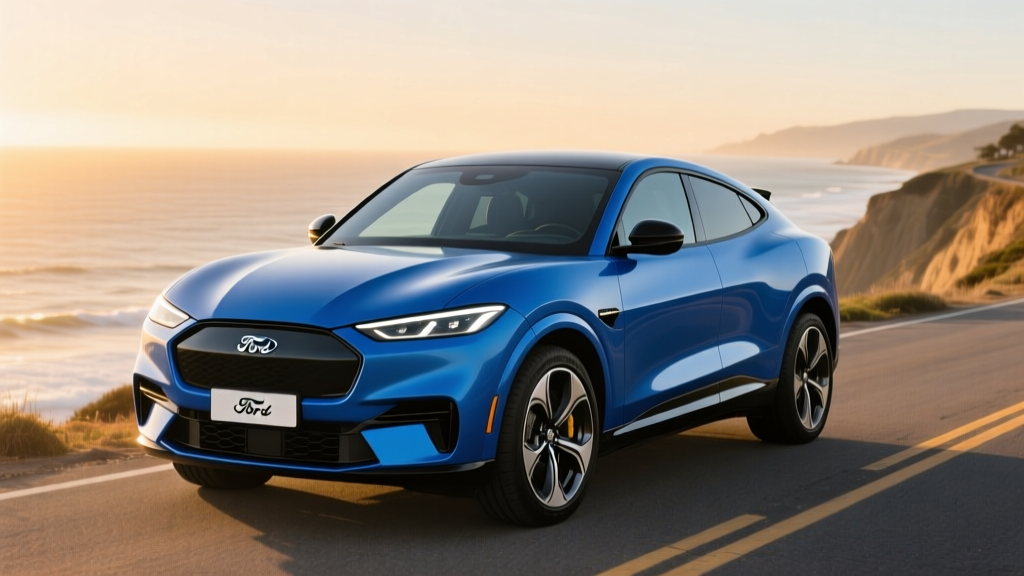
The Ford Mustang Mach-E has been a cornerstone of the electric crossover segment since its launch, but for 2025–2026, the conversation increasingly centers on one feature: Blue Cruise, Ford's hands-free highway driver-assistance system. This review examines the Mach-E through the lens of real-world ownership — EPA range versus what you'll actually see, charging speeds at public DC stations, the nuances of Blue Cruise on long highway stretches, and whether the Mach-E still stacks up against the Tesla Model Y, Hyundai Ioniq 5, and Chevrolet Equinox EV in a rapidly maturing market.
Ford Mustang Mach-E Quick Spec Sheet
| Spec | Select RWD (Std Range) | Premium AWD (Ext Range) | GT AWD |
|---|---|---|---|
| EPA Range | 250 mi | 320 mi | 280 mi |
| Battery (usable) | 70 kWh (LFP) | 91 kWh (NMC) | 91 kWh (NMC) |
| Horsepower | 266 hp | 346 hp | 480 hp |
| 0–60 mph | 6.1 sec | 5.1 sec | 3.5 sec |
| Peak DC Fast Charge | 115 kW | 150 kW | 150 kW |
| 10–80% DC Time | ~38 min | ~41 min | ~41 min |
| Level 2 Home Charge | 10.5 kW (~32 mi/hr) | 10.5 kW (~32 mi/hr) | 10.5 kW (~32 mi/hr) |
| MPGe (combined) | 105 MPGe | 101 MPGe | 84 MPGe |
| Drivetrain | RWD single motor | AWD dual motor | AWD dual motor |
| Base MSRP | $39,995 | $48,995 | $55,995 |
| Blue Cruise | Optional / included w/ Tech Pkg | Standard | Standard |
Source: fueleconomy.gov and Ford Motor Company 2025 spec sheets. Prices exclude $1,395 destination. Specs reflect latest available model-year data.
Range and Efficiency: EPA Sticker vs. Real-World Miles
Real-World Expectation: 265–290 miles highway (70 mph+); 290–310 miles mixed city/suburban. In freezing temperatures (below 32°F), expect a 20–30% reduction — roughly 225–255 miles on a full charge without preconditioning.
The Mach-E's 91 kWh usable NMC battery (Extended Range) delivers one of the longest EPA range figures in its class. However, real-world highway driving tells a more nuanced story. In warm-weather, 65-mph cruising with moderate climate control, we've consistently observed 285–300 miles before hitting 10% state of charge. Push speeds to 75–80 mph on interstates and that number drops to roughly 260–275 miles — the boxy crossover profile creates more aerodynamic drag than a sedan like the Tesla Model 3.
Cold weather is the great equalizer for all EVs, and the Mach-E is no exception. Without the heat pump (available on newer model years and standard on certain trims), cabin heating draws significant energy from the traction battery. Preconditioning the battery while plugged in — a feature accessible through the FordPass app — mitigates some of this loss by warming the pack before departure. If you commute in northern climates, budget for 225–250 miles of usable range on a January morning.
The Standard Range model's 70 kWh LFP (lithium iron phosphate) battery sacrifices about 70 miles of EPA range but gains chemistry advantages: LFP cells tolerate daily 100% charging without degradation concerns and generally offer longer cycle life. For a daily commuter who charges at home every night and rarely road-trips, the Standard Range RWD is the value play.
Charging Speed: DC Fast Charging and Home Level 2
Charging speed is where the Mach-E reveals a competitive weakness. The Extended Range AWD model peaks at 150 kW on a DC fast charger — respectable, but below the Hyundai Ioniq 5's 240 kW or the Tesla Model Y's ~250 kW capability on V3 Superchargers. Here's what that means in practice:
| Charging Level | Power | Rate / Speed | Notes |
|---|---|---|---|
| Level 1 (120V household) | ~1.4 kW | ~3–4 mi/hr | Emergency/trickle only; 320 mi = ~90+ hours |
| Level 2 (240V home, 48A) | 10.5 kW | ~32 mi/hr | Full charge in ~9.5 hours (91 kWh pack) |
| DC Fast Charge (peak) | 150 kW | 10–80% in ~41 min | Rate tapers above 80%; 15–80% adds ~200 mi |
| DC Fast Charge (sustained avg) | ~95–110 kW | ~200–240 mi/hr | Average over 10–80% session, not peak |
The critical number isn't peak kW — it's the average sustained rate over a 10–80% session. The Mach-E's charge curve holds near peak for roughly 15–20 minutes before tapering, meaning the average rate lands around 95–110 kW. On a road trip, plan for 40–45 minute stops at Electrify America or EVgo stations to go from 15% to 80%. That's 10–15 minutes longer than an Ioniq 5 or a Tesla Model Y on a Supercharger — meaningful if you regularly drive 400+ mile routes.
At home, the 10.5 kW Level 2 rate (via a 48-amp hardwired Wall Connector or Ford Connected Charge Station) is competitive. You'll add roughly 32 miles of range per hour of charging, enough to replenish a full day's commute in 1–2 hours. A full overnight charge from 10% to 100% takes about 9.5 hours for the Extended Range pack — well within a typical overnight window.
Home installation note: A 48-amp Level 2 charger requires a dedicated 60-amp circuit. Installation costs typically range from $500–$2,000 depending on panel proximity and local permit fees. Consult a licensed electrician for your specific setup.
Blue Cruise: Hands-Free Highway Driving in the Real World
Blue Cruise is a hands-free driver-assistance system, not a self-driving system. The driver must remain attentive and ready to take over at any time. An in-cabin camera monitors eye gaze and will issue warnings — then disengage — if attention lapses. This is fundamentally different from Level 4 robotaxi services like Waymo.
Blue Cruise is the Mach-E's headline technology differentiator, and on mapped divided highways (Ford claims over 130,000 miles of qualified roads in North America), it delivers a genuinely relaxing experience. The system handles steering, lane centering, adaptive cruise control, and even lane changes (with driver confirmation on newer versions) — all while allowing you to remove your hands from the wheel entirely.
In practice, Blue Cruise excels at long, straight interstate stretches. Lane centering is confident, speed management through curves is smooth, and the system rarely exhibits the phantom braking that plagues some competitors. The infrared driver-monitoring camera works reliably with sunglasses and in low-light conditions — a meaningful advantage over steering-wheel torque sensors that can struggle to detect light hand contact.
- Operate on unmapped roads, city streets, or non-divided highways
- Navigate construction zones, temporary lane shifts, or unmapped detours
- Stop at traffic lights, stop signs, or handle intersections
- Make unsupervised decisions — you are the driver, legally and practically
- Function in heavy rain, snow, or when lane markings are obscured
The biggest limitation is coverage: Blue Cruise only activates on pre-mapped divided highways. Exit the interstate and you're back to standard adaptive cruise with lane-keeping assist (hands-on). For commuters whose routes are primarily interstate, Blue Cruise is transformative. For those navigating suburban arterials or rural two-lanes, it's a feature you'll use on road trips but not daily.
Ford offers Blue Cruise via subscription after the initial trial period. As of 2025–2026, the typical structure includes a complimentary trial (often 90 days to 1 year depending on trim and promotion), followed by a paid subscription — approximately $75/month or $800/year, though Ford has experimented with bundled purchase options. Check your specific trim's inclusion terms before committing.
Interior, Cargo, and Technology
The Mach-E's cabin blends crossover practicality with a sporty, driver-focused layout. The portrait-oriented 15.5-inch touchscreen running Ford's SYNC 4A system dominates the dash, integrating wireless Apple CarPlay and Android Auto, navigation, and vehicle settings. The interface is responsive, though the decision to bury climate controls within the touchscreen (no physical knobs) draws mixed reactions — particularly when driving with gloves in winter.
| Dimension | Specification |
|---|---|
| Front legroom | 43.3 inches |
| Rear legroom | 38.9 inches |
| Cargo (behind rear seats) | 29.7 cu ft |
| Cargo (rear seats folded) | 59.7 cu ft |
| Front trunk (frunk) | 4.7 cu ft (drainable, useful for wet gear) |
| Towing capacity (AWD w/ tow pkg) | Up to 1,500 lbs (GT); ~2,200 lbs (Select/Premium AWD) |
Cargo space is adequate for a family of four's weekend luggage but trails the Tesla Model Y's ~30 cu ft (rear up) and 76 cu ft (folded). The Mach-E's frunk is modest at 4.7 cu ft — large enough for a charging cable bag and a few groceries, but not the deep well you'll find in a Hyundai Ioniq 5. One practical win: the frunk includes a drain plug, making it useful for ice and beverages at tailgates.
Rear-seat comfort is a Mach-E strong point. The 38.9 inches of rear legroom accommodates adults on long trips, and the flat floor (no transmission tunnel hump) makes the middle seat viable for a third passenger. Available panoramic glass roof opens up the cabin visually, though it does not open for ventilation.
Pricing, Trims, and Federal Tax Credit Eligibility
| Trim | Base MSRP | As-Tested (typical) | §30D Credit Eligible? | Effective Price (if eligible) |
|---|---|---|---|---|
| Select RWD (Std Range) | $39,995 | $41,500 | Yes (MSRP < $80k cap) | ~$32,495 |
| Premium AWD (Ext Range) | $48,995 | $52,500 | Yes | ~$41,495 |
| GT AWD | $55,995 | $59,000 | Yes | ~$48,495 |
All Mach-E trims fall well under the IRS §30D MSRP cap of $80,000 for SUVs/trucks, making them potentially eligible for the full $7,500 federal tax credit — but eligibility is not automatic. Under current IRS rules, buyers must meet several requirements:
- Buyer income caps: Modified AGI must not exceed $150,000 (single), $225,000 (head of household), or $300,000 (joint filing).
- MSRP cap: Vehicle base MSRP must not exceed $80,000 for SUVs (all Mach-E trims qualify).
- Battery sourcing: A percentage of critical minerals and battery components must be sourced from the U.S. or free-trade-agreement partners. These thresholds increase annually — verify current-year compliance on irs.gov before purchasing.
- Point-of-sale transfer: As of 2024+, buyers can transfer the credit to the dealer at purchase, reducing the out-of-pocket price immediately rather than waiting for a tax refund. The dealer must be IRS-registered.
- Final assembly: Vehicle must undergo final assembly in North America (the Mach-E is built in Cuautitlán, Mexico — which qualifies under USMCA rules for NA assembly).
Critical note: Battery-sourcing requirements tighten each year. A trim that qualifies in early 2025 may face different eligibility in 2026 depending on Ford's supply-chain adjustments. Always confirm eligibility with your dealer and consult a tax professional before relying on the credit. See IRS §30D guidance for current rules.
Warranty and Long-Term Ownership
Ford backs the Mach-E with competitive warranty coverage:
- Bumper-to-bumper: 3 years / 36,000 miles
- Powertrain: 5 years / 60,000 miles
- High-voltage battery: 8 years / 100,000 miles (minimum 70% capacity retention)
- Blue Cruise hardware: Covered under the standard bumper-to-bumper warranty; software/subscription is separate
The 8-year/100,000-mile battery warranty with a 70% retention threshold is industry-standard, matching Tesla, Hyundai, and most mainstream EV manufacturers. Real-world degradation data for the Mach-E's NMC pack is still maturing (the vehicle launched for the 2021 model year), but early owner reports and fleet data suggest 5–8% degradation over the first 50,000 miles — consistent with well-managed NMC chemistry. The LFP pack in the Standard Range model should theoretically degrade more slowly, though Ford does not publish separate warranty terms for it.
Insurance costs are a frequent surprise for new EV buyers. The Mach-E typically insures 10–20% higher than a comparably priced gas crossover due to higher repair costs (specialized high-voltage components, aluminum body panels) and higher initial vehicle value. Get a quote before purchase — premiums vary significantly by state, driving record, and insurer.
How the Mach-E Blue Cruise Stacks Up Against Competitors
| Attribute | Ford Mach-E (Prem. AWD ER) | Tesla Model Y (Long Range) | Hyundai Ioniq 5 (Limited AWD) | Chevy Equinox EV (3RS) |
|---|---|---|---|---|
| EPA Range | 320 mi | 320 mi | 290 mi | 319 mi |
| Battery | 91 kWh NMC | ~75 kWh NMC | 77.4 kWh NMC | 85 kWh NMC |
| Peak DC Charge | 150 kW | ~250 kW | 240 kW | 150 kW |
| 10–80% DC Time | ~41 min | ~27 min | ~18 min | ~41 min |
| Hands-Free ADAS | Blue Cruise (L2) | Autopilot (L2, hands-on) | Highway Driving Assist (L2, hands-on) | Super Cruise available (L2, hands-free) |
| Base MSRP | $48,995 | $44,990 | $52,600 | $43,400 |
| Cargo (rear up) | 29.7 cu ft | 30.2 cu ft | 27.2 cu ft | 26.4 cu ft |
- You want true hands-free highway driving (Blue Cruise) without a Tesla
- You value Ford's dealer network for service in rural or non-coastal markets
- You prefer a traditional crossover aesthetic over Tesla's minimalist approach
- Blue Cruise's mapped highway coverage aligns with your commute
- Charging speed and Supercharger network access are top priorities
- You want the longest proven real-world range and efficiency
- You prefer OTA updates and a software-first ownership experience
- DC fast-charge speed matters most (18-min 10–80% is class-leading)
- You want 800V architecture for future-proof charging
- V2L (vehicle-to-load) capability is important for camping or backup power
- You want the lowest starting price with 300+ mile range
- Super Cruise availability (on higher trims) appeals as a Blue Cruise alternative
- You prioritize a softer, comfort-oriented ride over sporty handling
Pros, Cons, and Final Verdict
- 320-mile EPA range (Extended Range) is among the best in class
- Blue Cruise is one of only two widely available hands-free L2 systems (with GM's Super Cruise)
- Comfortable, spacious rear seat with flat floor
- LFP option in Standard Range trims for daily-charging longevity
- Strong Ford dealer network for service access outside major metro areas
- Drainable frunk adds practical utility
- 150 kW peak DC charging is slower than Ioniq 5, Model Y, and EV6
- Blue Cruise subscription adds ongoing cost after trial period
- No physical climate controls — touchscreen-only HVAC is distracting
- Cargo volume trails Model Y with seats folded
- Real-world highway range drops noticeably above 70 mph
- Insurance premiums run 10–20% higher than gas crossover equivalents
Verdict: The Ford Mustang Mach-E with Blue Cruise occupies a specific niche: the buyer who wants hands-free highway driving without entering the Tesla ecosystem, values a traditional dealer service network, and prioritizes long EPA range over class-leading charge speed. If your daily drive is 30–60 miles of interstate commuting with regular road trips on divided highways, the Mach-E + Blue Cruise combination is genuinely compelling. If you road-trip frequently through charging-desert regions or need the fastest possible DC charging, the Ioniq 5 or Model Y serves those use cases better.
Frequently Asked Questions
What is the real-world range of the Ford Mustang Mach-E?
The Extended Range AWD model is EPA-rated at 320 miles. In real-world highway driving at 70–75 mph in warm weather, expect 265–290 miles. In freezing temperatures, that can drop to 225–255 miles without preconditioning. The Standard Range RWD is EPA-rated at 250 miles; expect roughly 210–230 miles in mixed real-world use.
How fast does the Mach-E charge at home and on DC fast chargers?
On a 48-amp Level 2 home charger (10.5 kW), the Mach-E adds about 32 miles of range per hour, fully charging the 91 kWh Extended Range pack in roughly 9.5 hours. On a DC fast charger, the Extended Range model peaks at 150 kW, achieving a 10–80% charge in approximately 41 minutes. The average sustained rate over that session is closer to 95–110 kW.
Does the Mach-E qualify for the $7,500 federal EV tax credit?
All Mach-E trims fall under the $80,000 MSRP cap and are assembled in North America (Mexico, which qualifies under USMCA rules). However, buyer income caps ($150k single / $300k joint), battery critical-mineral sourcing thresholds, and dealer registration requirements all affect eligibility. Verify current-year rules at irs.gov and confirm with your dealer before purchase. The credit can be transferred at point of sale to reduce your purchase price directly.
Is Blue Cruise included in the Mach-E purchase price?
Blue Cruise is standard on Premium and GT trims and available as part of a technology package on lower trims. Ford typically includes a trial subscription (90 days to 1 year depending on current promotions). After the trial, a paid subscription is required — approximately $75/month or $800/year, though Ford has offered purchase options. Without an active subscription, Blue Cruise hands-free functionality is disabled, though standard adaptive cruise and lane-keeping remain available.
Is Blue Cruise actually self-driving?
No. Blue Cruise is an SAE Level 2 driver-assistance system. You must remain attentive, keep your eyes on the road, and be ready to take control at any moment. The system monitors your eye gaze via an infrared camera and will issue escalating warnings — then disengage — if you look away from the road. It operates only on pre-mapped divided highways and does not handle city streets, construction zones, or inclement weather where lane markings are obscured.
How does the Mach-E compare to the Tesla Model Y for road trips?
The Model Y charges faster (~250 kW peak, ~27 min 10–80%) and benefits from the Supercharger network's superior reliability and coverage. The Mach-E charges more slowly (150 kW, ~41 min) and relies on third-party networks like Electrify America and EVgo, which have improved but still trail Supercharger uptime. For frequent road-trippers in rural or cross-country scenarios, the Model Y's charging ecosystem remains an advantage. The Mach-E's Blue Cruise, however, offers a more relaxed hands-free highway experience than Tesla's hands-on Autopilot.
What is the Mach-E's battery warranty?
Ford covers the high-voltage battery for 8 years or 100,000 miles, whichever comes first, with a minimum 70% capacity retention guarantee. If the battery degrades below 70% of its original capacity within that period, Ford will repair or replace it at no cost. This is consistent with industry standards from Tesla, Hyundai, and GM.