Quick Verdict: The Mustang Mach-E in Black Remains a Practical Crossover EV
The Ford Mustang Mach-E has been one of the most recognizable electric crossovers since its debut, and the 2026 model year brings incremental but meaningful updates to battery efficiency, infotainment responsiveness, and available BlueCruise hands-free zones. While the "Mustang" badge still sparks debate among pony-car loyalists, the Mach-E has carved out a loyal following among EV buyers who want a sporty silhouette without sacrificing daily usability.
This review focuses on the 2026 Mustang Mach-E lineup — available in Shadow Black, Star White, and six other exterior colors — with particular attention to how the black exterior package pairs with Ford's current EV technology. If you've been searching for a Mustang Mach-E in black, you're likely weighing its crossover practicality against rivals like the Tesla Model Y, Hyundai IONIQ 5, and Kia EV6. Here's every number that matters.
Range, Battery, and Real-World Efficiency
| Spec | Select RWD (Std Range) | Premium RWD (Ext Range) | GT AWD |
|---|---|---|---|
| EPA Range | 250 mi | 320 mi | 290 mi |
| Battery (usable) | 72 kWh (LFP) | 91 kWh (NMC) | 91 kWh (NMC) |
| MPGe (combined) | 101 MPGe | 98 MPGe | 86 MPGe |
| kWh/100 mi | 33 kWh | 34 kWh | 39 kWh |
| Drivetrain | RWD, single motor | RWD, single motor | AWD, dual motor |
| Horsepower | 266 hp | 290 hp | 480 hp |
| 0–60 mph | 6.1 sec | 5.8 sec | 3.5 sec |
The 2026 Mach-E's battery lineup uses two distinct chemistries. The Standard Range models use lithium iron phosphate (LFP) cells, which offer longer cycle life and tolerate regular 100% charging — ideal for daily commuters who charge at home every night. The Extended Range trims use nickel manganese cobalt (NMC) chemistry, which delivers higher energy density (more range in the same physical pack) but benefits from staying between 20–80% state of charge for daily use.
The EPA 320-mile figure on the Premium Extended Range RWD is achievable in mixed city/suburban driving at moderate temperatures. Expect ~260–280 miles on sustained highway trips at 70–75 mph, where aerodynamic drag reduces efficiency. In freezing weather (below 32°F), plan for 20–30% range reduction, bringing a fully charged Extended Range pack down to roughly 225–255 miles before needing a stop. The GT AWD's heavier dual-motor setup and stickier tires further reduce real-world range to approximately 230–250 miles in mixed driving.
According to fueleconomy.gov, the Mach-E Premium RWD posts 98 MPGe combined, which translates to roughly 34 kWh consumed per 100 miles driven. That's competitive with the IONIQ 5's efficiency but trails the Tesla Model Y Long Range's ~28 kWh/100 mi.
Charging Speed: DC Fast, Level 2, and Level 1
Charging speed is where many EV buyers get surprised by the gap between marketing claims and sustained reality. The Mach-E's peak DC fast-charge rate is 150 kW on Extended Range models and 115 kW on Standard Range models. However, peak rate only applies at the beginning of a charging session when the battery is warm and state of charge (SoC) is low.
| Charging Level | Power | Speed (miles added per hour) | Notes |
|---|---|---|---|
| Level 1 (120V household) | 1.4 kW | ~4 mi/hr | Emergency/trickle only; ~80 hours for full charge |
| Level 2 (240V home, 48A) | 11.5 kW | ~33 mi/hr | Full charge in ~8 hours (Extended Range) |
| DC Fast Charge (Std Range) | Peak 115 kW | ~250 mi/hr at peak | 10–80% in ~38 min; tapers sharply above 80% |
| DC Fast Charge (Ext Range) | Peak 150 kW | ~340 mi/hr at peak | 10–80% in ~30 min; tapers above 80% |
The 10–80% charging time of roughly 30 minutes for Extended Range models is respectable but not class-leading — the Hyundai IONIQ 5 and Kia EV6, with their 800V architectures, can hit 10–80% in approximately 18 minutes at a 350 kW charger. The Mach-E's 400V architecture limits its ceiling, and you'll see the charge curve taper noticeably past 60% SoC. On a road trip, plan your stops around 25–30 minutes each to stay in the fast-charging sweet spot.
For home charging, Ford includes the Ford Mobile Charger (a dual-voltage cord) with every Mach-E, but most buyers will want to install a dedicated Level 2 wall connector. A 48-amp hardwired unit on a 60-amp circuit delivers the full 11.5 kW, recovering roughly 33 miles of range per hour of charging. Expect a professional installation to cost between $500 and $2,000 depending on your electrical panel's capacity and the run distance from panel to garage.
Pricing, Trim Levels, and Federal Tax Credit Eligibility
| Trim | Base MSRP | Federal §30D Credit | Effective Price (if eligible) |
|---|---|---|---|
| Select (Std Range, RWD) | $39,995 | Up to $3,750 | ~$36,245 |
| Premium (Ext Range, RWD) | $48,495 | Up to $3,750 | ~$44,745 |
| Premium (Ext Range, AWD) | $51,495 | Up to $3,750 | ~$47,745 |
| GT (AWD) | $57,995 | Up to $3,750 | ~$54,245 |
| Rally (AWD) | $61,995 | Up to $3,750 | ~$58,245 |
The Mustang Mach-E qualifies for a partial federal tax credit of $3,750 under IRS §30D rules for the 2026 tax year. It does not currently qualify for the full $7,500 because its battery sourcing does not meet all critical-mineral requirements outlined by the IRS clean vehicle credit guidelines. Credit eligibility also depends on your income (modified AGI must not exceed $150,000 single / $300,000 joint) and the vehicle's MSRP staying under the $80,000 SUV cap — all Mach-E trims clear that threshold.
Since January 2024, buyers can transfer the credit to the dealer at the point of sale, effectively reducing the purchase price on the spot rather than waiting for a tax refund. Confirm eligibility with your dealer and tax professional before signing, as battery-sourcing compliance can shift with supply-chain changes.
Interior, Cargo, and Technology
The Mach-E's cabin is dominated by a 15.5-inch vertical touchscreen running Ford's SYNC 4A system with wireless Apple CarPlay and Android Auto. The rotary dial at the bottom of the screen provides physical volume control — a welcome compromise between full-touch and traditional buttons. A 10.2-inch digital instrument cluster sits behind the steering wheel.
The available BlueCruise hands-free driving system operates on over 130,000 miles of pre-mapped divided highways in the U.S. and Canada. It's important to understand that BlueCruise is an SAE Level 2 driver-assistance system, meaning the driver must remain attentive and ready to take over at any time — a driver-monitoring camera ensures compliance. This is fundamentally different from Level 4 robotaxi services like Waymo, which operate without a human driver in geofenced areas.
| Dimension | Measurement |
|---|---|
| Cargo (behind rear seats) | 29.7 cu ft |
| Cargo (rear seats folded) | 59.7 cu ft |
| Front trunk (frunk) | 4.7 cu ft (drainable, with washable liner) |
| Rear legroom | 38.1 in |
| Front headroom | 40.4 in |
| Towing capacity (AWD) | 1,500 lbs (with factory hitch) |
The drainable frunk is a standout feature — perfect for storing wet gear, ice for tailgating, or groceries that might leak. Rear legroom of 38.1 inches is generous for adults, and the flat floor (no transmission tunnel) makes the middle seat usable for short trips. Cargo capacity trails the Tesla Model Y's 76 cu ft maximum but beats the Hyundai IONIQ 5's 56 cu ft.
Pros and Cons at a Glance
Pros
- Distinctive styling — the fastback silhouette and sequential taillights stand out in a crossover segment dominated by boxy shapes
- BlueCruise availability — genuine hands-free highway driving on 130,000+ miles of mapped roads
- Drainable frunk — a practical feature competitors still lack
- LFP option on Select trim — longer cycle life and tolerance for daily 100% charging
- Competitive handling — low center of gravity and well-tuned suspension make it engaging on twisty roads
- Over-the-air updates — Ford continues adding features and refining performance post-purchase
Cons
- Charging speed lags 800V rivals — 150 kW peak means longer road-trip stops vs. IONIQ 5 or EV6
- Partial tax credit only — $3,750 instead of the full $7,500 due to battery sourcing
- Highway efficiency drops — real-world range falls notably on sustained 75 mph trips
- GT and Rally trims are expensive — pushing past $60,000 for performance you may rarely use
- No NACS port yet — Ford has announced future NACS adoption, but 2026 models still use CCS1 (Tesla Supercharger access via adapter)
- Rear visibility — the sloping roofline and thick C-pillars create blind spots; rely on cameras
How It Compares: Mach-E vs. Model Y vs. IONIQ 5
The Mach-E occupies a specific niche: sportier than the Model Y in handling, more traditionally styled than the IONIQ 5's retro-futurism, and priced in the middle. The Tesla Model Y Long Range AWD still leads in real-world highway efficiency and Supercharger network convenience, though Ford's CCS-to-NACS adapter grants Mach-E owners access to over 15,000 Supercharger stalls.
The Hyundai IONIQ 5 charges significantly faster (10–80% in ~18 minutes on a 350 kW station) and offers a slightly smoother ride, but its cargo area is smaller and its styling polarizes. If charging speed on road trips is your top priority, the IONIQ 5 or EV6 wins. If you want the most mature hands-free driving system on highways, the Mach-E with BlueCruise has an edge over Hyundai's more basic highway assist.
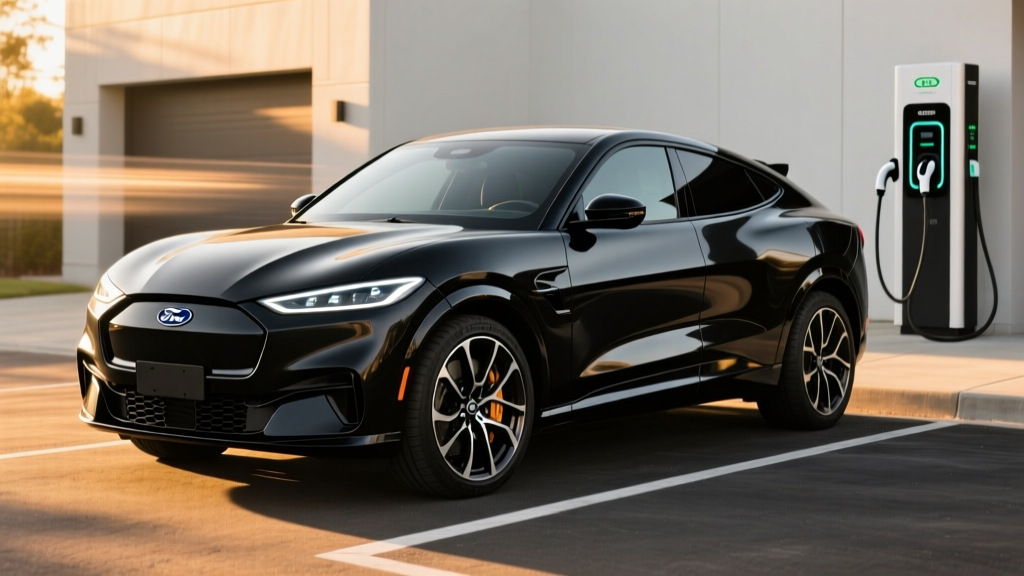
For buyers specifically searching for a Mustang Mach-E in black, the Shadow Black exterior paired with the available Black Appearance Package (black wheels, blacked-out badges, dark interior trim) creates the most aggressive visual in the lineup — and it tends to hold resale value slightly better than lighter colors in the used-EV market.
Warranty and Ownership Costs
Ford covers the Mach-E with a 3-year/36,000-mile bumper-to-bumper warranty and an 8-year/100,000-mile battery and powertrain warranty. The battery warranty guarantees that the pack will retain at least 70% of its original capacity over that period. Based on degradation data from earlier model years, Mach-E batteries are losing roughly 1–2% capacity per year under normal use, meaning most owners will see 85–90% state of health at the 8-year mark — well above the warranty threshold.
Insurance premiums for the Mach-E run 15–25% higher than comparable gas-powered crossovers, averaging $1,800–$2,400 annually depending on trim, location, and driving record. The GT model, with its 480 hp output, commands the highest premiums. Always get a personalized quote before purchasing.
Who Should Buy the 2026 Mustang Mach-E?
Choose the Mach-E Select (Standard Range, RWD) if: You commute under 60 miles daily, charge at home, and want the lowest entry price with LFP battery longevity. At ~$36,245 after the credit, it's a strong value.
Choose the Mach-E Premium (Extended Range, RWD) if: You take regular road trips of 200+ miles, want maximum range without paying for AWD performance, and value features like the panoramic roof and upgraded audio.
Choose the Mach-E GT if: You want sports-car acceleration (3.5 seconds to 60 mph) in a practical crossover and are willing to trade ~30 miles of range and higher insurance for the thrill.
Look elsewhere if: You regularly tow more than 1,500 lbs, live in an area with limited DC fast-charging infrastructure and need 800V charging speeds, or require the absolute lowest cost-per-mile — the Tesla Model Y still edges ahead on pure efficiency.
Frequently Asked Questions
What is the real-world range of the 2026 Mustang Mach-E?
The EPA rates the Extended Range RWD at 320 miles, but expect 260–280 miles on highway trips at 70–75 mph and 225–255 miles in freezing weather. The GT AWD delivers roughly 230–250 real-world miles in mixed driving.
How fast does the Mach-E charge at home and on the road?
At home on a 48-amp Level 2 charger, it adds about 33 miles per hour (full charge in ~8 hours). On a DC fast charger, the Extended Range model peaks at 150 kW and reaches 10–80% in approximately 30 minutes.
Does the 2026 Mustang Mach-E qualify for the full $7,500 federal tax credit?
No. The Mach-E qualifies for a partial credit of up to $3,750 under IRS §30D rules, as its battery sourcing does not meet all critical-mineral requirements. Buyer income caps ($150K single / $300K joint) and the $80,000 MSRP cap for SUVs also apply. Consult IRS guidelines and a tax professional.
Can I charge a Mustang Mach-E at Tesla Superchargers?
Yes, Ford provides a CCS-to-NACS adapter that allows Mach-E owners to access Tesla's Supercharger network. Ford has announced plans to transition to a native NACS port on future model years, but 2026 models ship with CCS1.
Is BlueCruise actually self-driving?
No. BlueCruise is an SAE Level 2 hands-free system that works on pre-mapped divided highways. The driver must remain attentive and ready to take over — a camera monitors your eyes. It is not autonomous driving.
Is the Mustang Mach-E in black worth the premium over other colors?
Shadow Black is a no-cost color option on most trims. The available Black Appearance Package (black wheels, badges, and trim) may carry a small upcharge but tends to hold resale value well and delivers the most aggressive look in the lineup.