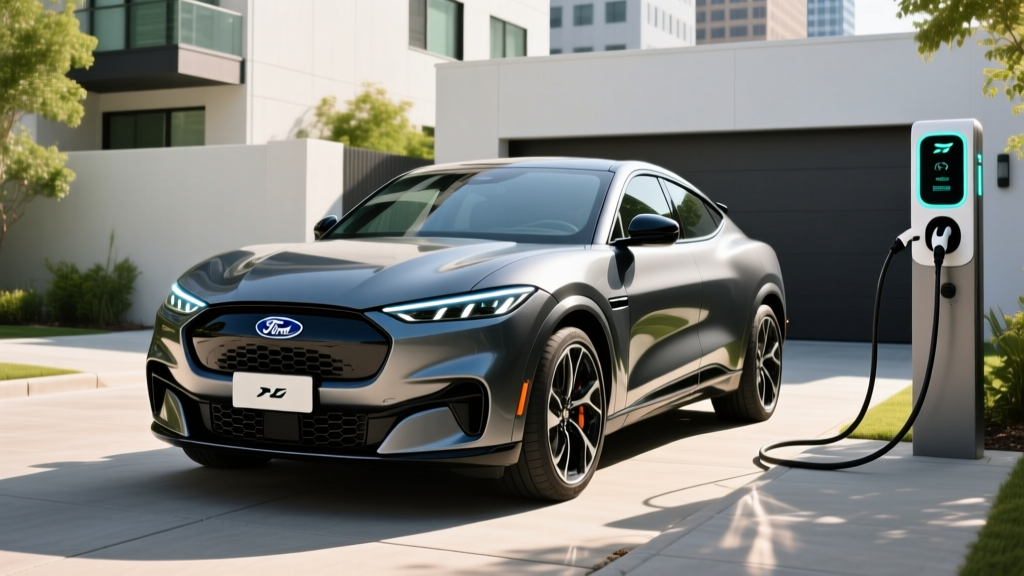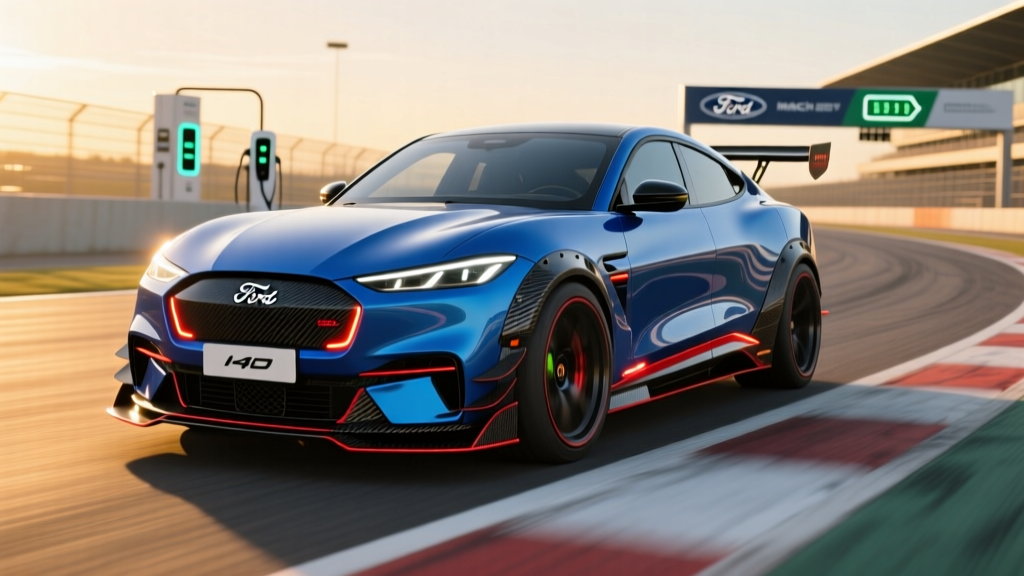
The Ford Mustang Mach-E 1400 is not an EV you can buy. Built as a one-off performance prototype in collaboration with RTR Vehicles, this seven-motor electric monster was designed to demonstrate the raw potential of electric powertrains on the drag strip and drift pad. With 1,400 horsepower, a purpose-built aerodynamic body, and a battery pack pushed far beyond production limits, the Mach-E 1400 exists as a technology showcase — not a showroom model. Here's everything you need to know about its specs, engineering, and what it means for the production Mach-E lineup you can actually purchase.
What Exactly Is the Mustang Mach-E 1400?
Unveiled in mid-2020 by Ford Performance and RTR Vehicles (led by drift champion Vaughn Gittin Jr.), the Mustang Mach-E 1400 is a single prototype built to answer a question: what happens when you stuff seven electric motors into a Mustang Mach-E body shell and turn the wick all the way up? The answer is 1,400 peak horsepower — roughly double what a Bugatti Chiron produces — delivered to all four wheels through a motorsport-grade drivetrain.
The project was never intended for production or sale. It served as a rolling laboratory for Ford's electric performance ambitions, testing thermal management, battery discharge rates, and motor control strategies under extreme conditions. If you're searching for a "Mustang Mach-E 1400 for sale," you won't find one — this car lives on the show circuit and in Ford's performance archive.
Powertrain: Seven Motors and 1,400 Horsepower
| Spec | Value |
|---|---|
| Total Motors | 7 (3 front, 4 rear) |
| Peak Output | 1,400 HP |
| Drivetrain | AWD (independent front/rear torque vectoring) |
| 0–60 mph (est.) | ~2.0 seconds (drag configuration) |
| Top Speed | Not officially published |
| Drive Modes | Drag, drift, road course (adjustable torque split) |
The motor configuration is the 1400's defining engineering feat. Three motors drive the front axle, while four handle the rear — a layout that allows granular torque vectoring at each corner. Ford Performance developed custom motor controllers capable of managing the staggering electrical current required to feed seven motors simultaneously. The system can shift torque front-to-rear and side-to-side, enabling everything from tire-shredding drifts to drag-strip launches.
For context, the production Mustang Mach-E GT uses a dual-motor AWD setup producing 480 HP (500 HP with the Performance Upgrade) — impressive for a family crossover, but a fraction of the 1400's output. The seven-motor architecture was never destined for a production vehicle; the thermal loads, cost, and packaging constraints make it impractical for daily driving.
Battery Pack: 75.7 kWh Pushed to the Limit
The Mach-E 1400 uses a 75.7 kWh usable battery pack built with nickel-manganese-cobalt (NMC) pouch cells — similar in chemistry to the extended-range pack found in early production Mach-E models, but configured for extreme discharge rates rather than energy density or longevity.
Ford equipped the prototype with an aggressive liquid thermal management system designed to keep cells within safe operating temperatures during repeated high-power runs. In a production EV, sustained maximum discharge would rapidly degrade the battery and trigger thermal protection limits. The 1400's cooling system is far more robust than any consumer EV, allowing short bursts of maximum power that would be unsustainable in a road car.
| Spec | Mach-E 1400 (Prototype) | 2025 Mach-E GT (Production) |
|---|---|---|
| Usable Capacity | 75.7 kWh | 91 kWh (Extended Range) |
| Chemistry | NMC (pouch cells) | NMC (pouch cells) |
| Thermal Mgmt | Motorsport-grade liquid | Active liquid cooling/heating |
| Peak Discharge | Extreme (short bursts) | ~350 kW sustained |
| Designed For | Track/demo runs | Daily driving + road trips |
It's worth noting that Ford has been transitioning some production Mach-E trims to lithium iron phosphate (LFP) battery chemistry for the standard-range pack, which offers greater cycle life and thermal stability at the cost of lower energy density. The 1400's NMC chemistry was chosen for its higher power density — exactly the opposite trade-off you'd want in a commuter vehicle.
Range, Charging, and Why EPA Numbers Don't Apply
Because the Mach-E 1400 is a prototype, it was never submitted for EPA testing. There is no official MPGe rating, no range sticker, and no meaningful efficiency figure. At 1,400 HP, the vehicle consumes electrical energy at a rate that would drain even a large battery pack in minutes under full throttle.
Charging specifications for the prototype were never formally published in the same way production EV specs are. The vehicle was designed to be charged between demonstration runs using whatever high-power equipment was available at Ford's test facilities or event venues. It does not represent a charging benchmark for consumers.
If you're evaluating the Mach-E platform for real-world ownership, the production models tell a very different story:
| Charging Level | Power | Speed |
|---|---|---|
| Level 1 (120V) | ~1.4 kW | ~3 mi/hr |
| Level 2 (240V, 48A) | 11.5 kW | ~27 mi/hr |
| DC Fast Charge (peak) | 150 kW | 10–80% in ~45 min |
The production Mach-E GT Extended Range AWD carries an EPA-estimated 290 miles of range. In real-world highway driving at 70+ mph, expect roughly 245–265 miles; in cold weather (below 30°F), that can drop to 210–230 miles due to battery resistance and cabin heating loads. These are the numbers that matter for actual buyers.
Aerodynamics and Chassis: Built for the Track
The 1400's bodywork shares little beyond silhouette with the production Mach-E. A massive front splitter, canards, rear diffuser, and an adjustable rear wing generate over 2,300 pounds of downforce at 160 mph. The chassis was reinforced with a roll cage, and the suspension uses motorsport-spec coilovers with adjustable damping.
Brembo brakes (borrowed from the Mustang GT350R program) handle deceleration, supplemented by aggressive regenerative braking from all seven motors. The interior was stripped and fitted with a racing seat, harness, and data-logging equipment — there's no 15.5-inch portrait touchscreen or B&O sound system here.
This level of aerodynamic and chassis modification underscores that the 1400 is a race car in EV clothing, not a production crossover with extra power.
What the Mach-E 1400 Means for Production Buyers
Ford used the 1400 prototype to validate motor control algorithms, thermal management strategies, and torque-vectoring concepts that eventually trickled into production vehicles. The dual-motor GT's responsive AWD system and the Mach-E Rally's off-road torque calibration both benefited from lessons learned during the 1400's development.
For the 2025–2026 model years, the production Mach-E lineup includes:
- Select (RWD/AWD): ~250–300 mi EPA range, from ~$42,995 MSRP
- Premium (RWD/AWD): ~290–320 mi EPA range, from ~$48,995 MSRP
- GT (AWD, dual-motor, 480–500 HP): ~290 mi EPA range, from ~$59,995 MSRP
- Rally (AWD, rally-tuned): ~265 mi EPA range, from ~$59,995 MSRP
All production Mach-E models come with Ford's 8-year/100,000-mile battery and powertrain warranty, covering defects and capacity loss below 70% of original capacity. The 1400 prototype carries no consumer warranty — it was never sold.
Federal Tax Credit Eligibility (Production Mach-E Only)
While the Mach-E 1400 is ineligible for any consumer incentive (it's not for sale), production Mach-E models may qualify for the IRS §30D federal tax credit of up to $7,500 — subject to strict eligibility requirements that change periodically:
- MSRP Cap: SUVs/crossovers must have an MSRP at or below $80,000 (all current Mach-E trims qualify)
- Buyer Income Cap: AGI must not exceed $150,000 (single), $225,000 (head of household), or $300,000 (joint)
- Battery Sourcing: Critical minerals and battery components must meet escalating domestic-sourcing thresholds — check the latest IRS guidance, as these requirements tighten annually
- Point-of-Sale Transfer: Eligible buyers can transfer the credit to the dealer at purchase, reducing the out-of-pocket price immediately
Not every Mach-E configuration qualifies for the full $7,500 in every tax year. Battery-sourcing compliance varies by build date and supply-chain changes. Always verify current eligibility on fueleconomy.gov and consult a tax professional before relying on the credit in your purchase decision.
Verdict: A Halo Car That Proves EV Potential
What the Mach-E 1400 Proves
- Electric motors can deliver supercar-beating power with instant torque
- Multi-motor torque vectoring enables handling dynamics impossible with ICE drivetrains
- Thermal management is the real bottleneck — not motor output
- Ford's EV engineering team can compete at the performance extreme
What It Doesn't Mean for Buyers
- You cannot buy this car or anything close to it from Ford
- 1,400 HP is irrelevant to daily driving practicality
- The 75.7 kWh pack at this power level offers minutes of runtime
- Production Mach-E models share only the basic platform architecture
The Mustang Mach-E 1400 succeeds brilliantly as a proof-of-concept. It demonstrated that electric powertrains can produce extraordinary power and that independent multi-motor control unlocks handling capabilities no mechanical differential can match. But for the EV shopper reading this, the relevant takeaway is that Ford's production Mach-E lineup — particularly the GT and Rally trims — channels some of this engineering DNA into practical, warrantied, tax-credit-eligible vehicles you can actually drive home.
Frequently Asked Questions
Can I buy the Mustang Mach-E 1400?
No. The Mach-E 1400 is a one-off prototype built by Ford Performance and RTR Vehicles. It was never produced for sale and has no MSRP, VIN-for-registration, or consumer warranty. Only one exists.
How much horsepower does the Mach-E 1400 make?
The Mach-E 1400 produces a peak output of 1,400 horsepower from its seven-motor configuration (3 front, 4 rear). This is roughly 2.8× the output of the production Mach-E GT.
What is the real-world range of the Mach-E 1400?
There is no EPA range rating. Under full-power track conditions, the 75.7 kWh battery would deplete in roughly 5–8 minutes. This vehicle was designed for short demonstration runs, not distance driving.
Does the production Mach-E GT share parts with the 1400?
They share the basic Global Electrified Platform (GE2) architecture and NMC battery chemistry concepts, but the 1400 uses entirely custom motors, controllers, cooling systems, bodywork, and suspension. No drivetrain components carry over to production.
Which production Mach-E should I consider instead?
If performance is your priority, the Mach-E GT (480–500 HP, 0–60 in ~3.5 sec, ~290 mi EPA range, from ~$59,995) is the closest production analog. For efficiency and value, the Premium Extended Range offers up to ~320 miles EPA at a lower price point. The Rally trim targets light off-road and mixed-surface driving with a unique suspension tune.
Does the production Mach-E qualify for the $7,500 federal tax credit?
It may, depending on your income, the specific trim's MSRP (all trims are under the $80,000 SUV cap), and current battery-sourcing compliance rules under IRS §30D. Eligibility changes as sourcing requirements tighten. Verify on fueleconomy.gov and with your tax advisor before purchasing.