The Quick Answer on Mullen EV
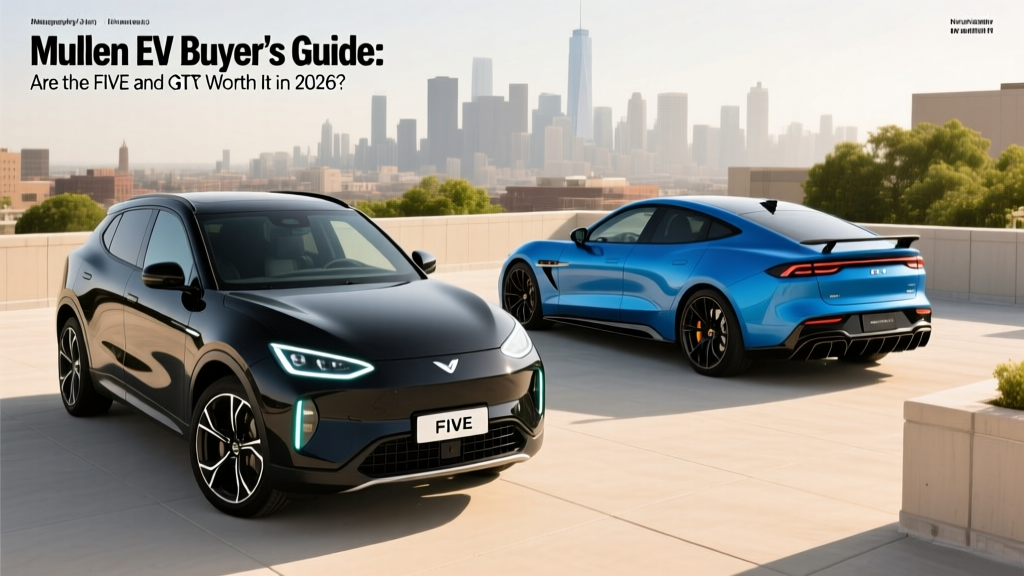
Mullen Automotive is a small California-based EV startup offering the Mullen FIVE (a compact crossover) and Mullen GTX (a performance SUV) primarily through a direct-to-consumer model. However, as of early 2026, Mullen has not yet achieved meaningful volume production or widespread customer deliveries. Prospective buyers should treat Mullen as a high-risk, early-stage brand — similar to where Fisker, Lordstown, or Bollinger once stood. Before committing a deposit, weigh Mullen's announced specs against proven alternatives like the Hyundai Ioniq 5, Tesla Model Y, or Ford Mustang Mach-E that offer established service networks, verified EPA ranges, and confirmed §30D tax-credit eligibility.
What Is Mullen Automotive and What EVs Do They Offer?
Mullen Automotive (NASDAQ: MULN) entered the EV space with ambitions to produce affordable electric crossovers for the US market. The company has announced two primary consumer vehicles:
- Mullen FIVE — a compact electric crossover targeted at the mainstream market, announced with a starting price around $29,999 and a claimed range of approximately 200–225 miles (EPA estimate pending).
- Mullen GTX — a larger, performance-oriented electric SUV, announced with a starting price near $39,999 and a claimed range of approximately 250–300 miles.
Mullen has also discussed solid-state battery development and commercial vehicle programs (Mullen ONE, Mullen THREE), but these remain in pilot or pre-production phases. The company has experienced significant financial volatility, including multiple reverse stock splits and NASDAQ compliance warnings, which buyers should factor into any purchase decision.
Announced Specs vs. Reality: What We Know and What We Don't
Because Mullen has not delivered vehicles at scale, most specifications remain manufacturer-claimed and unverified by the EPA. Here is what has been publicly announced alongside the data gaps that matter:
| Spec | Mullen FIVE (Announced) | Mullen GTX (Announced) | Verified? |
|---|---|---|---|
| Base MSRP | ~$29,999 | ~$39,999 | Preliminary — final pricing TBD |
| Battery Chemistry | Li-S / LFP (under development) | NMC / Solid-state (targeted) | Not independently confirmed |
| Battery Capacity (kWh) | ~60–72 kWh (claimed) | ~80–100 kWh (claimed) | No EPA certification data |
| EPA Range | 200–225 mi (claimed) | 250–300 mi (claimed) | Not EPA-verified |
| Peak DC Fast Charge (kW) | Not disclosed | Not disclosed | N/A |
| 10–80% DC Charge Time | Not disclosed | Not disclosed | N/A |
| 0–60 mph | ~7.5 sec (est.) | ~5.5 sec (est.) | Not independently tested |
| Horsepower | ~200 HP (est.) | ~400+ HP (est.) | Not independently tested |
| Battery Warranty | Not disclosed | Not disclosed | N/A |
| Production Status (2026) | Pre-production / pilot | Pre-production / pilot | No volume deliveries confirmed |
Why this matters: The EV market is filled with examples of startups that announced compelling specs but failed to deliver. Without EPA certification, independent crash testing from NHTSA or IIHS, and real-world charging data, buyers are essentially reserving a vehicle on faith. Established rivals like the Hyundai Ioniq 5 (EPA-verified 303 miles, peak 240 kW DC charging, 10–80% in ~18 minutes) offer data-backed certainty.
Mullen EV vs. Established Competitors: A Data Comparison
To put Mullen's announced pricing and specs in context, here's how they stack up against vehicles you can actually buy and drive today:
| Attribute | Mullen FIVE (Announced) | Hyundai Ioniq 5 SE (2025) | Tesla Model Y LR (2025) | Toyota RAV4 Hybrid (Gas Comparison) |
|---|---|---|---|---|
| Base MSRP | ~$29,999 | $42,600 | $44,630 | $32,675 |
| EPA Range / MPG | 200–225 mi (claimed) | 303 mi | 320 mi | 39 MPG combined |
| Peak DC Charge (kW) | Unknown | 240 kW | 250 kW | N/A |
| 10–80% Charge | Unknown | ~18 min | ~25 min | N/A |
| Service Network | None established | Nationwide dealers | Mobile + service centers | Nationwide dealers |
| Safety Rating | Not tested | IIHS Top Safety Pick+ | 5-star NHTSA | IIHS Top Safety Pick |
| Federal Tax Credit (§30D) | Unlikely (not in production) | $0–$7,500 (sourcing dependent) | $0–$7,500 (sourcing dependent) | $0 (not a BEV/PHEV) |
| Availability | Not available | In stock now | In stock now | In stock now |
The Mullen FIVE's announced $29,999 price point is appealing, but the gap between that number and a deliverable, warrantied, EPA-certified vehicle remains enormous. For buyers who need a car in 2026, the alternatives offer verified performance and established support.
Real Costs and Savings: What an EV Actually Costs to Own
Whether you're considering a Mullen or an established EV, understanding the total cost of ownership (TCO) is essential. Here's a 5-year breakdown comparing a typical mainstream EV against a gas-powered equivalent:
| Cost Category (5 Years) | Mainstream EV (e.g., Ioniq 5) | Gas Equivalent (e.g., RAV4) | Notes |
|---|---|---|---|
| Purchase Price (avg.) | $45,000 | $35,000 | EVs carry a ~$8k–$12k premium before incentives |
| Federal Tax Credit (§30D) | –$3,750 to –$7,500 | $0 | Per IRS §30D rules; income, MSRP, and sourcing caps apply |
| Fuel / Electricity (60k mi) | $2,400–$4,200 | $7,500–$9,000 | EV at $0.12–$0.18/kWh home; gas at $3.50/gal, 27 MPG avg |
| Maintenance | $800–$1,200 | $2,500–$3,500 | No oil changes, fewer brake replacements (regen), cabin filter |
| Insurance (5-year avg.) | $7,500–$9,500 | $5,500–$7,000 | EV premiums typically 15–25% higher |
| Home Charger Install (Level 2) | $800–$2,500 | $0 | One-time cost; varies by panel capacity and run length |
| Estimated 5-Year Total | $50,000–$55,000 | $50,500–$55,000 | TCO is often comparable; EV wins on fuel savings, loses on upfront + insurance |
Key takeaway: EVs typically break even or slightly beat gas cars on 5-year TCO, but the savings come from lower fuel and maintenance costs — not a lower purchase price. A startup like Mullen that hasn't delivered vehicles cannot offer verified TCO data, making financial planning speculative at best.
Tax Credit Reality: Will a Mullen EV Qualify for §30D?
The federal EV tax credit under IRS §30D offers up to $7,500 for qualifying new clean vehicles, but the requirements are stringent and eliminate most startups from eligibility:
- MSRP caps: Vans/SUVs/pickups must be ≤$80,000; sedans/other ≤$55,000
- Buyer income caps: AGI ≤$150,000 (single), ≤$300,000 (joint), ≤$225,000 (head of household)
- Battery sourcing: Increasing percentages of critical minerals and battery components must be sourced from the US or FTA partners — phased up annually through 2029
- Final assembly: Vehicle must undergo final assembly in North America
- Foreign Entity of Concern (FEOC): Battery components cannot come from FEOC entities (China, Russia, etc.)
- Manufacturer must be in production: The vehicle must be delivered to a qualifying buyer; reservations alone do not trigger the credit
Given Mullen's pre-production status and the company's past discussions of sourcing batteries from international suppliers (including Chinese solid-state battery developers), qualifying for the full §30D credit is far from guaranteed. Always verify current eligibility at fueleconomy.gov before making a purchase decision based on tax incentives.
Common Misconceptions About Startup EVs Like Mullen
| Myth | Fact |
|---|---|
| "A lower MSRP means a better deal." | A low announced price means nothing if the car isn't produced. Deposits on pre-production vehicles from financially unstable companies carry real risk of loss. |
| "All EVs charge the same way." | Charge speed (kW), connector type (NACS vs. CCS), and charge-curve behavior vary dramatically. Without published charge-curve data, you can't plan road trips around a startup's EV. |
| "Solid-state batteries will make this car revolutionary." | Solid-state batteries remain largely in lab/pilot stages industry-wide as of 2026. No mass-market EV uses them at scale. Claims of solid-state production should be treated as forward-looking, not current reality. |
| "I'll save money because there's no dealer markup." | Direct-to-consumer models can reduce costs, but they also mean no dealer service network, no established parts supply chain, and no recourse if the manufacturer ceases operations. |
| "The range claim is the same as EPA range." | Only EPA-certified range figures (verified at fueleconomy.gov) use standardized testing. Manufacturer claims often reflect optimistic WLTP or internal estimates that overstate real-world highway and cold-weather performance by 15–30%. |
First-Time EV Buyer Checklist: What to Know Before You Commit
If you're new to EVs — whether considering a Mullen or an established brand — these practical considerations will determine whether your ownership experience is smooth or frustrating:
- Home charging access is non-negotiable for most owners. Level 2 home charging (7.2–11.5 kW, adding ~25–44 miles per hour) is the backbone of convenient EV ownership. Without it, you'll rely on public DC fast chargers, which cost 2–3× more per kWh and require time you may not have. Budget $800–$2,500 for a Level 2 install (equipment + licensed electrician + permit). If your electrical panel is at capacity, a 200-amp upgrade can add $1,500–$4,000.
- Cold weather reduces range by 15–30%. An EV with a 300-mile EPA range may deliver 210–255 miles in freezing temperatures, especially with cabin heating. Heat pumps (standard on many 2025–2026 EVs) mitigate this, but physics is unforgiving.
- Highway driving eats range faster than city driving. Unlike gas cars, EVs are most efficient at low speeds. Expect 10–20% below EPA range on sustained 75+ mph highway trips.
- Charging above 80% slows dramatically. DC fast-charging curves taper significantly past 80% State of Charge to protect the battery. A "10–80% in 18 minutes" spec doesn't mean 10–100% in 23 minutes — the final 20% can take as long as the first 70%.
- Insurance is more expensive. EV insurance premiums run 15–25% higher than comparable gas vehicles due to battery replacement costs and specialized repair requirements. Get a quote before you buy.
- Service and parts availability matter. Established brands have thousands of service points. A startup with no production history means no parts inventory, no trained technicians, and potentially no one to call if something breaks.
Decision Framework: Should You Buy a Mullen EV?
Choose a Mullen EV (reserve/monitor) IF:
- You can afford to lose your deposit entirely without financial hardship
- You already own a reliable daily driver and are speculating on a future second vehicle
- You're deeply interested in EV startup investing and view a reservation as market research
- You live in an area where Mullen has announced a service or delivery center
Choose an established EV (buy now) IF:
- You need a vehicle within 3–6 months
- You require verified EPA range, NHTSA/IIHS safety ratings, and a published battery warranty
- You want to claim the §30D federal tax credit with confirmed eligibility
- You depend on a service network for maintenance and warranty repairs
- You plan to finance the vehicle (lenders may not finance pre-production startup vehicles)
- You want predictable insurance rates based on actuarial data
Frequently Asked Questions
Is Mullen Automotive still in business in 2026?
Mullen Automotive continues to operate and has announced ongoing development programs, but the company has faced persistent financial challenges including reverse stock splits and NASDAQ compliance issues. Check the latest SEC filings and news before making any financial commitment.
Can I actually buy and drive a Mullen FIVE or GTX today?
As of early 2026, neither the Mullen FIVE nor GTX has entered volume production or been delivered to retail customers. Reservations may be available, but these do not guarantee delivery timelines or final specifications.
Will a Mullen EV qualify for the $7,500 federal tax credit?
Tax credit eligibility under IRS §30D requires the vehicle to be in production, assembled in North America, and meet battery-sourcing requirements. Since Mullen has not delivered qualifying vehicles, credit eligibility cannot be confirmed. Always check fueleconomy.gov for the current eligible-vehicle list.
What's the safest EV I can buy right now in the $35,000–$50,000 range?
Vehicles with top safety ratings from IIHS and NHTSA in this price range include the Hyundai Ioniq 5 (IIHS Top Safety Pick+), Tesla Model Y (5-star NHTSA), and Ford Mustang Mach-E (IIHS Top Safety Pick). All are in production with verified specs and service networks.
How much does home EV charging installation cost?
A Level 2 (240V) home charger installation typically costs $800–$2,500 for the equipment and electrician, plus $100–$500 for permits. If your home's electrical panel needs an upgrade to 200 amps, add $1,500–$4,000. Always hire a licensed electrician and pull proper permits.
What's the difference between kW and kWh?
kW (kilowatts) measures power — how fast energy flows. It's the equivalent of water pressure in a hose. A 240 kW DC fast charger delivers energy very quickly. kWh (kilowatt-hours) measures energy — how much is stored or consumed. A 77 kWh battery holds enough energy to drive approximately 250–300 miles depending on efficiency. Never confuse the two: kW is the rate, kWh is the amount.