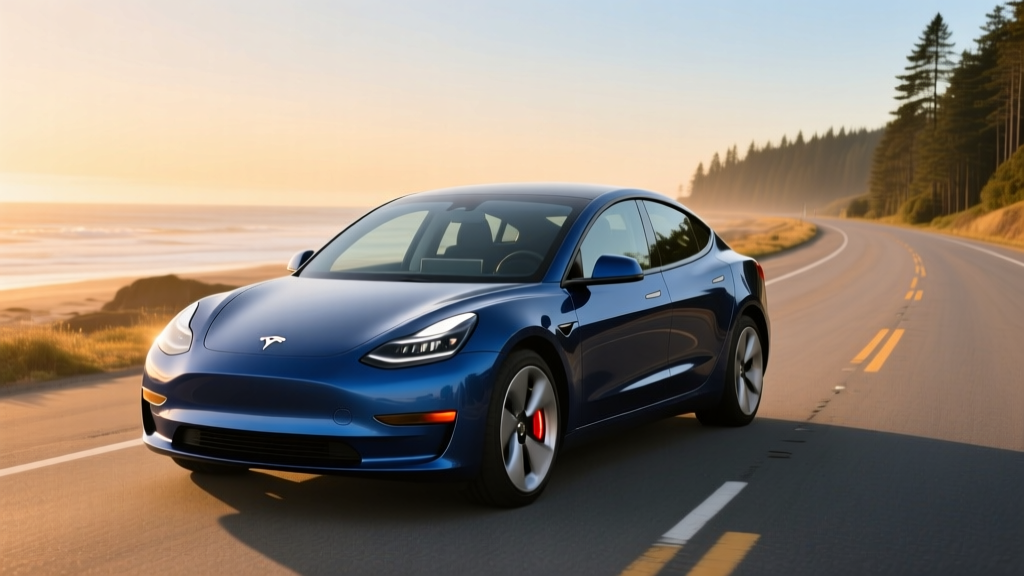
If you're transitioning from a gas car to an electric vehicle, one of the first questions you'll ask is: what's the MPG on a Tesla? The answer requires a fundamental shift in how we measure fuel economy. Electric vehicles don't burn fuel, so the EPA uses MPGe — miles per gallon equivalent — to translate electrical energy consumption into a familiar metric. But for Tesla owners making real purchasing and charging decisions, understanding kWh per 100 miles and actual efficiency under different driving conditions matters far more than a single MPGe sticker number.
In this deep-dive review, we'll break down the 2026 Tesla Model 3 lineup — the RWD, Long Range AWD, and Performance trims — covering their EPA-rated efficiency, real-world energy consumption, charging economics, and how they compare to key competitors. Whether you're calculating your monthly electricity bill or comparing a Tesla to a Hyundai Ioniq 6, this guide gives you the exact numbers you need.
Tesla Model 3 Efficiency: MPGe and kWh/100mi by Trim
The 2026 Tesla Model 3 "Highland" refresh continues to be one of the most energy-efficient electric sedans on the market. Tesla's powertrain engineering — combining a heat pump for cabin climate, SiC inverter technology, and low rolling-resistance tires — delivers class-leading efficiency across all three trims. Here's how they stack up according to EPA data on fueleconomy.gov:
| Trim | Drivetrain | Battery (kWh usable) | Chemistry | EPA Range | Combined MPGe | kWh/100mi | 0-60 mph | Horsepower |
|---|---|---|---|---|---|---|---|---|
| RWD (Base) | Rear-Wheel Drive | 60 kWh | LFP | 272 mi | 132 MPGe | 25 | 5.8 sec | 283 hp |
| Long Range AWD | Dual-Motor AWD | 79 kWh | NMC | 341 mi | 130 MPGe | 26 | 4.2 sec | 346 hp |
| Performance | Dual-Motor AWD | 79 kWh | NMC | 315 mi | 116 MPGe | 29 | 2.9 sec | 510 hp |
Understanding MPGe vs. kWh/100mi: MPGe converts the electrical energy used into the energy equivalent of a gallon of gasoline (33.7 kWh = 1 gallon gas equivalent). A higher MPGe is better. But kWh/100mi is the more practical metric — it tells you exactly how much electricity you'll consume per distance driven, which directly translates to your charging cost. The RWD Model 3 at 25 kWh/100mi means you use 25 kWh of electricity to travel 100 miles.
What Is the Real-World Range of a Tesla Model 3?
EPA Sticker: 341 miles (Long Range AWD)
Real-World Highway (70-80 mph): ~270-295 miles
Real-World City/Mixed: ~300-325 miles
Cold Weather (below 30°F): ~220-260 miles (20-35% reduction)
Regenerative braking in city driving recovers energy that highway driving cannot. Cold temperatures increase battery resistance and cabin heating demand, significantly reducing range.
The EPA range figure is a laboratory-derived estimate that blends city and highway driving cycles. In real-world use, your actual range on a Tesla Model 3 will vary substantially based on speed, temperature, elevation, and climate control usage.
Highway driving is where EVs lose the most efficiency. At 75 mph, aerodynamic drag increases exponentially compared to city speeds. Independent testing consistently shows the Long Range AWD Model 3 achieving approximately 270-295 miles at sustained highway speeds before reaching a low state of charge. This is a 13-21% reduction from the EPA sticker — typical for most EVs.
Cold weather is the single biggest range killer for any electric vehicle. Lithium-ion batteries operate less efficiently at low temperatures, and cabin heating (even with Tesla's heat pump) draws significant energy. Expect a 20-35% range reduction in sub-freezing conditions. The LFP battery in the RWD trim is slightly more affected by cold than the NMC chemistry in the Long Range, though Tesla's thermal management system mitigates this through battery preconditioning.
Practical tip: Use Tesla's built-in trip planner and precondition the battery while plugged in before departing. Preconditioning warms the battery to optimal operating temperature using grid power rather than battery power, preserving range and enabling faster DC charging.
How Fast Does the Tesla Model 3 Charge?
Charging speed is where the Model 3 Highland refresh made meaningful improvements over the previous generation. The Long Range and Performance trims now support faster DC fast-charging peaks, while the RWD trim's LFP battery can accept a 100% charge regularly without degradation concerns — a significant ownership advantage.
| Charging Level | RWD (LFP) | Long Range / Performance (NMC) | Miles Added per Hour |
|---|---|---|---|
| Level 1 (120V, 12A) | 1.4 kW | 1.4 kW | ~3-4 mi/hr |
| Level 2 (240V, 48A) | 11.5 kW | 11.5 kW | ~30-44 mi/hr |
| DC Fast Charge (Peak) | 170 kW | 250 kW | N/A |
| DC Fast 10-80% | ~28 min | ~22 min | N/A |
Understanding the charge curve: The peak DC fast-charge rate (170 kW or 250 kW) is only sustained at lower states of charge — typically between 10-50% SoC. As the battery fills, the charging rate tapers to protect cell health. Above 80% SoC, charging slows dramatically, which is why 10-80% time is the industry-standard metric. Charging from 80-100% on a DC fast charger can take as long as the 10-80% portion.
Home Level 2 charging is how most Tesla owners charge daily. With a Tesla Wall Connector on a 60-amp circuit (48 amps continuous), the onboard charger accepts up to 11.5 kW. This adds roughly 30-44 miles of range per hour of charging, meaning a full overnight charge (8-10 hours) easily replenishes any daily driving. Installation costs for a Level 2 home charger typically range from $500-$2,000 depending on electrical panel proximity and local permitting — factor this into your purchase budget.
Tesla Supercharger network: With over 6,000 V3 (250 kW) and expanding V4 Supercharger stalls across North America, Tesla owners have access to the most reliable DC fast-charging network available. The Model 3's native NACS connector means no adapter is needed at Tesla stalls. For non-Tesla networks (Electrify America, EVgo), a NACS-to-CCS adapter may be required for older stations, though most major networks are transitioning to NACS.
2026 Tesla Model 3 Pricing and Federal Tax Credit Eligibility
The 2026 Model 3 lineup starts at an accessible price point for a premium electric sedan, but the actual out-of-pocket cost depends heavily on federal and state incentives. Here's the current pricing structure:
| Trim | Base MSRP | As-Tested (Typical Options) | Federal §30D Credit Eligible? | Est. After-Credit Price |
|---|---|---|---|---|
| RWD | $38,990 | $39,990 | Yes (up to $7,500) | ~$31,490* |
| Long Range AWD | $45,490 | $47,490 | Yes (up to $7,500) | ~$37,990* |
| Performance | $52,990 | $54,990 | Yes (up to $7,500) | ~$45,490* |
*Estimated after-credit prices assume full $7,500 §30D credit eligibility. Actual credit amount depends on battery sourcing and critical mineral requirements.
- Income caps: Modified AGI must not exceed $150,000 (single), $225,000 (head of household), or $300,000 (joint filers)
- MSRP cap: Sedans must be under $55,000 MSRP — all Model 3 trims qualify
- Battery sourcing: The credit splits into two halves ($3,750 each) — one for critical minerals sourcing, one for battery component manufacturing. Tesla's US-built battery packs generally qualify for at least $3,750; full $7,500 depends on current-year mineral sourcing thresholds per IRS guidelines
- Point-of-sale transfer: You can transfer the credit to the dealer at purchase for an immediate price reduction rather than claiming it on your tax return
Always verify current-year eligibility on irs.gov or consult a tax professional before purchase.
Tesla Model 3 vs. Competitors: Efficiency and Value Comparison
The Model 3 doesn't exist in a vacuum. Several electric sedans compete directly on efficiency, range, and price. Here's how the Model 3 Long Range AWD compares to its closest rivals:
| Vehicle | EPA Range | Combined MPGe | kWh/100mi | Peak DC kW | 10-80% Time | Base MSRP |
|---|---|---|---|---|---|---|
| Tesla Model 3 LR AWD | 341 mi | 130 MPGe | 26 | 250 kW | ~22 min | $45,490 |
| Hyundai Ioniq 6 SEL AWD | 316 mi | 122 MPGe | 28 | 350 kW | ~18 min | $46,500 |
| BMW i4 eDrive40 | 307 mi | 109 MPGe | 31 | 200 kW | ~31 min | $57,900 |
| Polestar 2 LR Dual Motor | 320 mi | 112 MPGe | 30 | 205 kW | ~27 min | $54,300 |
Key takeaways: The Model 3 Long Range leads in combined MPGe and EPA range among AWD sedans in this price bracket. The Hyundai Ioniq 6 charges faster (800V architecture enabling 350 kW peaks), but sacrifices some efficiency. The BMW i4 offers premium build quality at a significant price premium with lower efficiency. If pure energy efficiency and lowest cost-per-mile are your priorities, the Model 3 RWD at 132 MPGe and $38,990 is unmatched in this segment.
Ownership Costs: What Does It Actually Cost to Drive a Tesla?
The "MPG on a Tesla" question ultimately comes down to cost per mile. Let's compare the Model 3 Long Range AWD to an equivalent gas sedan using national averages:
Tesla Model 3 LR AWD (26 kWh/100mi):
• Home charging ($0.16/kWh avg): $0.042 per mile
• DC fast charging ($0.48/kWh avg): $0.125 per mile
• Blended (80% home / 20% DC): $0.058 per mile
Comparable Gas Sedan (Toyota Camry, 32 MPG combined):
• At $3.40/gallon: $0.106 per mile
Annual savings (15,000 mi/yr, blended charging): ~$720/year in fuel costs
5-year fuel savings: ~$3,600
These savings compound when you factor in reduced maintenance — no oil changes, fewer brake replacements (regenerative braking reduces pad wear), and fewer moving parts. However, EV insurance premiums run 15-25% higher than equivalent gas vehicles, and tire replacement may come sooner due to the Model 3's instant torque and heavier curb weight. Factor these into your total cost of ownership calculation.
Interior, Cargo, and Daily Usability
The Highland refresh brought meaningful interior improvements to the Model 3 — ventilated front seats, ambient lighting, rear-seat ventilation controls, and significantly improved cabin noise isolation through acoustic glass. The minimalist interior remains polarizing, but build quality has improved noticeably.
Passenger space:
- Front headroom: 40.3 inches
- Front legroom: 42.7 inches
- Rear headroom: 37.8 inches
- Rear legroom: 35.2 inches
Cargo volume:
- Trunk: 21.0 cu ft (with rear seats up)
- Rear seats folded: 56.1 cu ft
- Front trunk (frunk): 3.1 cu ft
The Model 3's cargo capacity is adequate for a compact sedan but trails competitors like the Hyundai Ioniq 6 (which sacrifices some trunk space for its aerodynamic fastback shape) and significantly trails hatchback alternatives like the Model Y. If you regularly haul cargo or have a growing family, the Model Y's 30.2 cu ft behind the rear seats may be a better fit.
Warranty, Safety, and Driver Assistance
Tesla's warranty coverage is competitive but not class-leading:
- Basic vehicle warranty: 4 years / 50,000 miles
- Battery & drive unit warranty: 8 years / 100,000 miles (RWD), 8 years / 120,000 miles (Long Range & Performance)
- Battery capacity retention guarantee: Minimum 70% capacity retention during warranty period
Tesla's battery degradation data across hundreds of thousands of vehicles shows typical capacity loss of 8-12% over 100,000 miles, meaning most owners will retain well above the 70% warranty threshold. LFP batteries in the RWD trim tend to degrade more slowly than NMC, and Tesla recommends charging LFP to 100% regularly for optimal cell balancing — a practice that would accelerate degradation in NMC cells.
Safety: The Model 3 earned a 5-star overall rating from NHTSA and a Top Safety Pick+ from IIHS. Standard safety features include automatic emergency braking, lane departure warning, and blind-spot monitoring.
Autopilot and FSD (Supervised): Every Model 3 includes basic Autopilot (adaptive cruise control and lane centering). Full Self-Driving (Supervised) is available as a $8,000 option or $99/month subscription. It's critical to understand that FSD is an SAE Level 2 driver-assistance system — the driver must remain fully engaged and responsible at all times. It is not autonomous driving.
Tesla Autopilot and FSD (Supervised) are SAE Level 2 systems. The driver must maintain hands-on-wheel awareness and be prepared to take over at any moment. These systems do not make the vehicle self-driving. True autonomous driving (SAE Level 4) is currently only available through commercial robotaxi services like Waymo in limited geographic areas.
Pros, Cons, and Who Should Buy the Tesla Model 3
- Best-in-class energy efficiency (132 MPGe RWD)
- Access to Tesla Supercharger network — most reliable DC fast-charging in North America
- LFP battery option allows daily 100% charging without degradation concerns
- Strong resale value relative to other EVs
- OTA software updates continuously add features
- Highland refresh significantly improved cabin quietness and ride quality
- No physical turn signal stalks (steering-wheel buttons require adaptation)
- Rear visibility is limited; relies heavily on cameras
- Minimalist interior lacks physical climate/media controls
- Insurance costs 15-25% higher than comparable gas sedans
- FSD (Supervised) remains a Level 2 system despite the name and price
- Cargo space trails hatchback competitors
- Commuters: The RWD trim at $38,990 (after credit ~$31,490) with 272 miles of range covers virtually any round-trip commute with home charging. LFP battery longevity means worry-free daily 100% charging.
- Road trippers: The Long Range AWD with 341 miles EPA and Supercharger access makes long-distance travel practical. Plan for 270-295 real-world highway miles between stops.
- Tech-forward buyers: If you value OTA updates, app integration, and cutting-edge infotainment, Tesla's software ecosystem is unmatched.
- NOT ideal for: Families needing maximum cargo space (consider Model Y), buyers who prefer traditional controls and buttons, or those in extreme cold climates where range loss will be most pronounced.
Frequently Asked Questions
What is the real-world MPG equivalent on a Tesla Model 3?
The EPA rates the 2026 Model 3 RWD at 132 MPGe combined and the Long Range AWD at 130 MPGe combined. In real-world highway driving at 75 mph, expect efficiency to drop to approximately 105-115 MPGe equivalent due to aerodynamic drag. City driving with regenerative braking can exceed the EPA combined rating, sometimes reaching 140+ MPGe in stop-and-go traffic.
Does the Tesla Model 3 qualify for the $7,500 federal EV tax credit?
All 2026 Model 3 trims fall under the $55,000 MSRP cap for sedans and are assembled in the US, making them potentially eligible. However, the full $7,500 credit depends on battery critical-mineral sourcing and component manufacturing requirements that shift annually. Buyer income must not exceed $150,000 (single) or $300,000 (joint). The credit can be transferred at point of sale for an immediate price reduction. Always verify current eligibility on irs.gov before purchasing.
How much does it cost to charge a Tesla Model 3 at home vs. public chargers?
At the US average residential electricity rate of ~$0.16/kWh, fully charging a Long Range Model 3 (79 kWh) costs approximately $12.64 for 341 miles of range — about $0.037 per mile. DC fast charging at public rates averaging $0.48/kWh costs roughly $37.92 for a full charge — about $0.111 per mile. Most owners charge 80%+ at home, making the blended cost dramatically lower than gasoline.
How long will the Tesla Model 3 battery last before needing replacement?
Tesla warranties the battery for 8 years/100,000 miles (RWD) or 8 years/120,000 miles (Long Range/Performance) with a minimum 70% capacity retention guarantee. Real-world fleet data shows typical degradation of 8-12% at 100,000 miles, with most batteries lasting well beyond 200,000 miles before approaching the 70% threshold. A full battery replacement out of warranty costs approximately $12,000-$16,000, though this is rare within the vehicle's practical lifespan.
Is the Tesla Model 3 worth buying over the Hyundai Ioniq 6 or BMW i4?
The Model 3 wins on efficiency (highest MPGe in class), charging network access (Supercharger reliability), and overall value (lowest after-credit price). The Ioniq 6 charges faster (350 kW peak on 800V architecture) and offers a more traditional interior with physical controls. The BMW i4 provides superior build quality and driving dynamics at a significant price premium. For most buyers prioritizing low cost-per-mile and road-trip practicality, the Model 3 remains the benchmark — but test-drive all three before deciding.
What's the difference between LFP and NMC batteries in the Model 3?
The RWD trim uses an LFP (lithium iron phosphate) battery — it's slightly heavier, has lower energy density (hence the shorter 272-mile range), but offers slower degradation, better thermal stability, and can be charged to 100% daily without harm. The Long Range and Performance trims use NMC (nickel manganese cobalt) batteries with higher energy density for longer range but should typically be charged to 80-90% daily to maximize longevity. For commuters who can charge at home nightly, LFP is arguably the better long-term ownership choice.