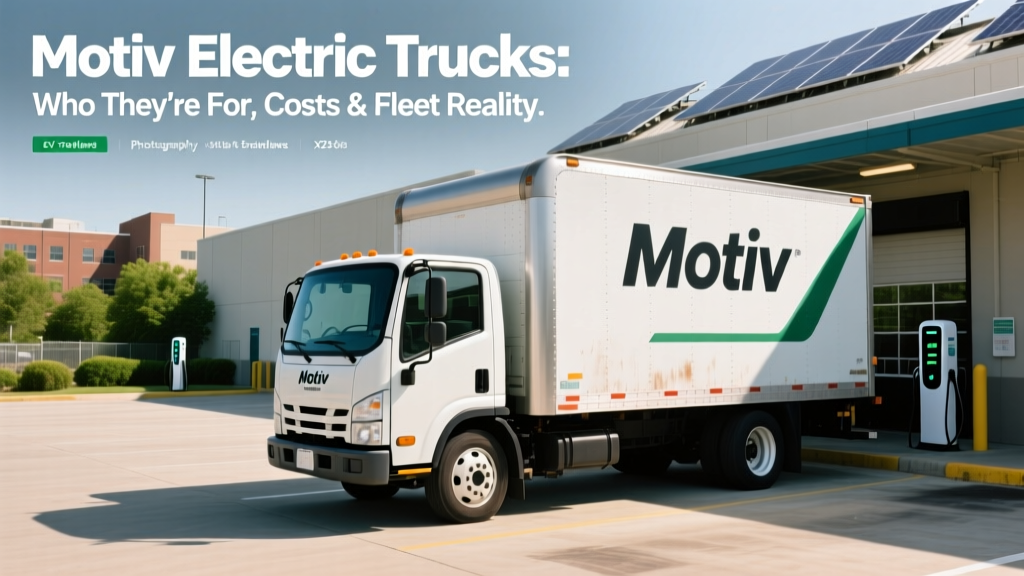
If you're searching for Motiv electric trucks to buy for personal use, here's the direct answer: Motiv Power Systems does not sell trucks to individual consumers. Motiv designs and manufactures the EPIC (Electric Powered Intelligent Chassis) — a purpose-built electric chassis sold to commercial upfitters and fleet operators for step vans, box trucks, shuttle buses, and similar vocational vehicles. You won't find one on a dealer lot or qualify for the consumer §30D tax credit. For fleet buyers, however, Motiv's chassis represents a mature, California-based medium-duty electrification option with real-world deployment data stretching back over a decade.
Quick Answer: Motiv Electric Trucks at a Glance
- What Motiv makes: EPIC electric chassis (Class 3–5, roughly 15,000–26,000 lb GVWR) sold B2B to upfitters and fleets
- Who buys them: Commercial fleet operators, municipalities, delivery companies, shuttle services
- Estimated range: 100–160 miles depending on battery configuration and duty cycle
- Charging: Level 2 AC (primary depot charging); DC fast charging available on select configs
- Consumer purchase? No — this is a fleet/commercial product only
What Is the Motiv EPIC Chassis and Who Actually Uses It?
Motiv Power Systems, headquartered in Foster City, California, has been building electric truck chassis since 2009. The EPIC platform is a ground-up electric skateboard-style chassis that upfitters like Morgan Olson, Utilimaster, and others use as the foundation for walk-in step vans, delivery box trucks, school shuttle buses, and linen/laundry trucks. The key distinction: Motiv doesn't build the finished truck body — they supply the rolling electric chassis with powertrain, battery packs, and control systems, and a partner completes the vehicle.
This matters because it means specifications vary significantly depending on the upfit. A Motiv-based step van for bread delivery will have different battery capacity, range, and weight distribution than a shuttle bus on the same EPIC platform. Fleet buyers typically work directly with Motiv and the upfitter to spec the right combination.
Notable fleet deployments include vehicles operating with companies like Purolator, various school districts, and municipal government fleets, primarily in California where incentive programs like HVIP (Hybrid and Zero-Emission Truck and Bus Voucher Incentive Project) substantially reduce acquisition cost.
Motiv EPIC Specs: Battery, Range, and Charging
Because Motiv configures each EPIC chassis to the fleet's duty cycle, there isn't a single spec sheet the way you'd find for a consumer EV. But based on published fleet data and Motiv's platform documentation, here are the typical parameters:
| Parameter | Typical Range / Value |
|---|---|
| Vehicle Class | Class 3–5 (15,000–26,000 lb GVWR) |
| Battery Chemistry | Lithium-ion (NMC packs, sourced from tier-1 suppliers) |
| Battery Capacity | ~85–150 kWh usable (config-dependent) |
| Estimated Range | 100–160 miles (varies with payload, stops, climate) |
| Motor Output | ~150–250 kW (200–335 hp) electric motor |
| Level 2 AC Charging | ~19.2 kW; full charge in 5–8 hours |
| DC Fast Charging | Available on select configurations; ~50–80 kW peak |
| Regenerative Braking | Multi-level regen; significant energy recapture in stop-and-go |
| Warranty | Typically 5 yr / 100,000 mi on battery & powertrain (fleet contract dependent) |
Real-world range reality: A Motiv step van running a dense urban delivery route with 100+ stops per day and heavy regenerative braking may achieve range near the upper end of estimates. A box truck running highway segments at 55–65 mph with full payload will see range compress toward the lower end — and cold-weather operation in northern climates can knock 15–25% off rated range due to battery chemistry and cabin/cargo heating demands. Fleet operators spec battery capacity around their worst-case route, not the best case.
Charging curve note: On DC fast charging configurations, expect peak charge rates (say 60–80 kW) to sustain only up to roughly 50–60% State of Charge before tapering. This is normal lithium-ion behavior — the pack management system reduces current to protect cell longevity. For most Motiv fleets, overnight Level 2 depot charging is the primary strategy anyway, making DC fast charging more of a mid-day top-up option than a daily necessity.
Cost Breakdown: Motiv Electric vs. Diesel Medium-Duty Trucks
The upfront cost of a Motiv-based electric truck is substantially higher than an equivalent diesel. But fleet buyers evaluate total cost of ownership (TCO) over a 7–10 year vehicle life, where the math often flips in the electric truck's favor — especially in California.
| Cost Category | Motiv Electric (Est.) | Diesel Equivalent (Est.) |
|---|---|---|
| Vehicle Purchase (pre-incentive) | $160,000–$220,000 | $80,000–$110,000 |
| California HVIP Voucher | −$45,000 to −$75,000 | $0 |
| Federal §45W Commercial Clean Vehicle Credit | −$40,000 (up to, per IRS) | $0 |
| Net Effective Purchase | $60,000–$135,000 | $80,000–$110,000 |
| Fuel / Energy (7 yr, 15k mi/yr) | $18,000–$28,000 (electricity) | $55,000–$75,000 (diesel) |
| Maintenance (7 yr) | $8,000–$14,000 | $22,000–$35,000 |
| Depot Charger Install (Level 2) | $5,000–$15,000 per stall | $0 |
| Estimated 7-Yr TCO | $91,000–$192,000 | $157,000–$220,000 |
Key takeaway: With California incentives, the net purchase price of a Motiv electric truck can approach or undercut a diesel equivalent, and the operating cost savings on fuel and maintenance widen the TCO gap every year. Without California incentives (in states with no voucher programs), the payback period stretches to 5–7 years depending on mileage and diesel prices. Fleets running high daily miles with predictable depot-return routes see the fastest payback.
Important tax credit note: Commercial fleets don't use the consumer §30D credit. Instead, the §45W Commercial Clean Vehicle Credit provides up to $40,000 for qualified commercial EVs over 14,000 lb GVWR (or 30% of cost, whichever is less). Eligibility depends on battery sourcing, vehicle assembly, and tax liability — consult a tax professional for your specific fleet situation.
Motiv vs. Other Electric Truck Platforms: Where It Fits
Motiv isn't the only player in electric medium-duty chassis. Here's how the competitive landscape looks for fleet buyers evaluating options:
| Platform | Type | Typical Range | Best For |
|---|---|---|---|
| Motiv EPIC | Chassis for upfitters | 100–160 mi | Step vans, shuttles, vocational |
| Ford E-Transit | Complete cargo van | ~126 mi (EPA) | Last-mile delivery, cargo |
| BrightDrop Zevo 600 | Complete step van | ~160 mi (est.) | Package delivery (FedEx, etc.) |
| Lightning eMotors | Upfitted chassis | 100–150 mi | Fleet vehicles, municipal |
| SEA Electric | Cab-chassis upfit | 120–175 mi | Box trucks, wide body types |
Motiv's differentiation is its longevity in the market (deployments since the early 2010s), its flexibility as a chassis platform rather than a fixed body style, and its deep integration with California's incentive ecosystem. For fleets outside California or those needing a turnkey vehicle without upfitter coordination, the Ford E-Transit or BrightDrop Zevo may be simpler to procure.
Real-World Ownership Considerations for Fleet Buyers
If you're a fleet manager evaluating Motiv electric trucks, these are the practical realities that spec sheets don't capture:
Depot Charging Infrastructure
Every Motiv electric truck needs a home base with Level 2 charging. For a fleet of 10 trucks, you're looking at 10 Level 2 charger stalls at ~19.2 kW each, plus potential electrical panel upgrades. Budget $5,000–$15,000 per stall for equipment and installation, and add $10,000–$50,000+ if your facility needs a service panel upgrade or transformer work. Engage a licensed electrician for site assessment before committing to vehicle orders.
Route Matching Is Everything
Electric trucks thrive on predictable, depot-return routes under 120 miles per day with overnight charging windows of 8+ hours. If your routes regularly exceed 150 miles, include highway-heavy segments, or operate in extreme cold, you need to spec larger battery packs or plan for mid-day DC fast charging — which adds infrastructure cost and driver downtime.
Driver Experience and Maintenance
Fleet operators consistently report that drivers prefer electric trucks: instant torque from a stop, quiet operation, no diesel exhaust, and regenerative braking that reduces brake wear. Maintenance savings are real — no oil changes, no DPF filters, no transmission fluid, and brake pads lasting 2–3× longer thanks to regen. But specialized EV service technicians are required, and Motiv's support network is strongest in California.
Cold-Weather Performance
Fleets operating in Minnesota, Michigan, or the Northeast should plan for 15–25% range reduction in winter. Battery thermal management helps, but heating a large cab and cargo space draws significant energy. Motiv-based vehicles in cold climates benefit from depot pre-conditioning (plugging in while parked to warm the battery and cabin before departure).
Common Misconceptions About Motiv Electric Trucks
| Myth | Fact |
|---|---|
| "I can buy a Motiv truck for personal use" | Motiv sells B2B to fleets and upfitters only. There is no consumer retail channel. |
| "Electric trucks can't handle heavy payloads" | The EPIC chassis is rated for Class 3–5 GVWR (up to ~26,000 lb). Electric motors deliver full torque at zero RPM, which actually improves launch performance under load vs. diesel. |
| "The batteries will need replacing in a few years" | Motiv's battery packs are designed for 10+ year / 150,000+ mile service life with managed degradation. Fleet contracts typically include battery warranty and end-of-life support. |
| "Electric trucks cost more to own overall" | Higher upfront cost is offset by incentives, lower fuel cost ($0.12–$0.18/kWh vs. $4+/gal diesel), and 40–60% lower maintenance. TCO parity or advantage is common in 5–7 years for high-utilization fleets. |
| "Charging takes too long for fleet operations" | Overnight Level 2 depot charging (6–8 hours) covers 100–160 miles — sufficient for most daily routes. Fleet vehicles charge while parked, not during driver time. |
Decision Framework: Is a Motiv Electric Truck Right for Your Fleet?
Choose Motiv EPIC if:
- Your fleet operates in California — HVIP vouchers and LCFS credits dramatically improve economics
- You need a custom body upfit — step van, shuttle bus, linen truck, or specialized vocational body
- Daily routes are under 120 miles with predictable depot return and 8+ hour parking windows
- You want a proven platform with 10+ years of fleet deployment data
- Stop-and-go urban routes dominate — regenerative braking maximizes efficiency and reduces brake maintenance
Consider Alternatives if:
- You're outside California with no comparable state incentives — evaluate Ford E-Transit, BrightDrop, or SEA Electric for potentially better local support
- You need a turnkey vehicle without coordinating between a chassis maker and an upfitter
- Daily routes exceed 150 miles or include sustained highway driving — range may be insufficient without mid-day charging
- You're an individual buyer — Motiv does not sell to consumers; look at Ford F-150 Lightning, Rivian R1T, or Chevrolet Silverado EV for personal electric trucks
Frequently Asked Questions
Can I buy a Motiv electric truck as an individual consumer?
No. Motiv Power Systems sells exclusively to commercial fleet operators and works through upfitter partners. There is no consumer retail purchasing path. If you want a personal electric truck, consider the Ford F-150 Lightning, Rivian R1T, Chevrolet Silverado EV, or Tesla Cybertruck.
How much does a Motiv electric truck cost?
Pre-incentive pricing typically falls in the $160,000–$220,000 range depending on battery configuration and upfit body. After California HVIP vouchers (up to $75,000) and the federal §45W commercial credit (up to $40,000), net acquisition cost can drop to $60,000–$135,000 — competitive with or below a diesel equivalent.
What is the real-world range of a Motiv EPIC truck?
Expect 100–160 miles depending on battery size, payload, route profile, and climate. Urban stop-and-go routes with heavy regenerative braking tend toward the higher end. Highway-heavy routes, full payloads, and cold weather compress range toward the lower end. Fleet operators should spec based on their worst-case daily route plus a 15–20% buffer.
How long does it take to charge a Motiv electric truck?
On Level 2 AC charging at ~19.2 kW, a full charge from empty takes approximately 5–8 hours depending on battery capacity — designed for overnight depot charging. DC fast charging (where available) can add significant range in 1–2 hours but is typically used as a supplement rather than primary charging method.
What incentives are available for Motiv electric trucks?
Key incentives include California's HVIP vouchers ($45,000–$75,000+ depending on vehicle class and fleet location), the federal §45W Commercial Clean Vehicle Credit (up to $40,000), and various utility make-ready programs that cover depot charging infrastructure costs. Incentive availability varies by state and year — consult IRS guidelines and your state air quality district for current programs.
What happens when the battery degrades?
Motiv designs battery packs for 10+ year operational life with managed degradation (typically retaining 70–80% capacity at end of warrantied life). Fleet contracts often include battery monitoring, support, and replacement pathways. Battery replacement cost for a pack of this size is significant ($25,000–$50,000+) but is rarely needed within the vehicle's primary service life under normal fleet usage patterns.