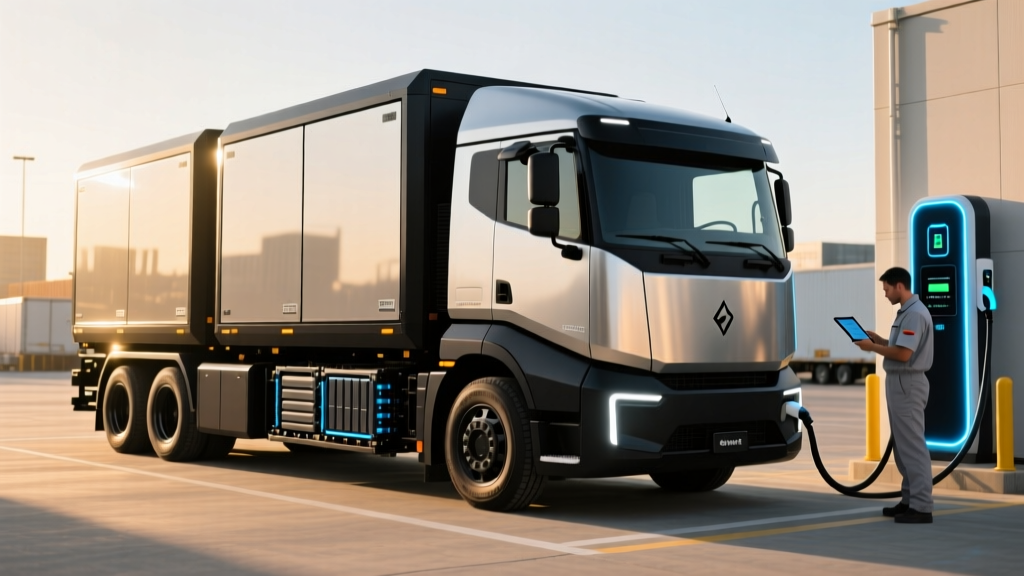
Quick Answer: A modular electric truck uses a skateboard-style chassis with swappable body modules (cargo van, flatbed, shuttle) on a single EV platform. In 2026, the leading production options include the Canoo Lifestyle Delivery Vehicle (LDV) and REE Automotive's P7 platform. Expect base pricing from ~$35,000 to $85,000+ depending on GVWR and module configuration, EPA-estimated range of 130–230 miles, and DC fast charging at 80–150 kW. For last-mile delivery fleets covering under 150 miles daily with depot charging, a modular electric truck can cut per-mile operating costs by 40–60% versus a comparable gas or diesel commercial van.
What Is a Modular Electric Truck — and Why It Matters for Fleet Buyers
A modular electric truck separates the propulsion system (the "skateboard" — battery pack, motors, suspension, and controls) from the body module bolted on top. Instead of buying a fixed-body vehicle, a fleet operator purchases a chassis and swaps modules as needs change: a step van for parcel delivery in Q1, a flatbed for construction supply in Q3, a passenger shuttle for corporate campuses year-round.
The concept isn't new — UPS and FedEx have tested modular platforms for years — but 2026 marks the first year multiple manufacturers are delivering production volumes at scale. The key players:
- Canoo LDV — Purpose-built last-mile delivery van on Canoo's multi-purpose platform (MPP). Available in 130- and 190-mile EPA range configurations.
- REE Automotive P7 — A 7-tonne GVWR platform with REEcorner technology (in-wheel motors, steer-by-wire). Partnered with fleet upfitters for custom bodies.
- BrightDrop Zevo 600 (GM subsidiary) — Not strictly modular in the skateboard sense, but offers configurable cargo modules and a 250-mile EPA range. Widely deployed by FedEx.
- Ford E-Transit — Conventional unibody electric van, included here as the baseline comparison. 126-mile EPA range, widely available, strong dealer network.
If you're a fleet manager or small-business owner weighing whether to invest in a modular platform versus a fixed-body EV van or a traditional gas truck, the answer depends on your route predictability, daily mileage, charging infrastructure, and whether your cargo needs shift seasonally.
Spec Comparison: Modular Electric Trucks vs. Gas and Fixed-Body EV Vans
| Spec | Canoo LDV (190-mi config) | REE P7 Platform | Ford E-Transit (148" WB) | Ford Transit 350 (Gas, 3.5L V6) |
|---|---|---|---|---|
| EPA Range | ~190 mi | ~150 mi (est., varies by body) | 126 mi | ~310 mi (fuel tank) |
| Real-World Range (loaded, mixed) | ~140–160 mi | ~110–130 mi | ~90–105 mi | ~270–290 mi |
| Battery (usable kWh) | ~80 kWh (NMC) | ~70–100 kWh (NMC, config.) | 68 kWh (NMC) | N/A (gasoline) |
| Peak DC Charge Rate | ~100 kW | ~150 kW | 115 kW | N/A |
| 10–80% DC Fast Charge | ~45 min | ~35 min | ~45 min | ~5 min (refuel) |
| Level 2 Charge Rate | ~11.5 kW | ~19.2 kW | 10.5 kW | N/A |
| Payload Capacity | ~1,800 lbs | ~4,500 lbs (varies by module) | ~3,880 lbs | ~4,530 lbs |
| Cargo Volume | ~550 cu ft | Varies by upfitter | 487 cu ft | 487 cu ft |
| Horsepower / Torque | ~350 hp / 420 lb-ft | ~268 hp / 590 lb-ft | 266 hp / 317 lb-ft | 310 hp / 400 lb-ft |
| 0–60 mph | ~7.0 sec | ~8.5 sec (est.) | ~8.0 sec | ~7.5 sec |
| Base MSRP (est.) | ~$35,000–$45,000 | ~$65,000–$85,000+ | ~$45,000 | ~$48,000 |
| GVWR Class | Class 2b | Class 4–5 | Class 2b | Class 2b |
| Battery/Powertrain Warranty | 8 yr / 100,000 mi | 8 yr / 100,000 mi | 8 yr / 100,000 mi | 5 yr / 60,000 mi (powertrain) |
Sources: fueleconomy.gov, manufacturer spec sheets (Canoo, REE Automotive, Ford Pro). Real-world range estimates reflect loaded commercial use at highway speeds; expect 15–25% reduction in cold weather below 30°F.
Total Cost of Ownership: Modular EV Truck vs. Gas Van Over 5 Years
The upfront sticker price of a modular electric truck is higher than a gas equivalent, but commercial fleets care about cost-per-mile over the vehicle's service life. Here's a realistic 5-year/75,000-mile TCO comparison for a last-mile delivery van doing ~40 miles/day, 5 days/week:
| Cost Category (5 yr / 75k mi) | Canoo LDV (~$40k base) | Ford Transit 350 Gas (~$48k base) |
|---|---|---|
| Purchase Price (after §45W commercial credit*) | ~$32,500 | $48,000 |
| Fuel / Electricity | ~$3,750 (at $0.13/kWh avg) | ~$11,250 (at $3.60/gal, 16 MPG) |
| Maintenance (brakes, fluids, filters) | ~$1,200 | ~$4,500 |
| Insurance (commercial fleet avg) | ~$6,500 | ~$5,800 |
| Tires | ~$2,400 (heavier vehicle) | ~$2,000 |
| Depreciation (est. residual at 5 yr) | ~$12,000 (30% retained) | ~$14,400 (30% retained) |
| Total 5-Year Cost | ~$58,350 | ~$85,950 |
| Cost Per Mile | ~$0.78 | ~$1.15 |
*The IRS §45W Commercial Clean Vehicle Credit provides up to $7,500 for vehicles under 14,000 lbs GVWR and up to $40,000 for heavier commercial EVs. Eligibility depends on battery sourcing, MSRP caps, and your business tax liability. Consult a tax professional for your specific situation.
The EV saves roughly $27,600 over five years in this scenario — primarily from fuel and maintenance. The savings widen if your depot electricity rate is below $0.10/kWh or if you can charge during off-peak utility windows. They narrow if you lack depot charging and must rely on public DC fast chargers at $0.35–$0.55/kWh.
Real-World Ownership: Charging, Climate, and Route Reality
Home and Depot Charging Access
The single biggest factor in whether a modular electric truck works for your operation is predictable charging access. If your fleet returns to a depot nightly and you can install Level 2 chargers (240V, 11.5–19.2 kW), you'll wake up to a full battery every morning. A typical depot install runs $3,000–$8,000 per charger, including panel upgrades, conduit, and permitting. For a 10-vehicle fleet, budget $40,000–$80,000 in charging infrastructure — but many utilities offer commercial EV make-ready rebates that cover 50–100% of this cost.
If you lack depot charging — say you're a sole proprietor parking on the street — a modular electric truck becomes significantly harder to operate. Public DC fast charging at 100–150 kW can replenish 10–80% in 35–45 minutes, but at $0.40/kWh, your fuel savings evaporate. Plan your routes around charging availability before you buy.
Cold-Weather Range Loss
Every EV battery loses range in cold weather due to increased internal resistance and cabin/cargo heating demands. For a modular electric truck operating in Chicago, Minneapolis, or Denver winters:
- Mild cold (30–45°F): Expect 10–15% range reduction from EPA sticker.
- Deep cold (below 15°F): Expect 20–35% range reduction. A 190-mile EPA truck may deliver only 125–150 real-world miles.
- Mitigation: Precondition the battery while plugged in (warms the pack using grid power, not battery energy). Spec a heat pump if available — it's 2–3x more efficient than resistive heating for cabin and cargo-area climate control.
Driving Patterns That Favor Modular EVs
Modular electric trucks thrive on stop-and-go, low-speed, predictable routes — exactly the profile of parcel delivery, food distribution, and campus shuttles. Regenerative braking recaptures energy at every stop, extending real-world range beyond the EPA estimate in urban driving. Conversely, sustained 75-mph highway runs drain the battery faster than the sticker suggests — a concern for regional haulers but irrelevant for most last-mile operators.
Common Misconceptions About Modular Electric Trucks
| Myth | Fact |
|---|---|
| "EV batteries need replacing every 3–5 years." | Modern NMC and LFP packs are warrantied for 8 years/100,000 miles with a guaranteed 70%+ capacity retention threshold. Real-world fleet data from NHTSA and independent testing shows most packs retain 85–90% capacity at 100k miles. Full replacement costs $8,000–$18,000 but is rarely needed in the vehicle's first decade. |
| "Modular platforms are unproven and risky." | REE Automotive's P7 is in production with fleet customers. Canoo's LDV has been in pilot programs since 2024. BrightDrop's Zevo has logged millions of real-world miles with FedEx. The skateboard architecture itself is proven — it underpins most modern EVs from Tesla to Rivian. |
| "Electric trucks can't tow or haul real payloads." | The REE P7 platform handles up to 4,500 lbs of payload — competitive with a gas Transit 350. Canoo's LDV is lighter-duty at ~1,800 lbs, which covers most parcel and food delivery. For heavy towing (10,000+ lbs), look at the Ford F-150 Lightning or Rivian R1T, which aren't modular but offer serious capability. |
| "Charging takes too long for commercial use." | If you charge overnight at a depot (8–10 hours on Level 2), charging time is irrelevant — the vehicle is ready when your shift starts. DC fast charging at 100–150 kW adds ~100 miles in 30–40 minutes, which works for mid-shift top-ups during driver lunch breaks. |
| "I'll save money immediately." | Upfront cost is higher. The break-even point versus a gas van is typically 2–3 years depending on mileage, electricity rates, and incentive eligibility. Low-mileage fleets (<20 mi/day) may not break even within the vehicle's service life. |
Federal and State Incentives for Commercial EV Trucks
The IRS §45W Commercial Clean Vehicle Credit is the primary federal incentive for business-purchased EVs in 2026. Key rules:
- Vehicles under 14,000 lbs GVWR: Up to $7,500 credit.
- Vehicles 14,000+ lbs GVWR: Up to $40,000 credit.
- Battery sourcing requirements: A percentage of critical minerals and battery components must be sourced from the US or FTA-partner countries. These thresholds increase annually — verify current-year compliance on the IRS site or with your dealer.
- No MSRP cap for commercial vehicles (unlike the consumer §30D credit), but the credit cannot exceed your business's tax liability (it's non-refundable).
- Point-of-sale transfer: As of 2024, eligible buyers can transfer the credit to the dealer at purchase, reducing the out-of-pocket price immediately.
Beyond federal credits, many states offer additional incentives. California's Energy Commission and HVIP program provide up to $120,000 for medium- and heavy-duty electric trucks. New York, New Jersey, and Colorado have similar programs. Check your state's energy or environmental agency for current availability — these programs are first-come, first-served and subject to legislative renewal.
Decision Framework: Should You Buy a Modular Electric Truck?
Choose a modular electric truck if:
- Your fleet averages under 150 miles per day on predictable routes.
- You have (or can install) depot Level 2 charging — overnight replenishment is the ideal use case.
- Your cargo needs change seasonally, making swappable modules a tangible operational advantage.
- You qualify for the §45W commercial credit and/or state incentives, narrowing the upfront cost gap.
- You operate in urban or suburban environments where regenerative braking maximizes efficiency.
Stick with a gas or diesel truck if:
- Your routes regularly exceed 200 miles per day with no mid-shift charging opportunity.
- You operate in extreme cold climates (<0°F regularly) and cannot accommodate 30%+ range loss.
- You need heavy towing (10,000+ lbs) or operate in remote areas with no charging infrastructure.
- Your daily mileage is very low (<20 mi/day) — the fuel savings won't offset the higher purchase price within a reasonable timeframe.
- You lack access to any form of reliable charging (no depot, no home Level 2, no nearby public DC stations).
Consider a fixed-body EV van (Ford E-Transit, BrightDrop Zevo) if:
- Your cargo needs don't change — you always need a step van, so modularity adds cost without value.
- You want the widest dealer-service network (Ford Pro has 600+ commercial vehicle centers nationwide).
- You need a proven, widely available vehicle today rather than a newer platform still scaling production.
Frequently Asked Questions
Can I swap modules myself, or do I need a service center?
Module swaps on platforms like REE's P7 are designed for upfitter facilities, not DIY. A body swap typically takes 2–4 hours with proper equipment. Canoo's LDV ships in a fixed configuration from the factory — the "modularity" is at the order stage, not in the field. True field-swappable platforms are still emerging and mostly in pilot phases.
What happens if the battery degrades below the warranty threshold?
If your battery's State of Health (SoH) drops below 70% within the 8-year/100,000-mile warranty window, the manufacturer is obligated to repair or replace it at no cost. Most fleet operators never hit this threshold — NMC chemistry in commercial duty cycles typically retains 80–88% SoH at 100k miles, according to fleet telemetry data.
Do modular electric trucks qualify for the $7,500 consumer tax credit?
No — the consumer §30D credit applies to personal-use vehicles. Commercial trucks purchased for business use fall under the §45W Commercial Clean Vehicle Credit, which offers up to $7,500 for light-duty and up to $40,000 for heavier vehicles. The eligibility rules differ: no MSRP cap, no personal income cap, but battery sourcing requirements apply. Always verify with the IRS and a tax professional before purchasing.
How does insurance cost compare for electric commercial trucks?
Commercial EV insurance typically runs 10–20% higher than equivalent gas vehicles, driven by higher repair costs (specialized high-voltage training, expensive battery components) and limited actuarial data. Budget ~$1,300–$1,600/year per vehicle vs. ~$1,100–$1,400 for gas. Some insurers (Progressive Commercial, Liberty Mutual) now offer EV-specific fleet policies — shop around.
What's the best way to spec a modular electric truck for my fleet?
Start with your actual daily mileage data (GPS telematics or driver logs, not estimates). Add a 30% buffer for cold weather and unexpected detours. That's your minimum real-world range requirement. Then match payload and cargo volume to your heaviest typical load, not your average. Finally, consult a licensed electrician about your depot's electrical panel capacity — you may need a 400-amp service upgrade ($5,000–$15,000) before installing multiple Level 2 chargers.