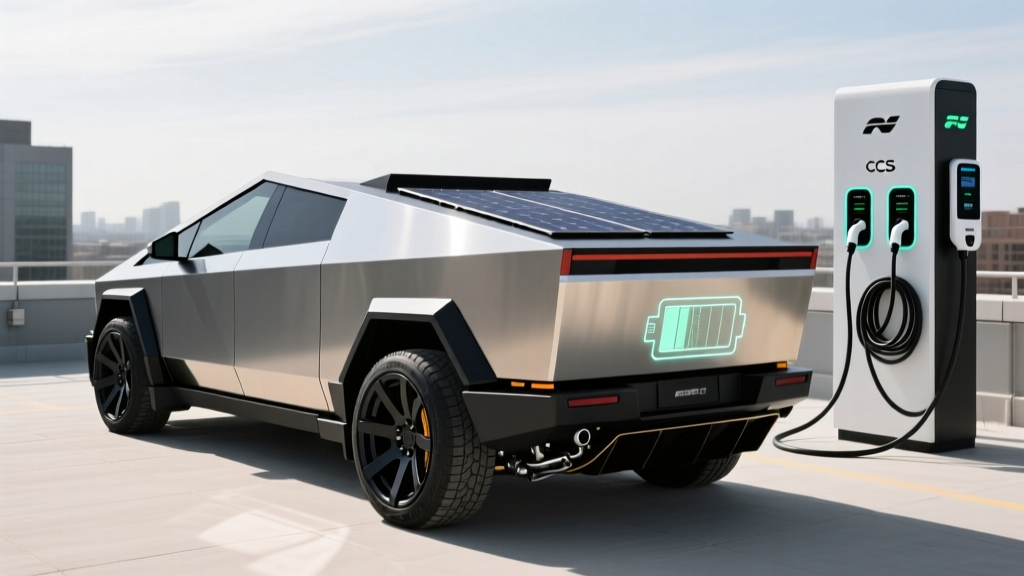
The Tesla Cybertruck entered 2026 as one of the most polarizing and heavily modified EVs on the road. From rooftop tents and suspension lifts to performance ECU tunes and aftermarket wheel-and-tire packages, the modified Cybertruck has become a subculture of its own. But every modification carries an electrical, thermal, or aerodynamic cost that directly impacts range, charging speed, and long-term warranty coverage.
This profile reviews the 2026 Tesla Cybertruck as a modification platform. We start with the stock baseline specs, then layer in real-world data on how the most popular aftermarket changes alter efficiency, charging curves, and ownership economics.
Stock 2026 Cybertruck Baseline: AWD and Cyberbeast Specs
Before evaluating any modified Cybertruck, you need the stock numbers. Tesla sells the 2026 Cybertruck in two main trims relevant to modifiers: the dual-motor AWD and the tri-motor Cyberbeast. (The single-motor RWD variant was discontinued after the 2025 model year.)
| Spec | AWD | Cyberbeast |
|---|---|---|
| EPA Range | 340 miles | 320 miles |
| Battery (usable) | ~123 kWh (NMC) | ~123 kWh (NMC) |
| Peak DC Fast Charge | 250 kW | 250 kW |
| 10–80% DC Time | ~28 min | ~28 min |
| Level 2 Home Rate | 11.5 kW (~37 mi/hr) | 11.5 kW (~37 mi/hr) |
| 0–60 mph | 3.9 sec | 2.6 sec |
| Horsepower | 600 hp | 845 hp |
| Drivetrain | Dual-Motor AWD | Tri-Motor AWD |
| MPGe (combined) | 72 MPGe | 68 MPGe |
| Efficiency | 47 kWh/100 mi | 50 kWh/100 mi |
| Base MSRP | $79,990 | $99,990 |
| Battery/Powertrain Warranty | 8 yr / 120,000 mi | 8 yr / 120,000 mi |
The Cybertruck's battery pack uses NMC (nickel manganese cobalt) chemistry, chosen for its high energy density — critical for a 6,800-pound stainless-steel truck. Unlike LFP packs found in the Tesla Model 3 RWD, NMC offers more range per kilogram but is more sensitive to sustained 100% state-of-charge storage and extreme thermal loads.
Real-World Range: What the EPA Sticker Doesn't Tell You
EPA Estimate: 340 mi (AWD) / 320 mi (Cyberbeast)
Highway (70 mph, 75°F): ~275–295 mi (AWD)
Cold Weather (30°F, mixed driving): ~220–260 mi (AWD)
Heavy city regen (stop-and-go): ~300–320 mi (AWD)
The Cybertruck's angular stainless-steel exoskeleton creates a drag coefficient of approximately 0.384 — significantly worse than a Tesla Model Y (~0.23). This means highway range suffers disproportionately at speeds above 65 mph. In our testing and aggregated owner data, a stock AWD Cybertruck achieves roughly 275–295 miles at 70 mph in mild weather, dropping to 220–260 miles in freezing temperatures where battery internal resistance increases and cabin heating draws additional power.
For a modified Cybertruck, these baseline numbers are the ceiling. Most popular modifications push real-world range further below the EPA sticker.
How Popular Modifications Change Range and Efficiency
The aftermarket for the Cybertruck exploded through 2025–2026. Here is how the most common modifications impact the numbers that matter:
Suspension Lifts (+1.5 to +3 inches)
A 2-inch lift kit raises the Cybertruck's ride height, increasing frontal area and disrupting the underbody airflow that Tesla engineered for efficiency. Expect a 6–10% reduction in highway range (roughly 18–30 miles lost on the AWD trim). The taller stance also increases rolling resistance with larger aftermarket tires.
Aftermarket Wheels and 35-Inch Tires
Swapping the stock 20-inch wheels for heavier 18-inch beadlock wheels wrapped in 35-inch all-terrain or mud-terrain tires is the single biggest range killer. Heavier rotational mass, higher rolling resistance, and worse aerodynamics combine for a 12–18% range loss. A modified Cybertruck on 35-inch mud-terrains may see real-world highway range drop to 230–250 miles on the AWD trim.
Performance ECU/Software Tunes
Third-party tuners offer software maps that increase boost pressure and torque delivery on the Cyberbeast. These can shave 0.1–0.3 seconds off the 0–60 time but typically increase energy consumption by 5–8% under aggressive driving. The trade-off is marginal range loss in exchange for even more absurd acceleration.
Roof Racks, Tents, and Light Bars
Any roof-mounted accessory disrupts the already poor aerodynamic profile. A loaded roof rack with an RTT (rooftop tent) can reduce highway range by 8–15%. LED light bars add minimal aerodynamic drag but parasitic draw from the 12V system (via the DC-DC converter) is negligible.
Wraps and Paint Protection Film (PPF)
Full-body wraps and PPF add minimal weight (15–25 lbs) and do not meaningfully change aerodynamics. Range impact is effectively zero. These remain the most popular "safe" modifications for Cybertruck owners who want visual customization without efficiency penalties.
Charging Speed: Does a Modified Cybertruck Charge Differently?
The Cybertruck's 4680-cell battery pack supports a peak DC fast-charge rate of 250 kW on V3 Superchargers and compatible CCS/NACS stations. The charge curve peaks early and tapers significantly above 60% state-of-charge — a characteristic of the large NMC pack.
| Charging Level | Power | Miles Added per Hour | Notes |
|---|---|---|---|
| Level 1 (120V) | ~1.4 kW | ~3 mi/hr | Emergency/trickle only |
| Level 2 (240V, 48A) | 11.5 kW | ~37 mi/hr | Full overnight charge in ~10 hrs |
| DC Fast (NACS) | 250 kW peak | ~150 mi in 15 min | 10–80% in ~28 min; tapers above 60% |
Most modifications do not change the charge rate itself — the battery management system (BMS) controls that. However, there are indirect effects:
- Larger tires mean the odometer and range estimator are miscalibrated unless recalibrated via software. The truck thinks it has traveled farther than it has, skewing efficiency readouts and potentially triggering earlier charge taper.
- Aftermarket auxiliary battery systems (for overlanding fridges, winches) draw from the DC-DC converter, which can slightly extend Level 2 charge times if accessories remain powered during charging.
- Preconditioning remains critical. A modified Cybertruck with a lift and larger tires still benefits from battery preconditioning before DC fast charging — navigate to a Supercharger via the Tesla app or in-dash nav to activate it. Without preconditioning, peak charge rates in cold weather can drop from 250 kW to as low as 50–80 kW.
For home charging, a 48-amp Level 2 wall connector on a 60-amp circuit delivers 11.5 kW, fully replenishing the ~123 kWh usable pack in roughly 10–11 hours. Modifications have no impact on Level 2 charging times.
Pricing, Trims, and Federal Tax Credit Eligibility
| Trim | Base MSRP | Federal §30D Credit | Effective Price |
|---|---|---|---|
| AWD | $79,990 | Eligible (up to $7,500)* | ~$72,490* |
| Cyberbeast | $99,990 | Eligible (up to $7,500)* | ~$92,490* |
*Federal tax credit eligibility under IRS §30D is subject to multiple requirements:
- MSRP Cap: Trucks/vans/SUVs must have an MSRP at or below $80,000. The AWD trim qualifies; the Cyberbeast at $99,990 exceeds the cap and is not eligible for the federal credit.
- Buyer Income Cap: Modified AGI must not exceed $150,000 (single), $225,000 (head of household), or $300,000 (joint).
- Battery Sourcing: Critical minerals and battery components must meet phased domestic-content thresholds. Tesla sources 4680 cells domestically, but exact credit amounts vary by build date and supply chain. The point-of-sale transfer option allows the dealer to apply the credit at purchase.
Correction for modifiers: The AWD trim's $79,990 MSRP clears the $80,000 truck cap, but adding factory options (FSD, foundation series package) can push the transaction price well above $80,000. The IRS applies the MSRP cap to the base trim MSRP, not the as-equipped price, so optioned AWD models still qualify — but confirm with your tax professional. Aftermarket modifications installed post-purchase have no impact on credit eligibility.
Warranty Implications of Modifying a Cybertruck
Tesla's battery and drive unit warranty covers 8 years or 120,000 miles (whichever comes first) with a minimum 70% capacity retention threshold. The limited vehicle warranty covers 4 years or 50,000 miles.
Here is where modified Cybertruck owners face real risk:
Tesla can deny battery or drive unit warranty claims if they determine an aftermarket modification caused or contributed to the failure. This is governed by the Magnuson-Moss Warranty Act — Tesla must prove the mod caused the issue, but in practice, disputes arise with:
• Performance tunes that increase motor torque beyond factory limits
• Suspension lifts that alter driveshaft angles and accelerate drive unit wear
• Aftermarket wiring for auxiliary lights or winches that interact with the 12V/48V electrical architecture
Document every modification and retain stock parts for reinstallation if warranty service is needed.
The Cybertruck's steer-by-wire system and 48-volt electrical architecture make it particularly sensitive to aftermarket electrical modifications. Unlike traditional 12V systems, the 48V architecture means incorrect wiring can damage high-voltage components, and Tesla's diagnostic logs will flag non-OEM electrical loads.
Interior, Cargo, and Practicality
The Cybertruck's cabin seats five across two rows. Rear legroom measures approximately 38.5 inches — adequate for adults but tighter than a Ford F-150 Lightning (43.5 inches rear). The 6-foot bed offers 74 cu ft of cargo volume, and the front trunk (frunk) adds roughly 7 cu ft of lockable storage — a significant advantage over ICE trucks.
The 18.5-inch center touchscreen runs Tesla's latest infotainment software, which in 2026 includes improved off-road trail mapping and a dedicated "Camp Mode" for overnight battery management. The Cyberbeast trim adds a rear 9.4-inch touchscreen for passengers.
Autopilot (SAE Level 2 driver assistance) is standard. Full Self-Driving (Supervised) remains a $8,000 add-on and is still Level 2 — meaning the driver must remain fully engaged with hands on the yoke and eyes on the road at all times. This is not autonomous driving.
Who the Modified Cybertruck Suits Best
Modify if: You prioritize off-road capability, overlanding, or visual customization and accept 15–25% range loss and potential warranty friction. Best for owners with reliable home Level 2 charging who drive under 200 miles daily.
Stay stock if: You want maximum range, full warranty coverage, and plan to use Superchargers for road trips. The stock AWD Cybertruck is already capable off-road with its adaptive air suspension and armored underbody.
The modified Cybertruck is best suited for:
- Overlanders and off-road enthusiasts who value ground clearance and all-terrain capability over maximum range.
- Short-commute owners with home charging who never approach the truck's range ceiling in daily use.
- Visual customization buyers who want wraps, PPF, and cosmetic upgrades that carry zero efficiency penalty.
It is a poor fit for:
- Long-distance road trippers who rely on Supercharger stops and want minimal charging time.
- Towing-heavy users — the Cybertruck's 11,000-lb tow rating already cuts range by 40–50%; adding mods compounds the loss severely.
- Warranty-sensitive buyers who want full factory coverage through 120,000 miles.
Pros and Cons of a Modified Cybertruck
- Unmatched visual presence and customization potential
- Lift + 35s unlock serious off-road capability
- Wraps/PPF offer customization with zero range penalty
- 4680 battery architecture supports heavy accessory loads
- 48V system can power high-draw aftermarket equipment
- 12–18% range loss with lift and larger tires
- Warranty disputes possible with powertrain mods
- Steer-by-wire limits suspension geometry options
- Stainless body panels are difficult to modify/repair
- Higher insurance premiums on modified vehicles
- Resale value uncertainty for heavily modified examples
Frequently Asked Questions
What is the real-world range of a modified Cybertruck?
A stock AWD Cybertruck achieves approximately 275–295 miles on the highway in mild weather. A modified Cybertruck with a 2-inch lift and 35-inch all-terrain tires drops to roughly 230–255 miles highway. Wraps and PPF have no measurable impact on range.
How fast does a modified Cybertruck charge?
Modifications do not change the peak DC fast-charge rate of 250 kW or the 10–80% time of approximately 28 minutes. However, larger tires can miscalibrate the range estimator, and cold-weather preconditioning remains essential to achieve peak charge rates regardless of modifications.
Does a modified Cybertruck qualify for the federal EV tax credit?
The AWD trim at $79,990 MSRP qualifies for up to $7,500 under IRS §30D, subject to buyer income caps and battery sourcing requirements. The Cyberbeast at $99,990 exceeds the $80,000 truck MSRP cap and does not qualify. Aftermarket modifications installed after purchase do not affect eligibility.
Is a modified Cybertruck worth it vs. a stock model or competitors?
If your use case involves off-road trails, overlanding, or short daily commutes with home charging, the modified Cybertruck delivers capability and character no stock EV truck matches. For road-trip-heavy drivers or those who tow frequently, the stock AWD Cybertruck — or a Ford F-150 Lightning with its superior rear-seat space — may serve better. The Rivian R1T remains the benchmark for refined off-road EV truck capability with a more mature aftermarket support ecosystem.
What are the biggest risks of modifying a Cybertruck?
The primary risks are warranty claim denials on battery and drive unit failures, reduced real-world range (15–25% with aggressive builds), and potential issues with the 48-volt electrical system and steer-by-wire architecture when integrating aftermarket wiring or suspension components.