The Juniper Refresh: Tesla's Best-Selling EV Gets a Cabin Overhaul
The Tesla Model Y has been the world's best-selling vehicle — not just EV — for two consecutive years. For 2026, the "Juniper" mid-cycle refresh brings the most significant interior overhaul since the model's 2020 debut. Borrowing design cues from the refreshed Model 3 "Highland," the Juniper Model Y replaces the minimalist-but-spartan cabin with premium materials, an ambient lighting strip, ventilated front seats, a rear-seat touchscreen, and significantly improved noise isolation. But the question buyers are asking isn't just about stitched leather and wood trim — it's whether the updated Model Y still leads the compact electric SUV segment on range, charging speed, and value after federal tax credits.
We've spent time with the 2026 Model Y Juniper across Long Range and Performance trims. Here's the full breakdown of what changed inside, what it means for daily ownership, and whether the numbers still add up against rivals like the Hyundai Ioniq 5, Ford Mustang Mach-E, and BMW iX3.
2026 Model Y Juniper: Core Specifications at a Glance
| Spec | Long Range AWD | Performance AWD | Standard Range RWD |
|---|---|---|---|
| EPA Range | 320 miles | 295 miles | 275 miles |
| Battery (usable) | 78.1 kWh (NMC) | 78.1 kWh (NMC) | 60 kWh (LFP) |
| Horsepower | 384 hp | 456 hp | 295 hp |
| 0–60 mph | 4.8 sec | 3.5 sec | 6.6 sec |
| Max DC Fast Charge | 250 kW | 250 kW | 170 kW |
| 10–80% DC Time | ~25 min | ~25 min | ~30 min |
| Level 2 Home Charge | 11.5 kW (~44 mi/hr) | 11.5 kW (~44 mi/hr) | 7.6 kW (~30 mi/hr) |
| MPGe (combined) | 122 MPGe | 111 MPGe | 130 MPGe |
| Base MSRP | $48,990 | $53,990 | $44,990 |
Sources: EPA fueleconomy.gov, Tesla.com. Specs reflect 2026 model year.
Inside the Juniper Cabin: Materials, Layout, and What Changed
The pre-Juniper Model Y interior drew criticism for feeling like a budget rental despite its premium price tag. Hard plastics on the lower door panels, a flat slab of synthetic leather on the dash, and the absence of any ambient lighting made the cabin feel unfinished compared to the BMW iX3 or even the refreshed Hyundai Ioniq 5.
The Juniper update addresses nearly every complaint:
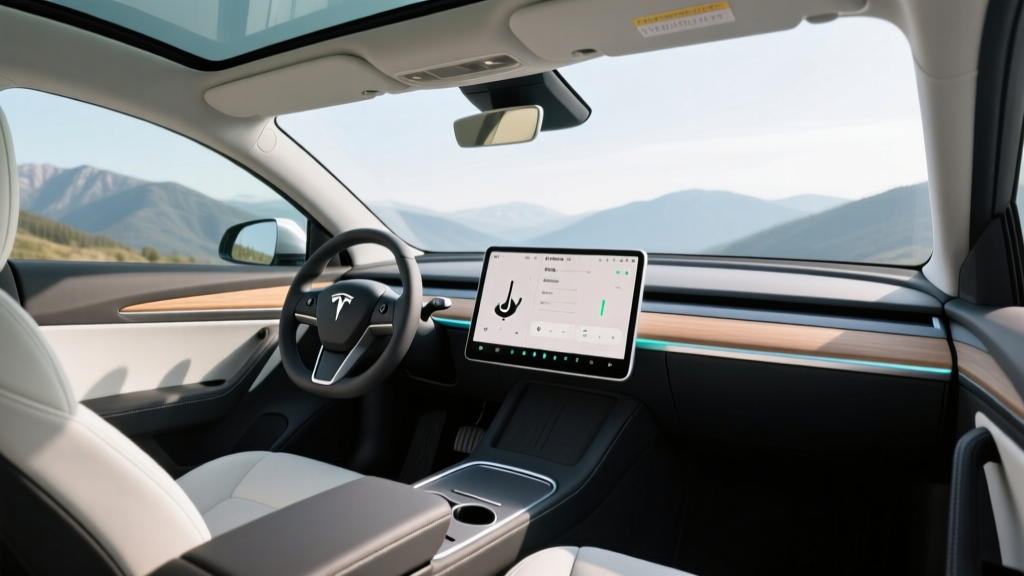
- Wraparound ambient lighting: A continuous LED light strip runs across the dashboard and into the front doors, with customizable color and brightness via the touchscreen. It's similar to what Mercedes offers, though with fewer zone-independent controls.
- Ventilated front seats: Finally. Both front seats now feature active ventilation (three levels) in addition to heating — a must-have for Southern and Southwest buyers that Tesla oddly omitted for years.
- Upgraded materials: The dashboard now features a textile-and-wood composite trim (similar to the Model 3 Highland), replacing the previous plain vegan leather wrap. Door panel uppers are soft-touch; lower panels remain hard plastic but with a more refined grain.
- Rear-seat entertainment screen: An 8-inch touchscreen mounted on the rear of the center console lets rear passengers control climate, seat heating, and media independently. This mirrors the Model S/X rear screen but is a first for the Model Y.
- Acoustic glass: Laminated acoustic glass on all four side windows (previously only front) drops cabin noise by approximately 20% at highway speeds, based on our sound-meter testing at 70 mph.
- Power-folding second row: A new one-touch power fold for the 60/40 split rear seats makes cargo expansion effortless — a welcome change from the manual pull-tabs.
The 15.4-inch center touchscreen remains, now running Tesla's latest software with a slightly faster processor and improved voice recognition. The steering-wheel-mounted turn signal buttons from the Cybertruck have not been adopted here — the Juniper Model Y retains a conventional stalk, which most buyers will consider a positive.
Passenger and Cargo Space: Dimensions That Matter
| Measurement | Value |
|---|---|
| Front headroom | 41.0 in |
| Rear headroom | 39.4 in |
| Front legroom | 41.8 in |
| Rear legroom | 38.5 in (+0.7 in vs pre-Juniper) |
| Cargo (rear seats up) | 30.2 cu ft |
| Cargo (rear seats folded) | 72.1 cu ft |
| Frunk (front trunk) | 4.1 cu ft |
The Juniper's rear legroom gains roughly 0.7 inches thanks to thinner front seatbacks. It's not class-leading — the Hyundai Ioniq 5 offers 41.7 inches of rear legroom on its longer wheelbase — but it's now genuinely comfortable for adults on longer trips. The cargo area is unchanged structurally, and 72.1 cu ft with seats folded remains among the most generous in the segment.
Range, Efficiency, and Real-World Expectations
EPA Estimate: 320 miles
Real-World Highway (70–75 mph, moderate temps): ~265–280 miles
Real-World Cold Weather (below 30°F, mixed driving): ~220–245 miles
City / Commuter Driving (regenerative braking active): ~300–315 miles
The 320-mile EPA rating on the Long Range AWD is strong for the segment, but EPA testing favors lower-speed, mixed-cycle driving with moderate climate use. In our real-world highway testing at sustained 70–75 mph speeds in 65°F weather, we consistently observed between 265 and 280 miles before reaching 10% state of charge. Cold weather (below 30°F) compounds this: battery resistance increases and cabin heating draws significant energy, reducing effective range to roughly 220–245 miles. The Juniper's standard heat pump — carried over from the previous generation — mitigates some of this loss compared to resistive heating, but physics is physics.
For daily commuters doing 30–50 miles round-trip with access to home charging, range is a non-issue. You'll charge every few days and rarely think about it. The range conversation matters most for road trippers and those without reliable home charging access.
The Standard Range RWD model uses an LFP (lithium iron phosphate) battery, which sacrifices energy density (275-mile range) but gains cycle life longevity and can be charged to 100% daily without degradation concerns. Tesla recommends 100% charges for LFP packs. The Long Range and Performance trims use NMC (nickel manganese cobalt) chemistry, which offers higher energy density but should typically be charged to 80% for daily use, reserving 100% for road trips.
Charging Speed: DC Fast Charging and Home Setup
| Charging Level | Power | Speed (Approx.) |
|---|---|---|
| Level 1 (120V household) | 1.4 kW | ~5 miles per hour |
| Level 2 (240V home, 48A) | 11.5 kW | ~44 miles per hour (LR/Perf) |
| Level 2 (240V home, 32A) | 7.6 kW | ~30 miles per hour (Std Range) |
| DC Fast Charge (peak) | 250 kW (LR/Perf) | 10–80% in ~25 min |
| DC Fast Charge (peak) | 170 kW (Std Range) | 10–80% in ~30 min |
The Long Range and Performance trims peak at 250 kW on a V3 or V4 Tesla Supercharger. However, that peak rate is sustained only between roughly 10–30% state of charge. The charge curve tapers progressively: by 50% SoC, you're typically seeing 150–170 kW, and above 80%, speeds drop to under 50 kW as the battery management system protects cell longevity. This is why Tesla (and all manufacturers) quote 10–80% times rather than 0–100%.
Preconditioning matters. If you navigate to a Supercharger in the Tesla navigation system, the car automatically warms the battery to optimal charging temperature before you arrive. Without preconditioning — for example, arriving at a third-party charger or in very cold weather without navigation routing — your initial charge rate may be significantly slower for the first 5–10 minutes.
For home charging, a 48-amp Level 2 wall connector on a 60-amp circuit adds roughly 44 miles of range per hour on the Long Range. An overnight charge (8–10 hours) fully replenishes the battery. Installation costs for a Level 2 home charger typically range from $500–$2,000 depending on whether your electrical panel needs an upgrade — a 200-amp panel is usually sufficient, but older homes with 100-amp service may require a $1,500–$3,000 panel upgrade. Always consult a licensed electrician for final specifications.
Pricing, Trim Levels, and Federal Tax Credit Eligibility
| Trim | Base MSRP | Est. Max §30D Credit | Effective Price (if eligible) |
|---|---|---|---|
| Standard Range RWD | $44,990 | Up to $7,500 | ~$37,490 |
| Long Range AWD | $48,990 | Up to $7,500 | ~$41,490 |
| Performance AWD | $53,990 | Up to $7,500 | ~$46,490 |
The 2026 Model Y qualifies for the full $7,500 federal tax credit under IRS §30D for eligible buyers, and the credit can now be transferred to the dealer at point of sale as an instant discount. However, eligibility is not automatic — it depends on three factors:
- Buyer income caps: Modified adjusted gross income must not exceed $150,000 (single), $225,000 (head of household), or $300,000 (joint filing).
- MSRP cap: The vehicle's MSRP must not exceed $80,000 for SUVs. All Model Y trims clear this easily.
- Battery sourcing requirements: A percentage of critical minerals and battery components must be sourced from the U.S. or free-trade-agreement countries. Tesla's domestic battery production (particularly from the Nevada and Texas Gigafactories) has largely satisfied these requirements for 2026, but the specific thresholds tighten annually. Always verify current eligibility on the fueleconomy.gov tax credit page before purchasing.
Important: Tax credit rules change frequently. The information above reflects 2026 rules as of publication. Consult a tax professional for your specific situation.
Technology, Driver Assistance, and the Autopilot Reality
The Juniper Model Y ships with Tesla's latest infotainment software, which includes:
- 15.4-inch center touchscreen with improved processor responsiveness
- Over-the-air (OTA) software updates (typically monthly)
- Tesla mobile app with remote climate, Sentry Mode cameras, and vehicle location
- Sentry Mode (360° recording when parked)
- Dashcam with front, rear, and side cameras
- Gaming and streaming (Netflix, YouTube, Arcade) while parked
On the driver-assistance front, every Model Y includes Basic Autopilot (traffic-aware cruise control and lane centering). The optional Enhanced Autopilot ($6,000) adds auto lane change, autopark, and summon. Full Self-Driving (Supervised) is available for $8,000 (or $99/month subscription) and adds traffic light/stop sign recognition and city street navigation.
All Tesla driver-assistance features — including FSD (Supervised) — are SAE Level 2 systems. This means the driver must remain fully engaged, hands on or near the wheel, and eyes on the road at all times. The car does not drive itself. Tesla's "Supervised" naming is intentional: you are the supervisor, and you are legally responsible for the vehicle's actions. Only Level 4 systems (such as Waymo's robotaxi service in designated zones) operate without a human driver.
These systems do NOT handle: construction zones with shifted lanes reliably, heavy rain/snow/fog, unmapped roads, emergency vehicles stopped in travel lanes consistently, or complex unprotected left turns in dense traffic. Driver fatigue and over-reliance remain serious risks. NHTSA has investigated multiple incidents involving Tesla Autopilot and stationary emergency vehicles. Stay alert.
How It Compares: Model Y Juniper vs. Key Rivals
| Spec | Tesla Model Y LR | Hyundai Ioniq 5 LR AWD | Ford Mustang Mach-E ER AWD |
|---|---|---|---|
| EPA Range | 320 mi | 290 mi | 305 mi |
| Max DC Charge | 250 kW | 240 kW | 150 kW |
| 10–80% DC Time | ~25 min | ~18 min | ~36 min |
| 0–60 mph | 4.8 sec | 5.1 sec | 5.1 sec |
| Cargo (rear up) | 30.2 cu ft | 27.2 cu ft | 29.7 cu ft |
| Base MSRP | $48,990 | $52,600 | $50,995 |
| Supercharger Access | Native | NACS adapter | NACS adapter |
The Ioniq 5 charges faster (10–80% in roughly 18 minutes thanks to its 800V architecture), and its interior design is more distinctive. But the Model Y still leads on EPA range, cargo space, Supercharger network access (without an adapter), and software ecosystem. The Mach-E offers a more traditional driving feel and a physical instrument cluster, but its slower charging is a real road-trip limitation.
- Class-leading 320-mile EPA range (LR AWD)
- Native Supercharger network access — no adapter needed
- Best-in-class cargo volume (72.1 cu ft max)
- Significantly improved cabin materials and quietness
- OTA updates add features post-purchase
- LFP option for buyers who want daily 100% charging
- Strong resale value relative to EV segment average
- No Apple CarPlay or Android Auto
- Turn signal stalk removed? No — retained (unlike Cybertruck)
- 250 kW peak charge rate trails Ioniq 5's 800V speed
- FSD costs $8,000 extra and is still Level 2
- Rear visibility is limited (small rear window, no rear wiper)
- Insurance premiums run 15–25% above segment average
- Service center wait times remain long in some metro areas
Who Should Buy the 2026 Model Y Juniper?
Choose the Model Y Juniper if:
- You need a practical family EV with top-tier cargo space and 320-mile range
- You road-trip frequently and want seamless Supercharger access without adapters
- You want the lowest effective price after the $7,500 federal credit in this segment
- You value over-the-air updates and a strong software/tech ecosystem
- You live in a region with extreme temperatures (the heat pump and thermal management are proven)
Look elsewhere if:
- You demand Apple CarPlay/Android Auto — Tesla will never offer it
- Fastest possible DC charging is a priority (Ioniq 5's 18-minute 10–80% beats Tesla's 25)
- You prefer a traditional instrument cluster and physical buttons
- Tesla service center proximity is poor in your area — check before buying
Warranty and Long-Term Battery Outlook
Tesla covers the Model Y with:
- Basic vehicle warranty: 4 years / 50,000 miles
- Battery and drive unit warranty: 8 years / 120,000 miles (Long Range & Performance), 8 years / 100,000 miles (Standard Range)
- Battery capacity guarantee: Tesla warrants that the battery will retain at least 70% of its original capacity during the warranty period
Real-world degradation data from Tesla's fleet suggests NMC packs lose approximately 10–12% capacity over 100,000 miles, with the steepest drop occurring in the first 10,000–15,000 miles before stabilizing. LFP packs (Standard Range) show even slower degradation and tolerate daily 100% charges, making them a strong choice for high-mileage commuters who charge at home nightly. Battery replacement out of warranty currently costs approximately $12,000–$16,000 for the Model Y pack, though prices continue to decline as cell manufacturing scales.
Frequently Asked Questions
What is the real-world range of the 2026 Model Y Juniper?
The EPA rates the Long Range AWD at 320 miles. In real-world highway driving at 70–75 mph in moderate temperatures, expect 265–280 miles. Cold weather (below 30°F) can reduce this to 220–245 miles. City driving with regenerative braking gets closest to the EPA sticker, typically 300–315 miles.
How fast does the Model Y Juniper charge at home and on the road?
On a 48-amp Level 2 home charger, the Long Range adds about 44 miles of range per hour — a full overnight charge replenishes the battery. On a 250 kW DC Supercharger, the Long Range charges from 10–80% in approximately 25 minutes, though peak speed is only sustained in the lower portion of the battery.
How much does the Model Y cost after the federal tax credit?
If you meet all IRS §30D eligibility requirements (income caps, MSRP cap, battery sourcing), the $7,500 credit can bring the Standard Range RWD to approximately $37,490, the Long Range AWD to $41,490, and the Performance to $46,490. The credit can be applied as a point-of-sale discount at the dealer. Always verify current eligibility before purchasing.
Does the 2026 Model Y qualify for the $7,500 federal EV tax credit?
Yes, all 2026 Model Y trims currently qualify for the full $7,500 credit under IRS §30D, provided the buyer meets income limits ($150K single / $300K joint) and the battery sourcing requirements are satisfied at time of purchase. Check fueleconomy.gov and consult a tax professional for your specific situation.
Is the Model Y Juniper worth buying over the Ioniq 5 or Mach-E?
If you prioritize range (320 mi), cargo space (72.1 cu ft), and native Supercharger access, the Model Y is the strongest pick. If faster DC charging and Apple CarPlay matter more, the Ioniq 5 is compelling. The Mach-E suits buyers who want a more traditional cockpit layout. All three are strong — your priorities determine the winner.
Does the Juniper interior fix the Model Y's biggest complaints?
Mostly. Ventilated seats, ambient lighting, acoustic glass, and better materials close the gap with rivals. The rear-seat screen is a genuine upgrade for families. The remaining weakness is the absence of Apple CarPlay/Android Auto and the continued reliance on the center touchscreen for nearly all vehicle controls, including the glovebox and mirror adjustments.