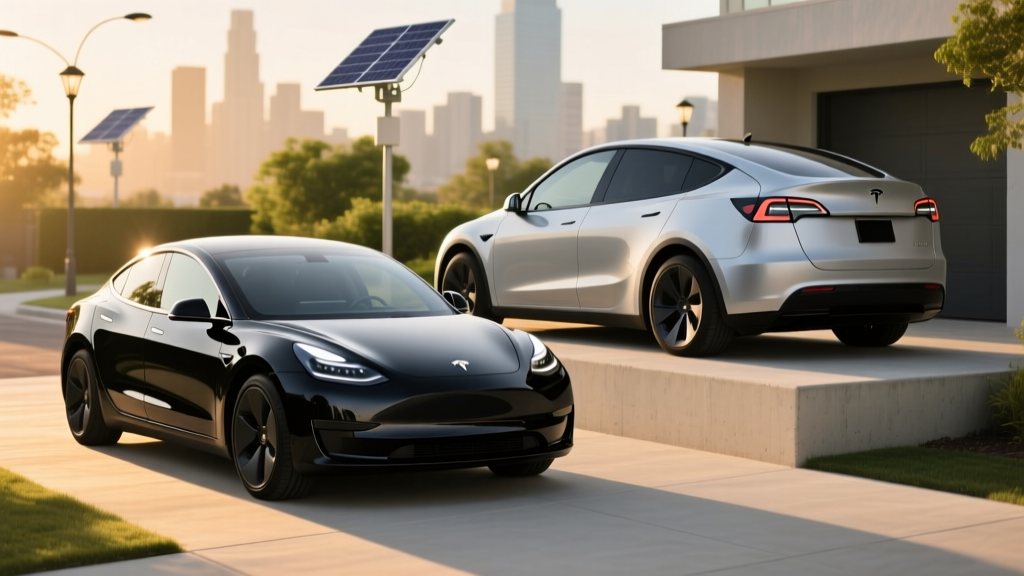
In late 2025, Tesla made a move that sent ripples through the EV community: it quietly removed Autosteer — the lane-centering component of its Basic Autopilot suite — from the base trims of the Model 3 and Model Y. For 2026, buyers of the entry-level Rear-Wheel Drive (RWD) variants get Tesla's Traffic-Aware Cruise Control but must pay extra or step up in trim to regain hands-on lane-keeping assistance. This article reviews both vehicles in the context of this controversial change, with full specs, real-world range data, charging performance, pricing, and a verdict on whether they remain the EVs to beat.
The Autosteer Removal Explained
Autosteer is the SAE Level 2 lane-centering feature that keeps the vehicle positioned within lane markings while cruise control manages speed. It is not self-driving — the driver must keep hands on the wheel and eyes on the road at all times. In prior model years, Autosteer was bundled into every Tesla at no additional cost as part of "Basic Autopilot."
For 2026, Tesla restructured its driver-assist packaging:
- Base RWD trims (Model 3 & Model Y): Include Traffic-Aware Cruise Control (TACC) only. Autosteer is no longer standard.
- Long Range and Performance trims: Autosteer remains included as before.
- Autosteer Add-On: Available as a standalone subscription (~$99/month) or one-time purchase (~$2,000) on base trims.
- Full Self-Driving (Supervised): Still available as an $8,000 option or $99/month subscription across all trims; includes Autosteer plus additional features like Navigate on Autopilot, Auto Lane Change, and Smart Summon.
This shift follows Tesla's broader strategy of unbundling software features to create recurring revenue streams. Critics argue it degrades the value proposition of the base cars; supporters note that TACC alone is sufficient for many highway commuters and that the subscription model offers flexibility.
2026 Tesla Model 3: Specs, Range, and Real-World Performance
The refreshed "Highland" Model 3 continues into 2026 with the same powertrain options introduced in the 2024 redesign. It remains one of the most efficient electric sedans on the market.
| Spec | RWD (Base) | Long Range AWD | Performance AWD |
|---|---|---|---|
| EPA Range | 272 mi | 341 mi | 315 mi |
| Battery (usable) | ~57.5 kWh (LFP) | ~75 kWh (NMC) | ~75 kWh (NMC) |
| Drivetrain | RWD, single motor | AWD, dual motor | AWD, dual motor |
| Horsepower | 271 hp | 346 hp | 510 hp |
| 0-60 mph | 5.8 sec | 4.2 sec | 2.9 sec |
| MPGe (combined) | 132 MPGe | 117 MPGe | 112 MPGe |
| Efficiency | 25 kWh/100mi | 28 kWh/100mi | 30 kWh/100mi |
| Max DC Charge Rate | 170 kW | 250 kW | 250 kW |
| 10-80% DC Time | ~25 min | ~20 min | ~20 min |
| Level 2 Home Charging | 11.5 kW (~44 mi/hr) | 11.5 kW (~44 mi/hr) | 11.5 kW (~44 mi/hr) |
| Base MSRP | $38,990 | $45,990 | $52,990 |
| Cargo Volume | 23 cu ft (trunk + frunk) | 23 cu ft | 23 cu ft |
The RWD Model 3 uses lithium iron phosphate (LFP) battery chemistry, which offers a longer cycle life and greater thermal stability compared to NMC, though at the cost of lower energy density and reduced cold-weather performance. Tesla recommends charging LFP batteries to 100% regularly for calibration, unlike NMC packs where 80-90% daily limits are preferred. The Long Range and Performance trims use NMC (nickel manganese cobalt) chemistry for higher energy density.
2026 Tesla Model Y: Specs, Range, and Real-World Performance
The Model Y received its "Juniper" refresh for the 2025 model year, bringing a redesigned interior, improved suspension tuning, and slightly revised battery management. The 2026 model year carries over these updates.
| Spec | RWD (Base) | Long Range AWD | Performance AWD |
|---|---|---|---|
| EPA Range | 260 mi | 320 mi | 295 mi |
| Battery (usable) | ~57.5 kWh (LFP) | ~75 kWh (NMC) | ~75 kWh (NMC) |
| Drivetrain | RWD, single motor | AWD, dual motor | AWD, dual motor |
| Horsepower | 295 hp | 384 hp | 510 hp |
| 0-60 mph | 6.6 sec | 4.8 sec | 3.5 sec |
| MPGe (combined) | 123 MPGe | 111 MPGe | 108 MPGe |
| Efficiency | 27 kWh/100mi | 30 kWh/100mi | 31 kWh/100mi |
| Max DC Charge Rate | 170 kW | 250 kW | 250 kW |
| 10-80% DC Time | ~25 min | ~20 min | ~20 min |
| Level 2 Home Charging | 11.5 kW (~40 mi/hr) | 11.5 kW (~40 mi/hr) | 11.5 kW (~40 mi/hr) |
| Base MSRP | $44,990 | $49,990 | $54,990 |
| Cargo Volume | 76 cu ft (seats folded) | 76 cu ft | 76 cu ft |
| Rear Legroom | 41.6 in | 41.6 in | 41.6 in |
Charging Performance: What You Need to Know
Tesla's Supercharger network remains the gold standard for public DC fast charging, and both the Model 3 and Model Y take full advantage. However, there are important nuances about the charge curve that Tesla's marketing doesn't emphasize.
| Charging Level | Model 3 RWD | Model 3 LR/Perf | Model Y RWD | Model Y LR/Perf |
|---|---|---|---|---|
| Level 1 (120V, 12A) | ~1.4 kW / ~5 mi/hr | ~1.4 kW / ~4 mi/hr | ~1.4 kW / ~4 mi/hr | ~1.4 kW / ~4 mi/hr |
| Level 2 (240V, 48A) | 11.5 kW / ~44 mi/hr | 11.5 kW / ~44 mi/hr | 11.5 kW / ~40 mi/hr | 11.5 kW / ~40 mi/hr |
| DC Fast (peak) | 170 kW | 250 kW | 170 kW | 250 kW |
| 10-80% DC Time | ~25 min | ~20 min | ~25 min | ~20 min |
Charge curve reality check: The 250 kW peak rate on Long Range and Performance trims is only sustained between roughly 10-30% State of Charge (SoC). From 30-60%, the rate tapers to approximately 150-180 kW, and above 80%, it drops sharply to under 50 kW to protect battery health. This means the advertised "20-minute 10-80%" time assumes optimal battery preconditioning — which the car handles automatically when you navigate to a Supercharger. If you arrive at a charger without preconditioning (e.g., a non-Tesla DC fast charger without navigation routing), expect 30-40 minutes for the same session.
The LFP-equipped RWD models peak at 170 kW and have a flatter charge curve, meaning they sustain a more consistent rate but never hit the NMC trims' peaks. For home Level 2 charging on a 48-amp circuit (requiring a 60-amp breaker), a full overnight charge from 20-100% takes approximately 6-8 hours depending on trim.
Pricing, Tax Credits, and True Cost
The Model 3 RWD at $38,990 and Model Y RWD at $44,990 are attractively priced, but the federal §30D tax credit eligibility requires careful attention to current rules.
| Trim | MSRP | Est. §30D Credit | Effective Price |
|---|---|---|---|
| Model 3 RWD | $38,990 | Up to $7,500* | ~$31,490 |
| Model 3 Long Range | $45,990 | Up to $7,500* | ~$38,490 |
| Model 3 Performance | $52,990 | Up to $7,500* | ~$45,490 |
| Model Y RWD | $44,990 | Up to $7,500* | ~$37,490 |
| Model Y Long Range | $49,990 | Up to $7,500* | ~$42,490 |
| Model Y Performance | $54,990 | Up to $7,500* | ~$47,490 |
- MSRP cap: Sedans (Model 3) must be under $55,000; SUVs/trucks/vans (Model Y) under $80,000. All current trims qualify.
- Buyer income cap: Modified AGI must not exceed $150,000 (single), $225,000 (head of household), or $300,000 (joint).
- Battery sourcing: Critical minerals and battery components must meet escalating domestic-content thresholds. As of 2026, vehicles with battery components from a "foreign entity of concern" (FEOC) are disqualified. Tesla's US-built packs have generally met requirements, but always verify on the IRS clean vehicle credit page before purchasing.
- Point-of-sale transfer: You can transfer the credit to the dealer at purchase for an immediate price reduction, rather than waiting for a tax refund.
- Consult a tax professional — eligibility depends on your specific tax situation.
Tech, Interior, and the Autosteer Impact on Daily Driving
Both the Model 3 and Model Y share Tesla's minimalist interior architecture: a single 15.4-inch center touchscreen handles all infotainment, climate, and vehicle controls. There is no instrument cluster — speed and navigation appear in the upper-left corner of the main display. The Juniper-refreshed Model Y adds ambient lighting, ventilated front seats, and a rear-seat touchscreen for passengers.
Key tech features across both models:
- Over-the-air (OTA) software updates that regularly add features
- Tesla app with remote climate control, charging monitoring, and Sentry Mode alerts
- Sentry Mode dashcam recording with USB export
- Phone-as-key with Bluetooth proximity unlock
- Native navigation with real-time Supercharger routing and preconditioning
- HEPA air filtration (Bioweapon Defense Mode) on Long Range and Performance trims
With Autosteer removed from base trims, RWD owners lose lane-centering assistance. Traffic-Aware Cruise Control still maintains following distance and speed, but the driver must actively steer at all times. For highway commuters who rely on Autosteer to reduce fatigue on long stretches, this is a meaningful downgrade. The $99/month subscription or $2,000 one-time purchase to restore Autosteer adds to the effective cost of the base trims.
Warranty and Battery Longevity
Tesla's warranty coverage remains competitive:
- Basic Vehicle Limited Warranty: 4 years / 50,000 miles
- Battery & Drive Unit Warranty (RWD): 8 years / 100,000 miles, with minimum 70% capacity retention
- Battery & Drive Unit Warranty (Long Range / Performance): 8 years / 120,000 miles, with minimum 70% capacity retention
The LFP battery in the RWD models is expected to exhibit less degradation over time compared to NMC, with real-world data from high-mileage Teslas showing 10-15% capacity loss after 150,000 miles for NMC packs and potentially less for LFP. Battery replacement out of warranty remains expensive — approximately $12,000-$16,000 for a Model 3/Y pack — but most owners will never need one within the vehicle's practical lifespan.
How Do They Compare to Key Competitors?
The Autosteer removal narrows the value gap between Tesla and rivals that include full ADAS suites as standard. Here's how the key competitors stack up:
| Vehicle | EPA Range | DC Charge (10-80%) | Base MSRP | Standard ADAS |
|---|---|---|---|---|
| Tesla Model 3 RWD | 272 mi | ~25 min | $38,990 | TACC only (no Autosteer) |
| Hyundai Ioniq 6 SE | 361 mi | ~18 min (800V) | $42,900 | Full Highway Driving Assist |
| BMW i4 eDrive40 | 307 mi | ~31 min | $57,900 | Driving Assistant Professional |
| Tesla Model Y LR | 320 mi | ~20 min | $49,990 | Autosteer included |
| Hyundai Ioniq 5 SEL | 310 mi | ~18 min (800V) | $47,500 | Full Highway Driving Assist |
| Ford Mustang Mach-E Select | 250 mi | ~35 min | $44,990 | BlueCruise (1-yr trial) |
The EPA's fueleconomy.gov data confirms that the Hyundai Ioniq 6 leads the sedan segment in range, and its 800-volt architecture enables faster DC charging than any Tesla. However, Tesla's Supercharger network remains significantly more reliable and widespread than third-party networks like Electrify America or EVgo, which is a major practical advantage for road trippers.
✓ Pros — Model 3 & Model Y
- Best-in-class Supercharger network access
- Class-leading efficiency (kWh/100mi)
- OTA updates continuously add features
- Strong resale value relative to most EVs
- Spacious Model Y cargo area (76 cu ft)
- LFP battery in RWD offers superior longevity
- Point-of-sale tax credit transfer available
✗ Cons — Model 3 & Model Y
- Autosteer removed from base RWD trims
- No physical buttons — all controls via touchscreen
- RWD LFP battery loses more range in cold weather
- 170 kW peak DC charge on RWD (slower than rivals)
- No Apple CarPlay or Android Auto
- Repair costs and insurance premiums above average
- Minimal dealer service network vs legacy brands
Who Should Buy the Model 3 or Model Y in 2026?
Choose the Model 3 if:
- You want the most efficient electric sedan under $45,000 (after tax credit)
- Your commute is under 50 miles round-trip and you charge at home
- You value performance — even the base RWD hits 60 mph in 5.8 seconds
- You don't mind the lack of Autosteer on the base trim, or you're willing to subscribe
Choose the Model Y if:
- You need crossover cargo space (76 cu ft with seats folded) for family gear or groceries
- You regularly carry rear-seat passengers who benefit from the elevated ride height and legroom
- You want available AWD for snow-belt climates
- You road-trip frequently and value the Supercharger network's reliability
Consider a competitor if:
- Standard lane-centering ADAS is non-negotiable (Hyundai Ioniq 5/6, Ford Mach-E)
- You need faster DC charging for frequent long trips (Hyundai/Kia 800V platforms)
- You prefer Apple CarPlay/Android Auto integration
- You want a traditional dealer service experience
Frequently Asked Questions
What is the real-world range of the Model 3 and Model Y?
For the Model 3 RWD, expect 230-245 highway miles in moderate weather, dropping to 185-210 in cold conditions. The Model 3 Long Range delivers 285-300 highway miles in good conditions. For the Model Y, the Long Range AWD manages 265-285 highway miles, and the RWD base manages 215-230. All figures assume 70-75 mph cruising speeds. See fueleconomy.gov for official EPA data.
How fast do the Model 3 and Model Y charge at home and on the road?
On a home Level 2 charger (240V, 48A), both vehicles charge at 11.5 kW, adding approximately 40-44 miles of range per hour. A full overnight session easily replenishes a day's driving. On DC fast chargers, the RWD trims peak at 170 kW (10-80% in ~25 minutes), while Long Range and Performance trims peak at 250 kW (10-80% in ~20 minutes), assuming proper battery preconditioning via navigation routing.
How much does a Model 3 or Model Y cost after the federal tax credit?
If you qualify for the full $7,500 §30D credit and the vehicle meets battery-sourcing requirements, the Model 3 RWD drops to approximately $31,490 and the Model Y RWD to approximately $37,490. Eligibility depends on your income (under $150K single / $300K joint), the vehicle's MSRP (all trims qualify), and battery component sourcing. The credit can be applied at the point of sale as an immediate discount. Always verify current eligibility on IRS.gov.
Is the Model 3 or Model Y still worth buying without standard Autosteer?
It depends on your priorities. If lane-centering assist is essential for your commute, the $2,000 add-on or $99/month subscription adds cost. However, Tesla's core strengths — Supercharger network, efficiency, OTA updates, and performance — remain intact. Competitors like the Hyundai Ioniq 5/6 include full ADAS standard but lack the Supercharger ecosystem. If you primarily drive in the city or on short commutes where TACC alone suffices, the base trims remain excellent values.
Does the Model 3 or Model Y qualify for the federal EV tax credit in 2026?
Both vehicles are assembled in the US (Fremont, CA and Austin, TX) and all trims fall under the MSRP caps ($55,000 for sedans, $80,000 for SUVs). Eligibility for the full $7,500 depends on battery critical-mineral and component sourcing requirements, which Tesla has generally met but which change annually. Buyer income caps also apply. Confirm the specific VIN's eligibility on the IRS clean vehicle credit lookup tool before purchasing.
What's the difference between LFP and NMC batteries in these cars?
The RWD trims use LFP (lithium iron phosphate) chemistry: longer cycle life, better thermal stability, lower cost, and Tesla recommends 100% charging for calibration. The trade-off is lower energy density (less range per kg) and worse cold-weather performance. The Long Range and Performance trims use NMC (nickel manganese cobalt) for higher range and better cold-weather output, but Tesla recommends limiting daily charges to 80-90% to preserve longevity.
Is Tesla's Autopilot or FSD self-driving?
No. Both Autopilot (including Autosteer) and Full Self-Driving (Supervised) are SAE Level 2 driver-assistance systems. The driver must remain fully engaged — hands on wheel, eyes on road — at all times. The "Supervised" in FSD's name is deliberate: you are the supervisor. Only Level 4 services like Waymo's robotaxis operate without a human driver, and those are limited to specific geofenced areas.
Sources: EPA fueleconomy.gov, IRS §30D Clean Vehicle Credits, Tesla Model 3 Owner's Manual, NHTSA. Pricing and credit eligibility reflect 2026 model year data and are subject to change. Verify all figures with the manufacturer and a tax professional before purchasing.