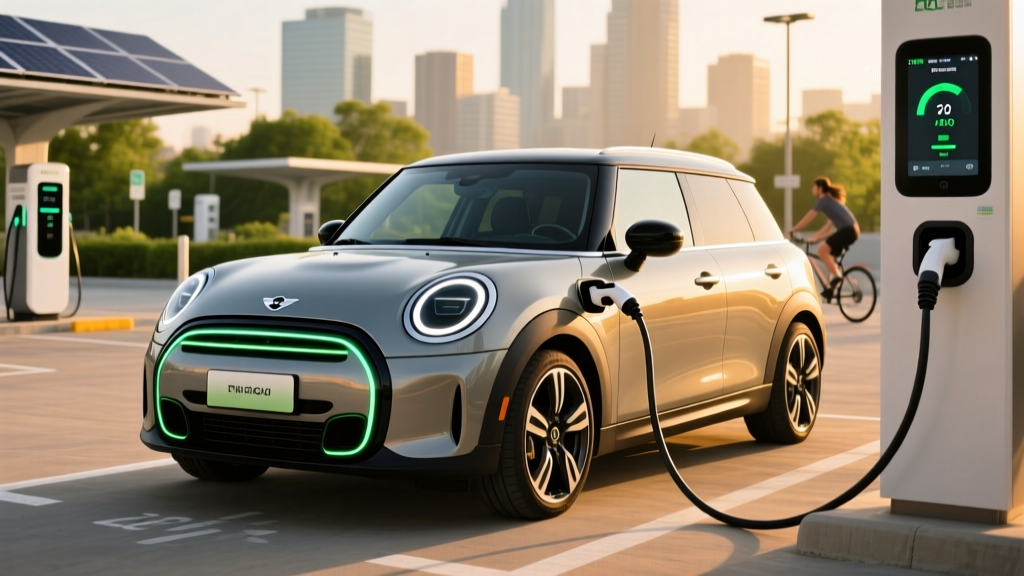
The compact EV segment has no shortage of hatchbacks, but the 2026 Mini Cooper SE Countryman (the closest thing to a mini electric wagon in Mini's lineup) carves out a distinct niche. It blends the brand's signature go-kart handling with genuine cargo practicality — 17.7 cubic feet behind the rear seats and a usable all-electric powertrain. After spending time with the Countryman SE ALL4, here is everything you need to know about its real-world range, charging behavior, pricing, and whether it earns a spot in your garage.
Quick Verdict: Who Is This Mini Electric Wagon For?
The 2026 Mini Cooper SE Countryman is best suited for urban and suburban drivers who want a premium-badged compact EV with wagon-like cargo flexibility. It excels as a daily commuter and weekend hauler for small families or active couples. It is not a road-trip champion — the 162-mile EPA range and modest DC fast-charge rate mean long highway stretches require planning. If your commute is under 60 miles round-trip and you have home Level 2 charging, this EV is a strong match. If you regularly drive 200+ miles between charges, look at the Hyundai Ioniq 5 or Tesla Model Y instead.
Choose the Mini Countryman SE if: You prioritize compact dimensions, premium interior feel, and cargo versatility in a city-friendly EV.
Look elsewhere if: You need 300+ mile range, ultra-fast DC charging, or three-row seating.
Range, Efficiency, and Real-World Expectations
| Spec | Value |
|---|---|
| EPA Range | 162 miles |
| Battery (usable) | 64.7 kWh (NMC) |
| Efficiency | 105 MPGe combined / 32 kWh/100mi |
| Drivetrain | Dual-motor AWD (ALL4) |
| Horsepower | 308 hp combined |
| 0-60 mph | 5.4 seconds |
| Cargo (rear seats up) | 17.7 cu ft |
| Cargo (rear seats folded) | 51.2 cu ft |
| Base MSRP | $46,200 (SE ALL4) |
| Battery Warranty | 8 years / 100,000 miles |
EPA sticker: 162 miles
Real-world expectation: In mixed city/highway driving at 65-70°F, expect roughly 145-155 miles. On sustained 75-mph highway runs, range drops to approximately 125-135 miles. In cold weather (below 32°F) without preconditioning, plan for 110-125 miles. The Countryman SE's boxy wagon profile creates more aerodynamic drag than a sleek sedan, which hits highway efficiency harder.
Mini equips the Countryman SE with a 64.7 kWh usable nickel-manganese-cobalt (NMC) battery pack. NMC chemistry offers higher energy density than LFP, which keeps the pack compact under the floor — critical for preserving cargo space in a vehicle this size. The trade-off is that NMC batteries prefer not to sit at 100% state of charge for extended periods; daily charging to 80-90% is ideal for longevity.
Efficiency lands at 105 MPGe combined per EPA testing, or about 32 kWh per 100 miles. That is competitive with the BMW iX1 but trails the more aerodynamic Hyundai Ioniq 5 (114 MPGe). In practical terms, a full home charge at the US average electricity rate of $0.17/kWh costs roughly $11.00 — translating to about $0.068 per mile driven.
Charging Speed: DC Fast, Level 2, and Level 1
Charging is where the Countryman SE reveals its most notable limitation for road-trip use. The peak DC fast-charge rate is 130 kW, and like most EVs, it does not sustain that peak for the entire session.
| Charging Level | Power / Rate | Speed / Time |
|---|---|---|
| Level 1 (120V household) | ~1.4 kW | ~4 miles per hour |
| Level 2 (240V, 11 kW onboard) | 11 kW | ~33 miles per hour; 0-100% in ~6.5 hours |
| DC Fast Charge (CCS) | Peak 130 kW | 10-80% in ~29 minutes |
The 10-80% DC fast-charge time of approximately 29 minutes is acceptable for a lunch stop but noticeably slower than competitors like the Hyundai Ioniq 5 (18 minutes at 240 kW) or the Tesla Model Y (15 minutes at 250 kW on V3 Superchargers). The charge curve tapers significantly above 80% — if you need to charge past 80% at a public station, expect the final 20% to add another 20-25 minutes.
At home on a Level 2 charger (240V, 48-amp circuit recommended), the 11 kW onboard charger replenishes the battery fully overnight in about 6.5 hours. Most owners will plug in each evening and wake up to a full battery — this is the ideal ownership pattern for a 162-mile-range EV. Important note for home charging: A 48-amp Level 2 charger requires a dedicated 60-amp circuit. Budget $800-$2,200 for professional installation depending on your electrical panel's proximity to the garage and whether a panel upgrade is needed.
The Countryman SE uses the CCS1 connector for DC fast charging and J1772 for Level 2 AC. Mini has confirmed NACS adapter compatibility for Tesla Supercharger access, though the native port remains CCS for the 2026 model year.
Performance and Driving Dynamics
The SE ALL4 trim pairs dual electric motors for standard all-wheel drive, producing a combined 308 horsepower and 354 lb-ft of torque. The 0-60 mph sprint takes 5.4 seconds — quick enough to merge confidently onto any freeway and genuinely fun in the twisty urban environments where Minis thrive.
Mini's trademark go-kart handling translates surprisingly well to the electric platform. The battery's low center of gravity and the instant torque delivery make the Countryman SE feel planted and eager. The steering is weighted heavier than most compact crossovers, which enthusiasts appreciate but some commuters may find fatiguing over long stints.
Regenerative braking offers adjustable levels through the Mini app and steering-wheel paddles, but there is no true one-pedal driving mode that brings the car to a complete stop. You will still use the brake pedal in stop-and-go traffic — a minor annoyance for drivers accustomed to full one-pedal operation in a Nissan Leaf or Tesla.
Interior, Cargo, and Technology
The Countryman SE's cabin is where the "mini wagon" concept earns its keep. Behind the rear seats, you get 17.7 cubic feet of cargo space — comparable to a Subaru Crosstrek and enough for a week's groceries or two large suitcases. Fold the 40/20/40 split rear seats and capacity expands to 51.2 cubic feet, accommodating a bicycle or bulky IKEA hauls.
Front legroom measures 40.4 inches; rear legroom is 37.0 inches. Adults up to about 6'2" will be comfortable in the rear for shorter trips, though the slightly elevated floor (due to the battery pack) creates a knees-up seating position that taller passengers notice on longer rides.
The centerpiece of the dashboard is Mini's 9.4-inch circular OLED display, running the latest Mini Operating System 9. It handles navigation, media, climate controls, and vehicle settings. The interface is visually distinctive but consolidates nearly all physical controls into the touchscreen — climate adjustments require multiple taps, which is distracting while driving. Wireless Apple CarPlay and Android Auto are standard.
Driver-assistance features include adaptive cruise control, lane-keeping assist, automatic emergency braking, and parking assistant with surround-view cameras. These constitute an SAE Level 2 system — the driver must remain fully engaged with hands on the wheel and eyes on the road at all times. This is a driver-assist suite, not an autonomous driving system.
Pricing, Trims, and Federal Tax Credit Eligibility
| Trim | Base MSRP | Est. As-Tested | Federal Credit Eligibility |
|---|---|---|---|
| Cooper SE ALL4 (Classic) | $46,200 | $48,500 | Partial — up to $3,750* |
| Cooper SE ALL4 (Signature) | $49,400 | $53,200 | Partial — up to $3,750* |
| John Cooper Works (JCW) ALL4 | $56,900 | $61,500 | Partial — up to $3,750* |
*Federal tax credit eligibility depends on battery component and critical-mineral sourcing requirements under IRS §30D. As of the 2026 tax year, the Countryman SE qualifies for the critical-minerals portion ($3,750) but does not meet the battery-component sourcing threshold for the full $7,500. Always verify current eligibility with a tax professional before purchasing.
§30D Federal Tax Credit Requirements (2026):
- MSRP cap: Vans/SUVs/wagons up to $80,000 — Countryman SE qualifies ✓
- Buyer income cap: $150,000 single / $300,000 joint filers — verify your AGI
- Battery critical minerals: Must be sourced from US or FTA partners ($3,750 portion)
- Battery components: Must be manufactured/assembled in North America ($3,750 portion)
- Point-of-sale transfer available — credit can reduce purchase price at the dealer
After applying the partial $3,750 credit, the base SE ALL4 effectively costs around $42,450. That positions it against the Hyundai Ioniq 5 SE ($42,000 after full $7,500 credit) and the Volvo EX30 ($36,500 after credit). The Mini commands a premium for its brand cachet, interior design, and AWD standard equipment, but value-focused shoppers should weigh that carefully.
Warranty and Long-Term Ownership
Mini backs the Countryman SE's high-voltage battery with an 8-year / 100,000-mile warranty, guaranteeing a minimum of 70% capacity retention. This is the industry-standard threshold shared by BMW, Hyundai, and Kia. If the battery degrades below 70% of its original capacity within the warranty period, Mini will repair or replace it at no cost.
The limited vehicle warranty covers 4 years / 50,000 miles, and complimentary scheduled maintenance is included for 3 years / 36,000 miles. For an EV, scheduled maintenance is minimal — primarily cabin air filter replacement, brake fluid checks, and tire rotation (EVs tend to wear tires faster due to instant torque and heavier curb weight).
Based on NMC degradation data from similar BMW/Mini platforms, owners can expect approximately 8-12% capacity loss over the first 100,000 miles under normal charging habits (avoiding frequent 100% charges and DC fast-charging exclusively). Following the 20-80% daily charging rule and preconditioning before DC fast charges will maximize long-term battery health.
Pros, Cons, and the Competition
Pros
- Premium interior with distinctive design and strong build quality
- Standard AWD on all SE ALL4 trims — rare at this price point
- Wagon-style cargo versatility (51.2 cu ft max) in a compact footprint
- Quick 5.4-second 0-60 with engaging handling dynamics
- 11 kW onboard Level 2 charger (faster than many competitors' 7.2-9.6 kW)
Cons
- 162-mile EPA range is below segment average for 2026
- 130 kW peak DC charging is slow for road trips vs 200+ kW competitors
- Touchscreen-only climate controls are distracting while driving
- Only partial $3,750 federal tax credit (not the full $7,500)
- No true one-pedal driving mode
Against the Hyundai Ioniq 5, the Mini trails on range (303 vs 162 miles), DC charge speed, and tax-credit value, but wins on interior material quality, AWD standard availability, and brand prestige. The Volvo EX30 undercuts the Mini on price and offers faster charging but sacrifices cargo space and rear-seat comfort. The Tesla Model Y dominates on range, Supercharger network access, and technology, but its minimalist interior and larger footprint don't appeal to buyers seeking a compact urban wagon.
Frequently Asked Questions
What is the real-world range of the 2026 Mini Countryman SE?
The EPA rates it at 162 miles, but real-world mixed driving yields approximately 145-155 miles in mild weather. Sustained highway driving at 75 mph reduces that to 125-135 miles. In freezing temperatures without preconditioning, expect as little as 110-125 miles. For a daily commuter covering under 60 miles round-trip, this is plenty with nightly home charging.
How fast does the Mini Countryman SE charge?
On a DC fast charger, it peaks at 130 kW and charges from 10-80% in approximately 29 minutes. At home on Level 2 (240V), the 11 kW onboard charger adds about 33 miles of range per hour and fills the battery fully in roughly 6.5 hours. Level 1 (standard 120V outlet) adds about 4 miles per hour — suitable only as a backup or trickle charge.
Does the Mini Countryman SE qualify for the federal EV tax credit?
It qualifies for the partial $3,750 critical-minerals portion of the §30D credit as of 2026, but does not meet the battery-component sourcing requirement for the full $7,500. Eligibility also depends on your income (under $150,000 single / $300,000 joint) and the vehicle's MSRP being under the $80,000 SUV/wagon cap. The credit can be transferred at the point of sale to reduce your purchase price directly. Consult a tax professional to confirm your individual eligibility.
Is the Mini Countryman SE worth buying over competitors?
It depends on your priorities. If you want a compact, premium-badged AWD EV with wagon cargo flexibility and your commute is under 70 miles, it is a compelling choice. If range and road-trip charging speed are your top concerns, the Hyundai Ioniq 5 or Tesla Model Y are stronger options. The Mini wins on design character, standard AWD, and urban practicality; it loses on efficiency-per-dollar and long-distance convenience.
What is the battery warranty on the Mini Countryman SE?
Mini provides an 8-year / 100,000-mile battery warranty with a 70% capacity retention guarantee. If the high-voltage battery drops below 70% of its original capacity within that window, Mini covers repair or replacement. The general vehicle warranty is 4 years / 50,000 miles.
Can I use Tesla Superchargers with the Mini Countryman SE?
The 2026 Countryman SE uses a native CCS1 port. Mini offers a NACS adapter that enables access to Tesla's V3 and V4 Supercharger network. Charging speeds on Superchargers will be limited by the Countryman's 130 kW peak — you will not see the 250 kW rates that Tesla vehicles achieve, but the network's reliability and coverage are a significant road-trip advantage.