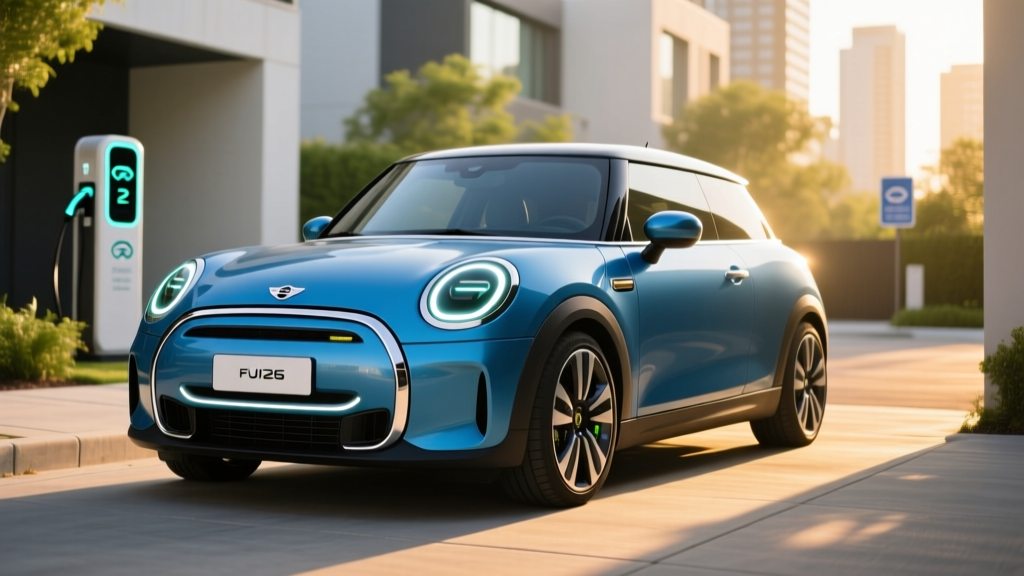
If you have been searching for a Mini Electric Hardtop 2 door for sale, you are likely drawn to its iconic styling, go-kart handling, and premium city-car footprint. The 2026 Mini Cooper Electric (the official U.S. name for the Hardtop 2 Door EV) trades long-range road-trip capability for something rarer in the EV market: genuine driving fun at an approachable price. But with an EPA-estimated range that tops out at 114 miles, this EV demands a clear-eyed look at your daily routine before you sign the paperwork.
We spent time with the 2026 Mini Cooper Electric across city commutes, highway stretches, and DC fast-charging stops to bring you the exact numbers — from sustained charge rates to real-world efficiency — that brochures leave out.
2026 Mini Cooper Electric: Core Specs at a Glance
| Spec | Cooper E (Base) | Cooper SE (Performance) |
|---|---|---|
| EPA Range | 114 miles | 114 miles |
| Battery (usable) | 40.7 kWh (NMC) | 40.7 kWh (NMC) |
| Horsepower | 181 hp | 215 hp |
| Torque | 214 lb-ft | 243 lb-ft |
| 0–60 mph | 6.7 sec | 6.2 sec |
| Drivetrain | FWD (single motor) | FWD (single motor) |
| Max DC Fast Charge | 95 kW | 95 kW |
| 10–80% DC Charge | ~28 min | ~28 min |
| Level 2 AC Charge | 11 kW (~37 mi/hr) | 11 kW (~37 mi/hr) |
| MPGe (city/hwy/combined) | 119 / 105 / 112 | 115 / 101 / 108 |
| Efficiency | 30 kWh/100 mi | 31 kWh/100 mi |
| Base MSRP | $30,900 | $34,900 |
| Battery Warranty | 8 yr / 100,000 mi | 8 yr / 100,000 mi |
Source: EPA / fueleconomy.gov, Mini USA
Real-World Range: What 114 EPA Miles Actually Means
EPA Estimate: 114 miles (Cooper E) / 114 miles (Cooper SE)
Real-World City/Commuting: ~100–110 miles (regen-friendly stop-and-go helps)
Real-World Highway (70+ mph): ~85–95 miles (aerodynamic drag hits the small battery hard)
Cold Weather (below 32°F): ~70–85 miles (expect 20–30% loss without preconditioning)
The 40.7 kWh usable battery (nickel-manganese-cobalt, or NMC, chemistry) is compact by 2026 standards. That makes the Mini Cooper Electric a fundamentally different proposition from a 300-mile Tesla Model 3 or Hyundai Ioniq 6. The range is honest and achievable in mild weather around town, where regenerative braking recaptures energy at every stoplight. On the highway, however, the small battery's buffer evaporates quickly — sustained 75 mph driving will have you watching the state-of-charge meter drop noticeably faster than the EPA sticker implies.
In cold weather, the story tightens further. NMC chemistry suffers reduced ion mobility at low temperatures, and while the Mini includes a heat pump (standard on SE, optional on E), you should budget a conservative 70–85 miles of usable range on a freezing January morning. Preconditioning the battery while still plugged in at home mitigates some of this loss and is essential if you plan to DC fast-charge in winter.
Charging Speed: 95 kW DC and What the Curve Really Looks Like
| Charging Level | Power (kW) | Speed (miles/hr added) | Notes |
|---|---|---|---|
| Level 1 (120V household) | ~1.4 kW | ~4–5 mi/hr | Emergency/top-up only; ~24 hrs for full charge |
| Level 2 (240V home/public) | 11 kW (max) | ~37 mi/hr | Full charge in ~4.5 hrs; requires 48A circuit |
| DC Fast Charge (CCS/NACS*) | 95 kW peak | ~180 mi/hr at peak | 10–80% in ~28 min; tapers sharply above 80% |
*2026 Mini Cooper Electric ships with CCS1 in the U.S. A NACS adapter is available for Tesla Supercharger access via Mini's partnership network.
The 95 kW peak DC fast-charge rate is respectable for a sub-50 kWh battery, translating to roughly a 2.3C charge rate — aggressive enough for quick top-ups but not class-leading. The critical detail is the charge curve: the Mini sustains near-peak power from roughly 10% to 55% state of charge, then begins a progressive taper. From 80% to 100%, charging slows dramatically to protect battery longevity, adding 15–20 minutes for that final 20%. For road-trip planning, plan your stops around 10–80% windows and don't linger waiting for a full charge at the station.
At home on a Level 2 charger, the 11 kW onboard charger is a strong point. A full overnight charge from near-empty takes about 4.5 hours — easily enough to start every morning at 100%. If your home electrical panel supports a 60A dedicated circuit (allowing 48A continuous draw), you will unlock the full 11 kW. Homes with older 100A panels may need an electrician to install a lower-amperage circuit, which will proportionally reduce charge speed.
Performance and Driving Dynamics
The Mini Cooper Electric does what Minis have always done — deliver tossable, eager handling — and the EV powertrain only amplifies it. The Cooper SE's 215 hp and 243 lb-ft of instant torque push the 3,350-lb hatchback to 60 mph in 6.2 seconds. That is genuinely quick for a subcompact, and the torque fill from zero RPM makes city merging effortless.
Front-wheel drive is the only configuration. There is no AWD option, which matters if you live in heavy-snow regions. However, the low center of gravity (battery pack under the floor) and Mini's well-tuned suspension keep body roll minimal through corners. The steering remains communicative — a rarity in the EV segment where many competitors default to numb, over-assisted racks.
Regenerative braking offers multiple levels selectable via paddle-like toggles, including a one-pedal-driving mode strong enough to bring the car to a complete stop. The adaptive regen setting, which uses forward sensors to adjust deceleration based on traffic ahead, is the most intuitive for daily driving.
Pricing, Trims, and Federal Tax Credit Eligibility
| Trim | Base MSRP | Destination | Typical As-Tested |
|---|---|---|---|
| Cooper E (Classic) | $30,900 | $995 | $31,895 |
| Cooper E (Signature) | $33,400 | $995 | $34,395 |
| Cooper SE (Signature Plus) | $34,900 | $995 | $38,500–$41,000 |
| Cooper SE (Iconic) | $38,900 | $995 | $42,000–$45,000 |
Does the Mini Cooper Electric Qualify for the $7,500 Federal Tax Credit?
This is where buyers searching for a Mini Electric Hardtop 2 door for sale need to pay close attention. Under current IRS §30D rules, the 2026 Mini Cooper Electric's eligibility for the full $7,500 federal tax credit depends on several factors that shift year to year:
- MSRP Cap: The Mini is classified as a sedan/hatchback, so the MSRP cap is $55,000. All trims clear this threshold comfortably.
- Buyer Income Cap: Modified adjusted gross income must not exceed $150,000 (single), $225,000 (head of household), or $300,000 (joint filing).
- Battery Component & Critical Mineral Sourcing: For 2026, the battery must meet escalating percentages of North American–manufactured components and qualifying critical-mineral sourcing. Mini's battery supply chain has been transitioning, and partial credit ($3,750) is more likely than the full $7,500 for many 2026 build dates. Confirm with your dealer using the VIN-specific lookup on the IRS clean vehicle report.
- Point-of-Sale Transfer: If eligible, you can transfer the credit to the dealer at purchase, reducing your out-of-pocket cost immediately rather than waiting for a tax refund.
Interior, Cargo, and Daily Practicality
The 2026 Cooper Electric's cabin is a design triumph — the circular OLED center display (9.4 inches) anchors a minimalist dashboard that blends retro cues with modern connectivity. Wireless Apple CarPlay and Android Auto are standard. The available head-up display and Harman Kardon audio system are worthwhile upgrades on Signature Plus and Iconic trims.
Space is where reality sets in. This is a true subcompact:
- Front legroom: 41.4 inches (comfortable for tall drivers)
- Rear legroom: 29.4 inches (tight for adults on longer trips)
- Cargo (rear seats up): 8.7 cu ft
- Cargo (rear seats folded): 28.4 cu ft
- No front trunk (frunk): The motor and power electronics occupy the space where a frunk might go
For a single professional or a couple without children, the cargo area handles weekly groceries, a carry-on suitcase, or a gym bag without issue. For families or anyone who regularly hauls bulky items, the limited volume is a genuine constraint. There is no towing rating — this vehicle is not designed for trailer use.
Driver Assistance and Safety Technology
The 2026 Cooper Electric comes equipped with Mini's Driving Assistant package:
- Forward collision warning with automatic emergency braking
- Lane departure warning (lane-keeping assist available on higher trims)
- Adaptive cruise control with stop-and-go (Signature Plus and above)
- Parking assistant with rear-view camera (standard)
- Surround-view camera (Iconic trim)
All driver-assistance features on the Mini Cooper Electric are SAE Level 2 — meaning the driver must remain fully engaged, hands on or near the wheel, and eyes on the road at all times. This is not autonomous or "self-driving" capability. Mini does not currently offer a hands-free highway driving system comparable to GM's Super Cruise or Ford's BlueCruise.
Safety ratings from NHTSA and IIHS should be checked closer to your purchase date, as the latest-generation Hardtop has been undergoing progressive testing. The previous-generation SE earned Good ratings in key IIHS crash tests, and the current platform adds additional structural reinforcement around the battery pack.
Who Should Buy the 2026 Mini Cooper Electric?
✅ Pros
- Engaging, sporty handling that few EVs match
- Premium interior with distinctive design
- Competitive pricing from ~$31,000 before incentives
- 11 kW Level 2 charging (fast for home)
- Heat pump availability for cold-weather efficiency
- Compact size ideal for tight urban parking
❌ Cons
- 114-mile EPA range limits road-trip use
- Tight rear seats and small cargo area
- No AWD option for snow-belt buyers
- Likely only $3,750 federal credit (not full $7,500)
- 95 kW DC peak is mid-pack, not class-leading
- No frunk for extra storage
Choose the Mini Cooper Electric if: You commute under 60 miles round-trip, have reliable home Level 2 charging, value driving dynamics over range, and want a premium subcompact that stands out in a parking lot.
Look elsewhere if: You need 200+ miles of range for regular road trips, frequently carry rear-seat passengers, live in a region without reliable DC fast-charging infrastructure, or need AWD for harsh winters. Consider the Chevrolet Bolt EV (259 mi), Hyundai Kona Electric (261 mi), or Volvo EX30 (275 mi) for more range in a similar footprint.
Ownership Costs and Warranty Coverage
Mini backs the 2026 Cooper Electric with competitive warranty coverage:
- Limited vehicle warranty: 4 years / 50,000 miles
- Battery & powertrain warranty: 8 years / 100,000 miles (covers battery degradation below 70% state of health)
- Complimentary maintenance: 3 years / 36,000 miles (brake fluid, cabin filters, scheduled inspections)
- Roadside assistance: 4 years / unlimited miles
The 70% capacity retention threshold in the battery warranty is standard for the industry. Given the relatively small 40.7 kWh pack, a degradation to 70% would reduce your usable range to roughly 80 miles — still functional for short commutes but noticeably diminished. Real-world data from the previous-generation Cooper SE (2020–2024) suggests NMC degradation of approximately 8–12% over the first 100,000 miles under normal use, meaning most owners should remain well within warranty limits.
Insurance premiums for the Cooper Electric run 10–15% higher than the gas-powered Mini Hardtop, reflecting EV repair-cost patterns. Get a quote before purchasing — in some ZIP codes, the premium differential can offset fuel savings.
Frequently Asked Questions
What is the real-world range of the 2026 Mini Cooper Electric?
Expect 100–110 miles in city driving, 85–95 miles on the highway at 70+ mph, and as low as 70–85 miles in freezing weather. The 114-mile EPA estimate is achievable in mild conditions with mixed driving, but plan conservatively for longer trips.
How fast does it charge at home and on the road?
On a Level 2 home charger (240V, 48A), the Mini charges at up to 11 kW, adding about 37 miles of range per hour and reaching a full charge in roughly 4.5 hours. On a DC fast charger, it peaks at 95 kW and charges from 10% to 80% in approximately 28 minutes.
Does the 2026 Mini Cooper Electric qualify for the federal EV tax credit?
It qualifies for at least partial credit under IRS §30D, likely $3,750 rather than the full $7,500, depending on battery-component and critical-mineral sourcing for your specific build date. All trims fall under the $55,000 MSRP cap, and buyer income limits apply ($150K single / $300K joint). Verify with the IRS clean vehicle report and a tax professional.
Is the Mini Cooper Electric worth buying over competitors?
If driving enjoyment, premium design, and urban practicality are your priorities, yes — nothing else in this price range handles as well. If maximum range is paramount, the Hyundai Kona Electric (261 mi, ~$33,000) and Chevrolet Bolt EV (259 mi, ~$27,000) offer significantly more miles per charge, though neither matches the Mini's interior quality or steering feel.
Can I take the Mini Cooper Electric on road trips?
You can, but it requires planning. With 85–95 highway miles between charges and ~28-minute DC fast-charge stops, a 300-mile trip means at least two charging stops. The experience is viable along well-served corridors (I-5, I-95, I-80) but frustrating in charging-desert regions. This EV excels as a daily commuter, not a cross-country tourer.
Does the Mini Cooper Electric have a frunk?
No. The front compartment houses the electric motor, power electronics, and cooling systems. All cargo space is in the rear hatch area (8.7 cu ft behind the rear seats, 28.4 cu ft with seats folded).