Charging cost is the single most asked question from prospective Tesla buyers — and the answer varies wildly depending on where you plug in. A full charge on a home Level 2 setup might cost you $8, while that same fill-up at a third-party DC fast charger could run $25 or more. In this guide, we break down exactly how much it costs to charge a Tesla car across every major charging scenario in 2026, using real per-kWh rates, current Tesla Supercharger pricing, and model-specific battery capacities.
We'll also cover the full ownership picture for Tesla's current lineup — range, efficiency, charging speed, and total cost of ownership — so you can weigh whether a Tesla still makes financial sense against rivals like the Hyundai Ioniq 5, Ford Mustang Mach-E, and Chevrolet Equinox EV.
Tesla Charging Cost Breakdown: Home, Supercharger, and Public DC
The short answer to "how much does it cost to charge a Tesla car" depends on three variables: your electricity rate (home), the per-kWh price at the charger (public/Supercharger), and your specific model's usable battery capacity (kWh). Let's look at all three charging environments.
Home Level 2 Charging (Cheapest Option)
Home charging remains the most economical way to power any Tesla. The U.S. residential average electricity rate sits around $0.16 per kWh as of early 2026, though this varies enormously by state — from roughly $0.10/kWh in Louisiana and Washington to over $0.30/kWh in California and Hawaii.
Using the national average, here's what a full charge costs at home for each current Tesla model:
| Model | Usable Battery (kWh) | Full Charge Cost | Cost Per Mile (EPA) |
|---|---|---|---|
| Model 3 RWD | ~57.5 kWh (LFP) | $9.20 | $0.034 |
| Model 3 Long Range AWD | ~75 kWh (NMC) | $12.00 | $0.035 |
| Model Y Long Range AWD | ~75 kWh (NMC) | $12.00 | $0.038 |
| Model S LR / Plaid | ~95 kWh (NMC) | $15.20 | $0.037 |
| Model X LR / Plaid | ~95 kWh (NMC) | $15.20 | $0.045 |
For comparison, a gas car averaging 27 MPG at $3.30/gallon costs about $0.122 per mile in fuel. Home-charged Teslas run at roughly one-third to one-quarter the per-mile fuel cost.
Tesla Supercharger Network
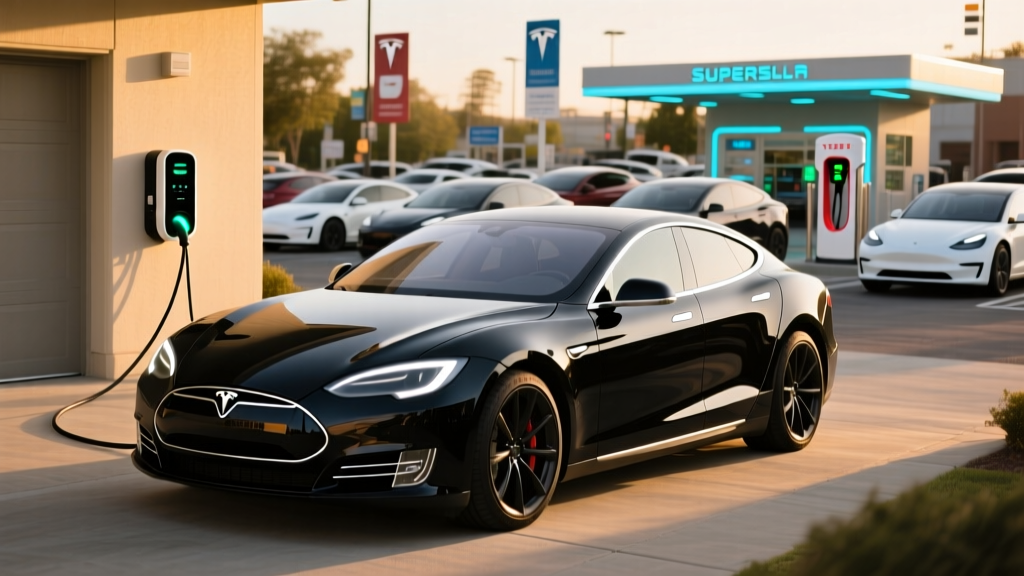
Tesla Supercharger pricing varies by location, time of day, and demand. In 2026, typical rates range from $0.25 to $0.40 per kWh, with peak-hour urban sites sometimes hitting $0.45+. Tesla's off-peak discounts at select stations can drop rates to $0.20/kWh.
Using a blended average of $0.32/kWh:
- Model 3 RWD full charge: ~$18.40
- Model Y Long Range full charge: ~$24.00
- Model S full charge: ~$30.40
Most Supercharger sessions are partial (10–80% or 20–90%), so your actual session cost will be lower. A typical 10–80% session on a Model Y Long Range uses roughly 52 kWh, costing about $16.64 at the blended rate.
Third-Party DC Fast Chargers (Electrify America, EVgo, ChargePoint)
Tesla vehicles now ship with NACS (North American Charging Standard) ports natively. While Tesla's Supercharger network has opened to some non-Tesla EVs via Magic Dock adapters, Tesla owners can also use CCS-equipped third-party networks with a NACS-to-CCS adapter (Tesla sells one for ~$199; third-party options exist for less).
Third-party DC fast charging tends to be the most expensive option:
- Electrify America: $0.37–$0.52/kWh (guest rate); $0.31–$0.43 with Pass+ subscription ($7/month)
- EVgo: $0.36–$0.48/kWh (guest); lower with EVgo Plus membership
- ChargePoint DC: Varies widely by site operator, often $0.35–$0.55/kWh
At $0.45/kWh, a full Model Y charge costs roughly $33.75 — nearly three times the home rate. For road trips, Superchargers remain the best balance of speed, reliability, and cost for Tesla owners.
Tesla Model Lineup: Range, Efficiency, and Charging Specs
Understanding charging cost requires knowing each model's battery size and efficiency. Here are the current 2026 Tesla specs that matter:
| Spec | Model 3 RWD | Model 3 LR AWD | Model Y LR AWD | Model S LR | Model X LR |
|---|---|---|---|---|---|
| EPA Range | 272 mi | 341 mi | 310 mi | 402 mi | 335 mi |
| Battery (Usable) | ~57.5 kWh (LFP) | ~75 kWh (NMC) | ~75 kWh (NMC) | ~95 kWh (NMC) | ~95 kWh (NMC) |
| Efficiency (MPGe) | 132 combined | 131 combined | 122 combined | 120 combined | 105 combined |
| kWh/100 mi | 25 | 26 | 28 | 28 | 32 |
| Max DC Charge Rate | 170 kW | 250 kW | 250 kW | 250 kW | 250 kW |
| 10–80% DC Time | ~25 min | ~22 min | ~23 min | ~27 min | ~28 min |
| Level 2 Rate | 11.5 kW (~44 mi/hr) | 11.5 kW (~44 mi/hr) | 11.5 kW (~40 mi/hr) | 11.5 kW (~41 mi/hr) | 11.5 kW (~35 mi/hr) |
| 0–60 mph | 5.8 sec | 4.2 sec | 4.8 sec | 3.1 sec | 3.8 sec |
| Horsepower | 271 hp | 384 hp | 384 hp | 670 hp | 670 hp |
| Drivetrain | RWD | Dual-Motor AWD | Dual-Motor AWD | Dual-Motor AWD | Dual-Motor AWD |
Real-World Range: What the EPA Number Doesn't Tell You
EPA estimates assume a mix of city and highway driving at moderate temperatures. In practice:
- Highway (70+ mph): Expect 85–90% of EPA range. A Model Y LR rated at 310 mi delivers ~260–275 mi at sustained interstate speeds.
- Cold weather (below 32°F): Range drops 15–30% depending on severity. The Model 3 RWD (LFP) is particularly sensitive to cold — expect ~190–220 mi in sub-freezing conditions. Tesla's heat pump helps, but battery chemistry limits remain.
- City/commuter driving: You'll often match or slightly exceed EPA range thanks to regenerative braking.
- Charging curve taper: DC fast charging peaks at the stated kW only between ~10–50% SoC. Above 80%, charge speed drops dramatically to protect the battery. Plan road-trip stops around 10–80% sessions for the fastest turnaround.
How Long Does It Take to Charge a Tesla?
Charge time matters as much as cost. Here's a breakdown by charging level for the popular Model Y Long Range:
| Charging Level | Power (kW) | Miles Added Per Hour | Typical Use Case |
|---|---|---|---|
| Level 1 (120V household) | ~1.2 kW | ~3–4 mi/hr | Emergency/overnight trickle |
| Level 2 (240V home wall connector) | 11.5 kW | ~40 mi/hr | Daily home charging (~8 hr for full) |
| DC Fast (Tesla Supercharger V3) | Up to 250 kW | ~175 mi in 15 min | Road trips (10–80% in ~23 min) |
| DC Fast (V4 Supercharger) | Up to 250+ kW | Similar to V3 for current Teslas | Newer station architecture |
Important distinction: kW (kilowatts) measures the rate of energy flow — think of it as the "speed" of charging. kWh (kilowatt-hours) measures total energy stored — your battery's "tank size." A 250 kW charger fills a 75 kWh battery fast, but only if the battery can accept that rate. Tesla's charge curve peaks near 250 kW at low SoC and tapers significantly past 50%, which is why 10–80% times are the industry standard metric.
For daily driving, most owners charge at home overnight on Level 2 and rarely need a full 0–100% session. Setting your Tesla to charge to 80% daily (or 100% for LFP models, which Tesla recommends for battery calibration) and using scheduled charging during off-peak utility hours is the cost-optimal strategy.
Monthly and Annual Charging Cost Estimates
Let's put real numbers to typical ownership. The average American drives about 13,500 miles per year. Using the Model Y Long Range (28 kWh/100 mi) as our baseline:
| Charging Mix | Avg. Cost/kWh | Annual Cost | Monthly Cost |
|---|---|---|---|
| 100% Home Level 2 ($0.16/kWh) | $0.16 | $605 | $50 |
| 80% Home / 20% Supercharger | $0.19 | $718 | $60 |
| 50% Home / 50% Supercharger | $0.24 | $907 | $76 |
| 100% Supercharger ($0.32/kWh) | $0.32 | $1,210 | $101 |
| 100% Third-Party DC ($0.45/kWh) | $0.45 | $1,701 | $142 |
Even in the worst-case scenario (exclusive public DC charging), a Model Y's annual "fuel" cost is roughly $1,700 — compared to about $1,650 for a 27 MPG gas car at $3.30/gallon. The savings compound dramatically when you charge at home: under $610/year vs. $1,650, saving over $1,000 annually.
Time-of-use (TOU) utility plans can push home charging costs even lower. Many utilities offer off-peak rates of $0.08–$0.12/kWh overnight, which would drop a Model Y's annual home-charging cost to roughly $350–$450.
Tesla Pricing, Trims, and Federal Tax Credit Eligibility
Here's where each Tesla model stands on pricing and the federal §30D EV tax credit as of 2026:
| Model / Trim | Base MSRP | §30D Credit Eligible? | Effective Price (w/ Credit) |
|---|---|---|---|
| Model 3 RWD | $38,990 | Yes — up to $7,500 (battery sourcing dependent) | ~$31,490 |
| Model 3 Long Range AWD | $45,740 | Yes — up to $7,500 | ~$38,240 |
| Model Y Long Range AWD | $46,630 | Yes — up to $7,500 | ~$39,130 |
| Model S Long Range | $79,990 | No — exceeds $55,000 sedan MSRP cap | $79,990 |
| Model X Long Range | $84,990 | No — exceeds $80,000 SUV MSRP cap | $84,990 |
Critical eligibility rules for the §30D credit (verify current status at IRS.gov):
- Income caps: Modified AGI must not exceed $150,000 (single), $225,000 (head of household), or $300,000 (joint).
- MSRP caps: $55,000 for sedans (Model 3 qualifies); $80,000 for SUVs/trucks (Model Y qualifies; Model S and X do not).
- Battery sourcing: The credit is split into two halves ($3,750 each) — one for critical minerals sourcing and one for battery component manufacturing. Tesla has worked to qualify for the full $7,500 on Model 3 and Y, but sourcing rules shift periodically. Always verify at the point of sale.
- Point-of-sale transfer: Since 2024, buyers can transfer the credit to the dealer for an upfront price reduction rather than waiting for tax filing.
Is a Tesla Worth It vs. Key Competitors?
The Tesla Model 3 and Model Y remain benchmark EVs, but the competitive landscape has matured significantly. Here's how they stack up against key rivals on the metrics that matter:
| Metric | Model Y LR | Hyundai Ioniq 5 LR | Ford Mach-E ER AWD | Chevy Equinox EV RS |
|---|---|---|---|---|
| EPA Range | 310 mi | 305 mi | 290 mi | 319 mi |
| Max DC Charge | 250 kW | 233 kW (800V) | 150 kW | 190 kW |
| 10–80% Time | ~23 min | ~18 min | ~36 min | ~28 min |
| Base MSRP | $46,630 | $49,850 | $48,995 | $43,900 |
| Charging Network | Native Supercharger | NACS (Supercharger access) | NACS (Supercharger access) | NACS (Supercharger access) |
Tesla's key advantages: The Supercharger network remains the most reliable, widespread DC fast-charging infrastructure in North America. While competitors now have NACS access, Tesla owners enjoy native integration — no adapters, seamless plug-and-charge, and in-app routing. Tesla's efficiency (kWh/100 mi) is also class-leading, which directly reduces charging costs.
Where competitors win: The Ioniq 5's 800V architecture delivers faster 10–80% charge times. The Equinox EV undercuts on price. The Mach-E offers a more conventional interior layout that some buyers prefer. And Tesla's panel gaps, ride firmness, and minimalist interior remain polarizing.
Choose Tesla If:
- You value the Supercharger network's reliability and seamless integration
- You want best-in-class efficiency (lowest per-mile charging cost)
- Over-the-air updates and tech-forward minimalism appeal to you
- You want strong resale value and the most proven EV platform
Consider Competitors If:
- You prefer physical buttons, a more traditional cabin layout
- You want the fastest possible DC charge times (Ioniq 5/6 on 350 kW chargers)
- You need a lower entry price (Equinox EV, base Model 3 alternatives)
- Ride comfort and build consistency are top priorities
Tesla Warranty, Battery Longevity, and Ownership Costs
Tesla's warranty structure is competitive but not class-leading:
- Basic vehicle warranty: 4 years / 50,000 miles
- Battery & drive unit (Model 3 RWD): 8 years / 100,000 miles, minimum 70% capacity retention
- Battery & drive unit (Model 3 LR, Model Y, S, X): 8 years / 120,000 miles, minimum 70% capacity retention
In practice, Tesla battery degradation has proven modest. Data aggregated from fleet telemetry shows most Tesla batteries retain 90%+ capacity at 100,000 miles and roughly 85–88% at 200,000 miles. LFP batteries (Model 3 RWD) tolerate frequent 100% charging better than NMC, making them well-suited to daily commuting. NMC batteries benefit from daily charge limits of 80–90% for longevity.
Insurance note: Tesla insurance premiums tend to run 15–30% higher than comparable non-Tesla EVs due to repair costs and parts pricing. Tesla's own insurance product (available in many states) uses real-time driving data and can be competitive for safe drivers — shop multiple quotes.
Pros, Cons, and Who Should Buy a Tesla
Pros
- Best-in-class efficiency — lowest cost per mile to charge
- Supercharger network: most reliable DC fast-charging in North America
- Strong OTA updates continuously add features
- Class-leading cargo space in Model Y (76 cu ft max with seats folded)
- Excellent performance across the lineup (3.1s 0–60 in Model S Plaid)
- Low long-term battery degradation based on fleet data
Cons
- Minimalist interior lacks physical controls — turn signals on steering wheel (Model 3 refresh) are polarizing
- Ride quality is firm, especially on larger wheel options
- No Apple CarPlay or Android Auto
- Insurance premiums are higher than segment average
- Model S and X no longer qualify for federal tax credit
- Build quality inconsistency still reported by some owners
Best for: Tech-savvy commuters and road-trippers who prioritize efficiency, charging infrastructure reliability, and over-the-air feature updates. The Model 3 RWD at ~$31,500 (after credit) is one of the best-value EVs available. The Model Y remains the default family EV crossover for good reason.
Less ideal for: Buyers who want a traditional luxury interior, physical buttons, or the absolute lowest purchase price. If you can't charge at home and rely entirely on public charging, the cost advantage over gas shrinks significantly.
Frequently Asked Questions
How much does it cost to charge a Tesla car at home per month?
For an average driver covering 1,125 miles/month in a Model Y Long Range, home charging at the $0.16/kWh national average costs roughly $50/month. With time-of-use off-peak rates, this can drop to $30–$40/month.
Is it cheaper to charge a Tesla at home or at a Supercharger?
Home charging is almost always cheaper. At $0.16/kWh home vs. $0.32/kWh Supercharger (blended average), home charging costs roughly half as much per mile. Superchargers are best reserved for road trips.
Does Tesla charge per minute or per kWh?
Tesla Superchargers bill by the kWh (energy delivered) in most U.S. locations. Some states with regulatory restrictions bill by the minute, using tiered pricing based on charge speed. Idle fees ($0.50–$1.00/minute) apply if you remain plugged in after your session completes.
How much does a Tesla add to your electric bill?
Driving 13,500 miles/year in a Model 3 RWD (25 kWh/100 mi) adds about 3,375 kWh annually to your electricity usage — roughly 281 kWh/month. At $0.16/kWh, that's about $45/month added to your electric bill.
Can you charge a Tesla at non-Tesla charging stations?
Yes. With a NACS-to-CCS adapter, Tesla owners can use Electrify America, EVgo, and other CCS networks. However, these stations tend to be more expensive per kWh than Superchargers, and reliability varies. Tesla's native Supercharger network remains the most seamless option.
Do Tesla Model 3 and Model Y qualify for the $7,500 federal tax credit?
As of 2026, both the Model 3 and Model Y are eligible for up to $7,500 under the IRS §30D clean vehicle credit, subject to buyer income limits ($150K single / $300K joint), MSRP caps, and battery sourcing requirements. Eligibility details can shift — always verify at purchase and consult a tax professional.
Is charging a Tesla cheaper than gas?
Yes, substantially — if you charge at home. A Model Y charged at home costs roughly $0.038/mile in electricity vs. $0.122/mile for a 27 MPG gas car at $3.30/gallon. That's a savings of about $1,134 per year over 13,500 miles. The gap narrows if you rely exclusively on expensive public DC chargers.
Sources: EPA efficiency data from fueleconomy.gov; federal tax credit rules from IRS.gov; Tesla specifications from Tesla's official vehicle pages. All pricing and credit eligibility reflect 2026 model year and are subject to change.