Why Mini Electric Excavators Are Gaining Traction in 2026
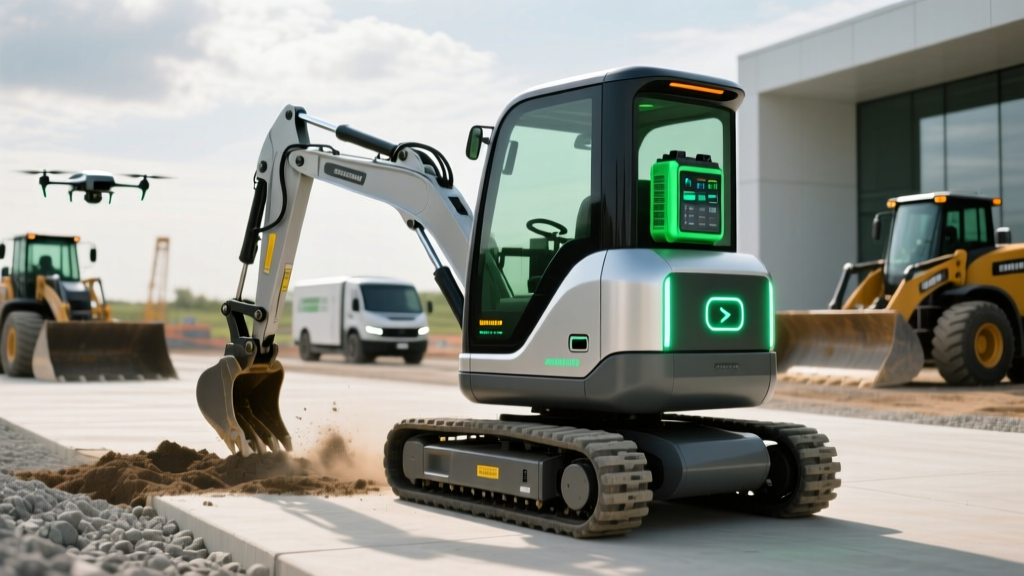
Compact electric diggers have moved from trade-show curiosities to viable job-site tools. Contractors face tightening emissions rules in urban zones, indoor demolition requirements, and rising diesel costs — all of which make mini electric excavators an increasingly practical alternative to their 1.5–3.5-ton diesel counterparts. Unlike passenger EVs, these machines are judged on duty-cycle endurance, hydraulic flow, and jobsite charging logistics rather than 0–60 mph times or highway range.
This review synthesizes the state of the compact electric excavator segment in 2026 — covering representative models from manufacturers like Volvo CE, Caterpillar, JCB, Kubota, and Wacker Neuson — with the same data-driven rigor we apply to road-going EVs. We'll translate excavator specs into the EV metrics you already know (kWh, kW, MPGe-equivalent efficiency) and answer the questions that actually matter on a job site.
Representative 2026 Mini Electric Excavator Specs at a Glance
The table below compares four widely available compact electric excavators in the 1.5–3.5 metric ton class. Specs reflect 2026 model-year data from manufacturer press materials.
| Spec | Volvo ECR25 Electric | Caterpillar 301.9 Electric (Announced) | JCB 19C-1E | Wacker Neuson EZ17e |
|---|---|---|---|---|
| Operating Weight | 2.7 tons (5,950 lbs) | 1.9 tons (4,190 lbs) | 1.9 tons (4,190 lbs) | 1.7 tons (3,750 lbs) |
| Battery Capacity | 20 kWh (NMC) | ~19 kWh (NMC, preliminary) | 15 kWh (LFP option avail.) | 23.4 kWh (NMC) |
| Rated Runtime (typical duty cycle) | ~4–6 hours | ~4–5 hours (est.) | ~3–5 hours | ~5–8 hours |
| Max DC Charge Rate | ~15 kW (CCS1) | ~15 kW (CCS1, est.) | ~10 kW (CCS1) | ~20 kW (CCS1) |
| 10–80% Charge Time | ~60 min (DC) | ~55 min (DC, est.) | ~70 min (DC) | ~50 min (DC) |
| Level 2 Onboard Charge | ~5 kW (240V, ~21A) | ~5 kW (est.) | ~3.3 kW (240V) | ~5 kW (240V) |
| Hydraulic Flow | 16.5 gal/min | ~14 gal/min (est.) | 13.2 gal/min | 13.7 gal/min |
| Dig Depth (max) | 8 ft 9 in | 7 ft 10 in | 7 ft 11 in | 7 ft 8 in |
| Base MSRP (approx.) | ~$65,000 | ~$55,000 (est.) | ~$48,000 | ~$58,000 |
| Battery/Powertrain Warranty | 5 yr / 5,000 hrs | TBA | 3 yr / 3,000 hrs | 5 yr / 5,000 hrs |
Runtime, Duty Cycles, and the 'Range' Question
Mini electric excavators don't have an EPA range sticker because they don't drive on highways. Instead, manufacturers rate runtime in hours under a representative duty cycle — typically a mix of digging, swinging, tramming (driving short distances), and idle time.
For context, a typical 8-hour workday requires either a machine with 8+ hours of rated runtime, a midday DC fast-charge session (60–70 minutes for a 10–80% top-up), or a swappable battery system. Volvo CE and Wacker Neuson both offer optional second-battery configurations for their compact electric lines.
Charging on the Job Site: DC Fast, Level 2, and Portable Options
Charging infrastructure is the single biggest adoption barrier for electric construction equipment. Here's how the three charging tiers translate to the job site:
| Charging Level | Power (kW) | Approx. Time (0–100%) | Job-Site Use Case |
|---|---|---|---|
| Level 1 (120V portable) | 1.2–1.8 kW | 12–20 hours | Overnight trickle at residential sites |
| Level 2 (240V wall-mount or portable EVSE) | 3.3–5 kW | 4–6 hours | Overnight at yard/depot; lunch-break top-up |
| DC Fast Charge (CCS1 portable or fixed) | 10–20 kW | 1–1.5 hours (0–100%) | Midday turnaround on active sites |
Most mini electric excavators in 2026 use the CCS1 connector — the same standard found on non-Tesla passenger EVs in North America. This means a portable DC fast charger (available from suppliers like Tritium or ABB in 15–20 kW skid-mounted units) can be shared across a fleet of electric machines and the crew's electric trucks.
Charge-curve reality check: Just like road-going EVs, peak DC charge rates are not sustained across the full session. A machine rated at 20 kW peak will typically sustain that rate only between roughly 10–50% state of charge (SoC), then taper. A 10–80% session on a 23.4 kWh battery at 20 kW peak takes approximately 50 minutes in ideal thermal conditions — add 10–15 minutes in cold weather when the battery management system (BMS) must warm the pack before accepting full current.
Battery Chemistry: LFP vs NMC for Construction Duty
The choice between lithium iron phosphate (LFP) and nickel manganese cobalt (NMC) batteries has real job-site implications:
| Factor | NMC (most models) | LFP (JCB option, some Chinese imports) |
|---|---|---|
| Energy Density | Higher — more kWh per kg, lighter pack | Lower — heavier for same capacity |
| Cycle Life | ~1,500–2,000 cycles to 80% SoH | ~3,000–5,000 cycles to 80% SoH |
| Cold-Weather Performance | Better low-temp discharge | More capacity loss below freezing |
| Thermal Runaway Risk | Higher (requires robust BMS) | Lower (inherently more stable) |
| Cost per kWh | Higher | Lower |
| Best For | Weight-sensitive, cold-climate work | High-cycle fleet use, warmer climates |
For a contractor running a machine 5 days/week, 8 hours/day, an LFP pack's longer cycle life can translate to 10+ years of service before hitting 80% state of health (SoH) — a significant total-cost-of-ownership advantage. However, if your machines operate in Minnesota winters, NMC's superior cold-weather discharge characteristics may outweigh the cycle-life benefit.
Pricing, Total Cost of Ownership, and Incentive Landscape
Mini electric excavators carry a significant upfront premium over diesel equivalents — typically 2–3× the price of a comparable 1.5–3 ton diesel mini excavator. Here's how the economics break down:
| Cost Factor | Diesel Mini Excavator (1.9t) | Electric Mini Excavator (1.9t) |
|---|---|---|
| Base Purchase Price | ~$22,000–$28,000 | ~$48,000–$65,000 |
| Annual Fuel/Energy (1,500 hrs/yr) | ~$4,500–$6,000 (diesel) | ~$1,200–$2,000 (electricity) |
| Annual Maintenance | ~$1,500–$2,500 (filters, fluids, DEF) | ~$300–$600 (hydraulic fluid, greasing) |
| 5-Year Total Operating Cost | ~$30,000–$42,500 | ~$7,500–$13,000 |
| 5-Year Total Cost (Purchase + Operating) | ~$52,000–$70,500 | ~$55,500–$78,000 |
The crossover point — where cumulative fuel and maintenance savings offset the higher purchase price — typically arrives between years 4 and 7, depending on utilization hours and local electricity rates. High-utilization fleets (2,000+ hours/year) reach parity faster.
Standout Tech and Job-Site Features
Beyond the powertrain, 2026 mini electric excavators bring technology advantages that diesel machines can't match:
- Zero local emissions: Enables indoor demolition, tunnel work, and operation in emissions-restricted urban zones without ventilation equipment.
- Dramatically lower noise: Typically 65–75 dB(A) vs. 85–95 dB(A) for diesel — allows work in noise-sensitive areas (hospitals, schools, residential neighborhoods) and reduces operator fatigue.
- Instant torque: Electric motors deliver peak torque at zero RPM, giving hydraulic pumps immediate response — no turbo lag or idle-speed compromise.
- Telematics and fleet management: Most 2026 models include built-in cellular telematics (Volvo CareTrack, JCB LiveLink, Wacker Neuson ecteq) providing real-time SoC monitoring, geofencing, utilization tracking, and remote diagnostics.
- Regenerative hydraulic systems: Some models recover energy during boom-lower and swing-deceleration, extending runtime by 5–10%.
Notable drawbacks:
- Charging logistics: Most active construction sites lack 240V or DC charging infrastructure. Contractors must invest in portable chargers, generators with EVSE output, or tow a battery-energy-storage system (BESS) trailer to site.
- Limited high-flow attachments: Hydraulic hammers and augers draw peak current, significantly reducing runtime. A machine rated for 6 hours of bucket work may manage only 2–3 hours of continuous hammer use.
- Weight distribution: Battery packs are heavy and positioned differently than diesel engines, which can slightly alter tipping load and lifting capacity compared to diesel equivalents.
- Cold-weather limitations: Below-freezing operation requires battery preconditioning and reduces both runtime and charge acceptance rate.
Pros and Cons: The Bottom Line
Pros
- Zero tailpipe emissions — works indoors and in restricted zones
- 65–75 dB operation — dramatically quieter than diesel
- ~70–80% lower fuel cost per operating hour
- ~75% lower maintenance cost (no engine oil, filters, DEF, DPF)
- Instant hydraulic response from electric motor torque
- Built-in telematics for fleet monitoring
- State/utility rebates can offset $10,000–$25,000+ of purchase price
Cons
- 2–3× higher upfront purchase price vs. diesel
- 4–8 hour runtime limits full-day heavy-duty use without midday charge
- Job-site charging infrastructure often absent — requires investment
- High-flow attachments (hammers) drastically cut runtime
- Cold weather reduces runtime 15–25% and slows charging
- Does NOT qualify for federal §30D tax credit (off-road equipment)
- Limited dealer/service network for electric-specific repairs in rural areas
Who Should Buy a Mini Electric Excavator?
Mini electric excavators make the most sense for contractors who:
- Work in emissions-restricted or indoor environments — basement demolition, parking-garage renovation, tunnel work, or cities with idle-emissions bans.
- Operate in noise-sensitive areas — hospital campuses, school zones, residential neighborhoods with strict ordinance hours.
- Run high annual hours (1,500+ hrs/yr) where fuel and maintenance savings accelerate payback.
- Have depot/yard charging access — a 240V Level 2 charger at the equipment yard enables overnight top-ups.
- Are pursuing green-building certifications (LEED, Envision) that reward zero-emissions equipment.
Stick with diesel if your work involves remote sites without power access, continuous heavy-breaker duty, extreme cold-climate operation, or low annual utilization where the payback period extends beyond the machine's useful life.
Frequently Asked Questions
What is the real-world runtime of a mini electric excavator?
Rated runtimes of 4–8 hours assume a mixed duty cycle (digging, swinging, tramming, idle). In practice, expect 3–5 hours of productive digging under moderate loads, dropping to 2–3 hours under continuous hydraulic-hammer use. Cold weather (below 32°F) further reduces usable runtime by 15–25% due to battery chemistry limitations — the same effect seen in passenger EVs.
How fast do mini electric excavators charge?
On DC fast charge (10–20 kW via CCS1), most 2026 models reach 10–80% in 50–70 minutes. On Level 2 (240V, 3.3–5 kW), a full 0–100% charge takes 4–6 hours — practical for overnight charging at a depot. Level 1 (120V) charging is available but impractical for daily use at 12–20 hours for a full charge.
Do mini electric excavators qualify for the federal EV tax credit?
No. The IRS §30D clean vehicle credit applies only to on-road vehicles that meet MSRP caps ($55,000 for SUVs/trucks, $25,000 for sedans), buyer income limits, and battery critical-mineral sourcing requirements. Off-road construction equipment is excluded. However, state-level programs like California's CORE voucher, and federal provisions like §45W (commercial clean vehicle credit) and §179 equipment expensing, may provide substantial offsets. Always consult a tax professional for current-year eligibility.
Is a mini electric excavator worth buying vs. a diesel model?
For contractors with 1,500+ annual operating hours, depot charging access, and work in emissions- or noise-sensitive areas, the 5-year total cost of ownership is competitive with diesel — and the operational advantages (indoor use, quiet operation, lower maintenance) are significant. For low-utilization or remote-site work, diesel remains the more practical choice in 2026.
What happens when the battery degrades?
Most manufacturers warranty battery packs for 3–5 years or 3,000–5,000 operating hours, guaranteeing 70–80% state of health (SoH) retention. NMC packs typically deliver 1,500–2,000 full cycles before hitting 80% SoH; LFP packs can reach 3,000–5,000 cycles. Replacement costs for a 15–23 kWh pack currently range from $8,000–$18,000 depending on chemistry and OEM — though prices continue to decline as battery manufacturing scales.
Can I use a portable generator to charge an electric excavator on a remote site?
Yes, but with caveats. A towable diesel or battery-energy-storage generator with a 240V outlet can power a Level 2 portable EVSE (3.3–5 kW). This is slower than depot charging but provides enough energy for a meaningful top-up during lunch breaks. Several manufacturers now offer integrated BESS trailers specifically designed for job-site EV charging.