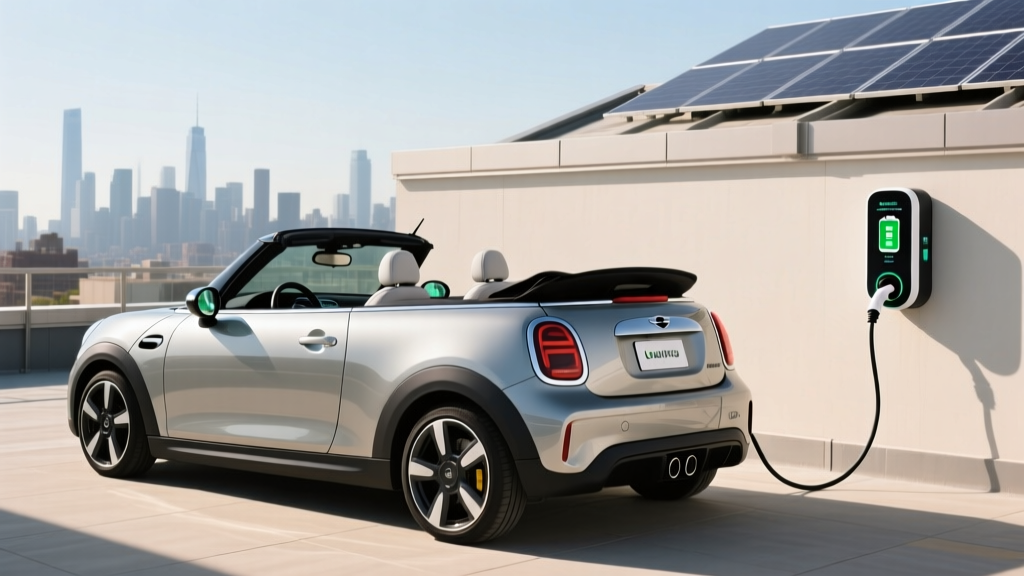
The Mini Electric Convertible occupies a space no other automaker currently dares to touch: a fully electric, four-seat drop-top priced under $45,000. For 2026, Mini continues to offer the Cooper SE Convertible as the only purpose-built electric convertible on the US market, combining the brand's signature go-kart handling with open-air driving and zero tailpipe emissions. But with an EPA-estimated range of just 137 miles and a compact footprint, this EV demands a clear-eyed look at who it actually serves — and who should look elsewhere.
We've driven the Mini Electric Convertible in city commuting, highway stretches, and top-down coastal runs to deliver the numbers and ownership realities that spec sheets alone won't tell you. Here's what you need to know before putting one on your shortlist.
Quick Verdict: Who the Mini Electric Convertible Is For
Choose the Mini Electric Convertible if: You want a fun, open-top daily driver for urban and suburban commuting under 60 miles round-trip, have reliable home charging, prioritize driving engagement over range, and want something genuinely unique in the EV space.
Look elsewhere if: You regularly drive more than 100 miles between charges, need back-seat practicality for adults, live in an extreme cold-weather climate without garage parking, or want a vehicle for road trips without careful DC fast-charging route planning.
The Mini Electric Convertible is not a compromise car — it's a deliberate choice. It trades range and cargo space for personality, handling, and the irreplaceable experience of electric open-top motoring. If that equation works for your lifestyle, nothing else delivers it at this price.
Range, Battery, and Efficiency
| Specification | Figure |
|---|---|
| EPA Estimated Range | 137 miles |
| Battery Capacity (Gross / Usable) | 54.2 kWh / ~48.9 kWh usable |
| Battery Chemistry | NMC (Nickel Manganese Cobalt) |
| EPA Combined Efficiency | 113 MPGe / 30 kWh per 100 mi |
| Drivetrain | Front-Wheel Drive (FWD), Single Motor |
| Horsepower | 181 hp (135 kW) |
| Torque | 221 lb-ft |
| 0–60 mph | 7.2 seconds |
| Top Speed | 93 mph (electronically limited) |
The 54.2 kWh gross battery pack uses conventional NMC chemistry, chosen for its energy density — a critical factor in a vehicle this compact where every millimeter of packaging matters. The usable capacity of roughly 48.9 kWh reflects a buffer that protects long-term battery health by preventing true 0% or 100% states at the cell level.
Real-World Range Reality: The EPA's 137-mile combined estimate blends city regenerative braking with highway driving. In practice:
- City / suburban driving (top up): 130–145 miles achievable thanks to frequent regen opportunities
- Sustained highway driving (65–75 mph): Expect 105–115 miles — the soft top and boxy shape create more aero drag than the hardtop Cooper SE
- Cold weather (below 32°F / 0°C): Range drops to approximately 90–100 miles without preconditioning; the heat pump (standard on US models) helps but doesn't eliminate winter losses
- Top-down, warm weather, city mix: Optimal conditions can push past 140 miles
For a commuter covering 30–50 miles daily with nightly home charging, the range is entirely sufficient. For anything beyond that, you'll need to plan around DC fast charging or accept range as a daily constraint.
Efficiency at 30 kWh per 100 miles is respectable for a convertible but trails more aerodynamic EVs like the Hyundai Ioniq 6 (25 kWh/100 mi) or the Tesla Model 3 (26 kWh/100 mi). The fabric roof mechanism adds weight, and the open-air body shape increases drag coefficient. When the top is up, efficiency improves modestly.
Charging Speed: DC Fast Charge and Home Level 2
| Charging Level | Power / Rate | Time / Speed |
|---|---|---|
| Level 1 (120V household) | ~1.4 kW | ~4–5 miles of range per hour; full charge in 35+ hours |
| Level 2 (240V home / public) | Up to 11 kW (AC) | ~30–35 miles per hour; 0–100% in ~5 hours |
| DC Fast Charging (CCS) | Peak 95 kW | 10–80% in approximately 28 minutes |
The 95 kW peak DC fast-charge rate is the Mini Electric Convertible's most significant charging limitation relative to the broader 2026 EV market. Competitors like the Hyundai Kona Electric (peak 100+ kW) and Chevrolet Equinox EV (peak 150 kW) charge faster. At 95 kW, the Mini can add roughly 75 miles of range in 15 minutes under ideal conditions — but the charge curve tapers noticeably above 80% State of Charge (SoC), and sustained rates typically average closer to 60–70 kW across the 10–80% window.
One practical note: the Mini Electric Convertible uses the CCS1 connector standard. Mini has confirmed NACS (Tesla-style) adapter compatibility for Supercharger network access, which significantly expands the public charging footprint. If you're evaluating this car in a region where Electrify America or EVgo coverage is sparse, Supercharger access via adapter is a meaningful advantage. Verify adapter availability and any firmware requirements with your dealer at purchase.
For home charging, the 11 kW onboard AC charger is a strong point. On a 48-amp Level 2 home charger (the most common residential installation), you'll replenish the battery from near-empty to full overnight in roughly 5 hours. A standard Level 2 home setup costs between $500 and $1,500 installed depending on your electrical panel — a necessary investment for any EV owner without workplace charging access.
Driving Dynamics and Performance
The Mini Electric Convertible delivers 181 horsepower and 221 lb-ft of instant electric torque to the front wheels. The 0–60 mph time of 7.2 seconds won't embarrass you at stoplights, but it's not the car's primary appeal. What defines this EV is the go-kart handling Mini has engineered for decades — now with the added benefit of a low-mounted battery pack that drops the center of gravity.
The steering is quick and communicative, body roll is minimal, and the single-speed transmission delivers seamless acceleration. Three driving modes (Core, Green, and Go-Kart) adjust throttle response, steering weight, and regen intensity. Go-Kart mode sharpens everything and is genuinely entertaining on a twisty back road with the top down.
Regenerative braking is adjustable but doesn't offer true one-pedal driving in the way a Nissan Leaf or Tesla does. You'll still use the brake pedal regularly, though the strongest regen setting handles most deceleration in city traffic. The brake pedal feel is natural — a common weakness in EVs that Mini has largely solved here.
Ride quality is firm, consistent with Mini's sporty character. Over rough pavement, you'll feel imperfections more than in a comfort-tuned EV like the Volkswagen ID.4. The convertible structure introduces a slight cowl shake over sharp bumps — inherent to any drop-top, but noticeable if you're coming from a rigid-roof EV.
Interior, Tech, and Practicality
The 2026 Mini Electric Convertible features the brand's 9.4-inch circular OLED display, which serves as both instrument cluster and infotainment screen. The interface runs Mini's latest Operating System 9, supporting wireless Apple CarPlay and Android Auto, over-the-air updates, and a built-in navigation system that factors battery SoC and charging stations into route planning.
The convertible soft top operates in approximately 18 seconds at speeds up to 18 mph. It includes a wind deflector and a heated glass rear window. With the top up, cabin noise is reasonable for a soft-top — noticeably louder than a hardtop EV at highway speeds, but conversations remain comfortable.
Interior dimensions and practicality:
- Front legroom: 41.4 inches — adequate for drivers up to about 6'2"
- Rear legroom: 29.3 inches — suitable for children or very short trips; not adult-friendly for sustained travel
- Cargo volume (top up): 5.7 cubic feet — enough for a weekend bag for two, not much more
- Cargo volume (top down): 4.1 cubic feet — the folded roof consumes trunk space
- Seating capacity: 4 (though the rear seats are best treated as 2 for small children or cargo overflow)
Driver-assistance features include forward collision warning with automatic emergency braking, lane departure warning, adaptive cruise control (available on higher trims), and parking sensors with a rearview camera. These are SAE Level 1 and Level 2 assist features — the driver must remain fully engaged and in control at all times. Mini does not offer hands-free driving capability comparable to GM's Super Cruise or Ford's BlueCruise.
Pricing, Trims, and Federal Tax Credit
| Trim | Base MSRP | Key Additions |
|---|---|---|
| Cooper SE Convertible (Signature) | ~$38,400 | Base convertible, 11 kW AC charging, circular OLED, heated front seats, soft top |
| Cooper SE Convertible (Iconic) | ~$42,900 | Head-up display, Harman Kardon audio, adaptive cruise, premium interior trim, heated steering wheel |
| As-Tested (Iconic with options) | ~$44,800 | Metallic paint, 18" alloy wheels, panoramic sunshade accessory |
Federal Tax Credit Eligibility (§30D)
The Mini Electric Convertible's eligibility for the IRS §30D federal clean vehicle credit requires careful verification at time of purchase, as battery sourcing and critical mineral requirements shift annually. Key eligibility parameters for 2026:
- MSRP cap: The vehicle must have an MSRP at or below $55,000 for passenger cars — both Mini trims qualify
- Buyer income limits: Modified adjusted gross income must not exceed $150,000 (single), $225,000 (head of household), or $300,000 (joint filing)
- Battery sourcing: A percentage of critical minerals and battery components must be sourced from the US or free-trade-agreement partners — verify current-year compliance with your dealer, as Mini's supply chain has evolved
- Point-of-sale transfer: Eligible buyers can apply the credit as an upfront price reduction at the dealership rather than waiting for a tax refund
- Credit amount: Up to $7,500, split between critical mineral ($3,750) and battery component ($3,750) requirements — partial credits of $3,750 are possible if only one threshold is met
Because sourcing requirements tighten each year under the Inflation Reduction Act, we strongly recommend confirming exact credit eligibility with your dealer's finance department and consulting a tax professional before relying on a specific credit amount. The IRS maintains an official eligible vehicle list that updates periodically.
If the Mini Electric Convertible qualifies for the full $7,500 credit, the effective price of the base Signature trim drops to approximately $30,900 — a compelling entry point for an electric convertible. If only the partial $3,750 credit applies, expect an effective price around $34,650.
Warranty and Long-Term Ownership
Mini provides the following warranty coverage for the 2026 Electric Convertible:
- Battery warranty: 8 years / 100,000 miles — guarantees minimum 70% capacity retention (State of Health)
- Powertrain warranty: 8 years / 100,000 miles (electric motor, power electronics)
- Bumper-to-bumper: 4 years / 50,000 miles
- Corrosion perforation: 12 years / unlimited miles
- Roadside assistance: 4 years / unlimited miles
The 70% battery capacity retention threshold is industry-standard, matching BMW (Mini's parent company) and most competitors. Real-world NMC degradation data from the broader BMW iX and i4 fleet suggests that typical 5-year degradation falls between 8–12% under normal use — meaning most owners will retain 88–92% capacity and never approach the warranty threshold.
One ownership consideration: the soft top mechanism carries its own wear items. The hydraulic system, fabric, and rear window are covered under the standard bumper-to-bumper warranty for 4 years. Beyond that, top replacement can cost $2,000–$4,000 — a long-term cost that hardtop EV buyers don't face. Budget accordingly if you plan to own the vehicle beyond the initial warranty period.
Mini Electric Convertible vs. the Competition
There is no direct rival to the Mini Electric Convertible in the US market. The closest comparisons require stretching the definition:
- Mini Cooper SE (hardtop): Same platform, slightly better range (~145 mi EPA), more cargo space, lower price (~$33,000). Loses the open-air experience.
- Hyundai Kona Electric: 261-mile EPA range, faster charging, practical crossover body. No convertible option, less engaging to drive.
- Fiat 500e: Comparable city-car size and personality, 149-mile range, but no convertible variant currently offered in the US.
- Used market: A pre-owned BMW i4 or Porsche Taycan offers more range and performance but at 2–3× the price and with zero open-top capability.
Pros
- Only electric convertible available in the US under $50,000
- Engaging go-kart handling with instant EV torque
- 11 kW AC home charging is faster than many rivals
- Circular OLED display and Mini OS 9 are well-executed
- Qualifies for up to $7,500 federal tax credit (verify sourcing)
- Compact size ideal for tight urban parking
- NACS adapter enables Tesla Supercharger access
Cons
- 137-mile EPA range limits highway and road-trip utility
- 95 kW DC fast charging is below 2026 market averages
- Rear seats are impractical for adults
- 5.7 cu ft cargo space (top up) is minimal
- Soft-top replacement is a long-term cost risk
- No hands-free highway driving assist available
- Firm ride may not suit comfort-oriented buyers
Frequently Asked Questions
What is the real-world range of the Mini Electric Convertible?
The EPA rates it at 137 miles combined. In real-world driving, expect 130–145 miles in city conditions with regenerative braking, 105–115 miles on sustained highway runs, and as low as 90–100 miles in freezing temperatures without preconditioning. For daily commutes under 60 miles round-trip with nightly home charging, the range is more than adequate.
How fast does the Mini Electric Convertible charge?
On a DC fast charger, it peaks at 95 kW and charges from 10–80% in approximately 28 minutes, though sustained rates average 60–70 kW. At home on a Level 2 (240V) charger at 11 kW, a full charge takes about 5 hours. Level 1 (120V) trickle charging is impractical for daily use at 4–5 miles of range per hour.
How much does the Mini Electric Convertible cost after tax credits?
The base Signature trim starts around $38,400 MSRP. If you qualify for the full $7,500 federal tax credit under IRS §30D (subject to income limits, MSRP caps, and battery sourcing requirements), the effective price drops to approximately $30,900. With only a partial $3,750 credit, expect roughly $34,650. Always verify eligibility at point of purchase.
Does the Mini Electric Convertible qualify for the federal EV tax credit?
It may qualify for up to $7,500 under §30D, but eligibility depends on current-year battery component and critical mineral sourcing requirements, your income level, and the vehicle's MSRP (both trims fall under the $55,000 car cap). Because sourcing rules tighten annually, confirm with your dealer and consult the IRS clean vehicle credit page before purchasing.
Is the Mini Electric Convertible worth buying over other EVs?
If you specifically want an open-top electric driving experience and your daily mileage fits within the 137-mile range envelope, there is literally no alternative at this price. If range, cargo space, or rear-seat practicality are priorities, the Hyundai Kona Electric, Chevrolet Equinox EV, or Tesla Model 3 serve those needs far better — but none offer a convertible roof.
Can I take the Mini Electric Convertible on road trips?
Yes, with planning. The 95 kW DC fast charging and ~100-mile highway range mean you'll stop every 80–100 miles for a 25–30-minute charge on long trips. With NACS adapter access to Tesla Superchargers, the charging network is viable — but road-tripping requires accepting significantly more stops than a 300+ mile EV. For owners who road-trip 2–3 times per year, this may be an acceptable trade-off.
How does cold weather affect the Mini Electric Convertible?
NMC batteries lose 25–35% of their usable capacity in sustained freezing temperatures. The standard heat pump mitigates cabin heating energy draw, but expect real-world range to drop to 90–100 miles in winter. Preconditioning the battery while plugged in (using the Mini app) before driving recovers some efficiency and improves DC fast-charge speed in cold conditions.
What is the battery replacement cost?
Out-of-warranty NMC battery replacement for the Mini Electric Convertible is estimated at $12,000–$16,000 including labor, based on current BMW Group EV service pricing. However, the 8-year/100,000-mile warranty covers capacity loss below 70%, and real-world NMC degradation data suggests most packs retain 85%+ capacity at the 8-year mark under normal use.
Sources: fueleconomy.gov (EPA range and efficiency data), IRS §30D clean vehicle credit rules, Mini USA official specifications.