If you've spent any time on EV forums or lakeside communities in 2026, you've likely seen the phrase mini electric boats for adults popping up alongside discussions about home charging setups and solar canopies. The electrification wave hasn't stopped at the driveway — it's reaching the dock. But before you swap your four wheels for a hull, it's worth understanding what the electric marine market actually looks like, how it compares to EV car ownership, and whether the technology is mature enough for serious buyers.
At AutoEdgeView, our core expertise is electric and hybrid vehicles — cars, trucks, SUVs, and the charging infrastructure that supports them. Electric boats fall outside our primary review scope (we don't rate marine vessels the way we rate EVs), but the questions we receive from readers about the crossover between EV ownership and electric boating are real and growing. This guide bridges that gap: we'll give you an honest, data-driven look at what's available in the mini electric boat segment, map those specs to the EV concepts you already know (kW vs. kWh, LFP batteries, Level 2 charging), and help you decide whether your next electric purchase floats or drives.
What Are Mini Electric Boats for Adults, Exactly?
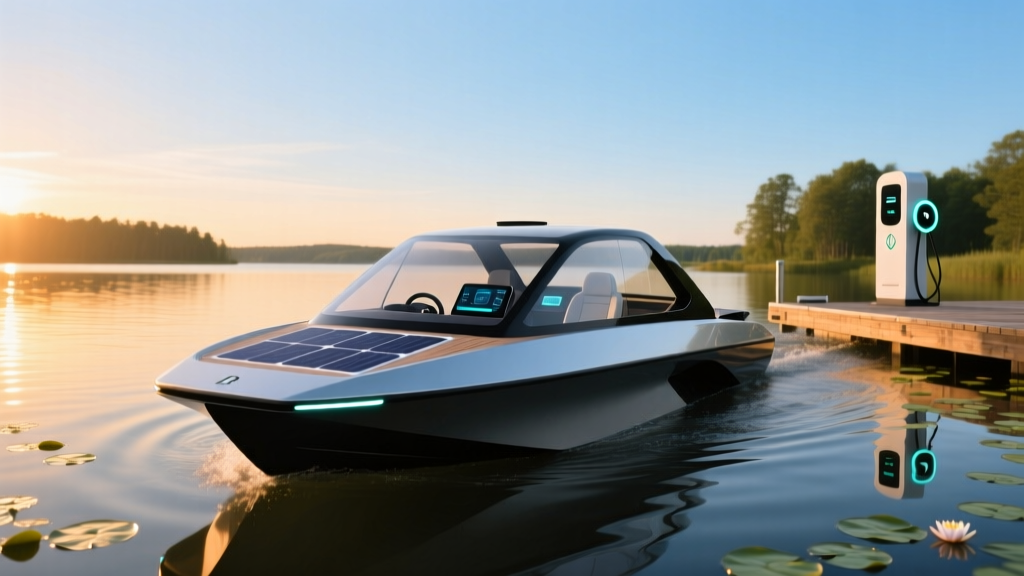
The term "mini electric boats for adults" generally refers to compact, battery-powered watercraft designed for one to four passengers, used primarily on calm inland waters — lakes, slow rivers, reservoirs, and protected coastal bays. These aren't electric jet skis (those are personal watercraft, or PWCs) and they aren't full electric yachts. They occupy a middle ground: larger and more stable than a kayak or SUP, smaller and more affordable than a cabin cruiser.
Common form factors in 2026 include:
- Electric pontoons and deck boats (12–18 ft): Stable platforms for fishing, lounging, or entertaining. Brands like Princecraft and Bennington have introduced electric-outboard-compatible models.
- Electric runabouts and day cruisers (14–20 ft): Sleeker hulls for recreational cruising. Companies like Candela (hydrofoiling), Arc Boat Co., and Vision Marine are pushing this segment.
- Electric fishing boats and bass boats (14–18 ft): Purpose-built with trolling motor integration and livewells. Tracker and Ranger offer electric-ready platforms.
- Micro-cruisers and tenders (8–12 ft): Ultra-compact boats for two, often used as yacht tenders or solo fishing craft.
The powertrain architecture mirrors what you'd find in an EV car: a lithium-ion battery pack (measured in kWh) feeds an electric motor (measured in kW), and the whole system can be recharged from shore power or, increasingly, from the same Level 2 home charger you use for your car.
Electric Boat Batteries: kWh, Chemistry, and What It Means for Range
Just like in the EV car world, the battery pack is the single most expensive and most consequential component of an electric boat. Here's how the marine segment maps to the EV terminology you already know:
| Attribute | LFP (Lithium Iron Phosphate) | NMC (Nickel Manganese Cobalt) |
|---|---|---|
| Energy density | Lower (~150–170 Wh/kg) — heavier pack for same kWh | Higher (~220–270 Wh/kg) — lighter, more compact |
| Cycle life | 3,000–5,000+ cycles to 80% SoH | 1,000–2,000 cycles to 80% SoH |
| Thermal stability | Excellent — less prone to thermal runaway | Good — requires more robust BMS and cooling |
| Cost per kWh | Lower — ~$90–$110/kWh at pack level (2026) | Higher — ~$120–$150/kWh at pack level (2026) |
| Common in marine? | Yes — increasingly standard for leisure/trolling use | Yes — used where weight/space is critical (performance boats) |
| Common in EVs? | Tesla Model 3 RWD, Ford F-150 Lightning Std Range, BYD models | Tesla Model Y LR, Hyundai Ioniq 5, most long-range EVs |
For most mini electric boats aimed at adults, LFP is becoming the default chemistry. The reasons are straightforward: boats operate in a marine environment where thermal stability matters enormously (a battery fire on water is a worst-case scenario), cycle life matters because weekend boaters may only use 30–50 cycles per year, and the weight penalty of LFP is less punishing in a hull than in a car. A 40 kWh LFP marine pack weighs roughly 550–600 lbs; in a 16-foot pontoon rated for 1,200 lbs of payload, that's manageable. In a car, that same weight penalty would reduce efficiency by 5–8%.
Performance-oriented electric runabouts (think Arc Boat Co. or Candela) tend to use NMC for the energy-density advantage — when you're trying to hydrofoil or hit 40+ mph, every pound counts.
Range on the Water: How Far Can a Mini Electric Boat Actually Go?
This is where the EV analogy gets tricky. In a car, range is measured in miles. In a boat, range is typically measured in nautical miles at a given speed, or in hours of runtime at a given throttle setting. Water resistance scales dramatically with speed — push a displacement hull past its hull speed and energy consumption spikes far more aggressively than aerodynamic drag does in a car.
A mini electric boat with a 20 kWh battery pack might deliver 25–35 nautical miles at 5–6 mph (trolling/cruising speed), but only 8–12 nautical miles at 15–20 mph. Just like an EV's EPA range assumes a mix of city and highway driving, a boat's published range assumes a specific speed profile. If you spend your day at full throttle, expect range to drop by 50–70% compared to the brochure number. Cold water (below 55°F) can reduce battery capacity by 10–15%, similar to cold-weather EV range loss.
Here's a representative spec breakdown for three popular form factors in the 2026 market:
| Category | Battery (kWh) | Motor (kW) | Range @ 5 mph (nm) | Range @ 15 mph (nm) | Top Speed | Approx. Price |
|---|---|---|---|---|---|---|
| Micro-cruiser / tender (10 ft) | 10–15 kWh | 5–10 kW | 15–25 | 5–8 | 10–15 mph | $12,000–$22,000 |
| Electric fishing boat (16 ft) | 20–40 kWh | 15–40 kW | 30–50 | 10–18 | 20–30 mph | $25,000–$55,000 |
| Electric runabout (18 ft) | 40–80 kWh | 50–150 kW | 40–70 | 15–30 | 30–45 mph | $60,000–$150,000+ |
For context, a typical day on a medium-sized lake involves 2–4 hours of mixed use, covering 10–25 nautical miles total. Most mini electric boats in the 20–40 kWh range handle this comfortably — as long as you're not trying to water-ski or run at wide-open throttle all afternoon.
Charging Your Electric Boat: Can You Use Your Home EV Charger?
This is the question we get most often from EV-owning readers considering an electric boat. The short answer: often yes, but with important caveats.
Most mini electric boats charge via standard AC shore power. The onboard charger converts AC from your dock or garage outlet into DC for the battery pack. Here's how that maps to the charging levels you know from EVs:
| Level | EV Equivalent | Typical Boat Charge Rate | Miles/Hour Added (Boat) | Notes |
|---|---|---|---|---|
| Level 1 (120V) | Standard household outlet | 0.8–1.5 kW | ~1–2 nm/hr | Overnight top-up only; 20 kWh pack takes 15–25 hrs |
| Level 2 (240V) | Home wall charger / public L2 | 3.3–7.2 kW | ~4–10 nm/hr | Sweet spot for dock or garage charging; 20 kWh in 3–6 hrs |
| DC Fast Charge | CCS/NACS DCFC station | 15–40 kW (rare on mini boats) | ~15–30 nm/hr | Only available on premium models (Arc, Candela); marina DCFC infrastructure is sparse in 2026 |
If you already have a Level 2 home charger installed for your EV — say a ChargePoint Home Flex or Tesla Wall Connector on a 240V/40A circuit — you can very likely use that same circuit to charge an electric boat, provided:
- The boat's onboard charger accepts the same voltage and amperage (most accept 240V/30A or 240V/50A via a NEMA 14-50 or hardwired connection).
- Your electrician confirms the circuit can handle the combined load if you plan to charge the car and boat simultaneously (most residential panels cannot support two 40A continuous loads on one circuit without an upgrade).
- You have a safe, code-compliant way to run the charging cable from your outlet to the boat — this may require a marine-rated shore power inlet on the boat and a GFCI-protected outdoor outlet near the dock.
Important distinction: kW is power (how fast energy flows into the battery); kWh is energy (how much the battery holds). A 40 kWh battery charged at 7.2 kW (a typical Level 2 rate) takes roughly 5.5 hours from 0–100% — identical math to charging your EV at home.
One area where marine charging lags behind EVs: public DC fast-charging infrastructure on waterways is nearly nonexistent in 2026. While EV drivers can rely on networks like Electrify America, EVgo, and Tesla Superchargers for road trips, boaters are almost entirely dependent on home/dock charging. Plan your trips accordingly.
Performance: How Do Mini Electric Boats Compare to Gas?
Electric boats deliver instant torque, just like electric cars. The result is smooth, quiet acceleration with no exhaust fumes — a transformative experience if you're coming from a two-stroke or four-stroke outboard. But raw performance varies enormously by price point:
- Budget micro-cruisers (5–10 kW motors): Top speeds of 10–15 mph. Think of this as the EV equivalent of a Nissan Leaf — perfectly adequate for the use case, but not thrilling.
- Mid-range fishing boats (20–40 kW): Top speeds of 20–30 mph. Comparable to a Chevy Bolt EV — practical, responsive, gets the job done.
- Premium runabouts (80–150+ kW): Top speeds of 35–50+ mph. This is Tesla Model S Plaid territory, and the price reflects it.
Where electric boats genuinely outperform gas counterparts: noise and vibration. A 20 kW electric outboard at cruising speed produces roughly 55–65 dB at the helm — comparable to a normal conversation. A gas outboard of equivalent power produces 75–85 dB. Over a four-hour day on the water, that difference is the difference between arriving home relaxed and arriving home fatigued.
Where gas still wins: refueling speed and long-distance range. A gas outboard can be refueled in 3 minutes at any marina and can run all day on a tank. Electric boats require hours of charging and are best suited to day-use patterns where you return to your dock or trailer each evening.
Pricing, Tax Credits, and the Economics of Electric Boating
Mini electric boats for adults carry a significant price premium over comparable gas-powered boats — typically 30–80% more upfront. Here's the landscape in 2026:
| Category | Gas Price Range | Electric Price Range | Premium |
|---|---|---|---|
| 10-ft tender/micro-cruiser | $5,000–$10,000 | $12,000–$22,000 | +100–140% |
| 16-ft fishing boat | $15,000–$30,000 | $25,000–$55,000 | +60–85% |
| 18-ft runabout | $30,000–$60,000 | $60,000–$150,000 | +80–150% |
Does an Electric Boat Qualify for the Federal EV Tax Credit?
This is a critical question, and the answer requires careful reading of IRS rules. The §30D Clean Vehicle Credit applies to "new clean vehicles" as defined by the IRS — and that definition specifically references vehicles "made by a manufacturer" that are "primarily for use on public streets, roads, and highways."
Boats do not qualify for the §30D federal EV tax credit. They are not street-legal vehicles and do not meet the IRS definition. This is a major economic differentiator between electric cars and electric boats.
However, some states and localities offer separate incentives for electric marine vessels. California's Air Resources Board (CARB) has included marine electrification in some clean-air grant programs, and certain lake authorities offer reduced slip fees or charging discounts for electric boats. Always check with your state energy office and local waterway authority for current programs — these vary by jurisdiction and change frequently.
The total cost of ownership equation still favors electric in some scenarios: electricity costs roughly $0.12–$0.18/kWh nationally in 2026, while marine gasoline costs $4.50–$6.00/gallon at most marinas. A 20 kWh charge (enough for a full day of moderate use) costs $2.40–$3.60 at home. The equivalent gas outing might burn 4–8 gallons, costing $18–$48. Over a 10-year ownership period with 40 outings per year, fuel savings of $600–$1,800/year are realistic. Maintenance savings (no winterization of engine, no fuel stabilizer, no impeller replacements, no lower-unit gear oil) add another $300–$600/year.
Who Should Buy a Mini Electric Boat — And Who Shouldn't?
Buy Electric If...
- You boat primarily on a single lake or calm waterway with dock/garage charging access
- You value quiet operation (birdwatching, fishing, conversation, relaxation)
- Your typical outing is under 4 hours and 25 nautical miles
- You already own an EV and have a Level 2 home charger
- You want to eliminate gas-engine maintenance (winterization, fuel system, exhaust)
- Local regulations incentivize or require electric-only on your waterway
Stick with Gas If...
- You need to cover long distances or boat on large, open bodies of water
- You waterski, wakeboard, or need sustained high-speed operation
- You trailer your boat to different lakes and can't guarantee charging access
- You're on a tight budget and the 60–150% electric premium is prohibitive
- You boat in cold climates where battery range loss compounds with already-limited range
- You need the flexibility to refuel in minutes at any marina
The Bottom Line: How Mini Electric Boats Fit into an EV Lifestyle
Mini electric boats for adults represent a genuine and growing niche in 2026, but they are not a direct analog to electric cars. The technology is mature enough for the right use case — calm-water day boating with reliable shore charging — but the economics, range, and infrastructure still lag well behind what EV drivers enjoy on land.
If you're an existing EV owner with a Level 2 home charger, a dock or boat lift with power access, and a boating pattern that fits within a 20–30 nautical mile daily envelope, a mini electric boat is a compelling and increasingly practical purchase. The quiet, fume-free experience is genuinely transformative, and the maintenance savings compound over time.
If you need long range, high speed, or the flexibility to boat anywhere without charging infrastructure, gas outboards remain the pragmatic choice — just as some drivers still choose hybrids or gas vehicles for road-trip flexibility.
At AutoEdgeView, we'll continue covering the electric vehicles we test and review daily — cars, trucks, SUVs, and the charging infrastructure that makes them work. But we'll keep an eye on the marine electrification space too, because the battery, motor, and charging technologies are deeply intertwined. The same LFP cells in your next EV might be powering your next weekend on the lake.
Frequently Asked Questions
What is the real-world range of a mini electric boat?
A typical 20 kWh mini electric boat delivers 25–35 nautical miles at slow cruising speed (5–6 mph) but only 8–12 nautical miles at higher speeds (15–20 mph). Cold water reduces range by 10–15%. Always plan for 50–70% less range than the brochure states if you'll be running above idle speed.
How fast does a mini electric boat charge?
On a Level 2 (240V) home charger at 7.2 kW, a 20 kWh boat battery charges from 0–100% in roughly 3 hours. On a standard 120V outlet, expect 15–25 hours. DC fast charging is rare in this segment and marina DCFC infrastructure is very limited in 2026.
Does an electric boat qualify for the $7,500 federal EV tax credit?
No. The IRS §30D Clean Vehicle Credit applies only to vehicles "primarily for use on public streets, roads, and highways." Boats do not qualify. Some state and local programs offer marine electrification incentives — check with your state energy office.
Can I charge an electric boat with my home EV charger?
Usually yes, if the boat's onboard charger accepts 240V AC and your circuit has adequate capacity. Have a licensed electrician verify that your panel can handle the load, especially if you plan to charge a car and boat simultaneously. Marine-rated GFCI protection is required for outdoor/dock installations.
Are electric boats reliable compared to gas outboards?
Electric marine drivetrains have far fewer moving parts than gas outboards — no fuel injectors, water pumps, thermostats, exhaust systems, or lower-unit gears. The primary failure points are the battery management system (BMS) and any cooling systems. Battery degradation follows the same patterns as EVs: expect 70–85% capacity retention after 10 years of typical recreational use. Leading marine battery manufacturers offer 5–8 year warranties.
Is an electric boat worth it vs. gas in 2026?
For the right use case — calm-water day boating with home charging — yes. The fuel and maintenance savings are real ($900–$2,400/year combined), the experience is dramatically quieter and cleaner, and the technology is proven. For long-distance, high-speed, or multi-lake use, gas remains more practical and affordable.