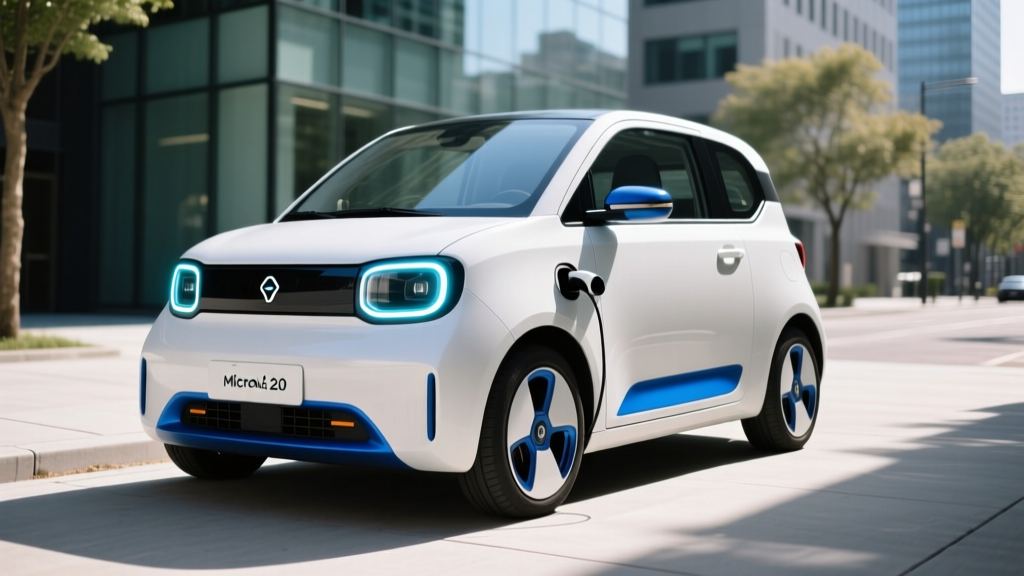
Quick Answer: The Microlino 2.0 electric car is a Swiss-designed, ultra-compact L7e-class quadricycle that is not currently sold or homologated for the United States as of 2026. In Europe, it offers three battery options (6 kWh, 10.5 kWh, and 14 kWh LFP) with a WLTP-rated range of 57 to 110 miles, a top speed of 56 mph (90 km/h), and pricing starting around €17,990. US buyers seeking a similar micro-EV should look at the EPA-rated alternatives covered below, as the Microlino's regulatory classification places it outside standard US passenger-vehicle safety requirements.
What the Microlino 2.0 Actually Is — And Why It Matters
The Microlino 2.0 is manufactured by Micro Mobility Systems in Turin, Italy. It occupies a niche that barely exists in the US market: the heavy quadricycle (EU category L7e). This classification exempts it from full passenger-car crash-testing mandates under European law, which keeps weight and cost down but creates a fundamental barrier to US street legality.
Think of it as a modern reinterpretation of the BMW Isetta — front-opening "fridge door," tandem-width cabin for two adults, and a footprint roughly one-third the size of a Honda Civic. It's designed for dense urban cores where parking is scarce and trips are short. In cities like Zurich, Rome, and Paris, that formula works. In the US regulatory environment, it's a different story.
Microlino 2.0 Specs: Battery, Range, and Charging
| Specification | Urban (6 kWh) | Dolce (10.5 kWh) | Competizione (14 kWh) |
|---|---|---|---|
| Battery Chemistry | LFP | LFP | LFP |
| Usable Capacity | 6 kWh | 10.5 kWh | 14 kWh |
| WLTP Range | 57 mi (91 km) | 109 mi (175 km) | 140 mi (225 km)* |
| Top Speed | 56 mph (90 km/h) | 56 mph (90 km/h) | 56 mph (90 km/h) |
| Motor Output | 12.5 kW (17 hp) peak | 12.5 kW (17 hp) peak | 12.5 kW (17 hp) peak |
| AC Charging (Level 2) | ~4 hours (0-100%) | ~4 hours (0-100%) | ~4 hours (0-100%) |
| DC Fast Charging | Not available | Not available | Not available |
| Vehicle Weight | ~965 lbs (438 kg) | ~965 lbs (438 kg) | ~965 lbs (438 kg) |
| EU Base Price | ~€17,990 | ~€21,990 | ~€25,990 |
*Range figures are WLTP-rated, which tend to be 10-15% more optimistic than US EPA estimates. Real-world range in cold weather or at sustained top speed will be significantly lower — expect 35-40 mi from the 6 kWh pack in winter conditions.
All three trims use lithium iron phosphate (LFP) cells, a chemistry that trades energy density for longevity and thermal stability. LFP batteries tolerate daily 100% charging without accelerated degradation, which is ideal for a vehicle with small batteries you'll be fully cycling regularly. For a deeper explanation of LFP versus NMC trade-offs, see our battery chemistry guide.
Why the Microlino 2.0 Isn't Available in the US
The National Highway Traffic Safety Administration (NHTSA) classifies vehicles by Gross Vehicle Weight Rating (GVWR) and design intent. The Microlino falls into a regulatory gray zone:
- Too heavy for a Neighborhood Electric Vehicle (NEV/LSV): Federal Motor Vehicle Safety Standard (FMVSS) 500 caps Low-Speed Vehicles at 3,000 lbs GVWR and a top speed of 25 mph. The Microlino hits 56 mph, disqualifying it.
- Too light and untested for a full passenger car: Standard FMVSS crash-testing (frontal offset, side impact, roof crush) is designed for vehicles weighing 2,500+ lbs. The Microlino at ~965 lbs would struggle to meet these standards without substantial structural redesign.
- No US type-approval pathway exists for the EU's L7e heavy-quadricycle category. There is no equivalent classification in American federal law.
Micro Mobility Systems has not announced any US homologation plans as of early 2026. Importing one privately under the 25-year "show or display" exemption is also not an option — that rule applies only to vehicles at least 25 years old.
US Alternatives: What to Buy Instead
If the Microlino's appeal is ultra-compact urban mobility, here are the closest US-legal options with real EPA data:
| Vehicle | EPA Range | Battery | Top Speed | 0-60 mph | Base MSRP (2026) | Federal Tax Credit |
|---|---|---|---|---|---|---|
| Chevrolet Equinox EV 2LT | 319 mi | 85 kWh NMC | 110 mph | ~8.0 sec | $33,600 | Up to $7,500 (§30D) |
| Hyundai Kona Electric SEL | 261 mi | 65 kWh NMC | 104 mph | ~7.5 sec | $32,675 | Not eligible (Korea-built) |
| Nissan LEAF S | 149 mi | 40 kWh LMO | 92 mph | ~7.9 sec | $28,140 | Not eligible (Japan-built) |
| Used BMW i3 (2019-2021) | 153 mi | 42.2 kWh NMC | 93 mph | ~7.2 sec | ~$16,000-$22,000 | Up to $4,000 (§25E used) |
| NEV/LSV (GEM, Arcimoto) | 30-60 mi | Lead-acid or small Li-ion | 25 mph | N/A | $10,000-$18,000 | None (not highway-capable) |
The used BMW i3 is the closest spiritual analog to the Microlino: compact footprint, quirky design, city-optimized, and tight turning circle. A 2019+ i3 with the 42.2 kWh battery can be found for $16,000-$22,000 and qualifies for the §25E used-EV credit of up to $4,000 if the dealer sale price is $25,000 or less and buyer income is under $75,000 (single) or $150,000 (joint).
Real Costs: What an Equivalent Micro-EV Costs to Own
Let's model a practical comparison. Suppose you're choosing between a used BMW i3 (closest US Microlino equivalent), a new Nissan LEAF, and a comparable gas-powered subcompact (2026 Hyundai Venue):
| Cost Factor (5 Years / 60,000 mi) | Used BMW i3 (42 kWh) | New Nissan LEAF S | 2026 Hyundai Venue (Gas) |
|---|---|---|---|
| Purchase Price | $19,000 | $28,140 | $21,500 |
| Tax Credit Applied | -$4,000 (§25E) | $0 | $0 |
| Net Purchase | $15,000 | $28,140 | $21,500 |
| Fuel/Energy (60k mi) | $1,800 (home charging, $0.13/kWh) | $2,700 (home charging) | $5,400 ($3.50/gal, 30 MPG) |
| Maintenance | $1,200 | $1,500 | $3,000 |
| Insurance (est.) | $6,000 | $7,200 | $5,400 |
| Depreciation | $5,000 | $11,000 | $8,500 |
| 5-Year Total Cost | $29,000 | $50,540 | $43,800 |
| Cost Per Mile | $0.48/mi | $0.84/mi | $0.73/mi |
Home charging at $0.13/kWh is the key variable. The i3's 42 kWh battery costs roughly $5.46 for a full charge yielding ~130 real-world miles — about 4.2 cents per mile. The Venue at 30 MPG combined and $3.50/gallon costs 11.7 cents per mile just in fuel. If you lack home charging access and rely on public DC fast chargers at $0.40-$0.50/kWh, the EV advantage narrows considerably — electricity cost rises to 13-16 cents per mile.
Common Misconceptions About Micro-EVs
| Myth | Fact |
|---|---|
| "Small EVs like the Microlino are legal to import if they're under 25 mph." | The Microlino's top speed is 56 mph, which disqualifies it from LSV/NEV import. NEVs must be governed to 25 mph maximum. |
| "You can drive a Microlino on US streets with a special permit." | No federal or state mechanism exists to register an L7e quadricycle for general road use. Some states allow restricted-use permits for specific vehicle types, but the Microlino does not qualify. |
| "Small batteries mean cheap replacements." | While the Microlino's 6-14 kWh packs are smaller, LFP replacement costs are roughly $100-$140/kWh at the cell level. A full 14 kWh pack replacement could cost $2,000-$3,500 installed — not trivial for a $26,000 vehicle. |
| "Micro-EVs are inherently safer than e-bikes or scooters." | The Microlino has a steel space frame and basic crash structure, but at 965 lbs it offers far less protection than any NHTSA-certified passenger vehicle. In a collision with a 4,000-lb SUV, physics is not on your side. |
| "The §7,500 federal tax credit applies to any EV I buy." | The §30D credit requires North American final assembly, MSRP caps ($55,000 sedans / $80,000 SUVs/trucks), buyer income limits ($150K single / $300K joint), and battery mineral sourcing thresholds. Most imported EVs do not qualify. |
Decision Framework: Should You Wait for the Microlino or Buy Now?
Choose a US-legal compact EV now if:
- You need highway-capable transportation (speeds above 55 mph)
- You want federal or state tax-credit eligibility
- You need NHTSA crash-test ratings and standard airbags
- You plan to drive in rain, snow, or extreme heat regularly
- You need to carry more than one passenger or any cargo
- You want access to DC fast charging for road trips
The Microlino would make sense (if it were US-legal) only if:
- Your daily driving is under 30 miles, entirely in a dense urban core
- You have guaranteed home or workplace Level 2 charging
- You never need highway speeds or carry passengers beyond a single adult
- You live in a mild climate (no sub-freezing winters)
- You accept zero NHTSA crash protection
First-Time EV Buyer Essentials
If the Microlino brought you here but you're now shopping for a real US-market EV, these five facts will save you money and frustration:
- kW vs kWh matters: kW (kilowatts) is the rate of power — like water flow from a hose. kWh (kilowatt-hours) is energy stored — like the size of the bucket. A 150 kW charger fills your 65 kWh battery; the charger is the hose, the battery is the bucket.
- EPA range is optimistic for highway driving: Expect 15-25% less range at sustained 70+ mph speeds versus the EPA sticker. Cold weather (below 32°F) can reduce range another 20-30% due to battery chemistry and cabin heating demands.
- Home charging is the backbone: A Level 2 home charger (240V, 32-48A) adds 25-35 miles per hour of charging and costs $500-$2,000 installed. Over 80% of EV charging happens at home. If you can't install one, evaluate public charging access carefully before buying.
- DC fast charging tapers above 80%: A car that "peaks at 150 kW" doesn't sustain that rate. The charge curve slows significantly past 80% State of Charge to protect the battery. Plan road-trip stops around 10-80% charges for optimal speed.
- Tax credits have strings attached: The §30D new-vehicle credit (up to $7,500) requires North American assembly, specific battery-mineral sourcing percentages that tighten annually, MSRP caps, and buyer income limits. Check the IRS's qualifying vehicle list before assuming eligibility.
Frequently Asked Questions
Can I legally import a Microlino 2.0 into the United States?
No. The Microlino does not meet FMVSS safety standards, is not classified as a Low-Speed Vehicle (top speed exceeds 25 mph), and has no US type-approval pathway. Private importation for road use is not permitted under current NHTSA regulations.
What is the Microlino 2.0's real-world range?
Under WLTP testing, the 10.5 kWh Dolce trim achieves 109 miles. In real-world European urban use, owners report 70-90 miles depending on temperature and driving style. There is no EPA rating because the vehicle is not sold in the US. In cold weather (below 40°F), expect range to drop to 50-65 miles for the mid-tier battery.
Does the Microlino support DC fast charging?
No. All Microlino 2.0 trims charge exclusively via AC (Level 1/Level 2) using a Type 2 connector in Europe. A full charge takes approximately 4 hours regardless of battery size, as the onboard charger is limited to roughly 3.6 kW. There is no CCS or NACS DC fast-charge capability.
How does the Microlino compare to a Smart EQ Fortwo?
The Smart EQ Fortwo (discontinued in the US after 2019) had a 17.6 kWh battery, 58-mile EPA range, and 80 mph top speed. It was a fully NHTSA-certified passenger vehicle with airbags and crash testing. The Microlino is lighter, more compact, and has a unique front-opening door, but lacks US safety certification and has a lower top speed.
What's the cheapest US-legal EV with similar urban appeal?
The 2026 Nissan LEAF S starts at $28,140 with 149 miles of EPA range, but doesn't qualify for the federal credit due to Japan assembly. A used 2019+ BMW i3 at $16,000-$22,000 with the §25E used-EV credit ($4,000 off) nets to roughly $12,000-$18,000 — the most affordable path to a compact, city-friendly EV with full US safety certification.