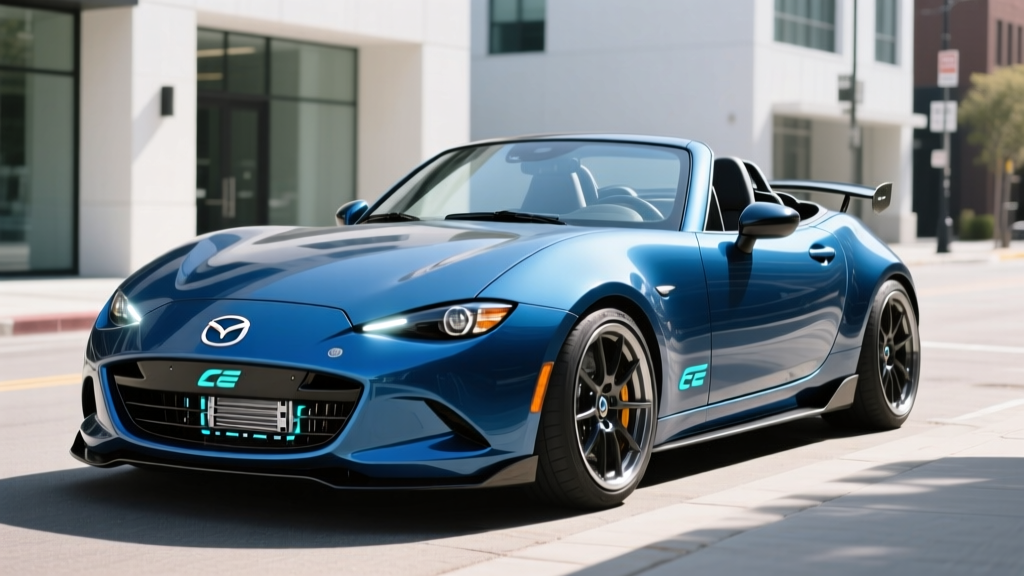
The Short Answer on Miata EV Conversions
A Mazda Miata (MX-5) electric conversion typically costs between $12,000 and $30,000+ on top of the donor car price, delivers 60 to 150 miles of real-world range depending on battery pack size, and requires 80 to 200+ hours of labor if you DIY. Kits from companies like EV West and Thunder Sky are popular, but the Miata's lightweight chassis (roughly 2,300–2,500 lbs curb weight after conversion) makes it one of the more efficiency-friendly platforms for a swap. You will not qualify for the federal §30D EV tax credit on a conversion, and there is no factory warranty on the powertrain. For most buyers, a conversion is a passion project — not a cost-saving alternative to a production EV.
What a Miata Electric Car Conversion Actually Involves
An EV conversion replaces the Miata's internal-combustion engine, fuel tank, exhaust, and transmission with an electric motor, motor controller, battery pack, onboard charger, and DC-DC converter. The Miata — particularly the NA (1989–1997) and NB (1998–2005) generations — is a favorite conversion candidate because of its low weight, simple mechanical layout, and large enthusiast community that shares wiring diagrams, motor-mount templates, and parts sourcing advice.
Here's what physically happens during the build:
- Engine and transmission removal: The 1.6L or 1.8L inline-four, clutch, flywheel, exhaust system, and fuel tank come out. This alone frees up 300–400 lbs.
- Motor and adapter plate installation: A DC motor (commonly a NetGain Hyper9 or WarP 9) or AC motor (such as a salvaged Tesla drive unit or a HPEVS AC-50) is bolted to the stock differential via a custom adapter plate. Some builders retain the Miata's manual transmission; others go direct-drive with a single-speed reduction.
- Battery pack fabrication: Lithium-ion modules — often salvaged Chevy Volt or Nissan Leaf packs, or new LiFePO4 (LFP) prismatic cells from suppliers like EVE or CALB — are mounted in the engine bay and/or where the fuel tank sat. Typical usable capacities range from 15 kWh to 35 kWh.
- High-voltage wiring and safety systems: Properly rated cabling, fuses, contactors, an inertia cutoff switch, and a manual service disconnect are mandatory.
- Ancillary systems: Electric vacuum pump for power brakes, electric power steering pump (the Miata's is engine-driven), DC-DC converter to run 12V accessories, and a cabin heater (PTC element or heat pump).
Cost Breakdown: What You'll Actually Spend
The biggest misconception in the EV conversion world is that it's cheap. It's not — at least not compared to buying a used production EV. Here's a realistic parts-and-labor breakdown based on builds documented in the EV conversion community through 2025 and into 2026:
| Component | Budget Build | Mid-Range Build | High-End Build |
|---|---|---|---|
| Donor Miata (NA/NB) | $2,500–$5,000 | $4,000–$8,000 | $6,000–$12,000 |
| Motor & controller | $2,000–$3,500 | $3,500–$6,000 | $6,000–$10,000 |
| Battery pack (cells + BMS + enclosure) | $3,000–$5,000 | $5,000–$9,000 | $9,000–$15,000 |
| Charger, DC-DC, wiring, safety | $1,500–$2,500 | $2,500–$4,000 | $3,500–$5,000 |
| Ancillaries (brakes, steering, heater) | $800–$1,500 | $1,500–$2,500 | $2,500–$4,000 |
| Fabrication & machine work | $500–$1,500 | $1,500–$3,000 | $3,000–$5,000 |
| Professional labor (if not DIY) | — | $5,000–$10,000 | $10,000–$20,000 |
| Registration, inspection, insurance | $300–$800 | $500–$1,200 | $800–$2,000 |
| Total | $10,600–$19,800 | $18,500–$34,700 | $30,800–$73,000 |
For context, a new 2026 Chevrolet Equus EV starts around $33,000 (before any incentives), and a used 2022–2023 Nissan Leaf S with 40 kWh and ~150 miles of range can be found for $15,000–$20,000. The conversion only makes financial sense if you already own the Miata, can do most of the labor yourself, and value the driving experience over pure economics.
Range, Efficiency, and Charging: The Real Numbers
The Miata's light weight works in your favor for efficiency, but its small physical footprint limits how many battery cells you can package. Here's what to expect across common pack sizes:
| Battery Capacity (Usable) | Est. Range (Summer/Mild) | Est. Range (Winter/Cold) | Level 2 Charge Time (0–100%) |
|---|---|---|---|
| 15 kWh (LFP or NMC) | 55–70 miles | 40–55 miles | 4–5 hours @ 3.3 kW |
| 22 kWh (LFP or NMC) | 80–100 miles | 60–80 miles | 6–7 hours @ 3.3 kW |
| 30 kWh (NMC modules) | 110–140 miles | 85–110 miles | 8–10 hours @ 3.3 kW |
| 35 kWh (large NMC pack) | 130–160 miles | 100–130 miles | 10–12 hours @ 3.3 kW |
Why these numbers matter: Most Miata conversions use a 3.3 kW or 6.6 kW onboard charger because high-power chargers are heavy and expensive. DC fast charging (CCS or CHAdeMO) is technically possible with add-on hardware from companies like EV West or custom solutions, but adds $2,000–$4,000 and significant weight. The majority of conversion owners charge exclusively at home on Level 2 (240V), which is perfectly adequate for a weekend car.
Expect efficiency around 250–320 Wh/mile in mixed driving. That's less efficient than a Tesla Model 3 (~240 Wh/mile) but far better than most conversion platforms (a converted Porsche 914 or VW Bus might hit 400–500 Wh/mile). The Miata's ~2,400-lb post-conversion weight and modest frontal area are the reasons.
Real-world range reality: A 22 kWh Miata conversion with an EPA-equivalent estimate of ~95 miles will deliver closer to 65–75 miles at sustained 70 mph highway speeds, and as little as 50–60 miles in sub-40°F weather with the cabin heater running. Plan your battery pack around your worst-case driving day, not your best.
Miata Conversion vs. Buying a Production EV
This is the comparison every prospective converter needs to make honestly. Here's how a mid-range Miata conversion stacks up against accessible production EVs you can buy in 2026:
| Metric | Miata Conversion (Mid-Range) | 2026 Nissan Leaf S | 2026 Chevy Equinox EV LT | Used 2023 Tesla Model 3 RWD |
|---|---|---|---|---|
| Total cost | $18,500–$34,700 | ~$30,000 MSRP | ~$33,000 MSRP | $18,000–$24,000 |
| EPA range | N/A (est. 80–100 mi) | 149 mi (40 kWh) | 319 mi (85 kWh) | 272 mi (60 kWh) |
| DC fast charging | Rare / add-on | Yes (CHAdeMO, ~50 kW) | Yes (CCS, ~150 kW) | Yes (NACS/CCS, ~170 kW) |
| Warranty | None (DIY) | 3yr/36k mi + 8yr/100k battery | 3yr/36k mi + 8yr/100k battery | Remaining factory or none |
| Federal tax credit (§30D) | Not eligible | Up to $7,500 (if eligible) | Up to $7,500 (if eligible) | Up to $4,000 used-EV credit |
| ADAS / safety tech | None | ProPILOT Assist (Level 2) | Super Cruise available (Level 2) | Autopilot (Level 2) |
| Fun factor | Very high (light, RWD, open-top) | Low | Low | Moderate |
The production EVs win on range, charging infrastructure access, warranty, safety technology, and — crucially — eligibility for the IRS §30D federal tax credit, which can knock up to $7,500 off a new EV or up to $4,000 off a qualifying used EV. A converted Miata qualifies for none of these incentives because it is not a new clean vehicle manufactured by an OEM, nor does it meet the used-EV credit's dealer-sale and MSRP requirements.
The Miata wins on driving engagement. There is no production EV under $60,000 that replicates the experience of a lightweight, rear-wheel-drive, open-top roadster. If that matters to you — and for Miata owners, it usually does — the conversion has a value proposition that spreadsheets can't fully capture.
Real-World Ownership Considerations
Before you pull the trigger on a conversion kit, work through these practical realities:
Home Charging Access
A Miata conversion almost certainly requires home charging. Public DC fast charging is either unavailable (most conversions lack DCFC hardware) or impractical (the small battery means you'd be sitting at a charger every 60–80 miles on a road trip). You'll need at minimum a standard 240V outlet — a NEMA 14-50 on a dedicated 50-amp circuit is ideal. Installation runs $500–$2,000 depending on your panel capacity and run length. If you live in an apartment or lack off-street parking, a conversion is essentially off the table.
Insurance and Registration
Insuring a converted EV is more complicated than a stock car. Many standard insurers won't cover a home-built EV conversion at agreed value. Specialty insurers like Hagerty or Grundy American, which handle modified and collector vehicles, are usually the better route — expect premiums of $600–$1,500/year depending on your state, driving record, and stated value. Registration requirements vary by state: some require a special inspection or "constructed vehicle" title, while others simply need a VIN verification and safety inspection. Check your state DMV's requirements before you start the build.
Climate and Seasonal Use
LFP batteries tolerate cold poorly compared to NMC, losing 25–35% of usable range in sub-freezing temperatures. If you live in the upper Midwest or Northeast, plan for a battery pack 30% larger than your summer range would suggest. Cabin heating is also a significant energy draw — a 2 kW PTC heater can consume 15–20% of your total battery capacity on a 45-minute winter drive. Some builders install heated seats (much more efficient) as the primary warmth source.
Maintenance
The good news: no oil changes, no timing belt, no clutch replacement, no exhaust rust-through. The realistic news: you are now the manufacturer's service department. If a contactor welds shut, a BMS cell goes out of balance, or your adapter plate bolts loosen from vibration, there is no dealership to visit. Budget $500–$1,000/year for incidental parts, and expect to spend 10–20 hours per year on maintenance and troubleshooting, especially in the first two years after the build.
Common Miata EV Conversion Misconceptions
| Myth | Fact |
|---|---|
| "Conversions are cheaper than buying an EV." | A mid-range conversion totals $18,500–$34,700 with no tax credit. A used Leaf or Model 3 is often cheaper and comes with range, warranty, and DCFC. |
| "I'll get 200 miles of range easily." | The Miata's packaging constraints limit most builds to 15–35 kWh. Realistic range is 60–150 miles, not 200+. |
| "It'll charge at any public station." | Most conversions only have Level 2 (J1772) capability. DC fast charging requires additional hardware that most builders skip due to cost and weight. |
| "I'll qualify for the $7,500 tax credit." | The §30D credit applies only to new qualifying OEM vehicles meeting MSRP caps, income limits, and battery sourcing rules. Conversions are not eligible. See IRS guidelines. |
| "It's basically maintenance-free." | While you eliminate ICE maintenance, EV conversions require ongoing attention to high-voltage connections, BMS calibration, contactor health, and cooling system integrity. |
Decision Framework: Should You Convert Your Miata?
Choose a Miata EV Conversion If:
- You already own a Miata that needs an engine rebuild and you'd rather go electric than rebuild the ICE.
- You have a garage with 240V access and can charge at home every night.
- You have mechanical and electrical skills (or a trusted fabricator) and enjoy hands-on projects.
- Your typical driving is under 60 miles round-trip, mostly local roads and back-country two-lanes.
- You value the open-top, lightweight, RWD driving experience above range and convenience.
- You understand this is a passion project, not a money-saving strategy.
Choose a Production EV Instead If:
- You need 200+ miles of range for commuting or road trips.
- You rely on public charging or live without off-street parking.
- You want a warranty, ADAS safety features, and a crash-tested vehicle.
- You want to take advantage of the federal §30D tax credit or state EV incentives.
- You want a daily driver with minimal maintenance risk and predictable operating costs.
- Your budget is under $20,000 and you need reliable transportation now.
What First-Time EV Buyers Should Know Before Converting
If you've never owned an EV and the Miata conversion is your entry point, understand these fundamentals:
kW vs. kWh: This is the most common confusion. kW (kilowatts) measures power — how fast energy flows, like the flow rate of a hose. kWh (kilowatt-hours) measures energy capacity — the total amount of "fuel" in the tank. Your Miata's battery might hold 22 kWh of energy, and your onboard charger might accept 3.3 kW of power. At 3.3 kW, fully charging a 22 kWh pack takes roughly 6.5–7 hours.
Charge curve taper: If you do add DC fast charging, understand that peak charge rates (say, 40 kW) only apply at low states of charge. Above 80% SoC, the charge rate drops dramatically to protect the battery. A "40 kW charger" doesn't deliver 40 kW for the entire session.
Battery chemistry trade-offs: LFP (lithium iron phosphate) cells are cheaper, longer-lasting (3,000+ cycles), and safer, but heavier and less energy-dense than NMC (nickel manganese cobalt). In a Miata where space and weight are at a premium, many builders opt for NMC despite its shorter cycle life (~1,500–2,000 cycles) and higher thermal sensitivity. If you choose NMC, a robust BMS and thermal monitoring system are non-negotiable.
Weight distribution matters: The Miata's near-50/50 weight balance is a big part of its handling character. Poor battery placement — too much weight forward or too high — can make the car feel nose-heavy or top-heavy. The best builds split the pack between the engine bay and the former fuel tank area to maintain balance.
Frequently Asked Questions
How long does a Miata EV conversion take?
A DIY builder working evenings and weekends should plan for 3–9 months. A professional conversion shop typically completes a build in 4–8 weeks. First-time builders should add a 50% time buffer for fabrication re-dos, parts delays, and troubleshooting.
Can I use a Tesla motor and battery in a Miata conversion?
Yes, but it's complex. Salvaged Tesla drive units (from a Model S or Model 3) are popular for their power density, but require custom adapter plates, a compatible inverter controller (such as an OpenInverter or EVWest Tesla controller), and significant fabrication. Tesla battery modules are also used, but the proprietary BMS requires either a third-party management solution or careful reverse-engineering.
Will a converted Miata pass state inspection?
It depends on your state. States like California, Oregon, and Washington have relatively straightforward processes for registering converted EVs (often as "specially constructed vehicles" or SB100 registrations). Other states may require a full inspection by a state referee or may not have a clear pathway at all. Research your state's DMV requirements before purchasing parts.
What's the top speed and 0–60 time of a converted Miata?
Performance varies widely by motor choice. A typical budget build with a NetGain Hyper9 motor and 144V system produces roughly 100–120 hp and does 0–60 mph in 7–9 seconds with a top speed of 90–110 mph. A high-end build using a salvaged Tesla small drive unit can push 200+ hp and hit 0–60 in under 5 seconds, but at the cost of range, weight, and budget.
Is regenerative braking effective in a Miata conversion?
Yes, and it's one of the best upgrades over the stock car. Most modern motor controllers support adjustable regen, which can recover 15–25% of energy during deceleration and significantly reduce brake pad wear. Some builders configure regen to enable one-pedal driving around town, though the Miata's light weight means regen forces feel less aggressive than in a heavier EV.
What happens if the battery degrades over time?
LFP packs typically retain 80%+ capacity after 2,000–3,000 charge cycles (roughly 10–15 years of moderate use). NMC packs may reach 80% capacity at 1,500–2,000 cycles. When replacement is needed, you can swap individual modules rather than the entire pack in most designs. Budget $3,000–$8,000 for a full cell replacement 10–15 years down the road, depending on chemistry and pack size.
Sources: EPA Fuel Economy for production EV range and efficiency data; IRS §30D Clean Vehicle Credit guidelines; manufacturer specification pages for Nissan Leaf, Chevrolet Equinox EV, and Tesla Model 3.