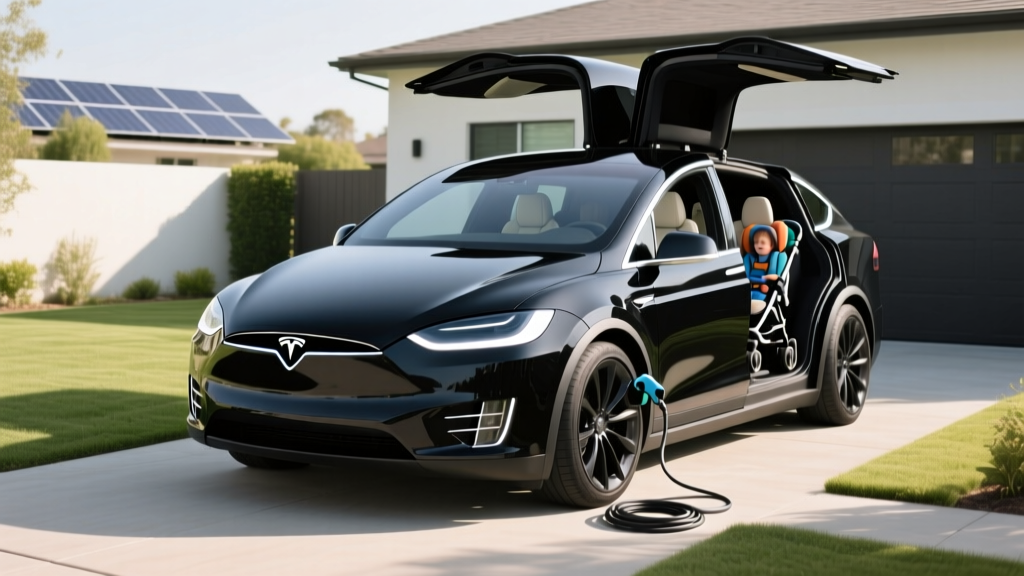
The Tesla Model X has long occupied a unique position in the EV market: a three-row electric SUV with falcon-wing rear doors, genuine towing capability, and the kind of acceleration that makes minivans blush. For buyers specifically seeking the Model X 6 seater configuration — which swaps the second-row bench for two individual captain's chairs — the value proposition shifts toward premium family comfort and easier third-row access. This review covers the current-generation Model X (refreshed interior, 2025-2026 model years) with exact specs, real-world ownership data, and the practical realities of living with a six-passenger electric SUV.
Model X 6-Seater: Quick Verdict
The Model X 6-seater is best understood as a luxury electric family hauler that prioritizes individual second-row comfort over maximum passenger capacity. The captain's chairs provide dedicated armrests, more shoulder room, and a walk-through gap to the third row — a meaningful upgrade for families who frequently use all three rows. However, you sacrifice one seatbelt (six vs. seven), and the $79,990 starting price places it firmly in luxury territory. If you need to move six people in electric comfort with access to the Supercharger network, this is one of very few options that fits the bill. If you routinely need seven seats, the Rivian R1S or a three-row PHEV may serve better.
Range and Real-World Efficiency
The Model X Long Range AWD — the volume trim and the one most buyers consider — carries an EPA-estimated 335 miles of range from its roughly 100 kWh usable battery pack (NMC lithium-ion chemistry). The Plaid trim, with its tri-motor setup and higher performance draw, drops to an EPA-estimated 311 miles.
EPA Sticker: 335 miles
Real-world highway (70-75 mph, mild weather): ~270–295 miles
Real-world mixed driving (city/suburban): ~290–315 miles
Cold weather (below 32°F, highway): ~220–255 miles
Towing (5,000 lb trailer, flat terrain): ~160–190 miles
The Model X's tall, wide profile creates meaningful aerodynamic drag at highway speeds. Expect a 12–18% reduction from EPA on sustained highway trips, and up to 30–35% in freezing temperatures. The heat pump (standard) mitigates cold-weather cabin heating losses but cannot fully offset battery chemistry limitations in deep cold.
Efficiency on the Long Range trim is rated at approximately 100 MPGe combined, which translates to roughly 34 kWh per 100 miles in mixed driving. That's competitive for a 5,100+ lb three-row SUV, though it trails the more aerodynamic Model S and sedans. The Plaid's tri-motor draw pushes consumption closer to 38–40 kWh/100 mi in spirited driving.
Charging Speed and Infrastructure
Charging capability is where Tesla's vertical integration continues to pay dividends. The Model X supports up to 250 kW DC fast charging on V3 Superchargers and compatible third-party CCS stations (via the NACS connector standard, now universal across Tesla's North American fleet).
| Charging Level | Power / Rate | Speed / Time | Best For |
|---|---|---|---|
| Level 1 (120V household) | ~1.4 kW | ~3–4 mi/hr | Emergency top-off only |
| Level 2 (240V home, 48A) | 11.5 kW | ~34 mi/hr, full charge in ~10 hr | Daily overnight charging |
| DC Fast (V3 Supercharger) | Up to 250 kW peak | 10–80% in ~30 min; ~175 mi in 15 min | Road trips, quick stops |
Charging curve reality check: The Model X peaks at 250 kW only at low state-of-charge (typically 5–15% SoC) and with proper battery preconditioning. Above 50% SoC, the rate tapers significantly — expect 80–120 kW through the mid-range and a steep drop above 80%. The 10–80% time of roughly 30 minutes assumes you've navigated to a Supercharger in the car's navigation system, which triggers automatic battery preconditioning. Arriving at a charger cold (without preconditioning) can add 10–15 minutes to your session.
For home charging, the onboard charger accepts up to 11.5 kW (48 amps) on a 240V Level 2 circuit. A typical installation with a Tesla Wall Connector on a 60-amp breaker delivers a full overnight replenishment. Most owners driving 40–60 miles daily will wake up fully charged every morning. Installation costs for a Level 2 home setup typically range from $800 (simple outlet near panel) to $2,500+ (long conduit runs or panel upgrades), per licensed electrician quotes.
Performance and Powertrain
The Model X Long Range AWD uses a dual-motor all-wheel-drive powertrain producing approximately 670 horsepower. The 0–60 mph time is a claimed 3.8 seconds — astonishing for a three-row SUV that weighs over 5,100 pounds. This is the kind of acceleration that merges onto highways effortlessly and makes passing maneuvers feel instantaneous.
The Plaid variant adds a third rear motor for 1,020 horsepower and a 0–60 time of 2.5 seconds. While technically the quickest production SUV ever sold, the Plaid's real-world utility is questionable for family use — the 24-mile range penalty and higher price are the trade-offs for performance most families won't exploit daily.
| Spec | Long Range AWD | Plaid |
|---|---|---|
| EPA Range | 335 mi | 311 mi |
| Battery (usable) | ~100 kWh, NMC | ~100 kWh, NMC |
| Drivetrain | Dual-motor AWD | Tri-motor AWD |
| Horsepower | ~670 hp | ~1,020 hp |
| 0–60 mph | 3.8 sec | 2.5 sec |
| Top Speed | 155 mph | 163 mph |
| Towing Capacity | 5,000 lbs | 5,000 lbs |
| MPGe (combined) | ~100 MPGe | ~93 MPGe |
| DC Fast Charge Peak | 250 kW | 250 kW |
| Base MSRP | $79,990 | $94,990 |
Source: fueleconomy.gov and Tesla's official specifications.
Interior, Cargo, and the 6-Seat Advantage
The six-seat interior is the defining choice for this configuration. The second-row captain's chairs feature individual cushioning, dedicated armrests, and a center gap wide enough for children or smaller adults to pass through to the third row without folding seats. This is a significant practical upgrade over the seven-seat bench layout when you regularly use all three rows.
Passenger dimensions (approximate):
- Front legroom: 41.2 inches
- Second-row legroom: 40.9 inches (captain's chairs)
- Third-row legroom: 32.7 inches — adequate for children or adults on shorter trips
- Front headroom: 41.7 inches
- Second-row headroom: 40.9 inches
Cargo volume:
- Behind third row: ~15.0 cu ft (enough for a few grocery bags or a stroller)
- Behind second row (third row folded): ~42.5 cu ft
- Behind front seats (all rear rows folded): ~81.5 cu ft
- Front trunk (frunk): ~6.5 cu ft — useful for charging cables or a small bag
The falcon-wing rear doors remain the Model X's most polarizing feature. They open upward with articulated hinges, providing outstanding headroom when loading children into car seats and excellent access in tight parking spaces. However, they are mechanically complex, slower to open than conventional doors, and have been a source of maintenance complaints in earlier model years. Tesla has improved reliability in recent production, but they remain a component with higher service risk than standard doors.
Pricing, Trims, and Federal Tax Credit Eligibility
The Model X 6-seater is available in two trims:
| Trim | Base MSRP | 6-Seat Upgrade | As-Configured | §30D Credit Eligible? |
|---|---|---|---|---|
| Long Range AWD | $79,990 | Included (6-seat std on some configs; +$0–$6,500 depending on layout) | ~$79,990–$86,490 | No — exceeds $80,000 SUV MSRP cap |
| Plaid | $94,990 | Included or +$6,500 | ~$94,990–$101,490 | No — exceeds $80,000 SUV MSRP cap |
Under current IRS rules, the §30D new clean vehicle credit offers up to $7,500 for qualifying EVs. However, SUVs must have an MSRP at or below $80,000, and buyer income must not exceed $300,000 (married filing jointly), $225,000 (head of household), or $150,000 (single). Additionally, the battery must meet critical-mineral and component sourcing requirements that shift annually.
The Model X Long Range starts at $79,990 — technically at the cap — but the six-seat configuration and any options (paint, wheels, FSD) push the MSRP above $80,000, disqualifying it from the federal credit. The Plaid is well above the cap. As of current model years, the Model X does not qualify for the $7,500 §30D credit for most buyers. Some state-level incentives (e.g., California, Colorado, New York) may still apply — check your state's energy office for current programs. Always consult a tax professional and reference IRS.gov §30D guidance before relying on credit eligibility.
Destination fees and options like Ultra Red paint ($2,500), 22-inch wheels ($5,500), and Full Self-Driving (Supervised) software ($8,000) can push a well-equipped Model X Long Range to $90,000–$95,000+ before taxes.
Driver Assistance and Technology
The Model X comes standard with Tesla Autopilot, which includes adaptive cruise control, lane centering, automatic emergency braking, and blind-spot monitoring. This is a SAE Level 2 driver-assistance system — it requires continuous driver supervision, hands on or near the wheel, and full attention to the road.
Tesla's Autopilot and the optional Full Self-Driving (Supervised) package are SAE Level 2 systems. The driver must remain engaged, monitor the environment, and be prepared to take over at any moment. FSD (Supervised) adds features like traffic light/stop sign recognition, city street navigation, and automatic lane changes, but it does not make the vehicle autonomous. True self-driving (SAE Level 4) is currently offered only by geofenced robotaxi services like Waymo in select cities.
The optional Full Self-Driving (Supervised) package ($8,000 one-time or $99/month subscription) extends Autopilot with Navigate on Autopilot (highway interchanges), Auto Lane Change, Autopark, Summon, and city-street traffic-aware navigation. In our experience, FSD handles many scenarios competently but still requires frequent driver intervention in construction zones, complex intersections, and inclement weather. Treat it as an advanced cruise-control convenience feature, not a replacement for attentive driving.
The 17-inch center touchscreen remains the command center for virtually all vehicle functions — climate, media, navigation, vehicle settings, and even the glovebox. The yoke steering wheel (now optional alongside a conventional round wheel) takes adaptation. Rear passengers get a dedicated 8-inch screen for climate and entertainment controls. The premium audio system with 22 speakers, active noise cancellation, and immersive sound is one of the best in any production vehicle.
Warranty and Long-Term Ownership
Tesla provides the following warranty coverage for the Model X:
- Basic vehicle limited warranty: 4 years / 50,000 miles
- Battery and drive unit warranty: 8 years / 150,000 miles (Long Range); 8 years / 150,000 miles (Plaid)
- Battery capacity retention threshold: Tesla warrants a minimum of 70% capacity retention over the warranty period
The 8-year/150,000-mile battery warranty is competitive within the luxury EV segment. Real-world data from Tesla's fleet suggests NMC packs in the Model X typically lose 8–12% capacity over the first 100,000 miles, with the degradation curve flattening significantly after the initial break-in period. Out-of-warranty battery replacement costs remain high — estimated at $15,000–$22,000 depending on pack configuration and service location — though most owners will never need this within typical ownership periods.
Long-term ownership considerations specific to the Model X include the falcon-wing door mechanisms (more complex than conventional doors, with higher repair costs out of warranty), air suspension (standard, generally reliable in recent years but historically a maintenance item), and the large touchscreen (which has seen hardware revisions over the years). Maintenance costs are lower than comparable ICE luxury SUVs (no oil changes, fewer brake replacements due to regenerative braking), but tire costs are significant — 20- or 22-inch tires on a heavy, torque-rich SUV wear quickly, and a set of four can run $1,600–$2,800.
Who Should Buy the Model X 6-Seater?
Choose the Model X 6-seater if:
- You need a three-row electric SUV with comfortable individual second-row seating
- You value Supercharger network access for frequent road trips
- You want SUV-class towing (5,000 lbs) with electric drivetrain benefits
- You prioritize acceleration and tech-forward features
- Your budget supports an $80,000+ luxury EV without relying on the federal tax credit
Look elsewhere if:
- You need seven seats regularly (consider the Rivian R1S or Kia EV9)
- You need the $7,500 federal tax credit to justify the purchase
- You prefer traditional dealer service networks over Tesla's mobile/service-center model
- Your daily driving is primarily city/suburban and a smaller EV would suffice
- You want the lowest cost-per-mile EV — the Model X is not an efficiency leader
For the family that road-trips regularly, tows a small camper or boat, and values the captain's chair comfort for second-row passengers (children in car seats, adults on longer hauls), the Model X 6-seater remains a compelling, if premium-priced, choice. The Supercharger network — now open to other brands via adapters but still most seamless for Tesla owners — provides genuine peace of mind on long routes that competing EVs still struggle to match in coverage and reliability.
Model X 6-Seater: Pros and Cons
- EPA 335-mile range (Long Range) is strong for a 3-row SUV
- Supercharger network access — most reliable DC fast-charging ecosystem
- 250 kW peak DC charging, 10–80% in ~30 min
- 5,000-lb towing capacity
- Falcon-wing doors ease car-seat loading and tight-space access
- 3.8-second 0–60 (Long Range) — class-leading acceleration
- Over-the-air updates continuously add features
- 8-yr/150,000-mi battery warranty
- Does NOT qualify for $7,500 federal tax credit (exceeds $80K MSRP cap)
- Real-world highway range drops to ~270–295 mi; worse in cold/towing
- Falcon-wing doors are mechanically complex and costly out of warranty
- Third-row legroom (32.7 in) is tight for adults on long trips
- High tire wear and replacement cost
- No Apple CarPlay or Android Auto
- Panel gaps and build-quality inconsistencies reported by some owners
- Insurance premiums run 15–30% higher than comparable ICE SUVs
Frequently Asked Questions
What is the real-world range of the Tesla Model X 6-seater?
The Long Range AWD is EPA-rated at 335 miles. In real-world highway driving at 70–75 mph in mild weather, expect approximately 270–295 miles. Cold weather (below freezing) can reduce range to 220–255 miles on highways. Towing a 5,000-pound trailer drops range to roughly 160–190 miles.
How fast does the Model X charge at home and on the road?
On a 240V Level 2 home charger at 48 amps (11.5 kW), the Model X adds approximately 34 miles of range per hour — a full overnight charge from near-empty takes about 10 hours. On a V3 Supercharger, it peaks at 250 kW and charges from 10–80% in roughly 30 minutes, provided the battery is preconditioned via navigation routing.
Does the Tesla Model X qualify for the $7,500 federal EV tax credit?
Generally, no. The §30D credit caps SUV MSRPs at $80,000. The Model X Long Range starts at $79,990, but the 6-seat configuration and any options push the price above the cap. The Plaid starts well above it. Additionally, battery sourcing requirements and buyer income limits apply. Check IRS.gov for the latest rules and consult a tax professional.
Is the Model X 6-seater worth it vs. the Rivian R1S or Kia EV9?
The Rivian R1S (starting ~$75,900, up to 410 miles EPA on Max Pack) offers seven seats, genuine off-road capability, and better third-row space, though its charging network is less mature. The Kia EV9 (starting ~$54,900, up to 304 miles EPA) is far more affordable, qualifies for some incentives, and offers three rows at a mainstream price point, but with less range and performance. The Model X wins on Supercharger access, acceleration, and tech integration, but loses on price, tax credit eligibility, and third-row room.
How much cargo space does the Model X 6-seater have?
Behind the third row: approximately 15.0 cu ft. With the third row folded: ~42.5 cu ft. With all rear rows folded: ~81.5 cu ft. The front trunk (frunk) adds ~6.5 cu ft. For a three-row SUV, cargo space behind the third row is modest — comparable to the R1S but less than some ICE three-row SUVs.
What is the battery warranty on the Model X?
Tesla covers the battery and drive unit for 8 years or 150,000 miles (whichever comes first), with a minimum 70% capacity retention guarantee. Real-world degradation data suggests most Model X packs lose 8–12% capacity over the first 100,000 miles.
Sources: fueleconomy.gov, IRS.gov New Clean Vehicle Credit, Tesla official specifications. Pricing and incentive data reflect current rules and are subject to change. Consult a tax professional for credit eligibility.