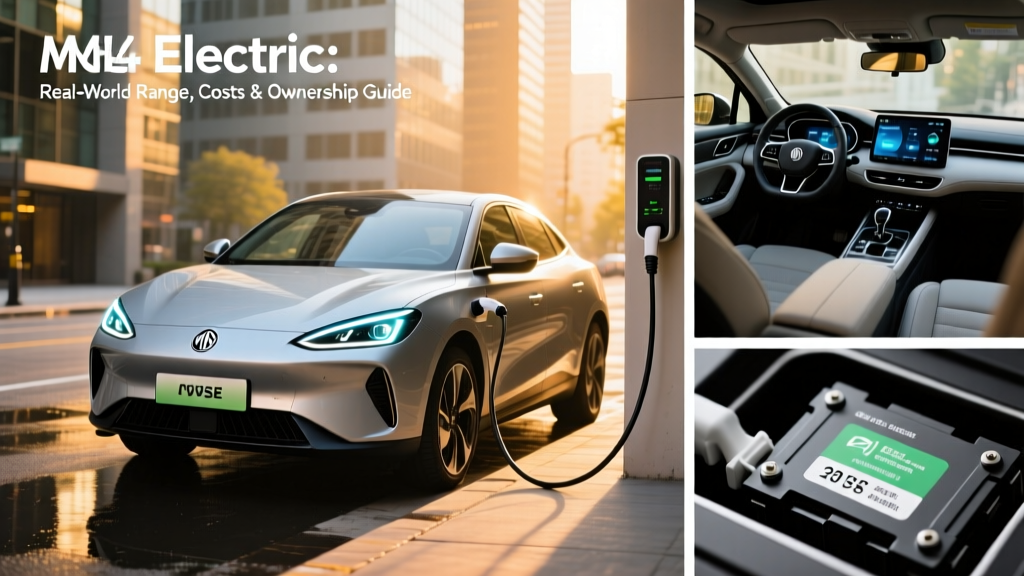
Quick Answer: The MG 4 Electric is a compact hatchback built by SAIC Motor, priced in international markets from roughly £26,000–£37,000 (approximately $32,000–$46,000 USD equivalent). It offers a 64 kWh LFP or 77 kWh NMC battery delivering a WLTP range of 281–323 miles (EPA-equivalent roughly 240–280 miles). DC fast charging peaks at 135 kW (10–80% in ~26 minutes). However, the MG 4 is not sold in the United States as of 2026. American buyers looking for a similar value EV should cross-shop the Chevrolet Equinox EV, Nissan Leaf successor, or Hyundai Kona Electric. If you're reading from the UK, Europe, or Australia, this guide covers everything you need to know about owning one.
What the MG 4 Electric Actually Offers
The MG 4 Electric sits in the compact EV hatchback segment, competing directly with the Volkswagen ID.3, BYD Dolphin, and Hyundai Kona Electric. SAIC Motor manufactures it on the MSP (Modular Scalable Platform), a rear-wheel-drive architecture that gives it sharper handling dynamics than many front-drive rivals in its price bracket.
For the 2025–2026 model years, MG offers the following powertrain configurations:
| Specification | SE (Standard) | SE Long Range | XPOWER |
|---|---|---|---|
| Battery Capacity | 51 kWh (LFP) | 64 kWh (LFP) / 77 kWh (NMC) | 64 kWh (LFP) |
| Power Output | 168 hp (125 kW) | 201 hp (150 kW) | 429 hp (320 kW) AWD |
| WLTP Range | 218 mi (350 km) | 281–323 mi (452–520 km) | 239 mi (385 km) |
| Est. EPA-Equivalent Range | ~185 mi | ~240–280 mi | ~200 mi |
| 0–62 mph (0–100 km/h) | 7.5 sec | 6.5 sec | 3.8 sec |
| Peak DC Charge Rate | 100 kW | 135 kW | 135 kW |
| 10–80% DC Fast Charge | ~30 min | ~26 min | ~26 min |
| Level 2 AC Charging | 7 kW (single-phase) / 11 kW (three-phase) | 7 kW / 11 kW | 7 kW / 11 kW |
Battery chemistry matters here. The LFP (lithium iron phosphate) packs sacrifice some energy density for longer cycle life, better thermal stability, and the ability to charge to 100% regularly without accelerated degradation. The 77 kWh NMC (nickel manganese cobalt) variant in the Long Range offers more miles but should ideally be charged to 80% for daily use, reserving 100% for road trips.
Real-World Range: What the Sticker Doesn't Tell You
WLTP testing tends to overstate range compared to the more stringent US EPA cycle. Based on European owner reports and independent testing, here's what to expect from the 64 kWh Long Range model in practice:
EPA-Equivalent Estimate: ~240–280 miles (64 kWh LFP Long Range)
Real-World Highway (70 mph / 110 km/h): ~195–220 miles
Real-World Mixed Driving (spring/autumn): ~220–250 miles
Cold Weather (below 32°F / 0°C): ~160–190 miles (20–30% loss typical for LFP chemistry without a heat pump on all trims)
City / Stop-Start with Regen: ~250–275 miles
The MG 4 does not come standard with a heat pump on all trims — it's an optional extra or included only on higher-spec models in some markets. Without a heat pump, cabin heating in winter relies on a resistive PTC heater, which draws significantly more energy from the traction battery. If you live in a climate with sustained sub-freezing winters, this is a critical ownership factor. Budget 25–30% range reduction in January and February driving.
The 77 kWh NMC variant mitigates this somewhat through sheer capacity, but its real-world winter highway range still drops to roughly 200–220 miles. For context, the Hyundai Kona Electric (65 kWh, with standard heat pump) achieves similar or slightly better real-world winter range thanks to more efficient thermal management.
Charging Speed and Infrastructure Reality
The MG 4's 135 kW peak DC fast-charge rate is respectable but not class-leading. The Hyundai Kona Electric and Kia EV3 both accept up to 100–150 kW depending on battery, while the Tesla Model 3 Highland can sustain 250 kW on V3 Superchargers. The key metric isn't peak kW — it's the charge curve, or how long the car sustains high power before tapering.
In real-world DC charging sessions, the MG 4 64 kWh sustains roughly 90–135 kW between 10–50% State of Charge (SoC), then tapers to 60–80 kW from 50–70%, and drops below 40 kW past 80%. This is why the 10–80% time of ~26 minutes is the useful benchmark. If you're charging from 20–80% on a road trip, expect about 22–24 minutes at a functional 150+ kW charger.
kW vs. kWh reminder: kW (kilowatts) measures the rate of charging power — how fast electrons flow into the battery. kWh (kilowatt-hours) measures the total energy capacity of the battery, analogous to the size of a fuel tank. A 64 kWh battery charged at a sustained 64 kW would theoretically fill in one hour; at 135 kW peak, it fills faster, but taper prevents that rate from being maintained across the full session.
For home Level 2 charging on a 7 kW wallbox, a full 0–100% charge of the 64 kWh battery takes approximately 9–10 hours. On an 11 kW three-phase connection (available in some European homes), that drops to about 6 hours. Most owners charging overnight from 20–80% need only 5–6 hours on a 7 kW unit, which is easily manageable with off-peak electricity tariffs.
Cost Breakdown: MG 4 Electric vs. Gas Hatchback
Let's compare the MG 4 SE Long Range (64 kWh) against a typical gas-powered compact hatchback — the Volkswagen Golf 1.5 TSI — over a 5-year, 60,000-mile ownership period. Costs are estimated for the UK market (the MG 4's largest market) but the framework applies broadly.
| Cost Category | MG 4 SE LR (64 kWh) | VW Golf 1.5 TSI (Gas) |
|---|---|---|
| Purchase Price (approx.) | £30,000 ($38,000 USD) | £27,500 ($35,000 USD) |
| Fuel/Energy (60k miles) | £2,400 (home charging at £0.24/kWh) | £6,300 (at £1.45/L, 40 MPG) |
| Maintenance (5 years) | £600 (cabin filter, brake fluid, tires) | £2,200 (oil, filters, brakes, spark plugs) |
| Insurance (5 years avg.) | £4,500 (£900/yr — EVs often 10–20% higher) | £3,750 (£750/yr) |
| Vehicle Tax (VED / annual) | £0 (zero-emission exempt in UK through 2025; £10/yr from April 2025) | £900 (£180/yr) |
| Depreciation (est. 5yr) | £14,000 (~47%) | £11,000 (~40%) |
| Total 5-Year Cost | £51,500 | £51,650 |
The numbers reveal a near-parity total cost of ownership, with the MG 4 saving heavily on fuel and maintenance but losing ground on insurance premiums and steeper depreciation (a pattern common to newer Chinese-manufacture brands in Western markets where resale values are still establishing).
For US readers drawing the comparison to a Chevrolet Equinox EV or Hyundai Kona Electric: the US federal §30D tax credit of up to $7,500 (subject to IRS income caps, MSRP limits, and battery sourcing requirements) can dramatically shift the purchase-price equation in favor of EVs that qualify. The MG 4 does not qualify because it isn't sold in the US. Always verify current-year eligibility on irs.gov before assuming credit availability.
EV vs. Gas vs. Hybrid: Where the MG 4 Fits
| Factor | MG 4 Electric (BEV) | Toyota Corolla Hybrid (HEV) | VW Golf (Gas) |
|---|---|---|---|
| Fuel/Energy Cost per Mile | ~4–6¢ (home) / 12–18¢ (public DC) | ~10–12¢ | ~14–18¢ |
| Tailpipe Emissions | Zero (upstream grid-dependent) | Low (~100 g/km CO₂) | ~130–150 g/km CO₂ |
| Home "Refueling" Possible | Yes (Level 1 or 2) | No | No |
| Road Trip Convenience | Plan 25-min charge stops | 5-min gas stop, 500+ mi range | 5-min gas stop, 400+ mi range |
| Maintenance Complexity | Low (no oil, fewer moving parts) | Medium (ICE + hybrid system) | Medium-High |
| Cold Weather Range Impact | 20–30% loss | Minimal (~5%) | Minimal (~5%) |
The MG 4 wins on per-mile energy cost and maintenance simplicity if you have access to home charging. The hybrid and gas alternatives still win on road-trip flexibility and cold-weather predictability. If your driving pattern is 85% commuting and local errands with 2–3 longer trips per year, the MG 4's economics favor you strongly. If you regularly drive 300+ miles in winter or lack home charging access, a hybrid like the Corolla HEV may be the more pragmatic choice.
Common Misconceptions About the MG 4
| Myth | Fact |
|---|---|
| "LFP batteries don't last as long" | LFP chemistry actually offers longer cycle life (2,000–5,000 cycles) than NMC (1,000–2,000 cycles). The trade-off is lower energy density and reduced cold-weather performance. |
| "The MG 4 qualifies for the US $7,500 tax credit" | The MG 4 is not sold in the United States. US federal EV credits under §30D apply only to vehicles purchased and placed in service in the US. See IRS guidelines. |
| "135 kW charging means it fills the battery in 30 minutes" | 135 kW is the peak rate, sustained only in a narrow SoC window. The realistic 10–80% time is ~26 minutes, and charging past 80% slows dramatically due to the charge curve taper. |
| "EVs need no maintenance at all" | The MG 4 still requires cabin air filter replacement, brake fluid checks, tire rotation (EVs wear tires faster due to weight and instant torque), windshield washer fluid, and periodic software updates. |
| "Range is the same year-round" | Cold weather reduces range by 20–30% in LFP batteries, particularly without a heat pump. A 281-mile WLTP rating becomes ~160–190 real-world miles at highway speeds in freezing temperatures. |
First-Time EV Buyer Checklist
If the MG 4 is your first EV (or you're considering any EV in this segment), work through these practical questions before signing:
- Can I charge at home? If you have a garage or dedicated parking spot where a Level 2 wallbox (7 kW) can be installed, EV ownership is dramatically cheaper and more convenient. Installation costs typically run £500–£1,500 ($600–$2,000 USD) depending on electrical panel capacity and cable run distance. If you rely entirely on public charging, your per-mile energy cost roughly triples, and you'll need to budget time for charging stops.
- What's my daily round-trip distance? If your commute is under 60 miles round-trip, even the 51 kWh MG 4 SE handles it effortlessly with range to spare. If you regularly exceed 150 miles in a day, the 77 kWh NMC Long Range is worth the premium.
- How cold does it get where I live? Sustained sub-freezing temperatures with no garage parking mean you'll lose 25–30% of rated range in winter. Specify the heat pump option if available in your market, or budget for more frequent winter charging.
- What's my road-trip frequency? Two or three 300-mile trips per year are manageable with one en-route DC fast-charge stop (plan ~25 minutes). If you drive long distances weekly, a PHEV or HEV may reduce friction.
- What's the warranty coverage? MG offers a 7-year / 80,000-mile vehicle warranty and 8-year / 100,000-mile battery warranty (with a 70% capacity retention threshold) in most markets. This is competitive with Hyundai/Kia's coverage and exceeds Volkswagen's.
- Is the infotainment acceptable to me? The MG 4's infotainment system has drawn consistent criticism from reviewers for sluggish response times and an unintuitive menu structure. Test-drive and spend 10 minutes with the system before committing — this is a daily-use interface.
Decision Framework: Should You Buy the MG 4 Electric?
Buy the MG 4 Electric if:
- You live in the UK, Europe, or Australia (where it's sold) and want a practical EV hatchback under £32,000 / €35,000 / A$55,000
- You have home charging access and your daily driving is under 100 miles
- You value driving dynamics — the rear-wheel-drive platform and low center of gravity make it genuinely engaging for the price
- You want LFP battery chemistry for its longevity and the freedom to charge to 100% daily without degradation anxiety
- You're upgrading from an older gas car and want to cut fuel costs by 60–70%
Look elsewhere if:
- You live in the United States (the MG 4 is not available; consider the Chevrolet Equinox EV, Hyundai Kona Electric, or Tesla Model 3)
- You lack any form of home or workplace charging and your local public DC charging network is sparse
- You regularly drive 250+ miles in freezing winter conditions and need maximum range predictability
- Infotainment quality and software polish are high priorities (test the VW ID.3 or Hyundai Kona Electric instead)
- Resale value certainty matters — MG's brand equity in Western markets is still building, and 5-year depreciation may exceed established rivals
Frequently Asked Questions
Is the MG 4 Electric available in the United States?
No. As of 2026, SAIC Motor does not sell the MG 4 in the US market. There have been periodic reports of MG considering a US entry, but no confirmed timeline or model lineup exists. US buyers seeking a similar compact EV should evaluate the Chevrolet Equinox EV (from ~$33,000, up to 319 miles EPA range), Hyundai Kona Electric (from ~$33,000, 261 miles EPA), or the Tesla Model 3 (from ~$38,990, 341 miles EPA).
How long does the MG 4 battery last before needing replacement?
MG warranties the battery for 8 years or 100,000 miles, guaranteeing at least 70% of original capacity. LFP batteries in the 51 kWh and 64 kWh models have demonstrated degradation rates of roughly 1–2% per year in typical use, based on early fleet data. A full battery replacement outside warranty would cost approximately £8,000–£12,000 ($10,000–$15,000 USD), though this is rare within the first decade of ownership.
Can I use the MG 4 for road trips?
Yes, with planning. The 64 kWh Long Range model can realistically cover 195–220 highway miles before needing a charge in moderate weather. On a 400-mile trip, plan one 25-minute DC fast-charge stop at roughly the halfway point. Use apps like A Better Routeplanner or Zap-Map (UK) to identify reliable chargers along your route. Avoid planning trips that require charging above 80% SoC, as the charge curve taper makes 80–100% painfully slow.
Does the MG 4 support V2L (Vehicle-to-Load)?
Yes, the MG 4 supports V2L via an optional adapter, allowing you to power external devices (laptops, camping equipment, power tools) at up to 2.2 kW from the traction battery. This is useful for camping or as emergency backup power but is not a substitute for a dedicated home battery system or V2H (Vehicle-to-Home) setup.
What's the difference between the LFP and NMC battery options?
LFP (lithium iron phosphate) batteries, used in the 51 kWh and 64 kWh variants, offer longer cycle life, better thermal stability, and the ability to charge to 100% regularly without accelerated degradation. The trade-off is lower energy density (heavier pack for the same kWh) and worse cold-weather performance. NMC (nickel manganese cobalt), used in the 77 kWh Long Range, packs more energy into a lighter package for greater range but should be kept between 20–80% SoC for daily use to maximize longevity. Choose LFP for city-heavy driving and daily full charges; choose NMC if maximum range per charge is your priority.
How does MG's reliability compare to established brands?
MG's reliability record is mixed. Early MG 4 models (2022–2023) had reported issues with 12V auxiliary battery drain, infotainment software glitches, and occasional charging communication faults. MG has issued software updates to address many of these. In the IIHS and Euro NCAP testing, the MG 4 earned a 5-star Euro NCAP safety rating (2022), which is a strong positive. Long-term reliability data beyond 3–4 years is still limited compared to Toyota or Hyundai.