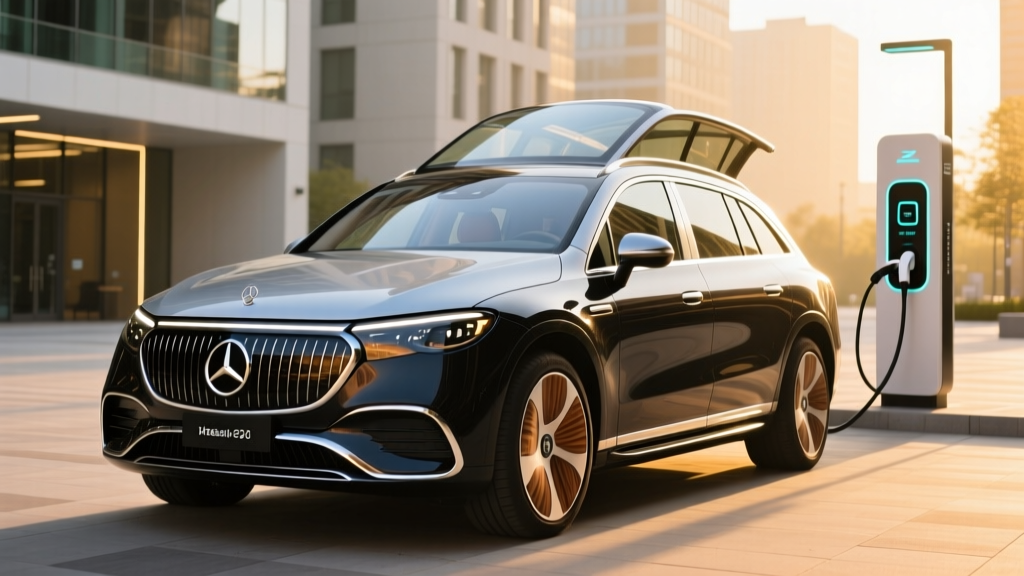
The Mercedes-Maybach EQS SUV occupies a category with almost no direct rival: a six-figure, all-electric ultra-luxury flagship that trades on handcrafted interior opulence rather than performance metrics. For 2026, the EQS 680 SUV remains Maybach's sole battery-electric offering, built on the same EVA2 platform as the standard Mercedes-Benz EQS SUV but re-engineered around rear-seat comfort, noise isolation, and material excess. This review covers the numbers buyers actually need — real-world range, charging behavior, efficiency, and whether the federal tax credit applies at this price point.
2026 Maybach EQS SUV: Core Specifications
| Spec | Value |
|---|---|
| EPA Estimated Range | 330 miles (combined) |
| Battery (Usable) | 108.4 kWh, NMC lithium-ion |
| Drivetrain | Dual-motor AWD (4MATIC) |
| Horsepower / Torque | 649 hp / 700 lb-ft |
| 0–60 mph | 4.1 seconds |
| Max DC Fast Charge | 200 kW (CCS1) |
| 10–80% DC Charge Time | ~31 minutes (est.) |
| Level 2 Home Charge Rate | 9.6 kW (~25 mi/hr) |
| EPA Efficiency | 79 MPGe combined (43 kWh/100 mi) |
| Cargo Volume (behind 2nd row) | 23.0 cu ft |
| Rear Legroom | 42.4 inches |
| Battery Warranty | 8 years / 100,000 miles |
| Base MSRP | $181,050 (incl. destination) |
Real-World Range: What to Actually Expect
Real-World Highway (70 mph, mild weather): ~265–285 miles
Cold-Weather Highway (below 32°F): ~220–245 miles
City / Suburban Mixed Driving: ~290–315 miles
The Maybach EQS 680 SUV carries the same 108.4 kWh usable NMC (nickel-manganese-cobalt) battery pack found in the standard EQS 580 SUV, but added sound-deadening, a heavier interior, and standard 21- or 22-inch Maybach-specific wheels work against efficiency. The EPA's 330-mile combined figure assumes a 55/45 city-highway split. On sustained highway runs at 70–75 mph, expect 265 to 285 miles before the battery buffer triggers range-reduction warnings — roughly a 14–20% drop from the sticker, which is typical for large luxury EVs with frontal areas this substantial.
Cold weather compounds the penalty. Without preconditioning the battery and cabin while plugged in, sub-freezing highway driving can push range down to 220 miles. The EQS platform includes a heat pump for cabin heating, which mitigates but does not eliminate winter losses. Buyers in northern climates should plan charging stops around a 200-mile practical winter highway range to maintain a comfortable reserve.
Regenerative braking in the Maybach is adjustable via steering-wheel paddles (three levels plus an adaptive auto mode), but the vehicle does not offer true one-pedal driving to a full stop — a deliberate choice by Mercedes for smoothness in chauffeured use. This slightly reduces energy recapture in stop-and-go traffic compared to competitors that allow full regen hold.
Charging Speed: DC Fast Charging and Home Level 2
| Charging Level | Power / Rate | Estimated Time or Miles/Hour |
|---|---|---|
| Level 1 (120V, 12A) | ~1.4 kW | ~3–4 mi/hr |
| Level 2 (240V, 40A) | 9.6 kW | ~25 mi/hr (full charge ~12 hrs) |
| DC Fast Charge (peak) | 200 kW (CCS1) | 10–80% in ~31 minutes |
| DC Fast Charge (sustained avg) | ~130–140 kW | 10–80% real-world average |
The 200 kW peak DC fast-charge rate is the headline figure, but the charging curve tells the practical story. Like the standard EQS SUV, the Maybach's 400-volt architecture (not 800V like the Porsche Taycan or Hyundai Ioniq 5) means peak rate is achieved only in a narrow state-of-charge window — roughly 10% to 25% SoC with a preconditioned battery. Above 50%, the rate tapers to approximately 110–130 kW, and above 80% it drops further to protect the NMC cells.
In real-world DC fast charging at a 350 kW Electrify America or Tesla Supercharger station (with CCS adapter or Magic Dock), expect 10–80% in roughly 31 minutes under ideal thermal conditions. If the battery is cold or un-preconditioned, add 8–12 minutes. The built-in navigation's route planner does precondition the battery when a DC fast charger is set as the destination — always use this feature for optimal charge speed.
At home on a Level 2 wallbox (240V, 40A), the 9.6 kW onboard charger replenishes the 108.4 kWh pack in approximately 12 hours from near-empty. For most owners who plug in nightly and charge between 20–80% SoC (the recommended daily range for NMC longevity), a typical overnight session adds 150–200 miles in 6–8 hours. Home installation of a hardwired Level 2 charger on a 50A circuit typically costs $800–$2,500 depending on panel proximity and local permitting, per U.S. Department of Energy guidance.
Performance and Driving Character
The dual-motor AWD powertrain produces 649 horsepower and 700 lb-ft of torque, launching the 6,200-pound Maybach to 60 mph in 4.1 seconds — brisk for its mass, though not in the same league as a Tesla Model X Plaid or even the AMG EQS SUV. That's intentional. Maybach tunes the accelerator mapping for linear, dignified thrust rather than aggressive snap. The air suspension with adaptive damping isolates occupants from road imperfections with a level of composure that is genuinely difficult to replicate at any price point.
Rear-axle steering (up to 10 degrees) is standard, shrinking the turning circle to a surprisingly manageable 36.1 feet — critical for a vehicle with a 126.6-inch wheelbase navigating urban environments. Steering feel is deliberately light and detached; this is a car designed to be driven in, not necessarily driven by the owner.
Interior, Tech, and Standout Features
The Maybach EQS 680 SUV is configured exclusively as a four-seat vehicle with two individual rear executive seats separated by a fixed center console housing a refrigerated compartment, silver-plated champagne flutes, and a tablet-style rear entertainment controller. Key interior and technology highlights:
- MBUX Hyperscreen: 56-inch curved glass spanning the dashboard with three OLED displays (12.3" driver, 17.7" center, 12.3" passenger)
- Rear-seat entertainment: Dual 11.6-inch screens with streaming, navigation mirroring, and vehicle-function control
- Burmester 4D surround sound: 22 speakers with seat-integrated bass exciters
- Active ambient lighting: 64 colors with animated Maybach-specific welcome sequences
- Rear-seat recline and massage: Power-reclining seats with calf rests, heating, ventilation, and 10-program massage
- HEPA filtration: Energized air system with fragrancing (Maybach-exclusive osmanthus bloom scent)
- Automatic comfort doors: Power-open/close for all four doors via gesture or rear-seat control
The driver-assistance suite includes Mercedes-Benz's latest Driver Assistance Package: adaptive cruise with stop-and-go, active lane-keeping with lane-change assist, active blind-spot intervention, and evasive steering assist. This is an SAE Level 2 system — the driver must remain engaged with hands on the wheel at all times. It is not self-driving. In highway use, the system is competent and smooth, though it requires more frequent steering-torque confirmation than GM's Super Cruise or Ford's BlueCruise on compatible roads.
Pricing, Trims, and Federal Tax Credit Eligibility
| Item | Amount |
|---|---|
| Base MSRP (single trim) | $181,050 |
| Typical Options (paint, wheels, rear-seat package upgrades) | $8,000–$20,000 |
| As-Tested Price (well-equipped) | $190,000–$201,000 |
| Federal §30D Tax Credit | $0 (exceeds MSRP cap) |
The Maybach EQS 680 SUV is offered in a single, heavily equipped trim at $181,050 including destination. Options are limited to paint colors (including two-tone Maybach finishes at ~$12,950), wheel designs, and rear-seat configuration upgrades. Most examples leave the dealership between $185,000 and $200,000.
- SUV MSRP cap under §30D: $80,000 — the Maybach at $181,050 exceeds this by over $100,000
- Buyer AGI income caps ($300K MFJ / $150K single) are irrelevant since the MSRP cap is already breached
- Battery critical-mineral and component sourcing requirements are moot at this price
- Point-of-sale transfer is unavailable for vehicles exceeding the MSRP cap
Some states and localities offer additional EV incentives that may not carry MSRP caps — check your state's energy office or DMV for current programs. However, at this price, most buyers are not incentive-dependent.
Efficiency, Cargo, and Ownership Practicalities
The EPA rates the Maybach EQS 680 SUV at 79 MPGe combined (43 kWh per 100 miles). For context, the standard EQS 580 SUV achieves 84 MPGe on the same battery — the Maybach's extra weight, larger wheels, and higher rolling resistance account for the 5-MPGe penalty. At the national average residential electricity rate of ~$0.17/kWh (EIA, 2025 data), a full charge costs approximately $18.40, yielding a fuel cost of about $0.056 per mile. A comparable gasoline Mercedes-Maybach GLS 600 at 15 MPG combined and $3.50/gallon costs $0.233 per mile — a four-fold difference.
Cargo space measures 23.0 cubic feet behind the second row. There is no third row and no front trunk (frunk), as the EVA2 platform uses that space for power electronics. For a vehicle of this size, cargo capacity is modest — the priority is rear-seat volume, which offers 42.4 inches of legroom and 39.8 inches of headroom.
The battery and powertrain carry Mercedes-Benz's standard EV warranty: 8 years or 100,000 miles, whichever comes first, with a capacity-retention threshold of 70%. The basic vehicle warranty is 4 years / 50,000 miles, and Maybach includes 4 years of complimentary scheduled maintenance and roadside assistance.
Pros and Cons
Pros
- Unmatched rear-seat luxury in the EV segment — no rival offers this level of material quality and seat comfort
- 330-mile EPA range is practical for most daily and regional travel
- Exceptionally quiet cabin — among the lowest interior dB readings of any production vehicle
- Rear-axle steering makes city maneuvering surprisingly easy
- Low per-mile energy cost vs. gasoline ultra-luxury alternatives
- Comprehensive driver-assist suite included standard
Cons
- $181K+ base price with zero federal tax credit eligibility
- 200 kW peak DC charge rate is modest — rivals on 800V architectures charge significantly faster
- Only four seats — no flexibility for a fifth passenger
- 23 cu ft cargo is tight for a vehicle this large
- Real-world highway range drops to ~265–285 mi; winter highway ~220 mi
- Depreciation on six-figure luxury EVs remains steep (expect 40–55% over 3 years)
- No frunk; limited storage for charging cables
Who Should Buy the Maybach EQS SUV?
- You prioritize rear-seat comfort and cabin silence above all other vehicle attributes
- You have reliable home Level 2 charging and most trips fall within 250 miles
- You want an EV but refuse to compromise on material quality or brand prestige
- You are replacing a Maybach GLS or S-Class and want to electrify without downsizing luxury
- You need maximum cargo space or seating for more than four
- You frequently drive 300+ miles between charging stops (the real-world range won't support this comfortably)
- You want the fastest DC charging available — consider the Lucid Air Grand Touring or Porsche Taycan on 800V
- Tax credit eligibility or total cost of ownership is a primary purchase driver
The competitive set is thin. The BMW i7 xDrive60 ($120K, 318-mile range, sedan) offers similar tech but less rear-seat opulence. The Cadillac Celestiq ($340K+, ultra-low volume) targets a higher tier. The Range Rover Electric (announced, pricing TBD) may emerge as the closest rival when it reaches production. For now, the Maybach EQS SUV stands nearly alone as an electric chauffeur-class vehicle.
Frequently Asked Questions
What is the real-world range of the 2026 Maybach EQS SUV?
The EPA rates it at 330 miles combined, but real-world highway driving at 70 mph yields approximately 265–285 miles in mild weather. In cold conditions (below 32°F), expect 220–245 highway miles. City driving is closer to the EPA figure, around 290–315 miles, thanks to regenerative braking.
How fast does the Maybach EQS SUV charge?
On a DC fast charger, it peaks at 200 kW (CCS1 connector), reaching 10–80% in approximately 31 minutes under ideal conditions. The sustained average rate is closer to 130–140 kW due to the 400V architecture's charge-curve taper above 50% SoC. At home on Level 2 (240V, 9.6 kW), it gains about 25 miles per hour of charging.
Does the Maybach EQS SUV qualify for the federal EV tax credit?
No. Under IRS §30D rules, SUVs must have an MSRP at or below $80,000 to qualify. The Maybach EQS 680 SUV starts at $181,050 — more than double the cap. Income limits and battery-sourcing requirements are irrelevant since the MSRP disqualifies it outright.
Is the Maybach EQS SUV worth buying vs. competitors?
If your priority is rear-seat luxury in an EV, it has virtually no direct competitor. The BMW i7 is a sedan with less rear-seat space. The standard Mercedes EQS 580 SUV offers similar range and tech for $70K less but without Maybach materials. The trade-off is steep depreciation, no tax credit, and a 200 kW charge rate that lags 800V rivals.
What battery does the Maybach EQS SUV use, and how long will it last?
It uses a 108.4 kWh usable NMC (nickel-manganese-cobalt) lithium-ion pack. Mercedes-Benz warranties it for 8 years or 100,000 miles with a 70% minimum capacity retention. NMC chemistry typically retains 85–90% capacity after 100,000 miles under normal use, though frequent DC fast charging and extreme temperatures accelerate degradation modestly.
Can the Maybach EQS SUV tow?
Mercedes-Benz rates it at 3,500 pounds maximum towing capacity — adequate for a light utility trailer or small boat, but this is not a vehicle designed for heavy towing. Towing will reduce range by approximately 30–40%.
Does it use CCS or NACS (Tesla) charging?
The 2026 Maybach EQS SUV uses the CCS1 connector natively. For Tesla Supercharger access, use the Tesla-provided CCS adapter or stations equipped with Tesla's Magic Dock. Mercedes-Benz has announced a transition to NACS for future models, but the current EQS platform retains CCS1.