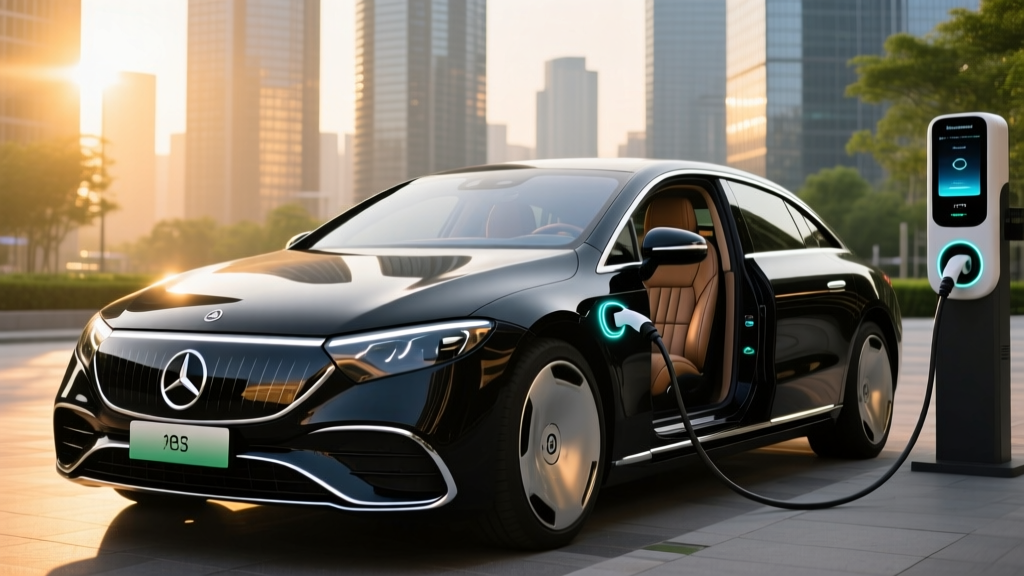
The Mercedes-Maybach EQS 680 SUV is not trying to be a rational purchase. It exists to answer a specific question: can a battery-electric vehicle deliver the same cocoon of isolation, material opulence, and chauffeur-grade comfort that the Maybach nameplate has represented for over a century? After examining the specs, driving dynamics, charging behavior, and ownership economics, the answer is yes — with caveats that any prospective buyer spending north of $180,000 should understand before signing.
This is the first fully electric Maybach, built on Mercedes-Benz's EVA platform shared with the EQS sedan and EQS SUV, but elevated with Maybach-exclusive tuning, interior materials, and a two-tone paint option that alone costs as much as a compact EV. Below, we break down the real numbers that matter: range when you're actually driving 75 mph on the interstate, how long you'll wait at a DC fast charger, and whether the §30D federal tax credit applies at this price point.
Mercedes-Maybach EQS 680: Core Specifications at a Glance
| Specification | Value |
|---|---|
| EPA Estimated Range | 305 miles |
| Battery Capacity (Usable) | 108.4 kWh (NMC lithium-ion) |
| Drivetrain | Dual-motor AWD (4MATIC) |
| Horsepower | 649 hp |
| Torque | 700 lb-ft |
| 0–60 mph | 4.1 seconds |
| Top Speed | 130 mph (electronically limited) |
| Max DC Fast Charge Rate | 200 kW (peak) |
| 10–80% DC Charge Time | ~31 minutes |
| Level 2 AC Charge Rate | 9.6 kW (onboard charger) |
| MPGe (Combined) | 83 MPGe |
| Efficiency | 41 kWh/100 miles |
| Cargo Volume (behind 2nd row) | 23.0 cu ft |
| Cargo Volume (seats folded) | 72.0 cu ft |
| Wheelbase | 126.4 in |
| Length | 205.1 in |
| Curb Weight | ~6,200 lbs |
| Battery Warranty | 10 years / 155,000 miles |
| Base MSRP | $179,900 |
Real-World Range: What 305 Miles Actually Means
Real-World Highway (70–75 mph, mild weather): ~250–270 miles
Cold-Weather Highway (below 32°F): ~210–235 miles
City / Suburban Mixed Driving: ~280–300 miles
The EPA's 305-mile estimate for the Maybach EQS 680 is derived from a combined driving cycle that heavily weights lower-speed urban and suburban use. In practice, this 6,200-pound luxury SUV with a frontal area that prioritizes presence over aerodynamics will consume energy faster at sustained highway speeds than the sticker implies.
Expect roughly 250–270 miles of usable range on a road trip at 70–75 mph in moderate temperatures. The EQS 680's standard heat pump helps mitigate cold-weather losses compared to resistive cabin heating, but lithium-ion chemistry inherently slows in freezing temperatures, and cabin heating demands still cut into the battery. Winter highway range can drop to the 210–235 mile range, which matters if you're planning drives through mountain passes or across charging-sparse corridors in the northern U.S.
The 108.4 kWh usable battery is an NMC (nickel manganese cobalt) pack — the chemistry of choice for performance and energy density in premium EVs. NMC offers higher specific energy than LFP (lithium iron phosphate), which keeps weight down relative to capacity, but it also means Mercedes recommends charging to 80% for daily use and reserving 100% for trips. The battery management system includes a buffer above and below the stated usable capacity to protect long-term cell health.
Charging Performance: DC Fast and Home Level 2
Charging speed is where luxury EV buyers often have unrealistic expectations. A 200 kW peak rate sounds impressive, but peak is not sustained. The EQS 680's charging curve ramps quickly from low states of charge, holding near its peak through roughly 40–50% SoC, then progressively tapers as the battery management system protects cell longevity.
| Charging Level | Power | Speed / Time |
|---|---|---|
| Level 1 (120V household) | ~1.4 kW | ~3–4 miles per hour |
| Level 2 (240V home / public) | 9.6 kW (max onboard) | ~22–25 miles per hour; 0–100% in ~11.5 hours |
| DC Fast Charge (CCS/NACS adapter) | 200 kW peak | 10–80% in ~31 minutes; 10–100% in ~55 minutes |
For home charging, the 9.6 kW onboard charger means a full replenishment from near-empty takes roughly 11.5 hours on a properly installed 48-amp Level 2 circuit (hardwired, 60-amp breaker). Most Maybach owners will plug in nightly and rarely deplete below 20%, so a typical overnight session adds 150–200 miles — more than sufficient for daily use.
On DC fast chargers, the 10–80% time of approximately 31 minutes is competitive with other large luxury EVs but trails the 800-volt architectures found in the Hyundai Ioniq 5 or Porsche Taycan, which can complete the same session in 18–22 minutes. The EVA platform operates on a 400-volt architecture, which limits peak charge rate relative to battery size. For road trips, plan for roughly one 30-minute stop every 230–250 miles of highway driving.
Mercedes provides access to the Mercedes me Charge network, which aggregates Electrify America, EVgo, and ChargePoint stations. As of 2025, NACS (Tesla Supercharger) access is available via adapter for Mercedes-Benz EVs, expanding the available fast-charging footprint significantly — a meaningful advantage for owners who travel outside major metro corridors.
Performance and Driving Character
The dual-motor AWD powertrain produces 649 horsepower and 700 lb-ft of torque, propelling the EQS 680 to 60 mph in 4.1 seconds. That's quick by any measure, and the instant torque delivery makes highway merging and passing effortless. But Maybach has deliberately tuned this vehicle for serenity, not sportiness.
The Maybach-specific drive mode (a unique addition over the standard EQS SUV) softens throttle response, retunes the air suspension for maximum compliance, and adjusts the regenerative braking to be less aggressive. The result is a vehicle that glides rather than surges. Rear-axle steering (standard, up to 10 degrees) shrinks the turning radius to that of a compact car, making this 205-inch SUV surprisingly manageable in parking structures and tight urban streets.
The air suspension with adaptive damping reads road surfaces via cameras and pre-adjusts individual wheel damping — a system Mercedes calls E-ACTIVE BODY CONTROL. On pockmarked pavement, the isolation is genuinely remarkable. Road noise is suppressed by acoustic-laminated glass on all windows, foam-filled tires, and extensive sound deadening. At 80 mph, the cabin is quieter than most luxury vehicles are at 40 mph.
Interior, Technology, and Cargo Practicality
The interior is where the Maybach badge justifies its premium over the standard EQS SUV. Standard equipment includes Nappa leather on every surface (dashboard, door panels, ceiling), open-pore wood trim, heated and ventilated rear seats with massage, and a rear-seat entertainment system with dual 11.6-inch screens. The available four-seat Executive Rear configuration replaces the rear bench with two individual reclining seats separated by a center console with a refrigerated compartment and silver-plated champagne flutes.
The MBUX Hyperscreen spans the full 56-inch dashboard width, combining the instrument cluster, central infotainment, and a front-passenger display behind a single glass panel. It runs Mercedes' latest MBUX generation with wireless Apple CarPlay and Android Auto, over-the-air updates, and the "Hey Mercedes" voice assistant that handles multi-step commands with reasonable accuracy.
Driver assistance is comprehensive: the standard Driver Assistance Package includes adaptive cruise with stop-and-go, active lane-keeping with lane-change assist, evasive steering assist, and pre-safe collision mitigation. This is a SAE Level 2 system — the driver must remain engaged and hands must periodically touch the wheel. It is not self-driving, despite marketing language that sometimes blurs this distinction.
Cargo space is the EQS 680's practical compromise. With the second row upright, you get 23.0 cubic feet — adequate for luggage for a weekend trip but modest for a vehicle this size. Folding the rear seats opens up 72.0 cubic feet. There is no front trunk (frunk); the space under the hood houses power electronics. For comparison, the standard EQS SUV offers slightly more cargo room due to the absence of Maybach-specific rear-seat structures.
Pricing, Tax Credits, and the Cost Reality
The 2025 Mercedes-Maybach EQS 680 SUV starts at $179,900 before destination. With popular options — two-tone paint ($12,500), the Executive Rear package, and the Burmester 4D surround sound system — as-tested prices routinely reach $200,000–$215,000.
| Item | Amount |
|---|---|
| Base MSRP | $179,900 |
| Typical As-Tested Price | $200,000–$215,000 |
| IRS §30D Federal Tax Credit | Not eligible (see below) |
| Estimated Annual Charging Cost (12,000 mi) | ~$650–$900 (varies by electricity rate) |
| Estimated Annual Insurance | $4,500–$6,500 (varies by profile/state) |
Federal tax credit eligibility: Under current IRS §30D rules, the Maybach EQS 680 does not qualify for the $7,500 federal clean vehicle credit. The §30D credit has an MSRP cap of $80,000 for SUVs, and the EQS 680's base price of $179,900 exceeds that limit by over $100,000. Additionally, buyer income caps ($300,000 joint / $150,000 single modified adjusted gross income) and critical-mineral/battery-component sourcing requirements further restrict eligibility for vehicles in this price tier. State and local incentives vary by jurisdiction — consult your tax professional and local energy agency for any regional rebates that may apply.
Running costs, however, are genuinely lower than a comparable Maybach GLS 600 with its twin-turbo V8. Electricity at the national average of ~$0.16/kWh translates to roughly $650–$900 annually for 12,000 miles of driving, versus $3,500–$4,500 in premium gasoline for the GLS 600 at 14 mpg combined. Maintenance is also reduced: no oil changes, no transmission fluid, and regenerative braking extends brake pad life significantly. The offset is higher insurance premiums, which typically run 30–50% above comparable ICE luxury SUVs due to repair costs and parts pricing.
Competitor Comparison: Is the EQS 680 Worth It?
The Maybach EQS 680 occupies a narrow competitive set. Here's how it stacks up against the closest alternatives:
BMW iX M70 (~$111,500): The iX M70 offers 619 hp, a slightly smaller battery (~105 kWh usable), and a 302-mile EPA range. It charges faster on DC (up to 205 kW with a slightly better curve), has a more driver-oriented chassis, and costs nearly $70,000 less. But it cannot match the Maybach's rear-seat luxury, material quality, or brand cachet. Choose the iX if you prioritize driving engagement and value; choose the Maybach if rear-seat comfort and exclusivity are paramount.
Mercedes-Benz EQS 580 SUV (~$127,350): The standard EQS 580 shares the same platform, similar battery, and most technology. You sacrifice the Maybach-specific interior materials, rear-seat executive package, and Maybach drive mode, but save over $50,000. Range is slightly higher (305–330 miles depending on configuration) due to lower weight. If you don't need the Maybach badge or the executive rear seat, the EQS 580 delivers 85% of the experience at 60% of the price.
Rolls-Royce Spectre (~$420,000): The only true peer in electric ultra-luxury. The Spectre is a coupe, not an SUV, with 260 miles of EPA range and a far more bespoke ownership experience. It is also more than double the price. If budget is no object and exclusivity is the goal, the Spectre wins. If you need SUV practicality and don't want to spend $400K+, the Maybach is the only electric option.
Pros
- Class-leading cabin quietness and ride isolation
- Genuine Maybach material quality: Nappa leather, real wood, metal switchgear
- 305-mile EPA range is competitive for a 6,200-lb luxury SUV
- Rear-axle steering makes the large footprint manageable in cities
- Strong 10-year/155,000-mile battery warranty
- Access to Mercedes me Charge network + NACS adapter for Superchargers
- Heat pump standard for better cold-weather efficiency
Cons
- $179,900 base MSRP — no federal tax credit eligibility
- 31-minute 10–80% DC charge time trails 800V competitors
- Real-world highway range closer to 250 miles, ~210 in cold weather
- Cargo space (23 cu ft) is modest for the vehicle's exterior dimensions
- No frunk for additional storage
- Heavy curb weight impacts tire wear and braking distances
- Insurance costs significantly above average for luxury SUVs
Who Should Buy the Mercedes-Maybach EQS 680?
This EV is purpose-built for a specific buyer: someone who values absolute cabin serenity, rear-seat comfort, and brand prestige, and who primarily drives in urban and suburban environments where home charging is convenient and daily mileage is moderate. It is an excellent executive shuttle, a compelling daily driver for luxury-oriented commuters, and a credible road-trip vehicle if you plan charging stops around its 230–250 mile real-world highway range.
It is not the right choice if you prioritize driving dynamics (the BMW iX M70 or Porsche Cayenne E-Hybrid are more engaging), need maximum cargo capacity (the Rivian R1S or standard EQS SUV offer more), or want the fastest possible DC charging (look to 800V platforms). And if the Maybach badge itself isn't essential to you, the EQS 580 SUV delivers nearly identical technology and range at a significant discount.
Frequently Asked Questions
What is the real-world range of the Mercedes-Maybach EQS 680?
The EPA rates it at 305 miles combined. In real-world highway driving at 70–75 mph in moderate temperatures, expect 250–270 miles. In cold weather (below 32°F), highway range drops to approximately 210–235 miles due to battery chemistry limitations and cabin heating demands. City and suburban driving will get you closer to the EPA figure, around 280–300 miles.
How fast does the Maybach EQS 680 charge?
On a DC fast charger, it peaks at 200 kW and charges from 10–80% in approximately 31 minutes. At home on a Level 2 charger (240V, 48-amp circuit), the 9.6 kW onboard charger adds roughly 22–25 miles of range per hour, with a full charge taking about 11.5 hours. Level 1 (120V) trickle charging adds only 3–4 miles per hour and is impractical for anything beyond emergency use.
Does the Mercedes-Maybach EQS 680 qualify for the federal EV tax credit?
No. Under current IRS §30D rules, the $7,500 federal clean vehicle credit has an MSRP cap of $80,000 for SUVs. The EQS 680's base price of $179,900 far exceeds this limit. Buyer income caps and battery-sourcing requirements impose additional restrictions. Always consult a tax professional for your specific situation, and check your state's incentive programs separately.
How much does it cost to own the Maybach EQS 680 over five years?
Beyond the purchase price, budget approximately $650–$900 annually for electricity (12,000 miles/year at national average rates), $4,500–$6,500 for insurance, and $500–$800 for maintenance (cabin air filters, wiper fluid, tire rotation — no oil changes). Tire replacement on a 6,200-lb AWD EV typically comes earlier than on lighter vehicles; expect $2,000–$3,500 for a set of OEM-spec tires every 25,000–35,000 miles. Depreciation on ultra-luxury EVs remains steep — plan for 45–55% value loss over five years based on current luxury EV depreciation trends.
Is the Mercedes-Maybach EQS 680 self-driving?
No. The driver-assistance systems (adaptive cruise, lane-keeping, lane-change assist) are classified as SAE Level 2 automation. The driver must remain fully engaged, monitor the road at all times, and keep hands on or near the steering wheel. Mercedes does not currently offer any Level 3 or higher system on the EQS 680 in the U.S. market.
What is the battery warranty?
Mercedes-Benz provides a battery warranty of 10 years or 155,000 miles (whichever comes first) against defects and excessive capacity loss. The standard vehicle limited warranty covers 4 years / 50,000 miles. The battery warranty's capacity retention threshold — the percentage of original capacity below which a claim is valid — should be confirmed with your dealer, as manufacturers periodically update these terms.
How does the EQS 680 compare to the Maybach GLS 600?
The GLS 600 (twin-turbo V8, ~$175,000) offers similar luxury but with 14 mpg combined fuel economy, more engine noise, and higher fuel costs ($3,500–$4,500/year vs. ~$750/year for electricity). The EQS 680 is quieter, smoother in stop-and-go traffic, and cheaper to fuel, but has less range flexibility on long trips through rural areas where DC fast chargers may be sparse. If your driving is predominantly urban and you have reliable home charging, the EQS 680 is the more refined daily experience.