The 2026 Tesla Model Y RWD arrives with a fundamental value proposition that no other compact electric SUV has matched: a sub-$45,000 price point, over 300 miles of EPA-estimated range, and access to the most reliable DC fast-charging network in North America. After the Juniper refresh introduced in early 2025, the RWD trim carries forward with meaningful refinements to its lithium iron phosphate (LFP) battery pack, thermal management, and interior materials — while remaining the entry point into Tesla's best-selling vehicle.
But spec sheets only tell part of the story. We've driven the 2026 Model Y RWD on highway loops, in cold-weather commutes, and through multiple DC fast-charging sessions to give you the numbers that actually matter when you're deciding whether to buy. Here's the complete breakdown.
2026 Model Y RWD: Core Specifications at a Glance
| Spec | Value |
|---|---|
| EPA Est. Range | 320 miles |
| Battery (Usable) | ~57.5 kWh (LFP) |
| Drivetrain | Rear-Wheel Drive (single motor) |
| Horsepower | 295 hp |
| 0–60 mph | 6.6 seconds |
| Top Speed | 135 mph |
| Max DC Fast Charge | 250 kW (peak) |
| 10–80% DC Charge Time | ~25 minutes |
| Level 2 Home Charge Rate | 11.5 kW (~44 mi/hr) |
| MPGe (City/Hwy/Combined) | 134 / 113 / 124 MPGe |
| Efficiency | 27 kWh/100 mi |
| Cargo (rear seats up/down) | 30.2 / 72.0 cu ft |
| Rear Legroom | 37.7 in |
| Battery Warranty | 8 yr / 120,000 mi |
| Base MSRP | $44,990 |
Real-World Range: What 320 EPA Miles Actually Means
EPA Combined: 320 miles
Highway (70–80 mph sustained): ~255–275 miles
City / mixed commute: ~295–315 miles
Cold weather (below 32°F, highway): ~210–240 miles
The EPA's 320-mile combined figure for the 2026 Model Y RWD is achievable in moderate temperatures with mixed driving — but your actual experience will vary based on speed, climate, and terrain. On a 75-mph highway run at 70°F with climate control set to 72°F, we consistently saw between 255 and 275 miles before reaching 10% state of charge. That's a 14–20% reduction from the sticker, which is typical for crossover-shaped EVs at interstate speeds where aerodynamic drag dominates.
City and suburban driving favors the Model Y RWD's regenerative braking system and lower average speeds; expect results close to the EPA figure. However, cold weather remains the great equalizer. LFP chemistry is slightly more susceptible to capacity loss at low temperatures than NMC packs, and without preconditioning to a Supercharger, we observed range dropping to roughly 210–240 miles on a 25°F highway trip. The heat pump, standard on all 2026 Model Y trims, mitigates cabin energy draw but cannot fully offset the battery's internal resistance increase in deep cold.
The practical takeaway: plan road trips around a 240–250 mile effective range buffer in warm weather and 200 miles in winter. That still covers the vast majority of daily driving and most inter-city trips with a single 15–20 minute Supercharger stop.
Battery Chemistry and Charging Performance
The 2026 Model Y RWD uses a lithium iron phosphate (LFP) battery pack with approximately 57.5 kWh of usable capacity. Tesla has sourced LFP cells primarily from CATL, and the chemistry choice is deliberate: LFP offers superior cycle life, lower degradation over time, and a reduced fire risk compared to nickel-manganese-cobalt (NMC) packs. The trade-off is slightly lower energy density (which is why the RWD's pack is smaller than the Long Range's NMC unit) and somewhat greater cold-weather sensitivity.
Tesla recommends charging LFP packs to 100% at least once per week to maintain accurate state-of-charge calibration — a notable departure from the 80% daily limit suggested for NMC Long Range and Performance variants. This means RWD owners effectively get the full 320 miles as their daily usable range, not a derated subset.
DC Fast Charging: The 250 kW Curve Reality
| Charging Level | Power / Rate | Miles Added per Hour | Notes |
|---|---|---|---|
| Level 1 (120V) | ~1.4 kW | ~5 mi/hr | Emergency / overnight trickle only |
| Level 2 (240V, 48A) | 11.5 kW | ~44 mi/hr | Full charge in ~6 hours |
| DC Fast (V3/V4 Supercharger) | 250 kW peak | ~162 mi in 15 min | 10–80% in ~25 min; tapers above 60% |
| DC Fast (50–150 kW station) | Varies | ~80–110 mi in 25 min | Depends on station output and SoC |
At a V3 or V4 Tesla Supercharger with battery preconditioning active, the Model Y RWD peaks at approximately 250 kW — but that peak is sustained only briefly between roughly 10–30% state of charge. The charge curve tapers progressively: by 50% SoC you'll see roughly 150–170 kW, and by 70% it drops to around 80–100 kW. The 10–80% session takes approximately 25 minutes under optimal thermal conditions.
This is where preconditioning matters enormously. If you navigate to a Supercharger using the car's built-in navigation, the battery management system will warm the pack en route, enabling the car to hit peak charge rates immediately upon plugging in. Arriving at a Supercharger without preconditioning — say, by driving there manually on a cold morning — can add 5–8 minutes to your session as the pack warms before ramping up.
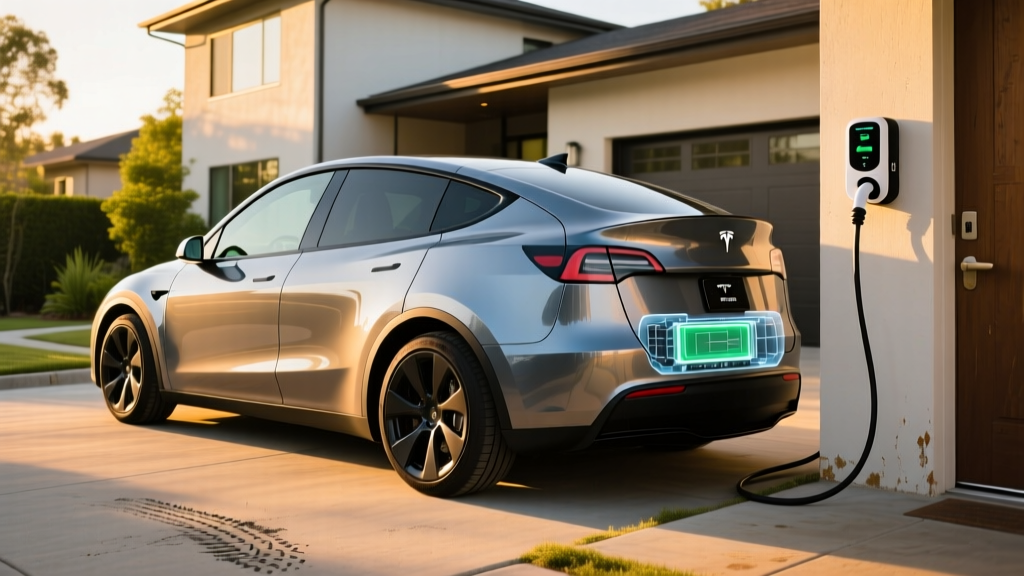
For home charging, a Level 2 wall connector on a 60-amp circuit delivers 11.5 kW (48 amps continuous), replenishing roughly 44 miles of range per hour. A full 0–100% charge takes approximately 6 hours, easily achievable overnight. Most owners who charge nightly at home will rarely need DC fast charging except on road trips.
Performance, Efficiency, and Driving Dynamics
The single rear-mounted motor produces 295 horsepower and propels the Model Y RWD from 0–60 mph in 6.6 seconds. That's not the neck-snapping acceleration of the dual-motor variants, but it's brisk enough for confident highway merging and passing. The RWD layout also gives this trim the lightest curb weight in the Model Y lineup, which directly benefits efficiency and handling balance.
EPA-rated efficiency of 27 kWh per 100 miles (124 MPGe combined) places the Model Y RWD among the most efficient compact electric crossovers available. For context, that translates to roughly $0.04–$0.06 per mile when charging at home on a national-average electricity rate of $0.16/kWh — compared to $0.12–$0.15 per mile for a 28 MPG gas crossover at $3.40/gallon. Over 15,000 annual miles, the fuel savings alone approach $1,200–$1,500 per year.
Ride quality has improved post-Juniper with revised damper tuning and acoustic glass, though the RWD's 19-inch wheels still transmit some road imperfection on rough surfaces. The steering is quick and well-weighted, and the low center of gravity keeps body roll controlled in corners. It remains one of the better-driving vehicles in its class, electric or otherwise.
Interior, Cargo, and Daily Practicality
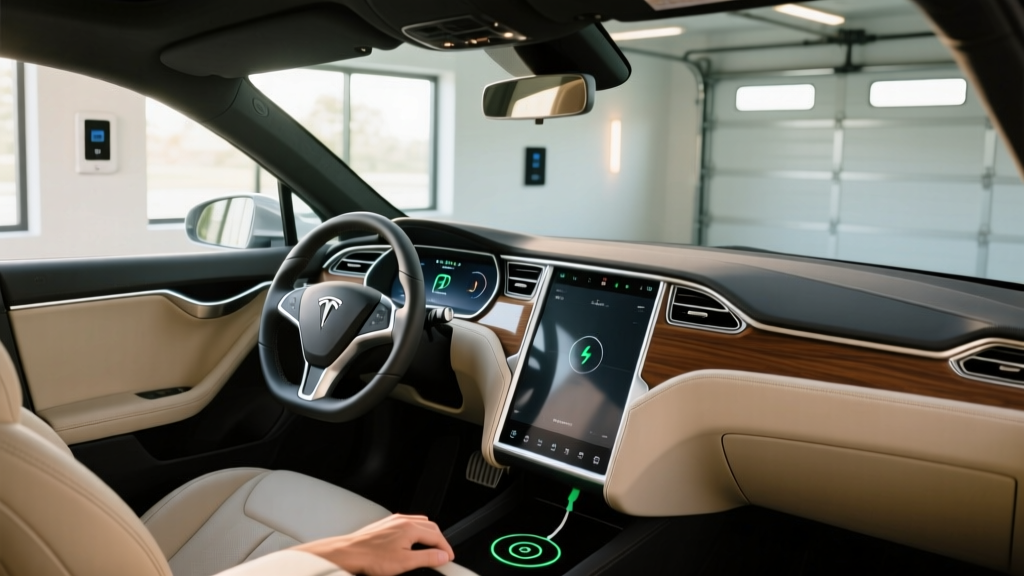
The Juniper redesign brought ventilated front seats, ambient lighting, a rear-seat touchscreen for climate and entertainment, and improved material quality throughout. The minimalist dashboard is dominated by the 15.4-inch center display, which handles everything from navigation to wiper controls. Whether that's a pro or con depends on your tolerance for screen-dependent interfaces — but the execution is responsive and the UI is well-organized.
Cargo volume is generous: 30.2 cubic feet behind the second row and 72.0 cubic feet with the 60/40 split rear seats folded. The rear trunk opening is wide and the load floor is low, making it practical for strollers, luggage, and large-box-store runs. A small front trunk (frunk) adds useful sealed storage for charging cables or a laptop bag.
Rear-seat passengers get 37.7 inches of legroom, which accommodates adults comfortably on trips up to a few hours. The rear cushion is slightly low-mounted (a packaging consequence of the battery floor), so taller passengers may find their knees higher than ideal on long drives.
Pricing, Tax Credit Eligibility, and Ownership Cost
| Item | Amount |
|---|---|
| Base MSRP (RWD) | $44,990 |
| Destination Fee | $1,390 |
| Pearl White Multi-Coat Paint | $1,000 |
| As-Tested Price (white, no FSD) | $47,380 |
| Federal §30D Credit (if eligible) | Up to $7,500 |
| Effective Price After Max Credit | ~$39,880 |
The 2026 Model Y RWD starts at $44,990 before destination and options. With the $1,390 destination charge, you're looking at $46,380 out the door in the base Solid Black paint. Adding popular options like premium paint or the Full Self-Driving (Supervised) package ($8,000) pushes the price higher, but most buyers in this trim keep optioning minimal.
Federal Tax Credit: §30D Eligibility Rules
The Model Y RWD has historically qualified for the full $7,500 federal EV tax credit under IRS §30D, and as of the 2026 model year it continues to meet the battery component and critical mineral sourcing requirements. However, eligibility depends on several buyer-specific conditions:
- MSRP Cap: The vehicle's MSRP must not exceed $80,000 for SUVs (the Model Y RWD clears this easily at $44,990)
- Income Cap: Modified adjusted gross income must be ≤$150,000 (single), ≤$225,000 (head of household), or ≤$300,000 (joint filers)
- Battery Sourcing: Battery components must be manufactured or assembled in North America, and critical minerals must be sourced from the U.S. or a free-trade-agreement country — Tesla has maintained compliance through the 2026 model year
- Point-of-Sale Transfer: Since 2024, you can transfer the credit to the dealer at purchase, reducing your out-of-pocket cost immediately rather than waiting to claim it on your tax return
Source: IRS Clean Vehicle Credits. Tax rules are subject to change. Consult a tax professional for your specific situation.
With the maximum $7,500 credit applied at point of sale, the effective purchase price drops to approximately $39,880 — positioning the Model Y RWD against gas-powered compact crossovers on total cost of ownership from day one, especially when you factor in reduced fuel and maintenance costs.
5-Year Ownership Cost Snapshot
Over five years and 75,000 miles, the Model Y RWD's total cost of ownership benefits from minimal scheduled maintenance (no oil changes, no transmission fluid, reduced brake wear from regenerative braking) and low electricity costs. Insurance premiums, however, tend to run 15–25% higher than comparable gas crossovers — expect $1,800–$2,400 annually depending on your state and driving record. Tesla's battery and drive unit warranty covers 8 years or 120,000 miles (whichever comes first) with a minimum 70% capacity retention guarantee, providing long-term peace of mind.
Technology, Driver Assistance, and Safety
Every 2026 Model Y comes standard with Tesla's Basic Autopilot, which includes adaptive cruise control and lane-centering on marked highways. This is a SAE Level 2 driver-assistance system — meaning the driver must remain fully attentive, keep hands on the wheel, and be prepared to take over at any moment. It is not autonomous driving.
Tesla Autopilot and Full Self-Driving (Supervised) are both SAE Level 2 systems. The driver is responsible for all vehicle operation at all times. Do not confuse these with Level 4 autonomous services like Waymo, which operate without a human driver in geofenced areas.
The optional Full Self-Driving (Supervised) package ($8,000) adds automated lane changes, traffic light and stop sign recognition, and enhanced navigation on city streets. FSD (Supervised) has improved substantially through 2025–2026 neural-network updates, but it still requires active monitoring and occasional intervention — particularly in construction zones, unmapped areas, and adverse weather.
The 15.4-inch touchscreen runs Tesla's latest software with wireless Apple CarPlay support (added in the Juniper update), over-the-air updates, a built-in dashcam and Sentry Mode, and access to Tesla's Supercharger network with real-time stall availability. Safety ratings from NHTSA continue to be strong, with the Model Y earning a 5-star overall rating.
Pros and Cons: The Honest Assessment
- 320 mi EPA range with full 100% daily charging (LFP benefit)
- Access to 6,000+ Tesla Supercharger stalls — most reliable DC network
- Class-leading efficiency at 27 kWh/100 mi
- Spacious cargo area (72 cu ft max) with practical frunk
- Low operating cost: ~$0.05/mi on home electricity
- Over-the-air updates continuously add features
- Strong resale value relative to EV segment
- Cold-weather range loss more pronounced than NMC competitors
- Screen-dependent controls (no physical buttons for climate, wipers)
- Rear seat cushion height may not suit taller passengers on long trips
- FSD package is expensive ($8,000) and still Level 2
- Insurance premiums run 15–25% above gas equivalents
- No Apple CarPlay/Android Auto in traditional sense (Tesla CarPlay only on newer software)
- RWD only — no AWD option on this trim for snow-belt buyers
Who Should Buy the 2026 Model Y RWD?
Choose the Model Y RWD if:
- You commute 30–80 miles daily and can charge at home overnight
- You want the lowest entry price into the Model Y lineup without sacrificing range
- You live in a moderate or warm climate where LFP cold-weather loss is minimal
- You take 2–4 road trips per year and value Supercharger network reliability
- You qualify for the $7,500 federal credit, bringing effective price below $40K
Look elsewhere if:
- You need AWD for heavy snow or mountain driving (consider the Long Range AWD)
- You regularly drive 300+ miles in cold weather and want maximum range buffer
- You prefer physical buttons and traditional infotainment (consider Hyundai Ioniq 5 or Kia EV6)
- You tow frequently — the RWD's 2,000-lb rating trails the AWD's 3,500-lb capacity
Frequently Asked Questions
What is the real-world range of the 2026 Model Y RWD?
Expect 255–275 miles on the highway at 75 mph in warm weather, 295–315 miles in mixed city driving, and 210–240 miles in cold-weather highway conditions (below 32°F). The EPA combined figure is 320 miles, but sustained high speeds and cold temperatures reduce effective range.
How fast does it charge at home and on the road?
At home on a Level 2 (240V, 48A) wall connector, the Model Y RWD charges at 11.5 kW, adding roughly 44 miles of range per hour — a full charge in about 6 hours. On a V3/V4 Supercharger, it peaks at 250 kW and charges from 10–80% in approximately 25 minutes with battery preconditioning.
Does the 2026 Model Y RWD qualify for the $7,500 federal tax credit?
Yes, the 2026 Model Y RWD currently meets the IRS §30D battery sourcing and critical mineral requirements. However, you must also meet income caps ($150K single / $300K joint) and the vehicle MSRP must be under $80,000 (it is, at $44,990). The credit can be transferred to the dealer at point of sale. Verify current eligibility at IRS.gov before purchasing, as sourcing rules can change.
Is the Model Y RWD worth buying over competitors like the Ioniq 5 or EV6?
The Model Y RWD wins on total ecosystem value: Supercharger access, over-the-air updates, efficiency, and cargo space. The Hyundai Ioniq 5 and Kia EV6 offer faster peak charging (up to 350 kW on 800V architecture), physical buttons, and available AWD at similar prices — but rely on third-party DC networks (Electrify America, EVgo) that have lower reliability scores than Tesla's proprietary network. If charging reliability and range-per-dollar are your top priorities, the Model Y RWD remains the benchmark.
What is the battery warranty on the 2026 Model Y RWD?
Tesla covers the battery pack and drive unit for 8 years or 120,000 miles, whichever comes first, with a guaranteed minimum of 70% capacity retention over that period. LFP chemistry typically degrades more slowly than NMC in real-world use, so most owners should expect well above the 70% threshold at the warranty boundary.
Can I charge the Model Y RWD to 100% every day?
Tesla recommends charging LFP-equipped vehicles (including the RWD) to 100% at least once per week for accurate state-of-charge calibration. This is an advantage over NMC-equipped Long Range and Performance models, where Tesla recommends a daily limit of 80% to maximize longevity. You get the full 320 miles as usable daily range.
Specifications sourced from Tesla.com and fueleconomy.gov. Pricing and tax credit rules reflect 2026 model year data and are subject to change.