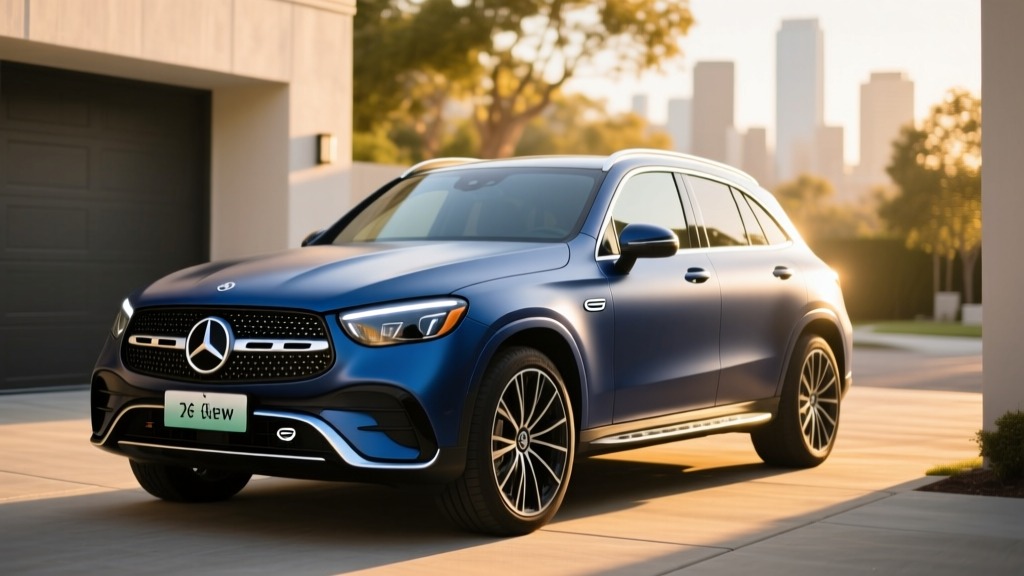
Quick Answer: The 2026 Mercedes-Benz GLC EV (internally designated X254) is the battery-electric successor to the gas GLC, built on the new MB.EA dedicated EV platform with an 800-volt architecture. Expect an EPA-estimated range near 310 miles from a ~94 kWh usable NMC battery, DC fast charging at up to 250 kW (10–80% in roughly 22 minutes), and a starting MSRP around $59,900 before incentives. It targets buyers who want luxury-compact crossover space with real road-trip charging capability — but at a premium over rivals like the Tesla Model Y and BMW iX3.
What Is the 2026 Mercedes GLC EV?
The 2026 GLC EV replaces the EQC nameplate and the stop-gap EQB in Mercedes' compact luxury electric lineup. Unlike the older EQ models adapted from ICE platforms, this SUV rides on the purpose-built MB.EA (Mercedes-Benz Electric Architecture) — the same 800V skateboard underpinning the next-generation electric C-Class. That means a flat floor, optimized weight distribution, and significantly faster DC charging than the 400V EQC it succeeds.
Mercedes has announced two launch trims for the US market:
- GLC 350 4MATIC EV: Dual-motor AWD, ~355 hp, ~310 miles EPA range, starting at $59,900
- GLC 450 4MATIC EV (AMG Line): Dual-motor AWD, ~463 hp, ~285 miles EPA range, starting at $68,500
These figures are preliminary based on Mercedes' global reveal and WLTP-to-EPA conversion patterns observed in the EQS and EQE. Final EPA certification numbers will be published closer to the US on-sale date in late 2026. We'll update this guide when official fueleconomy.gov data is posted.
Range, Battery & Real-World Efficiency
| Spec | GLC 350 4MATIC EV | GLC 450 4MATIC EV |
|---|---|---|
| Battery (usable) | ~94 kWh NMC | ~94 kWh NMC |
| EPA Range (est.) | ~310 mi | ~285 mi |
| Combined MPGe (est.) | ~98 MPGe | ~89 MPGe |
| Efficiency (kWh/100 mi) | ~34 kWh | ~37 kWh |
| 0–60 mph | 5.4 sec | 3.9 sec |
| Horsepower | 355 hp | 463 hp |
| Drivetrain | Dual-motor AWD | Dual-motor AWD |
Real-World Range Reality: The EPA sticker says ~310 miles for the GLC 350, but plan for 250–275 miles on sustained highway driving at 70–75 mph. In freezing temperatures (below 30°F), expect a 20–30% reduction, putting real range around 220–250 miles. The heat pump (standard on US trims) helps mitigate cabin-heating losses, but cold-soak still impacts the NMC cells. For road trips, budget charging stops every 200–220 miles to stay comfortable and avoid deep discharge.
Mercedes chose NMC (nickel-manganese-cobalt) chemistry over LFP for the GLC EV, prioritizing energy density to fit a large battery in a compact footprint. The trade-off: NMC degrades slightly faster than LFP over thousands of cycles and prefers not to sit at 100% SoC for extended periods. Mercedes includes a configurable charge limiter (80/90/100%) and battery preconditioning in the MBUX infotainment system.
Charging Speed & Connector Compatibility
The MB.EA platform's 800V architecture is the GLC EV's biggest practical upgrade. Here's what charging looks like at each level:
| Charging Level | Power / Voltage | Time (10–80%) | Miles Added per Hour |
|---|---|---|---|
| Level 1 (120V household) | ~1.4 kW | ~68 hours | ~5 mi/hr |
| Level 2 (240V, 48A) | 11.5 kW | ~8.5 hours | ~37 mi/hr |
| DC Fast (peak) | 250 kW (800V) | ~22 min | ~800 mi/hr (at peak) |
| DC Fast (sustained avg.) | ~175 kW avg. | ~28 min | N/A |
The 250 kW peak charge rate is only sustained between roughly 10–35% SoC. Like all EVs, the GLC's charge curve tapers significantly above 50%, and especially above 80%. On a 350 kW Electrify America or Tesla Supercharger (V4 with CCS adapter), you'll see peak speeds early, then a gradual decline. The 10–80% time of ~22 minutes is competitive with the Hyundai Ioniq 5 and Porsche Macan EV, though slightly behind the 800V Kia EV6's ~18-minute benchmark.
Connector note: The US-spec 2026 GLC EV ships with a NACS (Tesla) charge port, following Mercedes' commitment to the North American Charging Standard. This grants native access to Tesla Superchargers without an adapter — a significant advantage over CCS-equipped rivals. For legacy CCS stations (Electrify America, EVgo), Mercedes includes a NACS-to-CCS adapter in the vehicle.
Pricing, Trims & Federal Tax Credit Eligibility
| Trim | Base MSRP | Est. w/ Destination | §30D Credit Eligible? |
|---|---|---|---|
| GLC 350 4MATIC EV | $59,900 | $61,400 | Likely — under $80K SUV cap |
| GLC 450 4MATIC EV | $68,500 | $70,000 | Likely — under $80K SUV cap |
The GLC EV qualifies as an SUV under IRS §30D rules, meaning the MSRP cap is $80,000 (vs. $55,000 for sedans). Both trims clear this threshold comfortably. However, full $7,500 credit eligibility depends on:
- Buyer income caps: AGI ≤ $150K (single), ≤ $300K (joint), ≤ $225K (head of household)
- Battery sourcing: Critical minerals and battery components must meet escalating domestic-content thresholds — Mercedes sources battery cells from CATL and Farasis, and the percentage of US/FTA-sourced materials will determine whether you receive the full $7,500, a partial $3,750, or nothing
- Point-of-sale transfer: You can elect to transfer the credit to the dealer at purchase, reducing your out-of-pocket cost immediately
Consult a tax professional and check the latest IRS guidance before relying on the credit — battery sourcing rules tighten annually.
GLC EV vs. Gas GLC: 5-Year Ownership Cost
How does the electric GLC stack up against the best-selling gas GLC 300 4MATIC over five years? Here's a data-driven comparison assuming 12,000 miles/year, $3.50/gal gasoline, and $0.14/kWh home electricity (national averages):
| Cost Category | 2026 GLC 350 EV | 2026 GLC 300 4MATIC (Gas) |
|---|---|---|
| Base MSRP | $59,900 | $48,250 |
| Federal Tax Credit | −$7,500 (est.) | $0 |
| Net Purchase Price | $52,400 | $48,250 |
| 5-Year Fuel / Energy | $4,200 | $10,500 |
| 5-Year Maintenance | $1,800 | $4,500 |
| 5-Year Insurance (avg.) | $11,400 | $9,600 |
| 5-Year Depreciation (est.) | $22,000 | $19,000 |
| Total 5-Year Cost | $91,800 | $91,850 |
The EV and gas versions land at near-parity over five years, but the composition is very different. The GLC EV saves roughly $6,300 on fuel and $2,700 on maintenance (no oil changes, fewer brake replacements due to regen, no transmission service). Those savings are offset by a higher purchase price (even after the credit), higher insurance premiums (EVs cost ~15–20% more to insure on average), and slightly steeper projected depreciation.
The break-even point: If you charge primarily at home on a Level 2 setup at residential electricity rates, the EV pulls ahead in year 4–5. If you rely on public DC fast charging at $0.40–$0.60/kWh, your energy costs roughly double, pushing break-even to year 6+.
Real-World Ownership: What First-Time EV Buyers Should Know
Home Charging Is the Make-or-Break Factor
The GLC EV experience is fundamentally different depending on whether you can install a Level 2 home charger. A 240V/48A hardwired station (like a ChargePoint Home Flex or Wallbox Pulsar Max) delivers ~37 miles of range per hour — enough to fully replenish overnight. Installation costs range from $800–$2,500 depending on panel capacity and conduit runs. If your home has a 200A electrical panel with spare capacity, expect the lower end. A panel upgrade to 200A or 400A can add $2,000–$5,000.
If you live in an apartment or condo without dedicated charging, you'll rely on public infrastructure. The NACS port helps — Tesla Superchargers are the most reliable network — but daily public charging is expensive and time-consuming compared to home.
Driving Patterns Matter
The GLC EV excels as a commuter and weekend cruiser. For daily drives under 60 miles, you'll charge at home every 3–4 days and rarely think about range. For frequent road trips over 250 miles, the 800V fast charging keeps stops short (~20–25 minutes), but you'll need to plan around Supercharger or Electrify America locations.
Cold Climate Buyers
If you live where winters regularly drop below freezing, budget for 20–30% range loss. The standard heat pump helps, but preconditioning the battery while plugged in is essential to preserve range and enable fast charging. Garage parking makes a measurable difference.
Common Misconceptions — Myth vs. Fact
| Myth | Fact |
|---|---|
| "The battery will need replacing in 5 years." | Mercedes warranties the battery for 8 years / 100,000 miles against degradation below 70% capacity. NMC batteries typically retain 85–90% capacity at 100K miles based on EQE/EQS fleet data. |
| "It qualifies for the full $7,500 tax credit, guaranteed." | Credit eligibility depends on your income, the vehicle's battery mineral sourcing, and annual rule changes. Always verify against current IRS §30D guidance. |
| "DC fast charging damages the battery." | Modern thermal management systems actively cool cells during DC charging. Occasional fast charging is fine; Mercedes' battery management system limits charge rate at high SoC and extreme temperatures to protect longevity. |
| "I can charge from any public station." | The NACS port works natively at Tesla Superchargers. For CCS stations, you need the included adapter. CHAdeMO stations (increasingly rare) are not compatible. |
| "The GLC EV is self-driving with Drive Pilot." | Mercedes' Drive Pilot is an SAE Level 3 system approved only in specific conditions (highway, under 40 mph, clear weather, mapped roads in Nevada/California). The driver can disengage but must be ready to resume. It is not full autonomy. |
ADAS Clarification: The GLC EV's standard Driver Assistance Package (adaptive cruise, lane-centering, automated lane changes) is SAE Level 2 — you must keep hands on the wheel and eyes on the road at all times. The optional Drive Pilot system is Level 3 in narrowly defined conditions. Neither system is "self-driving." You are always the responsible operator.
Decision Framework: Is the 2026 GLC EV Right for You?
Choose the GLC EV if:
- You have (or can install) Level 2 home charging
- Your daily commute is under 80 miles round-trip
- You want luxury-compact crossover space with a premium interior and MBUX tech
- You value NACS Supercharger access for road trips
- You qualify for the §30D tax credit, bringing the effective price near $52K
Consider the gas GLC 300 instead if:
- You live in an apartment/condo with no charging access
- You regularly drive 300+ miles in rural areas with sparse charging
- Your budget is firmly under $50K and you can't absorb the EV premium
- You live in an extreme cold climate and need maximum range reliability year-round
Consider a PHEV (like the GLC 350e plug-in hybrid) if:
- You want electric commuting (~35 miles EV range) but gas flexibility for long trips
- You're not ready to commit to full EV ownership but want to reduce fuel consumption
Warranty, Service & Battery Longevity
Mercedes covers the 2026 GLC EV with:
- New Vehicle Warranty: 4 years / 50,000 miles
- Battery Warranty: 8 years / 100,000 miles (capacity retention ≥ 70%)
- Corrosion Warranty: 5 years / unlimited miles
- Roadside Assistance: 4 years / 50,000 miles
Battery replacement cost out of warranty is estimated at $18,000–$24,000 based on current EQE/EQS service pricing, though this is expected to decline as cell costs fall. Mercedes offers a battery health diagnostic through MBUX that displays State of Health (SoH) percentage — useful for tracking degradation over time and verifying warranty eligibility.
Frequently Asked Questions
When will the 2026 Mercedes GLC EV be available in the US?
Mercedes has announced a global reveal in mid-2026, with US deliveries expected to begin in Q4 2026 as a 2027 model-year vehicle. Reservations are not yet open; check mbusa.com for updates.
Does the GLC EV have a frunk (front trunk)?
Yes, the MB.EA platform enables a modest front trunk. Cargo volume is estimated at ~4 cu ft for the frunk, with ~24 cu ft behind the rear seats and ~56 cu ft with seats folded — comparable to the gas GLC.
Can the GLC EV tow?
Mercedes rates the GLC 350 EV at 3,500 lbs towing capacity (with factory hitch), matching the gas GLC. The 450 trim is rated slightly lower at ~3,300 lbs due to performance-tuned suspension calibration. Towing reduces range by 30–50% depending on trailer weight and speed.
How does the GLC EV compare to the Tesla Model Y?
The Model Y Long Range starts around $47,990, offers ~320 miles EPA range, and charges at 250 kW on Superchargers. The GLC EV costs ~$12,000 more but delivers a significantly more luxurious interior, better ride quality, MBUX with augmented-reality navigation, and Mercedes dealer service. The Model Y wins on value and efficiency; the GLC EV wins on luxury and build quality.
What happens if I charge to 100% regularly?
NMC batteries degrade faster when held at 100% SoC for long periods. Mercedes recommends setting the charge limit to 80–90% for daily use and reserving 100% for road trips. The built-in charge limiter makes this automatic. Following this practice, expect 8–12% degradation over 100,000 miles.