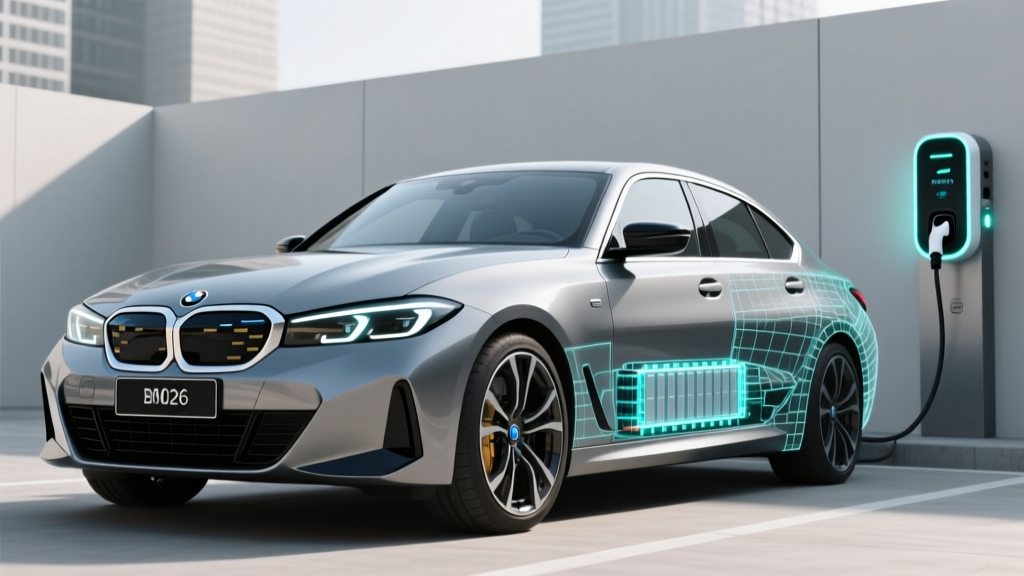
The original BMW i3 hatchback bowed out after the 2021 model year, leaving a gap in BMW's entry-level electric lineup. Now, a wave of BMW i3 renderings and spy shots points to a dramatically different successor: a proper compact electric sedan built on BMW's upcoming Neue Klasse platform. Expected to arrive as a 2026 or 2027 model, the next-gen i3 sedan aims to compete directly with the Tesla Model 3, Hyundai Ioniq 6, and Mercedes-Benz CLA EV.
Because this vehicle is announced but not yet on sale, every specification below is preliminary — based on BMW's official Neue Klasse concept disclosures, observed prototype testing, and credible industry analysis. Final EPA range, pricing, and tax-credit eligibility will not be confirmed until closer to launch. Treat these figures as well-informed estimates, not purchase commitments.
What the Spy Shots and Renderings Reveal
Prototype mules spotted testing in Munich and northern Sweden wear heavy camouflage, but the silhouette is unmistakable: a low-slung, four-door sedan with a fastback roofline reminiscent of the current i4 but scaled down to 3 Series proportions. Renderings by independent automotive artists, informed by BMW's Vision Neue Klasse concept shown at IAA Mobility 2023, depict a clean, surfacing-forward design with a reinterpreted kidney grille that functions as a sensor housing rather than an air intake.
Key visual takeaways from the BMW i3 spy shots:
- Wheelbase: Appears stretched relative to the current 3 Series, consistent with a dedicated EV skateboard architecture that pushes wheels to the corners.
- Roofline: Fastback-style taper, likely yielding a rear liftgate (similar to the i4 Gran Coupe) for practical cargo access.
- Sensor array: Prototypes show a roof-mounted LiDAR pod and thick A-pillar camera clusters, suggesting available Level 2+ or Level 3 highway assist.
- Charging port: Driver-side rear quarter panel location, consistent with NACS adoption for the North American market.
Preliminary Specs: Range, Battery & Efficiency
BMW has confirmed that the Neue Klasse platform will use prismatic NMC (nickel manganese cobalt) cells supplied by CATL and Samsung SDI, moving to a 46mm-diameter cylindrical format similar to Tesla's 4680 cells. BMW claims a 20% improvement in energy density and a 30% improvement in charging speed over the current fifth-generation eDrive battery packs.
| Attribute | Estimated Value |
|---|---|
| Battery Capacity (Usable) | ~75 kWh (NMC, cylindrical cells) |
| EPA Range (Est.) | ~320–340 miles |
| Efficiency | ~25–27 kWh/100 mi (~125–135 MPGe) |
| Max DC Fast Charge | ~250 kW (peak) |
| 10–80% DC Charge Time | ~20 minutes (est.) |
| Level 2 Home Charge Rate | 11 kW (~37 mi/hr) |
| Drivetrain | RWD (base) / AWD dual-motor (xDrive) |
| Horsepower | ~280 hp (RWD) / ~400 hp (xDrive) |
| 0–60 mph | ~5.8s (RWD) / ~4.2s (xDrive) |
| Connector (North America) | NACS (native Tesla Supercharger access) |
Charging Speed: DC Fast and Home Level 2
The shift to cylindrical cells and an 800-volt-class architecture (BMW has not confirmed 800V explicitly, but supplier disclosures point to a system voltage above 700V) should deliver meaningfully faster charging than the outgoing i3's 50 kW DC cap.
| Charging Level | Power (kW) | Miles Added per Hour | Notes |
|---|---|---|---|
| Level 1 (120V) | ~1.4 kW | ~4–5 mi/hr | Emergency/trickle only |
| Level 2 (240V, 48A) | 11 kW | ~37 mi/hr | Full charge in ~7 hours |
| DC Fast Charge | 250 kW (peak) | N/A | 10–80% in ~20 min; expect taper above 80% SoC |
Charging-curve reality check: The 250 kW figure is a peak, not a sustained rate. In practice, the i3 sedan will likely hold above 200 kW from 10% to roughly 50% SoC, then taper progressively. From 80% to 100%, charging slows dramatically — a characteristic of all NMC chemistries. For daily driving, charging to 80% is both faster and better for long-term battery health.
BMW has confirmed native NACS (North American Charging Standard) compatibility for all Neue Klasse vehicles sold in North America, granting access to Tesla's Supercharger network — currently the most reliable DC fast-charging infrastructure in the U.S., according to J.D. Power's EV charging satisfaction studies.
Performance and Driving Dynamics
The base rear-wheel-drive i3 sedan should produce approximately 280 horsepower from a single rear-mounted sixth-generation eDrive motor. BMW's xDrive dual-motor variant, likely badged as the i3 xDrive or a future i3 M Performance model, could push output above 400 horsepower.
Neue Klasse prototypes have been spotted testing at BMW's Aschheim proving ground and on the Nürburgring Nordschleife, suggesting the company is targeting the sporty handling benchmark that distinguished the original 3 Series. The dedicated EV platform lowers the center of gravity and allows near 50/50 weight distribution — a BMW hallmark.
Regenerative braking will likely offer multiple modes, including a true one-pedal driving option and an adaptive mode that uses navigation data and sensor input to modulate regen intensity automatically.
Interior, Cargo and Technology
The Vision Neue Klasse concept previewed a radical interior overhaul centered on BMW's Panoramic Vision head-up display, which projects information across the entire width of the windshield. This replaces the traditional instrument cluster and reduces reliance on a central touchscreen.
Expected interior dimensions, based on the stretched wheelbase observed in spy shots:
- Rear legroom: ~37–38 inches (competitive with Tesla Model 3's 35.3 in.)
- Cargo volume: ~16–18 cu ft (rear liftgate); possible front trunk (frunk) of ~2–3 cu ft for charging cables
- Seating: 5-passenger capacity, though the rear center position will likely be tight
On the driver-assistance front, prototypes equipped with roof-mounted LiDAR and multiple camera pods suggest BMW will offer an advanced Level 2+ highway driving assistant — potentially branded as a next-generation Driving Assistant Professional. This system will handle lane centering, adaptive cruise, and automated lane changes on divided highways, but the driver must remain engaged and hands-on or eyes-on at all times (SAE Level 2). BMW has been testing Level 3 capabilities (eyes-off in specific conditions) in Europe, but U.S. availability of Level 3 features depends on state-by-state regulatory approval.
Pricing, Tax Credits and Ownership Costs
BMW has not released official MSRP figures. Based on the outgoing i3's positioning and current competitor pricing, we estimate the following:
| Trim (Est.) | Base MSRP | After Est. §30D Credit |
|---|---|---|
| i3 RWD (base) | ~$47,000 | ~$39,500* |
| i3 xDrive AWD | ~$54,000 | ~$46,500* |
| i3 M Performance | ~$62,000 | ~$54,500* |
* Tax-credit-adjusted prices assume full $7,500 eligibility under IRS §30D. Eligibility depends on multiple factors that may change before launch.
- MSRP cap: Sedans must be priced at or below $55,000 (base i3 RWD likely qualifies; xDrive and M trims may exceed the cap).
- Buyer income cap: Modified AGI must not exceed $150,000 (single) / $300,000 (joint).
- Battery sourcing: Increasing percentages of critical minerals and battery components must be sourced from the U.S. or FTA partners — BMW's CATL/Samsung SDI supply chain may face compliance challenges.
- Point-of-sale transfer: Eligible buyers can apply the credit as an upfront dealer discount rather than waiting for a tax refund.
- Consult a tax professional before relying on credit eligibility — rules are subject to legislative change.
Battery and powertrain warranty: BMW currently offers an 8-year/100,000-mile high-voltage battery warranty on its EVs (covering capacity loss below 70% of original). Expect the same or improved coverage on the Neue Klasse i3, in line with federal mandates and competitor benchmarks.
BMW i3 Sedan vs. Key Competitors
The next-gen i3 enters a crowded compact luxury EV sedan segment. Here's how preliminary specs compare to established rivals:
| Spec | BMW i3 (Est.) | Tesla Model 3 LR | Hyundai Ioniq 6 SEL |
|---|---|---|---|
| EPA Range | ~330 mi | 363 mi | 361 mi |
| Battery | ~75 kWh NMC | 79 kWh NMC | 77.4 kWh NMC |
| Peak DC Charge | ~250 kW | 250 kW | 240 kW |
| 0–60 mph | ~5.8s | 5.8s | 6.1s |
| Starting MSRP | ~$47,000 | $42,380 | $38,650 |
| Connector | NACS | NACS | CCS1 → NACS adapter |
The Tesla Model 3 Long Range still leads on EPA range and pricing. The Ioniq 6 offers exceptional efficiency and value. The BMW i3's differentiation will come down to interior quality, driving dynamics, and the Panoramic Vision HUD — areas where BMW traditionally outperforms mainstream competitors.
Who Should Wait for the BMW i3 Sedan?
- Expected 320+ mile EPA range
- Native NACS / Supercharger access
- BMW build quality and driving dynamics
- Panoramic Vision full-width HUD
- Heat pump standard for cold-climate efficiency
- Available xDrive AWD
- Not yet available — likely late 2026 or 2027 delivery
- Estimated MSRP higher than Model 3 and Ioniq 6
- Tax credit eligibility uncertain (battery sourcing rules)
- Final EPA range and charging specs unconfirmed
- No real-world reliability data yet
Wait for the i3 if: You prioritize BMW's interior craftsmanship and driving feel, can defer your purchase 12–18 months, and want native Supercharger access in a compact luxury sedan.
Buy now instead if: You need a vehicle immediately, want proven EPA-certified range figures, or need certainty on §30D tax-credit eligibility. The Tesla Model 3, Hyundai Ioniq 6, and BMW's own i4 are available today with confirmed specs.
Frequently Asked Questions
What is the real-world range of the next-gen BMW i3?
With an estimated EPA range of ~330 miles, expect roughly 280–295 miles in real-world highway driving and 230–260 miles in cold weather. These figures are preliminary and will be confirmed upon EPA certification.
How fast does the BMW i3 sedan charge?
Estimated peak DC fast-charge rate is ~250 kW, with a 10–80% charge time of approximately 20 minutes. Home Level 2 charging at 11 kW adds roughly 37 miles of range per hour.
Does the BMW i3 sedan qualify for the federal EV tax credit?
Potentially. The base RWD trim (~$47,000 estimated) falls under the $55,000 sedan MSRP cap. However, eligibility depends on battery-sourcing and critical-mineral requirements under §30D, which BMW's supply chain may or may not satisfy by launch. Check IRS guidance closer to the on-sale date.
Is the next-gen BMW i3 worth waiting for vs. a Tesla Model 3?
If you value BMW's driving dynamics, interior materials, and the Panoramic Vision HUD — and can wait — the i3 is worth monitoring. If you need a car now or prioritize lowest cost and longest proven range, the Model 3 Long Range remains the segment benchmark.
Will the BMW i3 have a frunk?
Spy shots suggest a modest front trunk (~2–3 cu ft) suitable for storing charging cables, though BMW has not confirmed this officially.
When will the BMW i3 sedan go on sale?
BMW has indicated Neue Klasse production begins at its Debrecen, Hungary plant in late 2025, with North American deliveries likely in late 2026 or early 2027. U.S. production at BMW's Spartanburg, SC plant has not been confirmed for this model.