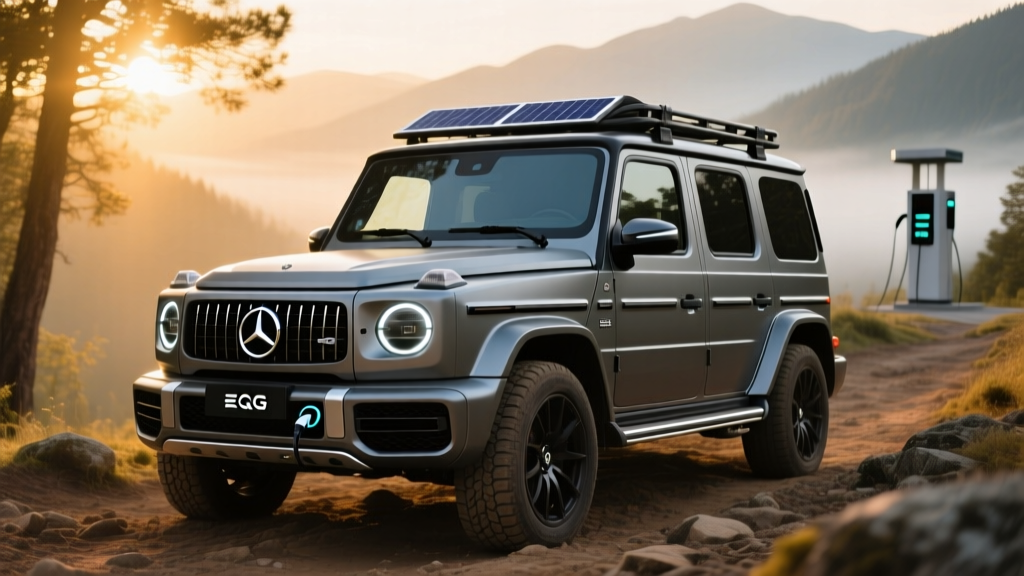
The Mercedes-Benz G-Class has been a status symbol and off-road icon for decades. The 2026 G 580 with EQ Technology — colloquially known as the EQG — swaps its twin-turbo V8 for four individually controlled electric motors while promising to keep the ladder-frame toughness intact. But bolting 932 pound-feet of torque to a brick-shaped luxury SUV creates a unique set of efficiency, range, and charging trade-offs that buyers need to understand before signing a $161,000+ check.
We've analyzed the EPA figures, Mercedes-Benz's published specs, and real-world driving dynamics to give you the unfiltered numbers on the EQG's range, charging curve, ownership economics, and whether it actually makes sense as a daily driver versus a weekend statement piece.
2026 Mercedes-Benz G 580 EQG Specifications at a Glance
| Specification | Value |
|---|---|
| EPA Estimated Range | ~240 miles (estimated) |
| Battery Capacity (Usable) | 116 kWh |
| Battery Chemistry | NMC (Nickel Manganese Cobalt) |
| Peak DC Fast-Charge Rate | 200 kW |
| 10–80% DC Charge Time | ~32 minutes |
| Level 2 Home Charge Rate | 9.6 kW (~20 mi/hr) |
| Drivetrain | Quad-motor AWD |
| Horsepower | 579 hp |
| Torque | 855 lb-ft |
| 0–60 mph | 4.4 seconds |
| Top Speed | 118 mph (electronically limited) |
| Cargo Volume (rear seats up) | ~17.0 cu ft |
| Cargo Volume (rear seats folded) | ~68.6 cu ft |
| Base MSRP | $161,400 |
| Battery/Powertrain Warranty | 8 years / 100,000 miles |
Range, Efficiency & Real-World Expectations
The G 580's 116 kWh usable battery is one of the largest in any production EV, but the G-Wagen's aerodynamic profile — roughly as sleek as a garden shed — works against it at highway speeds. The EPA estimated range lands at approximately 240 miles, with an efficiency rating around 51 MPGe combined (roughly 66 kWh/100 miles).
EPA Estimate: ~240 miles
Highway (70–75 mph, flat terrain): Expect 180–210 miles. The G-Wagen's boxy shape creates enormous drag above 65 mph, and efficiency drops sharply.
City / Stop-and-Go: 230–250 miles. Regenerative braking from four motors recovers meaningful energy in urban driving.
Cold Weather (below 32°F): 160–190 miles. NMC chemistry loses 15–25% capacity in freezing temps, and cabin heating draws heavily from the pack.
Towing (max 7,700 lbs): 120–150 miles. Aerodynamic drag and weight crush efficiency under load.
This is the EQG's most significant trade-off. If your commute is under 60 miles round-trip with home charging, the range is perfectly manageable. But if you plan regular 200+ mile highway trips, you'll be planning charging stops — and the G-Wagen's charging speed means those stops won't be quick.
Charging Speed: DC Fast Charging & Home Level 2
The G 580 supports a peak DC fast-charge rate of 200 kW via its CCS connector (NACS adapter availability varies by market and model year). At a compatible 200+ kW station, Mercedes-Benz quotes a 10–80% charge time of approximately 32 minutes.
However, the charging curve tells a more nuanced story. Like most large NMC packs, the EQG sustains peak charge rates only in the lower state-of-charge window (roughly 10–40%). Above 60% SoC, the rate tapers significantly to protect cell longevity, dropping below 100 kW and eventually to under 50 kW near 80%. This means the full 10–80% session averages closer to 130–150 kW sustained, not the headline 200 kW peak.
| Charging Level | Power | Estimated Speed |
|---|---|---|
| Level 1 (120V household) | ~1.4 kW | ~3 miles per hour |
| Level 2 (240V, 40A home charger) | 9.6 kW | ~20 miles per hour |
| DC Fast Charge (peak) | 200 kW | 10–80% in ~32 min |
| DC Fast Charge (sustained avg) | ~130–150 kW | ~180 mi in 32 min |
Home charging reality: A full Level 2 charge from 10% to 100% takes roughly 11–12 hours on a 9.6 kW charger. Most owners will plug in nightly and wake up with a full battery — standard practice for EV ownership. But if you arrive home with a near-empty pack, you'll need a dedicated overnight session. If your home electrical panel is limited to 100A service, you may need a panel upgrade to support a 48A/60A Level 2 circuit alongside other household loads — consult a licensed electrician for your specific setup.
Performance & Drivetrain: Four Motors, One Serious SUV
The quad-motor layout is the EQG's party trick. Each wheel has its own permanently excited synchronous motor, enabling true torque vectoring — the inside wheels can slow while the outside wheels accelerate through a corner. The result is 579 horsepower and 855 lb-ft of torque, launching this 6,400-pound SUV to 60 mph in 4.4 seconds. That's quicker than the outgoing G 550 and nearly matches the AMG G 63.
The individual motor control also unlocks the G-Turn feature: the EQG can rotate 360 degrees in place by spinning left-side and right-side wheels in opposite directions. It's a genuine off-road tool for tight trail situations, though Mercedes limits its use to low-traction surfaces. There's also G-Steering, which brakes the inside rear wheel to dramatically tighten the turning radius on trails.
On pavement, the quad-motor AWD system provides exceptional grip. The low center of gravity from the floor-mounted battery reduces body roll compared to the ICE G-Class, though the sheer weight is always present during hard cornering. Ride quality benefits from the adaptive damping system, but the solid rear axle (retained for off-road capability) transmits more road imperfections than a unibody luxury SUV.
Pricing, Trims & Federal Tax Credit Eligibility
The 2026 G 580 with EQ Technology starts at $161,400 (including destination). Mercedes-Benz offers it in a single well-equipped trim, with optional packages for interior leather upgrades, the AMG Line exterior package, and the MANUFAKTUR custom paint and interior program that can push the as-tested price well above $180,000.
| Item | Amount |
|---|---|
| Base MSRP (G 580 EQ Technology) | $161,400 |
| Typical As-Tested Price (with options) | $170,000–$185,000 |
| Federal §30D Tax Credit (max) | Up to $7,500 (eligibility varies) |
| Estimated Price After Max Credit | ~$153,900 |
Federal tax credit caveats: Under current IRS §30D rules, the G 580's eligibility for the full $7,500 credit depends on three factors that change periodically:
- MSRP cap: SUVs must have an MSRP at or below $80,000. The G 580 at $161,400 exceeds this cap, meaning it does not qualify for the §30D new-vehicle credit under current rules. (Source: IRS.gov §30D)
- Buyer income cap: AGI limits apply ($300K joint / $150K single), though this is moot given the MSRP disqualification.
- Battery sourcing / critical minerals: Phase-in requirements for North American mineral sourcing and battery component manufacturing tighten annually through 2029.
Bottom line: at $161,400, the EQG does not qualify for the federal purchase credit. Some state and local incentives may still apply — check your state's energy office or AFDC state incentive database for specifics.
Interior, Cargo & Technology
The G 580's cabin retains the upright, utilitarian architecture of the G-Class but with Mercedes' latest MBUX infotainment system on a 12.3-inch digital cluster and 12.3-inch central touchscreen. The EQG adds EV-specific displays: real-time energy flow, charge curve prediction, and an off-road energy consumption monitor. Wireless Apple CarPlay and Android Auto, a Burmester surround-sound system, and a head-up display are standard.
Driver assistance includes Mercedes' latest suite: adaptive cruise control with stop-and-go, active lane-keeping, automated emergency braking, and blind-spot monitoring. This is an SAE Level 2 driver-assist system — the driver must remain fully engaged with hands on the wheel and eyes on the road. It is not autonomous driving.
Passenger and cargo space: The G-Class was never a space champion, and the EQG is no different. Rear-seat legroom is approximately 38.0 inches — adequate but not generous for a vehicle at this price. Cargo volume behind the rear seats is roughly 17.0 cu ft (comparable to a compact crossover), expanding to about 68.6 cu ft with the rear seats folded. The side-hinged rear gate and externally mounted spare tire (now a charging cable storage compartment on the EQG) remain signature design elements.
Warranty & Long-Term Battery Outlook
Mercedes-Benz covers the G 580's high-voltage battery and electric powertrain for 8 years or 100,000 miles, whichever comes first. The standard vehicle warranty is 4 years / 50,000 miles. The battery warranty guarantees a minimum state of health (SoH) — typically 70% capacity retention — though Mercedes has not published the exact threshold for the EQG specifically.
The 116 kWh NMC pack is liquid-cooled with an advanced thermal management system designed to handle the heat generated by four motors and high-rate charging. NMC chemistry typically sees 10–15% degradation over 100,000 miles under normal use. Given the oversized battery, even 15% degradation would leave the EQG with roughly 200 miles of range — still viable for most use cases.
Mercedes has not published an official battery replacement cost for the G 580, but comparable large NMC packs in the industry run $20,000–$35,000 for a full replacement outside warranty. The quad-motor drivetrain adds complexity; individual motor or inverter service could be costly post-warranty.
How the EQG Stacks Up Against Competitors
- Unmatched off-road capability in an EV (3 differential locks, G-Turn, G-Steering)
- Brutal acceleration: 4.4 sec 0–60 from a 6,400-lb SUV
- Iconic, instantly recognizable design with heritage cachet
- Massive 116 kWh battery provides range buffer for city driving
- Quiet, smooth powertrain transforms the G-Wagen experience
- Poor highway efficiency (~180–210 real-world miles at 70+ mph)
- Does not qualify for federal §30D tax credit (MSRP exceeds $80K cap)
- 200 kW peak DC charging is slower than rivals (Rivian R1S: 220+ kW; Lucid: 300 kW)
- Cargo space is modest for a full-size luxury SUV
- $161K+ starting price with no credit offset makes TCO steep
- Weight (6,400+ lbs) increases tire wear and reduces braking confidence at speed
vs. Rivian R1S (Tri-Motor, 149 kWh Max Pack): The R1S offers up to 410 miles of EPA range, faster DC charging, qualifies for the federal credit (on trims under $80K), and starts around $80,000. It can't match the G-Wagen's brand prestige or G-Turn theatrics, but it's a far more practical daily-driver EV.
vs. Cadillac Escalade IQ: GM's electric Escalade offers more passenger and cargo space, an estimated 450+ mile range, and a more modern luxury interior. It targets the same affluent buyer but prioritizes comfort and range over off-road capability.
vs. Mercedes-AMG G 63 (ICE): The traditional V8 G 63 gets 13 MPG combined and costs $185K+, but has unlimited range via gas stations and no charging infrastructure dependency. For buyers in charging deserts or who tow frequently, the ICE G-Class remains more practical.
Who Should Buy the 2026 Mercedes-Benz G 580 EQG?
Buy the EQG if:
- You want the G-Class experience — heritage, presence, off-road chops — with silent, instant electric torque
- Your daily driving is under 100 miles and you have reliable home Level 2 charging
- Off-road capability matters and you want EV-specific trail tools (G-Turn, G-Steering)
- Tax credit eligibility is irrelevant to your purchase decision
Look elsewhere if:
- You regularly drive 200+ highway miles between charging stops
- You need maximum cargo and passenger space for family duty
- Total cost of ownership and efficiency are primary purchase drivers
- You tow frequently over long distances
Frequently Asked Questions
What is the real-world range of the Mercedes-Benz G 580 EQG?
The EPA estimates approximately 240 miles. In real-world highway driving at 70–75 mph, expect 180–210 miles due to the G-Wagen's poor aerodynamics. City driving with regenerative braking can yield 230–250 miles. In freezing temperatures, plan for 160–190 miles.
How fast does the EQG charge at home and on the road?
At home on a Level 2 (9.6 kW) charger, the EQG adds roughly 20 miles of range per hour, with a full 10–100% charge taking about 11–12 hours. On a 200 kW DC fast charger, 10–80% takes approximately 32 minutes, though sustained charging speed averages 130–150 kW due to charge-curve tapering above 60% SoC.
Does the G 580 EQG qualify for the $7,500 federal EV tax credit?
No. Under current IRS §30D rules, new EV SUVs must have an MSRP of $80,000 or less to qualify. The G 580 starts at $161,400, well above this cap. State and local incentives may still apply — check the AFDC incentive database for your area.
Is the EQG worth buying over the Rivian R1S or Escalade IQ?
It depends on your priorities. The EQG wins on heritage, off-road capability, and exclusivity. The Rivian R1S wins on range (up to 410 mi EPA), charging speed, practicality, and price (starting ~$80K with tax credit eligibility). The Escalade IQ wins on interior space and comfort. The EQG is a niche purchase for buyers who specifically want an electric G-Wagen.
What is the G-Turn feature and when can I use it?
G-Turn rotates the EQG 360 degrees in place by spinning the left and right wheel pairs in opposite directions. Mercedes restricts its activation to low-traction surfaces (dirt, gravel, snow) at low speeds. It's a genuine off-road tool for tight trail switchbacks, not a pavement party trick — using it on high-grip surfaces would cause excessive tire and drivetrain wear.
How long will the EQG's battery last?
Mercedes covers the 116 kWh NMC battery for 8 years / 100,000 miles with a minimum capacity retention guarantee (typically ~70% SoH). Based on industry NMC degradation data, expect 85–90% capacity after 100,000 miles under normal charging habits. Avoiding routine 100% charges and extreme heat exposure will maximize longevity. Out-of-warranty replacement costs are estimated at $20,000–$35,000 based on comparable large-pack vehicles.
Can the EQG tow, and how does towing affect range?
Yes. The G 580 has a maximum towing capacity of approximately 7,700 pounds. However, towing a heavy trailer dramatically reduces range — expect 120–150 miles depending on trailer weight and aerodynamics. For frequent long-distance towing, an ICE or diesel G-Class (or a heavy-duty truck) remains more practical.
Sources: Mercedes-Benz USA G-Class, IRS §30D Clean Vehicle Credits, Alternative Fuels Data Center — State Incentives.