The Electric G-Wagon in 60 Seconds
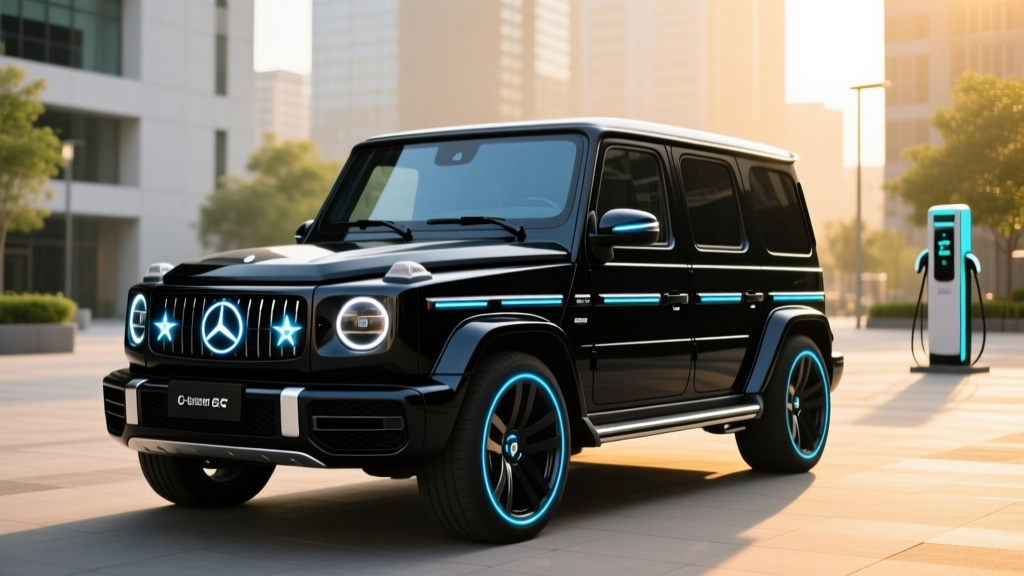
The 2026 Mercedes-Benz G 580 with EQ Technology — colloquially the "electric G-Wagon" — starts at $161,450 (including destination). It carries a 116 kWh usable battery (NMC chemistry), returns an EPA-estimated 239 miles of range, and produces 579 HP from its four-motor AWD system. DC fast charging peaks at 200 kW, reaching 10–80% in approximately 32 minutes. It does not qualify for the federal §30D tax credit because its MSRP exceeds the IRS cap for SUVs ($80,000). Expect real-world highway range closer to 190–210 miles, and significantly less in cold weather.
Range and Efficiency: What the EPA Sticker Doesn't Tell You
The G 580 EQ's EPA rating of 239 miles sounds modest for a six-figure luxury SUV, but context matters. This is a 6,100-pound, brick-shaped off-roader with the aerodynamic profile of a shipping container. Its combined efficiency lands at roughly 48 MPGe (approximately 70 kWh/100 mi) — poor by EV standards, but expected given the mass and drag.
Real-World Range Expectations
| Condition | Estimated Range |
|---|---|
| EPA Combined (sticker) | 239 mi |
| Highway (70 mph, 75°F) | ~195–210 mi |
| City / Suburban Mixed | ~225–240 mi |
| Cold Weather (20°F, highway) | ~155–175 mi |
| Off-Road (low-speed, high load) | ~160–190 mi |
The G 580 uses NMC (nickel manganese cobalt) cell chemistry, which offers strong energy density but is more sensitive to cold-weather capacity loss than LFP. Plan for a 25–35% range reduction in sustained sub-freezing highway driving. Mercedes includes a heat pump as standard, which helps mitigate cabin-heating energy draw, but physics is physics — a 116 kWh battery pushing 6,100 pounds through cold, dense air will consume energy rapidly.
For most G-Wagon owners who use the vehicle as a daily driver in urban or suburban settings, 200+ miles is adequate — these vehicles rarely see 300-mile road trips without a second vehicle available. But if you plan to tow (rated at 7,700 lbs) or drive long highway stretches, range planning becomes critical.
Charging Speed and Infrastructure Reality
The G 580 EQ supports DC fast charging at up to 200 kW via its CCS1 port (NACS adapter availability for Tesla Supercharger access is offered through Mercedes-Benz). Level 2 AC charging maxes out at 11 kW, meaning a full 0–100% home charge takes roughly 11 hours.
| Level | Power (kW) | Time | Miles Added per Hour |
|---|---|---|---|
| Level 1 (120V, 12A) | ~1.4 kW | ~83 hrs (0–100%) | ~3 mi/hr |
| Level 2 (240V, 48A) | 11 kW | ~11 hrs (0–100%) | ~22 mi/hr |
| DC Fast (peak) | 200 kW | ~32 min (10–80%) | N/A |
| DC Fast (sustained avg.) | ~130–150 kW | ~40 min (10–80%) | N/A |
Charging curve reality: The 200 kW peak is not sustained. Expect the G 580 to hold roughly 170–200 kW between 10–40% state of charge, then taper progressively. Above 80%, charging slows dramatically to protect the NMC battery — this is normal and by design. On a road trip, plan stops around the 150–180 mile mark and charge to 80%, not 100%, for the fastest turnaround.
Home charging is essentially mandatory for practical ownership. A Level 2 home installation on a 60A circuit (delivering 48A continuous to the vehicle) will fully replenish the battery overnight. Installation costs for a dedicated 240V/60A circuit typically run $1,200–$3,500 depending on panel capacity and run distance from your breaker box. If your home has a 100A electrical panel, anticipate a panel upgrade adding $2,000–$4,000. Always consult a licensed electrician for final specifications.
Performance: Four Motors, 579 HP, and the G-Turn
The G 580 EQ uses four independently controlled electric motors — one per wheel — producing a combined 579 HP and 854 lb-ft of torque. The 0–60 mph time lands at 4.6 seconds, which is remarkable for a body-on-frame SUV weighing over three tons.
The four-motor layout enables the headline party trick: G-Turn, which spins the vehicle 360 degrees in place by counter-rotating the left and right wheel pairs. It also allows G-Steering, which brakes the inside rear wheel during tight turns to dramatically shrink the turning radius — useful on narrow trails. These features are limited to low-speed off-road use.
On pavement, the electric powertrain delivers the instantaneous torque response that makes heavy vehicles feel surprisingly agile. The single-speed transmission (no multi-gear box needed with electric motors) means seamless, uninterrupted acceleration. Regenerative braking offers adjustable levels via paddle shifters, though true one-pedal driving with a full stop is not as aggressive as some competitors.
EV vs. Gas G-Wagon: The Ownership Cost Showdown
How does the electric G 580 stack up against the gas-powered G 550 and the high-performance AMG G 63? The comparison is illuminating — not because the EV always wins, but because the cost profile is fundamentally different.
| Cost Factor | G 580 EQ (Electric) | G 550 (Gas) | AMG G 63 (Gas) |
|---|---|---|---|
| Base MSRP | $161,450 | $149,950 | $184,000 |
| Federal Tax Credit (§30D) | $0 (MSRP cap) | $0 | $0 |
| Fuel/Energy (5 yrs, 60k mi) | ~$6,800* | ~$18,500** | ~$22,200** |
| Maintenance (5 yrs) | ~$3,200 | ~$7,800 | ~$9,500 |
| Insurance (5 yrs est.) | ~$28,000 | ~$24,000 | ~$30,000 |
| Estimated Depreciation | ~$72,000 | ~$55,000 | ~$65,000 |
| Total 5-Year Cost (approx.) | ~$271,450 | ~$255,250 | ~$311,200 |
* Based on $0.14/kWh national average, home charging dominant. ** Based on $3.80/gal premium, G 550 at 14 MPG combined, G 63 at 12 MPG combined. Source: fueleconomy.gov. All figures are estimates; actual costs vary by region, driving habits, and electricity/gas prices.
Key takeaways:
- Fuel savings are real: The G 580 saves roughly $11,000–$15,000 in energy costs over five years compared to the gas models, assuming predominantly home charging at average electricity rates.
- Maintenance is cheaper: No oil changes, no transmission fluid, no spark plugs, no exhaust system. Brake wear is reduced thanks to regenerative braking. Mercedes-Benz EVs still require cabin filter replacements, brake fluid checks, tire rotations, and software updates.
- Depreciation is the wild card: Luxury EVs have historically depreciated faster than their gas counterparts, partly due to rapid technology turnover and battery-health concerns among second owners. The G-Class's legendary resale value may partially insulate the electric version, but early data suggests EV G-Wagons are depreciating more steeply than the gas models. This is the single biggest financial risk.
- Insurance runs higher: EV repair costs (especially around the battery pack) and the G 580's $161k MSRP push insurance premiums above the G 550, though slightly below the G 63.
Tax Credit, Incentives, and What You Actually Pay
The G 580 EQ does not qualify for the federal §30D new clean vehicle credit. The reason is straightforward: the IRS caps eligible SUVs at an MSRP of $80,000, and the G 580 starts at $161,450 — more than double the threshold. This is not a battery-sourcing or income-limit issue; it's purely a price-cap disqualification.
§30D Federal Tax Credit Eligibility: G 580 EQ
- ✅ Vehicle classification: SUV (eligible category)
- ❌ MSRP cap: $161,450 vs. $80,000 SUV limit — fails
- ❌ Therefore: $0 federal credit regardless of buyer income or battery sourcing
- ⚠️ State incentives: Some states (CA, CO, NY, others) offer separate rebates or tax credits that may apply — check your state's energy or DMV website
- ⚠️ Utility rebates: Many electric utilities offer $250–$1,000 rebates for EV purchase or home charger installation — check with your provider
Tax credit rules are subject to change. Consult IRS.gov §30D guidance and a qualified tax professional before making a purchase decision based on incentive eligibility.
Real-World Ownership: Who Should (and Shouldn't) Buy This
The electric G-Wagon is not a rational purchase in the way a Tesla Model Y or Hyundai Ioniq 5 is rational. It's a statement vehicle that happens to be electric. That said, certain buyers will find it genuinely well-suited to their needs, while others should walk away.
Decision Framework: Is the G 580 EQ Right for You?
Choose the G 580 EQ (Electric) if:
- You have reliable home Level 2 charging (or can install it)
- Your daily driving is under 120 miles round-trip
- You want the G-Wagon presence and off-road capability with silent, instant-torque drivability
- You live in an area with ZEV mandates or congestion-charge exemptions for EVs
- You value the G-Turn and four-motor torque vectoring as genuine off-road tools, not just gimmicks
- You already own a long-range vehicle for road trips exceeding 200 miles
Choose the gas G 550 or G 63 instead if:
- You regularly drive 250+ miles between stops (rural areas, frequent road trips)
- You cannot install home charging and your area has limited DC fast-charging infrastructure
- You tow frequently near the 7,700-lb maximum (towing crushes EV range)
- Resale value preservation is a top priority — gas G-Wagens currently hold value better
- You live in extreme cold climates where NMC range loss compounds with the vehicle's already high consumption
Consider a luxury EV alternative if:
- Range is paramount: The Lucid Gravity (400+ mi EPA) or Rivian R1S Quad (est. ~320 mi) offer more range in an electric SUV package, though neither matches the G-Wagon's brand cachet or off-road heritage.
- Price matters: The BMW iX xDrive50 starts around $87,000, offers 300+ miles of range, and qualifies for partial incentives depending on trim and sourcing.
Common Misconceptions About the Electric G-Wagon
| Myth | Fact |
|---|---|
| "It qualifies for the $7,500 federal tax credit." | It does not. The MSRP cap for SUVs under §30D is $80,000. The G 580 starts at $161,450. |
| "Electric means zero maintenance." | Tires, cabin filters, brake fluid, wiper fluid, suspension components, and software updates still require service. Expect ~$600–$800/year in maintenance. |
| "239 miles of range is plenty for everyone." | Real-world highway range drops to ~195–210 mi. Cold weather drops it further. Towing drops it to ~130–150 mi. Plan accordingly. |
| "It charges as fast as a Tesla or Porsche." | The 200 kW peak is competitive but not class-leading. The Porsche Macan Electric peaks at 270 kW; the Hyundai Ioniq 5 at 240 kW. Charging speed matters on road trips. |
| "The battery will need replacing in a few years." | Mercedes-Benz warranties the high-voltage battery for 10 years or 155,000 miles (whichever comes first) against capacity loss below 70%. NMC batteries in liquid-cooled systems typically retain 85–90% capacity after 100,000 miles based on industry data. |
| "It's self-driving." | The G 580 includes Mercedes-Benz Driver Assistance (adaptive cruise, lane-keeping, automated parking). This is SAE Level 2 — the driver must remain fully engaged and hands on or near the wheel at all times. It is not autonomous. |
First-Time EV Buyer Essentials: What the G 580 Demands of You
If the G 580 EQ is your first EV, several ownership realities deserve your attention before signing:
1. Home charging is non-negotiable for convenience. Relying solely on public DC fast charging is expensive ($0.35–$0.55/kWh at Electrify America or EVgo stations, versus ~$0.14/kWh at home), time-consuming, and hard on the battery long-term. Budget $1,500–$4,000 for a professional Level 2 home charger installation. If you live in a condo or apartment without charging access, seriously reconsider.
2. Electricity rates matter more than you think. At $0.14/kWh (national residential average), fully charging the 116 kWh battery costs about $16.24. In California, where rates can exceed $0.35/kWh during peak hours, that same charge costs $40.60. Time your charging for off-peak hours — most utilities offer time-of-use plans. Over 12,000 miles/year, the difference between $0.14 and $0.35/kWh is roughly $1,900 annually.
3. Tires wear faster on heavy EVs. The G 580 weighs 6,100 lbs and delivers instant torque to all four wheels. Expect tire replacement every 25,000–35,000 miles, and budget $1,800–$2,800 per set for the OEM-spec rubber. This is a hidden cost that catches many first-time EV owners off guard.
4. The 12V battery still exists and still dies. Like all modern EVs, the G 580 has a conventional 12V auxiliary battery that powers electronics, lights, and the computers that manage the high-voltage system. If it dies, the vehicle won't start — even if the main battery is full. Replace it proactively every 3–4 years.
5. Insurance quotes vary wildly. Get quotes from at least three insurers before purchasing. Some carriers price luxury EVs significantly higher due to battery repair costs and specialized parts. Expect annual premiums in the $4,500–$7,000 range depending on your driving record and location.
Spec Summary: 2026 Mercedes-Benz G 580 with EQ Technology
| Specification | Value |
|---|---|
| Base MSRP | $161,450 |
| EPA Range | 239 mi |
| Battery (usable) | 116 kWh, NMC chemistry |
| Drivetrain | Quad-motor AWD |
| Horsepower | 579 HP |
| Torque | 854 lb-ft |
| 0–60 mph | 4.6 sec |
| Top Speed | 118 mph (electronically limited) |
| DC Fast Charge (peak) | 200 kW (CCS1) |
| 10–80% DC Charge Time | ~32 min |
| Level 2 AC Charge Rate | 11 kW |
| EPA Efficiency | ~48 MPGe (70 kWh/100 mi) |
| Towing Capacity | 7,700 lbs |
| Curb Weight | ~6,100 lbs |
| Cargo Volume | ~35 cu ft (rear seats up) |
| Battery Warranty | 10 yr / 155,000 mi (70% capacity) |
| Bumper-to-Bumper Warranty | 4 yr / 50,000 mi |
| Federal Tax Credit | $0 (exceeds MSRP cap) |
| ADAS Level | SAE Level 2 (driver supervision required) |
Frequently Asked Questions
Is the electric G-Wagon actually good off-road?
Yes. The four-motor layout provides precise torque vectoring to each wheel independently, and the G-Turn/G-Steering features offer capabilities no gas G-Wagon can match. Ground clearance, approach/departure angles, and wading depth are competitive with the gas model. The battery pack is housed in a reinforced underbody skid plate. However, the 6,100-lb curb weight means more ground pressure in soft sand or deep mud compared to lighter off-roaders.
Can I charge the G 580 at Tesla Superchargers?
Mercedes-Benz has been expanding access to the Tesla Supercharger network through a NACS adapter program. Check with your dealer for the latest adapter availability and compatibility for the G 580 EQ. The vehicle natively uses a CCS1 connector. The broader Supercharger network access significantly improves road-trip charging options.
How long will the battery last?
Mercedes warranties the battery for 10 years or 155,000 miles against degradation below 70% of original capacity. Industry data on liquid-cooled NMC packs suggests 85–92% capacity retention at 100,000 miles is typical under normal use. Avoid habitual DC fast charging to 100% and frequent deep discharges to 0% for optimal longevity. Charging to 80% daily and only going to 100% for long trips is the recommended practice.
What happens if the battery needs replacement out of warranty?
Full high-voltage battery replacement for a 116 kWh pack is expensive — expect $25,000–$40,000 including parts and labor at current pricing. However, module-level repairs (replacing individual failed cell modules rather than the entire pack) may be available at significantly lower cost. This is a worst-case scenario; most EV batteries outlast their warranty periods with gradual, manageable degradation.
How does the G 580 compare to the Rivian R1S or Lucid Gravity?
These are fundamentally different vehicles. The R1S (~$100k, quad-motor, ~320 mi range) is more practical and affordable but lacks the G-Class's heritage and brand prestige. The Lucid Gravity (~$80k, 400+ mi range) excels in efficiency and range but is a unibody crossover, not a body-on-frame off-roader. The G 580 occupies a unique niche: ultra-luxury, heritage off-road icon, electrified. You're paying for the badge and the experience, not just the specs.
Does the G 580 qualify for any state incentives?
Possibly. While the federal credit is off the table, some states offer their own EV incentives that may not have MSRP caps. Colorado, for example, has offered state tax credits for EV purchases, and California's Clean Fuel Rebate program has provided point-of-sale incentives. Rules change frequently — check your state's department of energy or revenue website for current eligibility, and consult a tax professional.