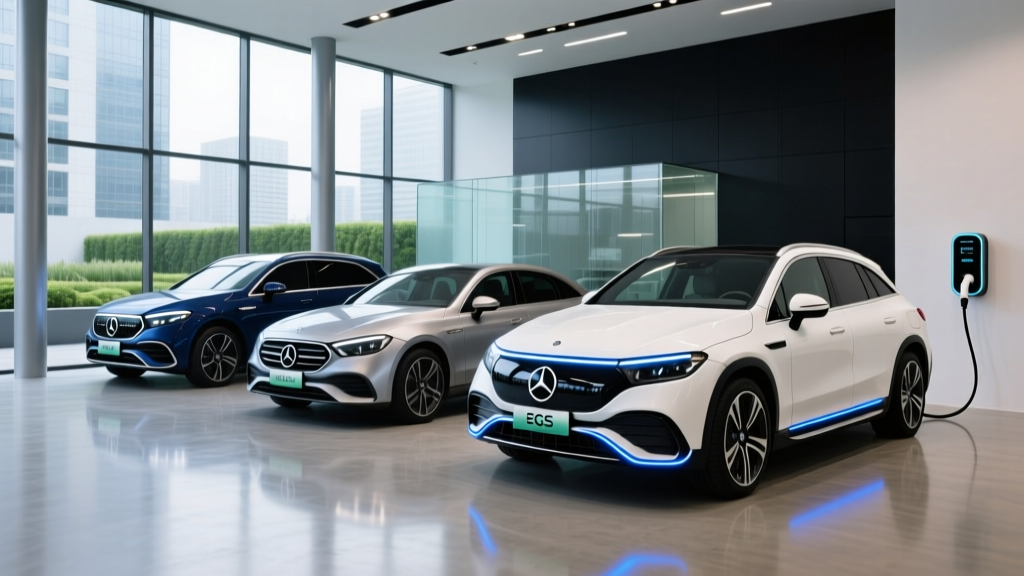
If you're researching a Mercedes EV, the short answer is this: Mercedes-Benz currently offers four primary electric models in the U.S. for 2026, ranging from the compact EQB crossover to the flagship EQS sedan. Expect real-world highway range between 200 and 330 miles depending on model, DC fast charging from 10–80% in roughly 28 to 35 minutes, and starting prices between $54,000 and $105,000 before incentives. Most models are not eligible for the full $7,500 federal tax credit due to battery-sourcing requirements, though point-of-sale leasing workarounds and state incentives may apply.
Quick Answer: Is a Mercedes EV Worth It in 2026?
Mercedes EVs deliver class-leading cabin refinement, competitive range, and improving charging speeds — but they carry premium pricing, and most models miss out on the §30D federal purchase credit. They're best suited for buyers who prioritize luxury, have reliable home Level 2 charging, and don't need maximum range-per-dollar. If federal incentives are critical to your budget, compare carefully against Tesla, Hyundai, or GM alternatives that qualify.
The 2026 Mercedes EV Lineup: Models, Range, and Specs
Mercedes-Benz has restructured its electric portfolio heading into 2026, phasing out the original EQS/EQE SUV configurations and introducing the new MMA-platform CLA EV. Here's how the current lineup stacks up by the numbers.
| Model | Body Style | Battery (kWh, usable) | Chemistry | EPA Range | Peak DC Charge (kW) | 10–80% Time | 0–60 mph | Starting MSRP |
|---|---|---|---|---|---|---|---|---|
| EQB 300 4MATIC | Compact SUV (3-row) | 66.5 kWh | NMC | 245 mi | 100 kW | ~32 min | 7.7 sec | $54,550 |
| EQE 350+ | Mid-size Sedan | 90.6 kWh | NMC | 305 mi | 170 kW | ~32 min | 6.2 sec | $75,050 |
| EQE 350 4MATIC SUV | Mid-size SUV | 90.6 kWh | NMC | 279 mi | 170 kW | ~32 min | 6.4 sec | $78,050 |
| EQS 450+ | Full-size Sedan | 118.0 kWh | NMC | 345 mi | 200 kW | ~31 min | 5.9 sec | $105,550 |
| CLA 250+ (MMA) | Compact Sedan | 85.0 kWh (est.) | NMC | ~340 mi (est.) | 250 kW (est.) | ~18 min (est.) | ~6.5 sec (est.) | ~$48,000 (est.) |
Sources: EPA fueleconomy.gov, Mercedes-Benz USA. The CLA 250+ is announced for 2026; specs are preliminary estimates.
Real-World Range Reality Check
EPA estimates vs. what to expect: The EQS 450+ posts an EPA-rated 345 miles, but in sustained 75-mph highway driving with climate control active, expect closer to 280–305 miles. The EQB, with its boxier aerodynamic profile, drops more sharply at speed — plan for roughly 190–210 miles on a highway road trip. In cold weather (below 30°F), all models lose 15–25% of rated range due to battery heating demands and cabin climate load. The EQS's standard heat pump mitigates this somewhat compared to the EQB.
Mercedes EV vs. Gas Mercedes: Cost and Efficiency Comparison
The most common cross-shop for Mercedes EV buyers is the equivalent internal-combustion model. Here's how the EQE 350+ sedan compares against the E 350 gas sedan over a typical ownership scenario.
| Metric | EQE 350+ (EV) | E 350 Sedan (Gas) |
|---|---|---|
| Starting MSRP | $75,050 | $62,300 |
| EPA Efficiency | 90 MPGe combined (37 kWh/100mi) | 26 MPG combined |
| Fuel/Energy Cost (15,000 mi/yr) | ~$630/yr (home L2 at $0.14/kWh) | ~$2,020/yr (premium at $3.50/gal) |
| Annual Maintenance (est.) | ~$200 | ~$650 |
| 5-Year Fuel + Maintenance | ~$4,150 | ~$13,350 |
| Federal Tax Credit (§30D) | $0–$7,500 (sourcing-dependent) | N/A |
| Estimated 5-yr Total Cost* | ~$87,000 | ~$89,000 |
*Includes purchase price, estimated depreciation (50% EV / 55% gas), fuel/energy, maintenance, insurance differential. Excludes state incentives. Insurance on the EQE typically runs 10–15% higher than the E 350 due to repair-cost factors.
The break-even point arrives around year 4–5 for most buyers, heavily dependent on your local electricity rates and whether you can charge at home. Public DC fast charging at $0.40–$0.60/kWh erases much of the energy-cost advantage — home Level 2 charging is where the economics work.
Charging the Mercedes EV: Home, Public, and What to Expect
Every current Mercedes EV in the U.S. uses the CCS1 connector for DC fast charging and J1772 for Level 2 AC. Mercedes has announced NACS (Tesla-style) adoption for future models, but as of 2026, CCS remains the standard across the lineup. You can use a NACS-to-CCS adapter at Tesla Superchargers where Mercedes has enabled compatibility through its Mercedes me Charge network.
| Level | Power | Connector | Miles Added per Hour | Typical Use |
|---|---|---|---|---|
| Level 1 (120V) | ~1.4 kW | J1772 | 3–5 mi/hr | Emergency / overnight trickle |
| Level 2 (240V, 48A) | ~11.5 kW | J1772 | 28–38 mi/hr | Home daily charging |
| DC Fast Charge | 100–200 kW (model-dependent) | CCS1 | 180–350 mi in 30 min | Road trips |
Home Charging Setup and Cost
For daily ownership, a home Level 2 charger is practically essential. The EQS and EQE accept up to 11.5 kW on AC (9.6 kW on some trims), meaning a full charge from 10–100% takes roughly 8–10 hours overnight.
| Component | Typical Cost Range |
|---|---|
| Level 2 Charger (hardwired, 48A) | $500–$800 |
| Electrician (240V/60A circuit run) | $800–$2,500 |
| Permit and inspection | $100–$400 |
| Electrical panel upgrade (if needed, 200A) | $1,500–$4,000 |
| Total (no panel upgrade) | $1,400–$3,700 |
Final installation specs should always be confirmed by a licensed electrician — panel capacity, wire gauge, and circuit-breaker sizing depend on your home's existing infrastructure.
DC Fast Charging Curve: What the Peak kW Doesn't Tell You
The EQS 450+ advertises a 200 kW peak charge rate, but like all EVs, it does not sustain that rate across the entire session. The charging curve is strongest between 10–40% SoC, then progressively tapers. Expect 10–80% in roughly 31 minutes at a capable 200+ kW station, but 10–90% stretches closer to 48 minutes. The last 10–20% is painfully slow — plan road-trip stops around 80% departures for optimal time efficiency.
Preconditioning matters: if you navigate to a DC fast charger using the MBUX navigation system, the battery will pre-warm to optimize charge acceptance. Arriving at a fast charger without preconditioning (especially in cold weather) can add 10–15 minutes to your session as the battery thermal management system catches up.
Federal Tax Credit and Incentive Eligibility
This is where Mercedes EV buyers need to pay close attention. Under current IRS §30D rules, the full $7,500 federal tax credit requires the vehicle's battery to meet critical-mineral and battery-component sourcing thresholds that increase annually. As of 2026, most Mercedes-Benz EVs use battery cells sourced from suppliers that do not fully satisfy these thresholds, meaning many trims qualify for $0 to $3,750 rather than the full $7,500.
- MSRP cap: Sedans must be ≤$55,000; SUVs/vans/pickups ≤$80,000
- Buyer income cap: ≤$150,000 single / ≤$300,000 married filing jointly (modified AGI)
- Battery sourcing: Critical minerals and components must meet escalating annual thresholds
- Point-of-sale transfer: If eligible, you can transfer the credit to the dealer for an upfront price reduction
- Lease loophole: Commercial-vehicle lease credit (§45W) may allow the lessor to pass savings to you — ask the dealer
The EQB (priced under $80K as an SUV) has the best shot at partial credit eligibility depending on the model year's sourcing compliance. The EQS sedan, at $105,550, exceeds the $55,000 sedan MSRP cap entirely — no purchase credit regardless of sourcing. Always verify current eligibility on fueleconomy.gov before committing, as the qualified-vehicle list updates regularly.
Mercedes EV vs. Competitors: Where Does It Stand?
Mercedes EVs compete in a crowded luxury-electric space. Here's how the key models compare against their most common cross-shops.
| Attribute | Mercedes EQS 450+ | Tesla Model S LR | BMW i7 xDrive60 |
|---|---|---|---|
| EPA Range | 345 mi | 402 mi | 318 mi |
| Battery | 118 kWh NMC | 100 kWh (est.) | 101.7 kWh NMC |
| Peak DC Charge | 200 kW | 250 kW | 195 kW |
| 10–80% DC Time | ~31 min | ~27 min | ~34 min |
| 0–60 mph | 5.9 sec | 3.1 sec | 4.5 sec |
| Starting MSRP | $105,550 | $74,990 | $120,295 |
| §30D Credit | None (MSRP cap) | Up to $7,500 | None (MSRP cap) |
The Tesla Model S wins on range, charging speed, and price by a wide margin. The BMW i7 competes more directly on luxury execution but costs more. The EQS's advantage is cabin isolation, ride quality, and MBUX integration — qualities that don't show up in a spec table but matter over long highway miles.
Common Mercedes EV Misconceptions
| Myth | Fact |
|---|---|
| "Mercedes EVs get their full EPA range in real driving." | Expect 80–88% of EPA range at sustained highway speeds. City driving with regen braking recovers more of the sticker number. |
| "You can't road-trip a Mercedes EV." | The CCS network (Electrify America, EVgo, ChargePoint) covers major interstate corridors. With 280+ real-world highway miles and 30-minute charge stops, 500-mile days are manageable. |
| "All Mercedes EVs qualify for the $7,500 tax credit." | Most do not, due to MSRP caps and battery-sourcing rules. Leasing may unlock savings through the §45W commercial credit. |
| "The battery will need expensive replacement in 5 years." | Mercedes warranties the high-voltage battery for 10 years/155,000 miles with a 70% capacity-retention threshold. NMC degradation data shows most packs retain 85–90% after 5 years of normal use. |
| "Mercedes EVs are self-driving." | Mercedes DRIVE PILOT is SAE Level 3 (limited to specific highway conditions in approved states like NV and CA, below 40 mph). Standard Driver Assistance Package is Level 2 — hands on wheel, eyes on road, always. |
SAE Automation Level: What DRIVE PILOT Actually Does
Mercedes DRIVE PILOT is certified as SAE Level 3 — meaning the car handles all driving tasks under specific conditions (divided highways, traffic jams under 40 mph, clear weather, mapped routes in approved states). When engaged, you can legally take your eyes off the road. However, it is not a full self-driving system. It disengages and requires takeover in construction zones, on surface streets, in heavy rain, or above 40 mph. The standard Driver Assistance Package on all other trims is Level 2: adaptive cruise + lane centering that requires constant driver supervision.
Who Should Buy a Mercedes EV — Decision Framework
Choose a Mercedes EV If:
- You have reliable home Level 2 charging (garage or driveway with 240V access)
- Cabin refinement, ride quality, and brand prestige are top priorities
- Your daily commute is under 80 miles round-trip, with occasional 200–300 mile road trips
- You're in a state with additional EV incentives (CA, CO, NY, MA) that offset the federal credit gap
- You value the Mercedes dealer service network for warranty and maintenance
Look Elsewhere If:
- The $7,500 federal tax credit is essential to your purchase math — consider Tesla Model Y, Hyundai Ioniq 5, or GM Ultium-platform vehicles that qualify
- You need maximum range-per-dollar — the Tesla Model S (402 mi EPA, ~$75K) offers significantly more range at lower cost
- You live in an apartment or lack home charging access and rely entirely on public infrastructure in a region with sparse CCS coverage
- You regularly drive 400+ mile trips in cold climates — the charging-curve taper and cold-weather range loss add significant time
- You need three-row seating with genuine cargo space — the EQB's third row is best for children only; consider the Rivian R1S or Kia EV9 instead
First-Time Mercedes EV Buyer Checklist
- Confirm home charging feasibility before purchasing — get an electrician quote for a 240V/60A circuit. If your panel is maxed out, factor in a $1,500–$4,000 upgrade.
- Test the actual CCS charging network in your area. Download the Electrify America, EVgo, and ChargePoint apps and check station density along your common routes.
- Verify tax credit eligibility on fueleconomy.gov for the specific model year and trim — don't rely on dealer verbal assurances.
- Ask about lease incentives — the §45W commercial credit can sometimes be passed through as a lease capital-cost reduction even when the purchase credit is unavailable.
- Budget for insurance — get quotes before signing. Mercedes EVs typically carry 10–20% higher premiums than their gas equivalents.
- Understand the warranty: 4 years/50,000 miles bumper-to-bumper, 10 years/155,000 miles on the high-voltage battery (70% SoH threshold).
Frequently Asked Questions
What is the longest-range Mercedes EV available?
The EQS 450+ sedan leads the lineup at 345 miles EPA-rated. In real-world highway driving, expect approximately 280–305 miles. The upcoming CLA 250+ on the MMA platform is estimated at roughly 340 miles EPA, but final specs are not yet confirmed.
Can I charge a Mercedes EV at a Tesla Supercharger?
Yes, with a CCS-to-NACS adapter. Mercedes has enabled Supercharger access through the Mercedes me Charge network for compatible models. You'll need to verify adapter compatibility for your specific model year, and charge speeds may be limited by the adapter's rating.
How much does it cost to charge a Mercedes EQS at home?
A full charge of the EQS 450+ (118 kWh usable) at the U.S. average residential rate of ~$0.16/kWh costs approximately $18.90. At 345 miles per charge, that's roughly $0.055 per mile — about one-quarter the per-mile cost of premium gasoline in an equivalent S-Class.
Does the Mercedes EQB qualify for the federal tax credit?
Eligibility varies by model year and current IRS sourcing determinations. The EQB's MSRP falls under the $80,000 SUV cap, but battery-component and critical-mineral sourcing requirements must be met. Check the latest qualified-vehicle list at fueleconomy.gov and consult a tax professional for your specific situation.
What happens if the Mercedes EV battery degrades?
Mercedes guarantees the high-voltage battery will retain at least 70% of its original capacity for 10 years or 155,000 miles, whichever comes first. If capacity drops below that threshold within the warranty period, Mercedes will repair or replace the battery at no cost. Out-of-warranty replacement costs for the larger packs (EQS/EQE) are estimated at $15,000–$25,000, though real-world failure rates on modern NMC packs remain very low.
Is the Mercedes DRIVE PILOT system available everywhere?
No. As of 2026, DRIVE PILOT (SAE Level 3) is approved only in Nevada and California, and only on specific divided highways under 40 mph in clear conditions. It is an expensive option (approximately $2,500) with significant geographic and operational limitations. For most buyers, the standard Level 2 Driver Assistance Package is the practical choice.