California EV Incentives in 2026: What's Actually Available?
If you're shopping for an EV in California, the headline number is tempting: stack a California rebate on electric cars with federal tax credits, utility incentives, and local air-district grants, and you can knock $10,000–$15,000 off the effective price of a new battery-electric vehicle. But the fine print matters more than the sticker. Eligibility depends on your income, the vehicle's MSRP, where the battery minerals come from, and even which ZIP code you live in.
This guide breaks down every major incentive available to California EV buyers in 2026 — and then runs the real numbers on what owning an EV actually costs over five years, including the line items most buyers forget: insurance premiums, home charger installation, and depreciation.
- Federal §30D Clean Vehicle Credit (up to $7,500)
- Clean Cars 4 All (CC4A) — up to $12,000 for low-income trade-ins
- Utility rebates (PG&E, SCE, SDG&E, LADWP)
- CARP (Clean Air Rebate Program) — where still funded
- HOV lane access stickers (CVRP decals expired; CC4A still qualifies in some cases)
Note: The classic CVRP (Clean Vehicle Rebate Project) $2,000 point-of-sale rebate ended when funding was exhausted. Always verify current status at energy.ca.gov.
The Federal §30D Tax Credit: Rules That Still Apply in 2026
The federal Clean Vehicle Credit under IRC §30D remains the single biggest price-reducer for new EVs, but qualifying has gotten harder since the Inflation Reduction Act rewrote the rules. As of 2026, the credit is worth up to $7,500, split into two halves — $3,750 for critical-mineral sourcing and $3,750 for battery-component manufacturing — and it can now be transferred to the dealer at point of sale as a down-payment reduction.
You can read the full, current rules on the IRS §30D page. The summary checklist below captures what determines whether you — and the car you want — actually qualify.
- Buyer income cap: MAGI ≤ $150,000 single / $225,000 head of household / $300,000 married filing jointly
- Vehicle MSRP cap: ≤ $55,000 for sedans, wagons, hatchbacks; ≤ $80,000 for SUVs, pickups, vans
- Final assembly: Must occur in North America (VIN check required)
- Critical minerals: A rising percentage must be sourced from the U.S. or FTA-partner nations ($3,750 half)
- Battery components: A rising percentage must be manufactured in North America ($3,750 half)
- FEOC exclusion: Vehicles with battery components or critical minerals from a "foreign entity of concern" (China, Russia, Iran, North Korea) are disqualified
- Point-of-sale transfer: Buyer can elect to transfer the credit to the dealer, reducing purchase price at signing
Practical reality: many popular mid-price EVs — such as the Tesla Model 3 RWD (~$38,990 MSRP) and Hyundai Ioniq 5 SE (~$42,400) — still qualify for the full $7,500 in 2026, but several Korean- and German-built models only qualify for $3,750 or nothing at all because final assembly happens overseas. Always run the VIN through the fueleconomy.gov credit lookup before signing paperwork.
California-Specific Rebates: Beyond the Federal Credit
California layers additional incentives on top of §30D, but availability is uneven and income-targeted. Here's what's active or rolling in 2026:
Clean Cars 4 All (CC4A)
Run by the state's five major air districts (Bay Area, South Coast, San Joaquin Valley, Sacramento, San Diego), CC4A offers up to $12,000 toward a new or used EV — but only to low-income drivers who retire a pre-1999 or high-polluting vehicle. Income caps are typically 400% of the federal poverty level. This is the true successor to the old CVRP for budget-conscious buyers.
Utility Rebates
Most California IOUs and municipal utilities still offer rebates for Level 2 home chargers and, in some cases, panel upgrades:
- PG&E: Up to $1,000 toward a residential Level 2 charger (income-qualified; varies by program year)
- SCE (Southern California Edison): Charger Ready program — rebates up to $1,500 for equipment and make-ready wiring
- SDG&E: EV charger rebate up to $1,250 for income-qualified customers
- LADWP: Up to $500 toward a Level 2 charger; separate EV-only TOU rate
These change annually with budget cycles. Check your utility's EV program page before purchasing equipment.
Clean Air Rebate Program (CARP)
CARP has offered $1,000–$2,000 rebates on new EV purchases to residents of disadvantaged communities, independent of income. Funding has been intermittent — check current availability through your air district.
HOV Lane Stickers
California's Clean Air Vehicle decals (white/green) granting solo carpool-lane access were sunset for new applicants, but CC4A participants and certain used-EV buyers may still qualify under transitional rules. Verify with the DMV before relying on this perk.
5-Year Total Cost of Ownership: EV vs Gas in California
Incentives only matter if the long-run math works. To test that, we compared a realistic 2026 EV (Tesla Model 3 RWD, ~$38,990 MSRP) against a comparably sized gas sedan (Toyota Camry LE, ~$29,995 MSRP) over five years and 75,000 miles. Both are popular California purchases.
| Category | Tesla Model 3 RWD | Toyota Camry LE |
|---|---|---|
| Purchase price (MSRP) | $38,990 | $29,995 |
| Federal §30D credit | −$7,500 | $0 |
| CA / utility rebates (typical) | −$1,000 | $0 |
| Net acquisition | $30,490 | $29,995 |
| Home Level 2 install | $1,200–$2,500 | $0 |
| Fuel / electricity (75k mi) | $2,250 (home TOU) | $7,650 (27 MPG, $4.10/gal) |
| Maintenance (5 yrs) | $800 | $2,400 |
| Insurance (5 yrs, avg CA) | $11,500 | $8,750 |
| Depreciation (est.) | $14,200 | $11,500 |
| Total 5-yr cost | ~$61,440 | ~$60,295 |
| Cost per mile | $0.82 | $0.80 |
Assumptions: CA electricity $0.28/kWh blended (home TOU), Model 3 efficiency 26 kWh/100 mi, Camry 27 MPG combined at $4.10/gal. Insurance based on CA average for good-driver profiles. Depreciation from Kelley Blue Book / Edmunds 5-yr retained-value data. Your mileage — literally — will vary.
The takeaway: incentives narrow the gap but rarely flip it completely in California's high-insurance, high-electricity-rate environment. The EV wins decisively on fuel and maintenance, but loses on insurance and (often) depreciation. Buyers who charge at home on off-peak TOU rates and drive 15,000+ miles per year tip the math in the EV's favor; low-mileage urban renters who rely on public DC charging often don't.
Charging vs Gas: The Per-Mile Math in California
California has some of the cheapest EV driving in the country if you charge at home on a time-of-use plan — and some of the most expensive if you rely on public DC fast chargers. The spread is enormous.
| Charging scenario | Rate / cost | $/mile (EV @ 3.8 mi/kWh) |
|---|---|---|
| Home off-peak TOU (PG&E EV2-A) | $0.14/kWh | $0.037 |
| Home blended TOU | $0.28/kWh | $0.074 |
| Public Level 2 (ChargePoint avg) | $0.45/kWh | $0.118 |
| DC fast charger (EA / EVgo avg) | $0.55–$0.65/kWh | $0.145–$0.171 |
| Tesla Supercharger (avg CA) | $0.38–$0.48/kWh | $0.100–$0.126 |
| Gas baseline: Camry LE @ 27 MPG, $4.10/gal → $0.152/mile | ||
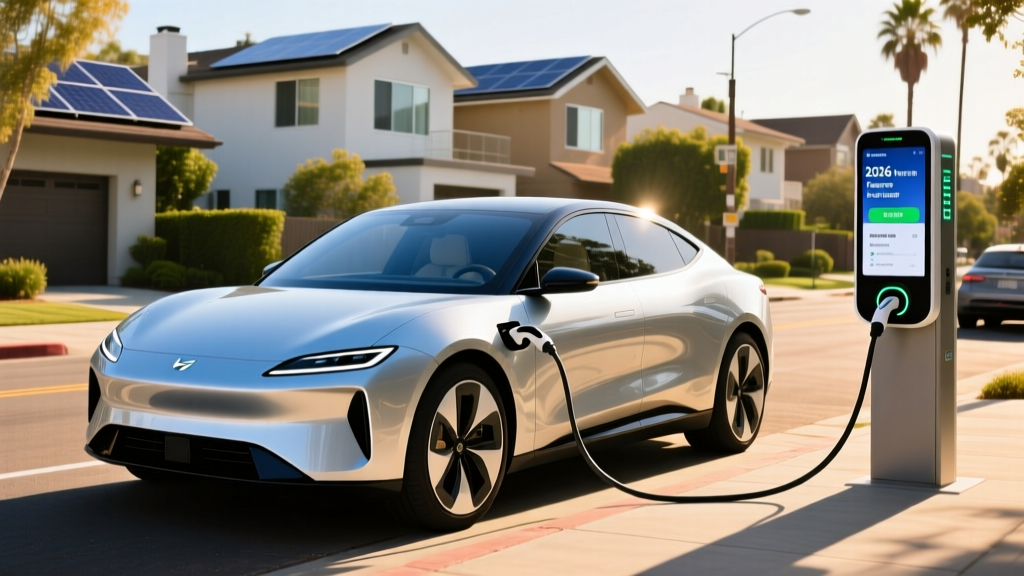
Home charging on an off-peak TOU plan is roughly 4× cheaper per mile than gas in California. Public DC fast charging, however, can equal or exceed gasoline costs — a critical consideration for apartment dwellers without home charging access. Budget at least a 240V / 40–48A Level 2 circuit at home ($1,200–$2,500 installed, more if a panel upgrade is needed) to capture the savings the math promises.
Maintenance Savings: Where EVs Quietly Win
Maintenance is the EV's strongest ongoing-cost advantage, and it compounds with mileage. Battery-electric vehicles eliminate oil changes, spark plugs, timing belts, fuel filters, and exhaust systems. Regenerative braking typically extends pad life to 100,000+ miles.
| Service | BEV | Gas sedan |
|---|---|---|
| Oil & filter changes | $0 | $600–$900 |
| Brake pads (front) | $0–$250 | $400–$600 |
| Spark plugs / ignition | $0 | $300–$500 |
| Transmission fluid | $0 | $150–$250 |
| Coolant, cabin filter, wipers | $400 | $400 |
| Tire rotation / replacement | $1,400 (heavier car, instant torque) | $1,100 |
| Total (est.) | ~$800 | ~$2,400 |
Net savings: roughly $1,600 over five years. The catch? EV tires wear 15–25% faster due to vehicle weight and instant torque — budget for a premium all-season or EV-specific tire (Michelin Pilot Sport EV, Hankook iON) at $250–$350 per corner.
Insurance: The Line Item EV Advocates Understate
California EV owners typically pay 15–30% more for insurance than owners of equivalent gas cars. The reasons are structural, not discriminatory:
- Higher repair costs: Battery packs, aluminum panels, and sensor-heavy bumpers are expensive to fix after a collision.
- Total-loss thresholds: Even minor damage to a battery enclosure can trigger a total-loss declaration.
- Specialized labor: Fewer shops are certified for high-voltage work, raising labor rates.
- Higher MSRP base: Insurers price off replacement cost.
For a Model 3 in California, expect annual premiums of $2,100–$2,500 for a clean-record driver in their 30s–40s, versus $1,600–$1,900 for a Camry. Over five years, that's a $1,750–$3,000 gap — enough to erase much of the fuel savings for low-mileage drivers. Always run a quote through your insurer before purchase; Tesla has its own insurance product in California that can be competitive for Autopilot-heavy drivers.
Depreciation and Resale: The Moving Target
EV depreciation has been volatile. After a brutal 2022–2024 period where price cuts by Tesla and aggressive Chinese-competition pressure collapsed used-EV values, the market stabilized in 2025–2026. Current 5-year retained-value estimates (KBB / Edmunds) for popular California models:
- Tesla Model 3: ~42–48% retained at 5 years
- Tesla Model Y: ~45–50%
- Hyundai Ioniq 5: ~38–44%
- Ford Mustang Mach-E: ~35–41%
- Toyota Camry (gas): ~50–55%
EVs still depreciate faster than top-resale gas cars like the Camry or RAV4, primarily due to rapid tech obsolescence (newer models charge faster, go farther) and battery-health uncertainty in the used market. Mitigants: buy a model with a strong battery warranty (8 yr / 100,000 mi, minimum 70% capacity retention), keep the battery between 20–80% SoC daily, and document health via the car's SoH readout when selling.
Stacking the Incentives: A Real California Purchase
Here's what a maximally stacked 2026 California EV purchase can look like for an income-qualified buyer in a disadvantaged community:
- Vehicle: Tesla Model 3 RWD — $38,990 MSRP
- Federal §30D (point-of-sale transfer) — −$7,500
- Clean Cars 4 All (retiring a 1998 Civic, income-qualified) — −$9,500
- SCE Charger Ready rebate — −$1,500 toward L2 install
- Utility TOU enrollment — ongoing fuel savings
- Effective acquisition cost: ~$22,000 before destination and taxes
That's a dramatically different proposition than the MSRP suggests — but it requires (a) qualifying for CC4A, (b) having an eligible trade-in, (c) living in an active air-district program, and (d) buying a §30D-eligible vehicle. Most California EV buyers will capture only the $7,500 federal credit and perhaps a $500–$1,500 utility charger rebate. Plan your budget around the conservative stack, and treat additional programs as upside.
Does the California CVRP rebate still exist in 2026?
The original Clean Vehicle Rebate Project ($2,000 point-of-sale rebate) was fully subscribed and sunset. It has been functionally replaced by Clean Cars 4 All (income-targeted, up to $12,000) and various utility/air-district programs. Always verify at energy.ca.gov and your local air district.
Can I combine the federal §30D credit with California incentives?
Yes — the §30D credit stacks with state and utility rebates, and there is no "double-dipping" prohibition between federal and California programs. The §30D credit is applied against federal income tax liability (or transferred to the dealer at POS), while state/utility rebates are separate.
Do used EVs qualify for any California rebate?
Used EVs can qualify for the federal previously owned clean-vehicle credit (up to $4,000 or 30% of sale price, with stricter income caps of $75k/$112.5k/$150k) and may qualify under CC4A. California utility charger rebates generally apply regardless of vehicle age.
Is the HOV lane sticker still available for new EV buyers?
The main Clean Air Vehicle decal programs are sunset for new applicants as of 2026. Limited exceptions exist for CC4A participants. Do not purchase an EV assuming carpool-lane access — verify current DMV rules before signing.
How do I check if a specific EV qualifies for the §30D credit?
Use the VIN lookup tool at fueleconomy.gov and confirm battery-sourcing eligibility on the manufacturer's website. The IRS maintains the official qualifying-vehicle list and updates it periodically.
Are California EV electricity rates high enough to erase fuel savings?
Only if you charge primarily on public DC fast chargers ($0.55–$0.65/kWh) or on a default residential tier without TOU enrollment. On a PG&E EV2-A or SCE TOU-EV plan charging overnight at $0.12–$0.16/kWh, an EV costs roughly $0.04/mile in electricity vs $0.15/mile for a 27-MPG gas sedan.