Quick Answer: Is a Mercedes EV Worth It in 2026?
Mercedes-Benz currently sells four battery-electric models in the US — the EQB compact SUV, EQE sedan and SUV, and flagship EQS sedan and SUV — ranging from roughly $53,000 to over $125,000 before incentives. The best-selling EQS 450+ delivers an EPA-estimated 390 miles of range and charges at up to 200 kW DC. However, none of the current Mercedes EVs qualify for the full $7,500 federal §30D tax credit due to battery-sourcing and critical-minerals requirements, though point-of-sale lease credits may apply. Real-world range typically falls 10–18% below EPA stickers on highway trips, and cold weather can cut range by 20–30%. A Mercedes EV makes sense if you prioritize luxury refinement, have reliable Level 2 home charging access, and drive mostly within 200 miles daily.
Current Mercedes EV Lineup: Specs at a Glance
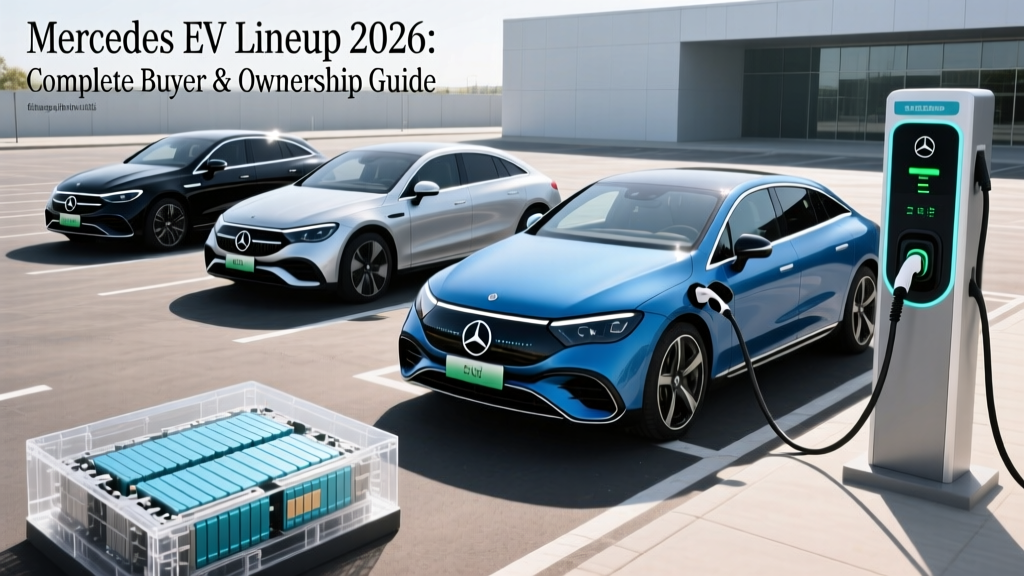
Mercedes-Benz uses the "EQ" sub-brand for its battery-electric vehicles. As of the 2026 model year, the lineup spans from a compact three-row crossover to a full-size luxury flagship sedan. Below are the core specifications buyers need to compare trims.
| Model | Body Style | Battery (usable kWh) | EPA Range | Peak DC Charge | 10–80% DC Time | 0–60 mph | Starting MSRP |
|---|---|---|---|---|---|---|---|
| EQB 300 4MATIC | Compact SUV (3-row) | 66.5 kWh (NMC) | 251 mi | 100 kW | ~32 min | 7.7 sec | $53,050 |
| EQE 350+ | Mid-size sedan | 90.6 kWh (NMC) | 308 mi | 170 kW | ~31 min | 6.2 sec | $74,900 |
| EQE SUV 350 4MATIC | Mid-size SUV | 90.6 kWh (NMC) | 279 mi | 170 kW | ~32 min | 6.4 sec | $77,900 |
| EQS 450+ | Full-size sedan | 118 kWh (NMC) | 390 mi | 200 kW | ~31 min | 5.9 sec | $104,400 |
| EQS SUV 450 4MATIC | Full-size SUV | 118 kWh (NMC) | 330 mi | 200 kW | ~31 min | 5.8 sec | $105,550 |
Sources: EPA fueleconomy.gov, Mercedes-Benz USA press specifications. Real-world highway range typically 10–18% lower than EPA. Cold-weather (below 30°F) range reduction: 20–30%.
Real-World Range vs. EPA Sticker
EPA 390 mi (EQS 450+) → Expect ~320–350 mi on highway road trips at 70–80 mph. In winter conditions (20–30°F), plan for 270–310 mi between charges. The EQS's massive 118 kWh battery helps absorb these losses better than smaller packs, but physics always wins at speed and in cold.
Mercedes EV vs. Gas Mercedes: Total Ownership Cost
The sticker-price gap between a Mercedes EV and its internal-combustion equivalent is real, but the five-year cost picture shifts once you factor in fuel, maintenance, and depreciation. Below is a comparison between the EQS 450+ sedan and the gas-powered S 500 4MATIC over five years and 75,000 miles.
| Cost Category | EQS 450+ (EV) | S 500 4MATIC (Gas) | Difference |
|---|---|---|---|
| Base MSRP | $104,400 | $117,300 | EV saves $12,900 |
| Federal Tax Credit (§30D) | $0–$7,500 (lease only) | $0 | Varies by structure |
| Fuel/Energy (75k mi) | $5,400 (home L2 avg) | $13,500 (premium 93 octane) | EV saves $8,100 |
| Maintenance (5 yr) | $2,200 | $5,800 | EV saves $3,600 |
| Insurance (5 yr avg) | $14,500 | $12,800 | EV costs $1,700 more |
| Estimated Depreciation | $52,200 (50%) | $52,785 (45%) | Roughly equal |
| 5-Year Total | ~$74,300 | ~$90,015 | EV saves ~$15,700 |
Assumptions: $0.16/kWh home charging, $4.50/gal premium fuel, 15,000 mi/year. Insurance based on national luxury-EV averages. Depreciation estimates from industry resale data. Your actual costs depend on local electricity rates, driving patterns, and state incentives. Consult IRS §30D guidelines for current credit eligibility.
Charging the Mercedes EV Lineup: What Owners Need to Know
Mercedes EVs use the CCS1 connector for DC fast charging and the J1772 connector for Level 2 AC charging. With Mercedes-Benz committing to the NACS (Tesla-style) connector for future models, current EQ owners can access Tesla Superchargers via a CCS-to-NACS adapter once Mercedes officially enables the adapter pathway (expected broadly by mid-2026).
| Charging Level | Power (kW) | Miles Added per Hour | Typical Use Case | Cost per Full Charge |
|---|---|---|---|---|
| Level 1 (120V household) | 1.4 kW | 3–5 mi/hr | Emergency/trickle | ~$15 (EQS) |
| Level 2 (240V home) | 7.4–11.5 kW | 20–35 mi/hr | Daily overnight | ~$14–18 (EQS) |
| DC Fast (public) | 100–200 kW | 150–250 mi in 30 min | Road trips | ~$25–45 (EQS) |
Charging-curve reality check: The EQS 450+ peaks at 200 kW only between roughly 10–30% State of Charge (SoC). From 30–60%, it sustains around 150 kW, and above 80%, it tapers sharply to under 50 kW to protect battery health. This means the published "10–80% in 31 minutes" figure is accurate, but charging from 80–100% can add another 40+ minutes. Plan road-trip stops to charge from 10–80% and move on.
Preconditioning matters: Use the Mercedes me app to schedule departure preconditioning. This warms the battery to optimal temperature before you arrive at a DC fast charger, potentially cutting charge time by 15–25% in cold weather. Without preconditioning, a cold battery in winter may accept only 40–60 kW for the first 10 minutes of a fast-charge session.
Federal Tax Credits and Incentives: The Honest Picture
This is where Mercedes EV buyers face the most confusion. As of 2026, the federal §30D clean vehicle credit offers up to $7,500 — but eligibility depends on battery component sourcing, critical-mineral origin, buyer income caps, and MSRP limits. Here's the checklist:
- MSRP cap: Vans/SUVs/pickups ≤ $80,000; sedans ≤ $55,000. This disqualifies the EQS and EQE sedans (over $55K cap) and most EQE/EQS SUV trims (over $80K).
- Buyer income cap: Modified AGI ≤ $150K single / $300K joint / $225K head of household.
- Battery sourcing: Battery components must be manufactured or assembled in North America (phasing percentages increase yearly). Critical minerals must be sourced from the US or FTA partners. Current Mercedes EQ battery supply chains largely do not meet these thresholds.
- Point-of-sale transfer: You can transfer the credit to the dealer at purchase for an immediate price reduction — but only if the vehicle qualifies.
- Lease loophole: Under §45W (commercial clean vehicle credit), the leasing company may claim a $7,500 credit and pass it to you as a lease incentive. Many Mercedes EQ models are eligible through this route. Confirm with your dealer.
Always verify current eligibility on IRS.gov and consult a tax professional before relying on credit assumptions.
Common Mercedes EV Misconceptions: Myth vs. Fact
| Myth | Fact |
|---|---|
| "Mercedes EVs get full $7,500 tax credit" | Most trims exceed MSRP caps or fail battery-sourcing rules. Lease structures may unlock the credit via §45W. |
| "390-mile range means I'll always get 390 miles" | Highway driving at 75 mph reduces range ~15%. Cold weather (20°F) cuts it 20–30%. Plan for 270–350 real-world miles. |
| "I need a Tesla to use Superchargers" | Mercedes is adopting NACS access. With the approved CCS-to-NACS adapter, EQ models can use Tesla Supercharger stalls as the network opens to non-Tesla vehicles. |
| "The battery will need replacing in 5 years" | Mercedes warranties its EV batteries for 8 years/100,000 miles with a minimum 70% capacity retention threshold. NMC chemistry in liquid-cooled packs typically degrades 8–12% over 100K miles. |
| "Public charging is unreliable everywhere" | Mercedes is building its own High-Power Charging network (targeting 2,500+ stalls in North America by late 2027). Electrify America and EVgo reliability has improved, averaging 90%+ uptime at newer stations. |
Decision Framework: Which Mercedes EV Fits You?
Choose Based on Your Situation
Choose the EQB 300 if: You need a compact luxury SUV with an occasional-use third row, your budget is under $60K, and your daily commute is under 50 miles round trip. Its 251-mile EPA range and 100 kW peak charging make it best for city and suburban driving with home Level 2 charging.
Choose the EQE 350+ if: You want a mid-size luxury sedan with genuine road-trip capability (308 mi EPA), strong rear-seat comfort, and don't need the flagship price. Best for buyers replacing an E-Class who have reliable home charging and take 2–4 road trips per year under 300 miles.
Choose the EQS 450+ if: You prioritize maximum range (390 mi EPA), flagship technology (MBUX Hyperscreen, rear-axle steering), and S-Class replacement-level luxury. Best for high-mileage luxury buyers who can absorb the $104K+ MSRP and understand the tax credit likely won't apply to outright purchase.
Choose the EQE or EQS SUV if: You need cargo space, all-wheel drive, and the higher driving position. Expect 10–15% less range than sedan equivalents due to increased weight and frontal area. The EQS SUV's 330-mile EPA range still outpaces most electric SUVs on the market.
Wait or consider a PHEV instead if: You lack home Level 2 charging access, regularly drive 400+ miles between charging opportunities, or live in an area with sparse DC fast-charging infrastructure. A Mercedes plug-in hybrid (like the S 580e) gives you 40+ miles of electric commuting plus a gas engine for long trips.
Real-World Ownership: What First-Time Mercedes EV Buyers Should Know
Home charging is essential. Relying solely on public DC fast charging adds $1,500–$3,000 per year in energy costs compared to home Level 2, and accelerates battery wear from repeated high-power sessions. Budget $800–$2,200 for a professional Level 2 home charger installation (equipment + electrician + permit), and confirm your electrical panel has capacity for a 40–60 amp circuit before purchasing.
Insurance costs 10–20% more. EV repair costs, battery replacement risk, and higher vehicle values push premiums up. Get quotes before committing — a $105K EQS SUV may cost $2,800–$3,500/year to insure depending on your state and driving record.
Maintenance drops dramatically. No oil changes, no spark plugs, no transmission fluid. Expect brake pad replacements every 80,000+ miles thanks to regenerative braking doing most of the deceleration work. Cabin air filters and tire rotations remain the primary service items, totaling roughly $400–$600/year.
Tire wear increases 15–25%. EVs are heavy (the EQS weighs over 5,600 lbs) and deliver instant torque. Budget for premium tire replacement every 25,000–35,000 miles. Mercedes recommends EV-specific tires with low rolling resistance and foam noise-dampening layers.
Software updates are frequent. Mercedes delivers over-the-air (OTA) updates that can adjust range estimates, charging behavior, and MBUX features. Some updates require dealer visits. Factor in occasional service-center appointments for software-related issues, especially in the first year of ownership.
Frequently Asked Questions
Does Mercedes still make EVs under the EQ name in 2026?
Yes. Mercedes-Benz continues to sell the EQB, EQE, and EQS in the US market. The company has announced it will eventually transition to new naming conventions, but current EQ models remain in production with updated battery management and software for the 2026 model year.
How long does a Mercedes EV battery last?
Mercedes warranties its high-voltage batteries for 8 years or 100,000 miles, whichever comes first, with a guaranteed minimum of 70% State of Health (SoH). Based on NMC chemistry degradation curves in liquid-cooled packs, most owners can expect 85–92% capacity retention at 100,000 miles. Full battery replacement costs range from $18,000–$32,000 depending on the model, though complete replacements are rare under normal use.
Can I charge a Mercedes EV at Tesla Superchargers?
Mercedes-Benz has committed to NACS adoption, and current EQ models can access Tesla Superchargers using a CCS-to-NACS adapter (sold separately or through Mercedes dealers). Confirm adapter compatibility with your specific model year before relying on this for travel.
Is a Mercedes EV cheaper to own than a gas Mercedes?
Over five years, yes — typically $10,000–$18,000 cheaper in total cost of ownership when comparing equivalent segments (EQS vs. S-Class). The savings come primarily from energy costs ($8,000+ less) and reduced maintenance ($3,000+ less), partially offset by higher insurance premiums and steeper depreciation on some trims.
What happens if I can't install a home charger?
Without home Level 2 charging, EV ownership becomes significantly more expensive and inconvenient. Public DC fast charging costs 2–3× more per mile than home charging, and daily reliance on fast charging accelerates battery degradation. If home charging isn't possible, consider a Mercedes plug-in hybrid (PHEV) instead, which offers 40–50 miles of electric range for short commutes plus a gas engine for flexibility.
How does cold weather affect Mercedes EV range?
In temperatures below 30°F, expect a 20–30% range reduction due to battery chemistry slowdown and cabin heating demands. The EQS 450+ drops from 390 EPA miles to roughly 270–310 real-world miles in winter. Models equipped with a heat pump (standard on EQS, available on EQE) recover 5–10% of that loss compared to resistive heating. Always precondition the cabin and battery while still plugged in to minimize range loss.