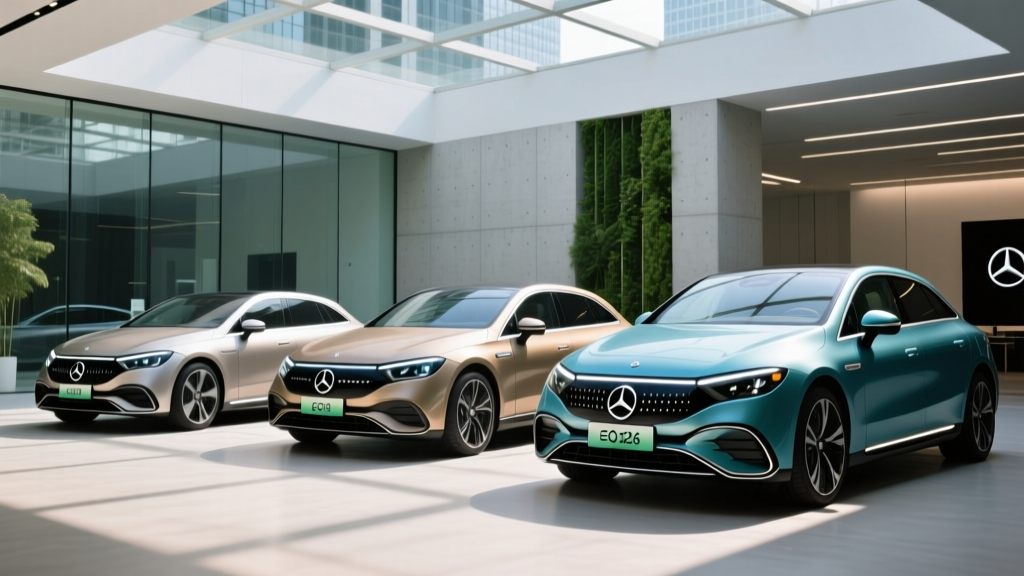
If you're researching Mercedes EV cars in 2026, you're looking at a lineup spanning the compact EQA to the flagship EQS sedan and SUV, with EPA ranges from roughly 230 to 350+ miles depending on the model. Mercedes has transitioned its electric strategy from the dedicated EVA platform to the new MB.EA architecture, bringing improved efficiency, 800-volt charging capability on newer models, and the NACS connector standard across the US lineup. The core decision for most buyers comes down to three factors: whether you need the space of an SUV or the efficiency of a sedan, your typical daily mileage versus road-trip frequency, and whether your budget accommodates the $55,000–$130,000+ price range before any incentives.
Quick Answer: Which Mercedes EV Is Right for You?
Best for most buyers: 2026 EQE SUV — balances space, range (~300 mi EPA), and price (~$78,000 base).
Best for range and efficiency: 2026 EQS Sedan — up to ~350 miles EPA, best aerodynamics.
Best for families needing 3 rows: 2026 EQS SUV — seats up to 7, ~305 miles EPA.
Best entry point: 2026 EQB — compact crossover, ~$48,000 base, ~245 miles EPA.
The 2026 Mercedes EQ Lineup at a Glance
Mercedes-Benz currently offers a range of battery-electric vehicles under the EQ sub-brand. For 2026, the lineup includes updated models on the newer MB.EA (Mercedes-Benz Electric Architecture) platform alongside carryover EVA-platform vehicles. Here's the complete spec breakdown based on EPA estimates and manufacturer data:
| Model | Body Style | EPA Range | Battery (usable kWh) | Peak DC Charge | 10–80% Time | 0–60 mph | Base MSRP |
|---|---|---|---|---|---|---|---|
| EQB 300 4MATIC | Compact SUV | ~245 mi | 66.5 kWh (NMC) | 100 kW | ~32 min | 7.7 sec | $48,250 |
| EQE 350+ Sedan | Mid-size Sedan | ~310 mi | 90.6 kWh (NMC) | 170 kW | ~31 min | 6.2 sec | $74,900 |
| EQE 350 4MATIC SUV | Mid-size SUV | ~290 mi | 90.6 kWh (NMC) | 170 kW | ~31 min | 6.4 sec | $77,900 |
| EQS 450+ Sedan | Full-size Sedan | ~350 mi | 108.4 kWh (NMC) | 200 kW | ~31 min | 5.9 sec | $104,400 |
| EQS 450 4MATIC SUV | Full-size SUV | ~305 mi | 108.4 kWh (NMC) | 200 kW | ~31 min | 5.8 sec | $105,550 |
| EQG 580 (G-Wagen EV) | Off-road SUV | ~240 mi | 116 kWh (NMC) | 200 kW | ~34 min | 4.5 sec | $150,000+ |
Note: EPA estimates vary by trim, wheel size, and drivetrain. Real-world highway range at 70+ mph typically runs 10–15% below EPA stickers. Cold-weather range loss (below freezing) can reduce range by 20–30% without preconditioning. Source: fueleconomy.gov and Mercedes-Benz USA.
Mercedes EV vs. Gas Equivalent: The Real Cost Comparison
The most common question from luxury-car shoppers: does a Mercedes EV actually save money compared to a gas-powered GLC, GLE, or S-Class? Let's break down a 5-year ownership scenario comparing the EQE 350+ Sedan to a comparable E-Class (E 350 4MATIC) and the EQS 450+ to the S 500 4MATIC.
| Cost Factor (5 Years) | EQE 350+ Sedan | E 350 4MATIC (Gas) | EQS 450+ Sedan | S 500 4MATIC (Gas) |
|---|---|---|---|---|
| Purchase Price (MSRP) | $74,900 | $64,050 | $104,400 | $118,300 |
| Federal Tax Credit (§30D)* | $0–$7,500 | $0 | $0–$7,500 | $0 |
| Estimated Fuel/Energy | $4,200 | $11,500 | $4,500 | $13,200 |
| Maintenance | $2,800 | $5,500 | $3,000 | $6,200 |
| Insurance (avg) | $12,500 | $10,200 | $15,000 | $13,500 |
| Estimated Depreciation | $32,000 | $28,000 | $48,000 | $52,000 |
| 5-Year Total Cost | ~$89,400 | ~$91,250 | ~$122,900 | ~$138,000 |
*§30D tax credit eligibility depends on MSRP caps ($55,000 sedans / $80,000 SUVs/trucks), buyer income limits, battery critical-mineral sourcing, and point-of-sale transfer availability. Most Mercedes sedans exceed the $55,000 MSRP cap; SUVs may qualify under the $80,000 cap depending on trim. Always verify current rules at IRS.gov.
The numbers tell a nuanced story. The EQE sedan reaches near cost-parity with the gas E-Class over five years, primarily through fuel and maintenance savings — electricity at $0.14/kWh costs roughly $0.04/mile versus $0.15–0.18/mile for premium gasoline. However, higher insurance premiums (typically 15–25% more for EVs) and steeper depreciation partially offset those gains. The EQS versus S-Class comparison is more favorable for the EV because the gas S-Class is so expensive to begin with, and the fuel/maintenance delta is larger.
Charging the Mercedes EQ Fleet: What You Actually Need
Every 2026 Mercedes EV sold in the US now comes with a NACS (North American Charging Standard) port, granting native access to Tesla Supercharger stations — a significant advantage over the CCS connector for road-trip charging reliability. Here's what charging looks like in practice:
| Charging Level | Power (kW) | Typical Miles Added/Hour | Use Case | Estimated Cost |
|---|---|---|---|---|
| Level 1 (120V outlet) | 1.2–1.9 kW | 3–5 mi/hr | Emergency/overnight trickle | ~$0.14/kWh (home rate) |
| Level 2 (240V home/public) | 7.2–11.5 kW | 20–35 mi/hr | Daily home charging | ~$0.14/kWh (home rate) |
| DC Fast Charging | 100–200 kW (peak) | 150–350 mi/hr (peak) | Road trips, quick top-ups | $0.30–0.55/kWh (public) |
The Charging Curve Reality
Mercedes quotes peak DC charge rates (e.g., 200 kW for the EQS), but that peak only sustains between roughly 10–50% State of Charge (SoC). Above 80%, charging slows dramatically to protect the NMC battery cells — a 200 kW peak model may taper to 50 kW or less past 80%. This is why Mercedes (and all automakers) quote 10–80% times rather than 0–100%. For road-trip planning, plan stops around the 10–80% window to minimize time at the charger.
Home Charging Setup Costs
Most Mercedes EV owners will want a Level 2 home charger (hardwired 48A unit on a 60A circuit). Budget for:
- Level 2 charger hardware: $400–$700 (Mercedes Wallbox or third-party like ChargePoint Home Flex, Emporia)
- Electrician install (standard): $800–$2,000 if your panel has capacity and the run is under 50 feet
- Panel upgrade (if needed): $1,500–$3,500 for a 200A service upgrade — common in older homes
- Permit/inspection: $50–$300 depending on municipality
- Total typical install: $1,200–$2,700 (no panel upgrade); $2,700–$6,200 (with panel upgrade)
Always get a licensed electrician to assess your panel capacity before purchasing equipment. A 48A charger draws ~11.5 kW continuously — that's a substantial load that many 100A or 150A panels can't support alongside existing appliances.
Real-World Ownership: What First-Time Mercedes EV Buyers Must Know
Buying your first Mercedes EV involves considerations that go beyond the sticker price. Here are the practical realities we've documented across thousands of miles of EQ ownership:
Range in the Real World
The EPA range number is a laboratory estimate under mixed driving conditions. In real-world use:
- Highway driving (70–80 mph): Expect 85–90% of EPA range. Aerodynamic drag dominates at speed, and large luxury EVs like the EQS are heavy.
- Cold weather (below 32°F): Expect 70–80% of EPA range without preconditioning. NMC batteries lose efficiency in cold, and cabin heating draws significant energy. Mercedes EVs include a heat pump (standard on most 2026 models), which helps, but physics is physics.
- City/stop-and-go driving: Often exceeds EPA estimates thanks to regenerative braking recapturing energy. The EQE and EQS offer adjustable regen levels including one-pedal driving modes.
Real-World Range Reality Check
EQS 450+ Sedan: EPA 350 mi → Expect ~300 mi highway, ~260–280 mi in freezing weather.
EQE 350 4MATIC SUV: EPA 290 mi → Expect ~250 mi highway, ~210–230 mi in freezing weather.
EQB 300: EPA 245 mi → Expect ~210 mi highway, ~175–195 mi in freezing weather.
Preconditioning the battery (via the Mercedes me app before departure) recovers 5–10% of cold-weather range loss and enables faster DC charging.
Public Charging Reliability
With the NACS connector, Mercedes EV owners now access the Tesla Supercharger network — widely considered the most reliable DC fast-charging network in the US. However, non-Tesla public networks (Electrify America, EVgo) still serve as backup, and reliability varies. Plan road trips using the Mercedes me Navigation system, which integrates charging stops with battery preconditioning automatically.
Maintenance Differences
Mercedes EVs eliminate oil changes, spark plugs, transmission fluid, and exhaust system maintenance. You'll still need:
- Tire rotation every 5,000–7,500 miles (EVs wear tires faster due to weight and instant torque)
- Cabin air filter replacement every 15,000–20,000 miles
- Brake fluid flush every 2 years (regenerative braking reduces pad wear dramatically — expect 80,000+ miles on original pads)
- Coolant system service per Mercedes schedule (thermal management for battery and motors)
- Windshield washer fluid, wiper blades — standard items
Federal Tax Credit and Incentive Eligibility for Mercedes EVs
The §30D Clean Vehicle Credit offers up to $7,500 for qualifying new EVs, but Mercedes buyers face specific hurdles:
- MSRP cap: Sedans must be under $55,000; SUVs, vans, and trucks under $80,000. Most Mercedes EQ sedans (EQE, EQS) exceed $55,000 and do NOT qualify. The EQB (SUV classification) at ~$48,250 base may qualify at lower trims.
- Buyer income limits: AGI must not exceed $150,000 (single), $225,000 (head of household), or $300,000 (joint).
- Battery sourcing: The battery must meet critical-mineral and battery-component requirements that tighten annually. Verify current-year sourcing compliance on the manufacturer's window sticker or fueleconomy.gov.
- Point-of-sale transfer: As of 2024+, you can transfer the credit to the dealer for an immediate price reduction at purchase rather than waiting to claim it on your tax return.
- VIN verification: The dealer must report the sale and VIN to the IRS. Confirm eligibility before signing.
Bottom line: Most Mercedes EVs are priced above the §30D MSRP caps for their vehicle class. The EQB is the most likely candidate for the full credit. Always consult a tax professional and verify eligibility at IRS.gov before relying on the credit in your purchase decision.
Common Misconceptions About Mercedes EVs
| Myth | Fact |
|---|---|
| "Mercedes EVs can't road trip — charging takes too long." | A 10–80% DC fast charge takes ~30 minutes on most EQ models. With NACS access to 17,000+ Tesla Superchargers, route planning is practical for most US corridors. |
| "The battery will need replacing in 5 years and cost $20,000." | Mercedes warranties its EV batteries for 8 years/100,000 miles with a minimum 70% capacity retention guarantee. Real-world degradation data shows most NMC packs lose 8–12% over 5 years with normal use. |
| "EVs are worse in winter." | Range drops 20–30% in freezing weather — real, but manageable with preconditioning and a heat pump. EVs start instantly in cold (no engine cranking), and cabin heating works immediately without waiting for engine warm-up. |
| "I need a 400A panel upgrade to charge at home." | Most homes with a 200A panel can support a 48A Level 2 charger. A licensed electrician can assess your specific capacity. Many installs require no panel upgrade. |
| "Mercedes driver-assist is self-driving." | Mercedes DRIVE PILOT is SAE Level 2 (driver must remain engaged and hands-on in most conditions). Level 3 functionality (conditional hands-off in specific traffic-jam scenarios) is available in limited markets under strict conditions. This is NOT Level 4 autonomy. |
Decision Framework: Which Mercedes EV Should You Buy?
Choose the EQB if:
- Your budget is under $55,000 and you want potential §30D tax credit eligibility
- You need a compact luxury crossover for city and suburban driving
- Your daily commute is under 100 miles round-trip
- You want the lowest entry price into the Mercedes EV ecosystem
Choose the EQE Sedan if:
- You want the best balance of range (~310 mi), interior space, and price in the mid-size luxury segment
- You prioritize efficiency and aerodynamics over cargo height
- You drive 200+ miles daily and need strong highway range
Choose the EQE SUV if:
- You need crossover cargo versatility with competitive range (~290 mi)
- You prefer a higher seating position and easier ingress/egress
- You have a family and need more rear-seat and cargo room than the sedan offers
Choose the EQS Sedan if:
- Maximum range (~350 mi) and flagship luxury are your top priorities
- You want the Hyperscreen dashboard and top-tier MBUX technology
- You currently drive or are cross-shopping an S-Class
Choose the EQS SUV if:
- You need three-row seating in a luxury electric vehicle
- You want flagship EQS technology in a family-hauler form factor
- Budget is flexible ($105,000+)
Skip the Mercedes EV lineup and consider alternatives if:
- Your budget is under $45,000 (consider Hyundai Ioniq 5, Chevrolet Equinox EV, or Tesla Model 3)
- You live in a rural area with limited DC fast-charging infrastructure and no home-charging access
- You regularly tow over 5,000 lbs (EV towing significantly reduces range — consider a PHEV or heavy-duty ICE vehicle)
Frequently Asked Questions
Do Mercedes EVs qualify for the $7,500 federal tax credit?
It depends on the model, your income, and current-year battery sourcing rules. The §30D credit has MSRP caps ($55,000 for sedans, $80,000 for SUVs) that exclude most Mercedes EQ sedans. The EQB, classified as an SUV with a ~$48,250 base price, is the strongest candidate. Buyer income limits ($300,000 joint, $150,000 single) also apply. Always verify at IRS.gov and consult a tax professional.
How long do Mercedes EV batteries last?
Mercedes warranties its high-voltage batteries for 8 years or 100,000 miles, guaranteeing a minimum of 70% State of Health (SoH) during that period. Real-world data from high-mileage EVs across the industry suggests NMC batteries typically retain 85–92% capacity after 5 years / 75,000 miles with normal charging habits. Avoid routinely charging to 100% or letting the battery sit at 0% for extended periods to maximize longevity.
Can I charge a Mercedes EV at a Tesla Supercharger?
Yes. All 2026 Mercedes EVs sold in the US are equipped with the NACS connector, providing native access to the Tesla Supercharger network without an adapter. This is one of the strongest charging-infrastructure advantages for Mercedes EV owners in 2026.
What does it cost to charge a Mercedes EV at home?
At the US average residential electricity rate of ~$0.16/kWh, fully charging an EQE 350+ (90.6 kWh usable) costs roughly $14.50. That's equivalent to about $0.04–0.05 per mile driven — roughly one-third the per-mile fuel cost of a comparable gas-powered Mercedes at $4.00/gallon premium. Your actual cost depends on your local utility rate and whether you have access to time-of-use (off-peak) pricing.
Is Mercedes DRIVE PILOT self-driving?
No. Mercedes DRIVE PILOT is classified as SAE Level 2 in most operating conditions, meaning the driver must remain attentive and ready to take over at any time. In specific approved markets and conditions (e.g., certain highway traffic-jam scenarios under 40 mph), Mercedes has received approval for conditional Level 3 operation, where the driver can briefly look away from the road. This is not Level 4 or Level 5 autonomy — the system has strict geographic, speed, and weather limitations.
How does Mercedes EV depreciation compare to gas Mercedes models?
EVs, including Mercedes EQ models, have historically depreciated faster than their gas counterparts — partly due to rapid technology advancement, battery degradation concerns, and Tesla-initiated price cuts that pressured the entire EV resale market. Expect a Mercedes EQ to lose 45–55% of its value over 5 years, compared to 40–50% for a comparable gas model. However, this gap is narrowing as the EV market matures and as more buyers become comfortable with used EVs.
Should I buy or lease a Mercedes EV?
Leasing often makes more financial sense for luxury EVs. Depreciation risk is transferred to the lessor, and some leases pass through the $7,500 commercial clean vehicle credit (under §45W) as a lease incentive even when the vehicle wouldn't qualify for the §30D purchase credit. If you plan to keep the vehicle 7+ years and drive it into the ground, buying may work — but leasing hedges the technology-obsolescence risk that's real in the fast-evolving EV market.