Quick Answer: Is a Mercedes EV Car Worth It in 2026?
A Mercedes EV car in 2026 spans four main models — the EQE Sedan (EPA 305 mi, from $76,050), EQE SUV (EPA 279 mi, from $79,050), EQS Sedan (EPA 345 mi, from $105,550), and EQS SUV (EPA 330 mi, from $111,550). All use a 90.6 kWh usable NMC battery on a 400-volt architecture with peak DC charging up to 170 kW (10-80% in ~31 minutes). Expect real-world highway range 15-20% below EPA stickers, and cold-weather reductions of 25-30%. Federal §30D tax credit eligibility varies by battery sourcing and buyer income — most 2026 Mercedes EVs do not qualify for the full $7,500 credit due to critical-mineral and assembly requirements. Total 5-year ownership can undercut equivalent gas Mercedes models by $8,000-$14,000 if you charge primarily at home on off-peak electricity.
The 2026 Mercedes EV Car Lineup at a Glance
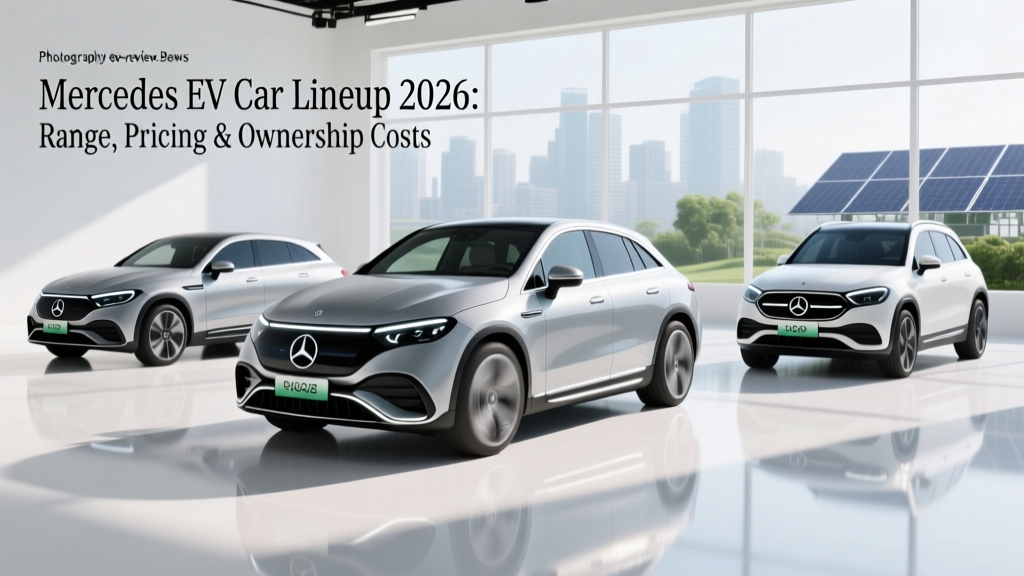
Mercedes-Benz has consolidated its electric portfolio around the EVA2 platform. The smaller EQA and EQB remain available as compact crossovers, while the flagship EQE and EQS lines (sedan and SUV) represent the core of the Mercedes EV car strategy. Below are the key specifications buyers need to evaluate.
| Model | EPA Range | Battery (usable) | Peak DC kW | 10-80% Time | 0-60 mph | HP | Base MSRP |
|---|---|---|---|---|---|---|---|
| EQE 350+ Sedan | 305 mi | 90.6 kWh NMC | 170 kW | ~31 min | 6.2s | 288 | $76,050 |
| EQE 350 4MATIC SUV | 279 mi | 90.6 kWh NMC | 170 kW | ~31 min | 6.4s | 288 | $79,050 |
| EQS 450+ Sedan | 345 mi | 118 kWh NMC | 200 kW | ~31 min | 5.9s | 355 | $105,550 |
| EQS 450 4MATIC SUV | 330 mi | 118 kWh NMC | 200 kW | ~31 min | 5.7s | 355 | $111,550 |
Real-world range note: EPA estimates assume mixed driving. On sustained 75 mph highway runs, expect the EQE Sedan to deliver roughly 250-265 miles, and the EQS Sedan around 280-300 miles. In freezing temperatures (below 32°F), cabin heating and battery thermal management can reduce range by 25-30% — meaning an EQE 350+ could see as little as 210-225 miles on a winter highway trip. The EQS models benefit from a larger 118 kWh pack, providing more buffer against cold-weather loss.
Mercedes EV Charging: Home and Public Speeds
Every current Mercedes EV car uses the NACS (Tesla-style) charge port for 2026, following the industry-wide transition. This gives Mercedes owners direct access to Tesla Supercharger stations via native plug, in addition to Electrify America, EVgo, and ChargePoint networks.
| Charging Level | Power (kW) | Miles Added per Hour | Typical Use Case |
|---|---|---|---|
| Level 1 (120V household) | ~1.4 kW | ~4-5 mi/hr | Emergency / overnight trickle |
| Level 2 (240V home wallbox) | 9.6-11.5 kW | ~30-38 mi/hr | Daily home charging |
| DC Fast Charge (peak) | 170-200 kW | ~500-600 mi/hr (peak) | Road trips, 10-80% top-ups |
Charging curve reality: The 170-200 kW peak rate applies only between roughly 10-40% State of Charge (SoC). Above 60%, the charge rate tapers significantly — often dropping below 50 kW past 80%. This is standard for NMC chemistry to protect long-term battery health. Plan road-trip stops around 10-80% sessions (~31 minutes) rather than attempting full charges.
Home charging cost: A Level 2 home wallbox (Mercedes-Benz Wallbox or a third-party like ChargePoint Home Flex) costs $500-$750 for equipment. Professional installation by a licensed electrician runs $800-$2,500 depending on panel capacity and conduit distance. If your home has a 200-amp electrical panel with spare capacity, expect the lower end. Older homes with 100-amp service may need a panel upgrade ($1,500-$3,000 additional).
Mercedes EV vs Gas: 5-Year Ownership Cost Breakdown
How does a Mercedes EV car compare to its gasoline equivalent over five years? We modeled the EQE 350+ Sedan against the E 350 (gas) using 15,000 miles/year, national average electricity and fuel prices, and typical maintenance schedules.
| Cost Category (5 Years) | EQE 350+ Sedan (EV) | E 350 Sedan (Gas) | Difference |
|---|---|---|---|
| Purchase Price (MSRP) | $76,050 | $59,950 | +$16,100 (EV) |
| Federal Tax Credit (§30D) | $0-$3,750* | $0 | Varies |
| Fuel / Electricity | $4,950 (home + public mix) | $12,750 (premium 91 octane) | -$7,800 (EV saves) |
| Maintenance | $1,800 | $4,200 | -$2,400 (EV saves) |
| Insurance | $11,400 | $9,600 | +$1,800 (EV costs more) |
| Estimated Depreciation | $38,000 | $28,500 | +$9,500 (EV depreciates more) |
| Total 5-Year Cost | $128,450 | $115,000 | +$13,450 (EV) |
*Federal §30D credit for Mercedes EVs is limited in 2026. Most models do not meet the full critical-mineral and battery-component sourcing thresholds under current IRS rules. Some buyers may qualify for $3,750 (partial critical-minerals credit) depending on VIN-specific sourcing. Always verify eligibility via the IRS VIN lookup tool before purchase.
The math changes significantly with home solar, off-peak utility rates (as low as $0.08/kWh in some markets), or state incentives. California buyers stacking the $7,500 federal credit (if eligible), $2,000 CVRP rebate, and utility off-peak rates can narrow the gap to under $5,000 over five years. Conversely, apartment dwellers relying solely on public DC fast charging ($0.35-$0.48/kWh) will see electricity costs climb to $8,000-$10,000 over five years — erasing most fuel savings.
Real-World Ownership: What First-Time Mercedes EV Buyers Should Know
Home Charging Is Non-Negotiable for Cost Savings
If you cannot install a Level 2 charger at home or at your workplace, a Mercedes EV car becomes considerably more expensive and inconvenient to own. Public DC fast charging costs 3-5x more per kWh than residential electricity and adds wear to the battery through repeated high-rate sessions. Before purchasing, confirm your parking situation supports a 240V, 48-amp circuit.
Maintenance Is Minimal but Not Zero
Mercedes EVs eliminate oil changes, spark plugs, and transmission fluid. You will still need cabin air filter replacement (~$150-$200 annually), brake fluid flushes (every 2 years), tire rotation (every 7,500 miles — EVs wear tires 15-20% faster due to instant torque and heavier weight), and windshield washer fluid. The regenerative braking system significantly extends brake pad life — many owners report original pads at 60,000+ miles.
Battery Warranty and Degradation
Mercedes-Benz provides an 8-year/100,000-mile high-voltage battery warranty covering defects and capacity loss below 70% of original capacity. Real-world degradation data from EVA2-platform vehicles shows approximately 5-8% capacity loss over the first 100,000 miles under normal charging habits. NMC chemistry is more energy-dense than LFP but slightly more sensitive to sustained 100% SoC storage — Mercedes recommends setting a daily charge limit of 80-90% and only charging to 100% for long trips.
Insurance Premiums Run Higher
Expect insurance costs 15-25% above equivalent gas Mercedes models. Factors include higher repair costs for battery-adjacent collision damage, limited independent repair shop availability, and elevated parts pricing. Get quotes from your current insurer and at least two competitors before committing.
Common Mercedes EV Misconceptions — Myth vs. Fact
| Myth | Fact |
|---|---|
| "Mercedes EVs get their full EPA range." | Real-world highway range is typically 15-20% below EPA. Cold weather adds another 10-15% loss. Plan conservatively. |
| "The battery will need replacing in 5 years." | NMC batteries in the EVA2 platform show 5-8% degradation at 100K miles. Most will retain 85%+ capacity at 150K miles with proper charge habits. |
| "DC fast charging to 100% is fine." | Charging above 80% on DC is slow (taper curve) and accelerates degradation. Charge to 80% on road trips; use Level 2 for daily 90% targets. |
| "All Mercedes EVs qualify for the $7,500 tax credit." | Most 2026 Mercedes EVs do not meet full §30D sourcing requirements. Verify per-VIN via the IRS tool. Some qualify for $3,750 partial credit. |
| "EVs are worse in winter." | Range drops 25-30% in freezing temps, but Mercedes' heat pump system (standard on EQE/EQS) recovers waste heat efficiently. Preconditioning while plugged in mitigates most loss. |
Decision Framework: Which Mercedes EV Car Fits You?
Choose the EQE 350+ Sedan if:
- You want the most range per dollar in the Mercedes EV lineup (305 mi EPA, $76,050)
- Your daily commute is under 80 miles round-trip and you have home Level 2 charging
- You prioritize driving dynamics and a lower center of gravity over cargo space
Choose the EQE 350 4MATIC SUV if:
- You need all-wheel drive for snow/ice climates (the 350+ sedan is RWD only)
- Cargo versatility matters (31.7 cu ft behind rear seats vs. 15.2 cu ft in the sedan trunk)
- You accept a 26-mile range penalty for the SUV body and AWD system
Choose the EQS 450+ Sedan if:
- Maximum range is your priority (345 mi EPA — best in the lineup)
- You regularly drive 200+ mile routes and want fewer charging stops
- Budget allows $105K+ and you value the MBUX Hyperscreen and rear-seat luxury amenities
Choose the EQS 450 4MATIC SUV if:
- You need three-row seating (optional) and maximum cargo volume (up to 74.2 cu ft)
- You want the largest battery buffer (118 kWh) for cold-climate range resilience
- Towing is a factor (up to 3,500 lbs rated capacity)
Skip a Mercedes EV entirely if:
- You lack access to any form of Level 2 charging (home or workplace) and your nearest DC fast charger is more than 15 minutes away
- You regularly tow more than 3,500 lbs — towing with an EV can cut range by 40-50%
- Your budget is firm below $65,000 — consider the Hyundai Ioniq 6, Tesla Model 3, or BMW i4 instead
Mercedes EV vs Gas vs Plug-In Hybrid: Which Powertrain Wins?
| Factor | Mercedes EV (EQE 350+) | Mercedes Gas (E 350) | Mercedes PHEV (E 350e) |
|---|---|---|---|
| Base MSRP | $76,050 | $59,950 | $68,500 |
| Energy Cost per Mile | $0.044 (home L2) | $0.17 (premium gas) | $0.09 (blended) |
| EPA Range / MPG | 305 mi / 96 MPGe | — / 27 MPG combined | 25 mi EV + 370 mi gas |
| Maintenance (5 yr) | $1,800 | $4,200 | $3,400 |
| Best For | Home chargers, daily commuters | Road warriors, no home charging | Short commutes + long trips, partial charging access |
The PHEV E 350e offers a pragmatic middle ground: 25 miles of electric-only range covers most daily errands, while the gas engine eliminates range anxiety on road trips. However, PHEVs carry dual powertrain maintenance (oil changes plus EV systems) and a smaller battery that degrades on a similar timeline. If you have reliable home charging and rarely exceed 250 miles in a single day, the pure EV saves more over five years. If charging access is uncertain or you frequently drive 400+ mile routes, the PHEV or gas model avoids the public-charging cost penalty.
Frequently Asked Questions
Does any Mercedes EV car qualify for the full $7,500 federal tax credit in 2026?
As of early 2026, most Mercedes-Benz EVs do not qualify for the full $7,500 §30D credit due to battery-component and critical-mineral sourcing requirements that favor North American supply chains. Some VINs may qualify for the $3,750 partial credit. Check the fueleconomy.gov tax credit lookup for the specific vehicle you are considering. Buyer income caps ($150K single / $300K joint) and the $55,000 sedan MSRP cap (most Mercedes EVs exceed this) further limit eligibility. Consult a tax professional for your specific situation.
How long does it take to charge a Mercedes EV at home overnight?
On a Level 2, 240V/48A home charger delivering ~11.5 kW, the EQE's 90.6 kWh battery charges from 10% to 90% in approximately 7 hours — easily completing overnight. The larger 118 kWh EQS battery takes roughly 9.5 hours for the same session. Most owners plug in upon arriving home and wake to a full daily charge.
Is the Mercedes MBUX infotainment system reliable in EV models?
The MBUX system in the EQE and EQS uses the latest-generation "NTG7" hardware with the available 56-inch Hyperscreen. Software stability has improved significantly since the 2022 launch, with OTA updates addressing most early complaints about lag and phantom touch inputs. Wireless Apple CarPlay and Android Auto are standard. The navigation system includes EV-specific route planning with charging stop integration and battery preconditioning for DC fast charging.
What happens if the Mercedes EV battery fails out of warranty?
Out-of-warranty high-voltage battery replacement for the EQE/EQS platform currently ranges from $18,000 to $28,000 depending on the model and labor. However, catastrophic battery failure is rare — most degradation is gradual. Individual module replacement (rather than the full pack) may be possible at independent EV repair shops as the vehicles age and aftermarket support develops. Mercedes also offers extended battery warranty packages at purchase.
Can I use Tesla Superchargers with a Mercedes EV?
Yes. All 2026 Mercedes EVs come equipped with the NACS charge port natively, providing direct plug-in access to Tesla Supercharger V3 and V4 stations without an adapter. Mercedes' MBUX navigation integrates Supercharger locations into route planning. Charging speeds on Superchargers are limited by the vehicle's 170-200 kW peak acceptance rate, not the station's higher output capability.
Sources: fueleconomy.gov (EPA range and MPGe data), IRS §30D clean vehicle credit rules, Mercedes-Benz USA official specifications. All pricing reflects 2026 model year MSRP excluding destination charges. Verify trim-specific details and tax credit eligibility with your dealer and tax professional before purchasing.