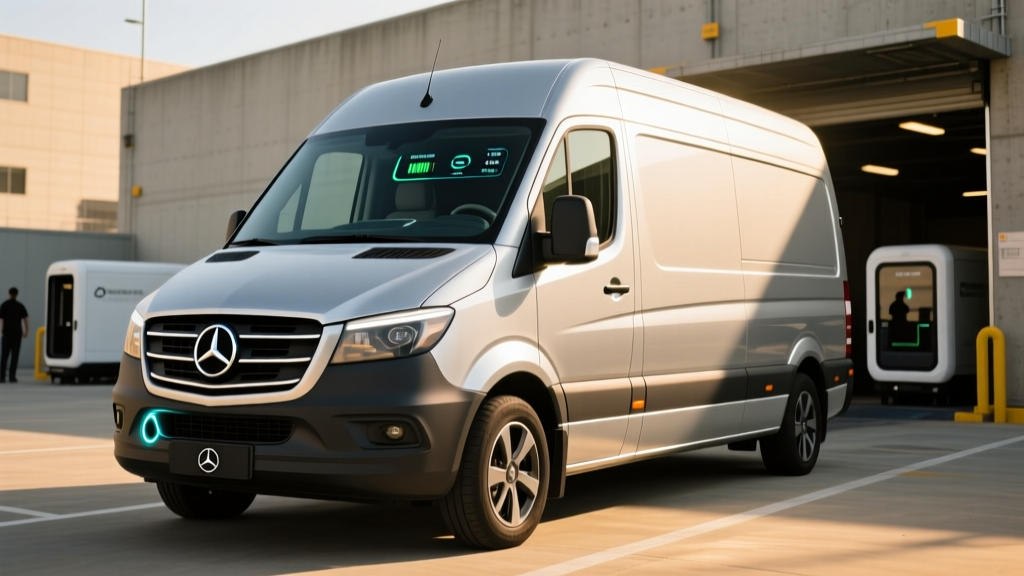
If you run a delivery fleet, an adventure-van conversion shop, or a last-mile logistics operation, the Mercedes-Benz eSprinter is the battery-electric full-size van that most closely mirrors the cargo volume, wheelbase options, and upfitting ecosystem of the diesel Sprinter you already know. For the 2026 model year, the eSprinter is sold in the U.S. exclusively with the large 150 kWh (usable ~113 kWh) battery pack, a front-wheel-drive layout, and a 201-hp (150 kW) electric motor. EPA-estimated range lands around 198–205 miles depending on body style and roof height, with real-world highway and cold-weather figures closer to 150–170 miles when fully loaded.
Quick Verdict: Is the eSprinter Right for Your Operation?
Buy it if: Your routes are predictable, under ~150 miles per day, you have depot-level Level 2 or DC fast charging, and you want to eliminate diesel fuel cost and DPF/DEF maintenance.
Skip it if: You regularly exceed 200 miles between charges, operate in extreme cold without garage parking, or need the 3,500+ lb max payload of the diesel Sprinter 2500/4500.
eSprinter Specs at a Glance
Mercedes-Benz consolidated the eSprinter lineup for 2026 after dropping the smaller 81 kWh battery option that was available in early U.S. deliveries. Here is what you are actually buying:
| Spec | Value |
|---|---|
| Battery (usable / gross) | ~113 kWh usable / 150 kWh gross, NMC chemistry |
| EPA-estimated range | ~198–205 miles (varies by roof/wheelbase) |
| Real-world range (loaded, mixed) | 150–175 miles; 120–140 miles highway @ 70 mph or in <30°F |
| Motor / drivetrain | 201 hp (150 kW), 295 lb-ft torque, FWD |
| 0–60 mph | ~10.5 seconds (unloaded) |
| DC fast charge (peak) | 115 kW, 10–80% in ~42 minutes |
| Level 2 AC charge | 9.6 kW onboard charger; 0–100% in ~12–13 hours |
| Max cargo volume | Up to 533 cu ft (2500 High Roof, 170" WB extended) |
| Max payload | ~2,624 lbs (2500); lower than diesel equivalent |
| Towing | Not rated for towing in the U.S. |
| Base MSRP (2500 Std Roof) | ~$72,000 before incentives |
| Battery / powertrain warranty | 8 years / 100,000 miles (70% capacity retention) |
Real-World Range Reality Check
The EPA sticker says ~200 miles, but commercial vans rarely drive like EPA test cycles. Expect 150–175 miles with a typical 1,000-lb payload in mixed urban/suburban driving. At sustained 70-mph highway speeds, figure on 120–140 miles. In sub-freezing weather without preconditioning, range can dip to 110–130 miles. If your daily route exceeds 140 miles, you need mid-day DC fast charging or a different powertrain.
Charging the eSprinter: Depot, Public, and the 115 kW Curve
Charging is where commercial EV ownership lives or dies. The eSprinter uses a CCS1 connector in North America (Mercedes has not yet adopted NACS on the van platform as of 2026) and supports three charging modes:
| Level | Power (kW) | Connector | Time (10–80% or full) | Use Case |
|---|---|---|---|---|
| Level 1 (120V) | ~1.4 kW | J1772 | ~55+ hours (full) | Emergency / trickle only |
| Level 2 (240V) | 9.6 kW | J1772 | ~10–13 hours (full) | Overnight depot charging |
| DC Fast | 115 kW peak | CCS1 | ~42 min (10–80%) | Mid-day top-up or public charging |
A few practical notes from real depot deployments:
- DC charge curve taper: The eSprinter holds close to 100–115 kW up to roughly 50% SoC, then tapers to ~60 kW by 70%, and drops to ~25 kW above 85%. Plan your fast-charge stops to the 10–80% window; charging from 80–100% adds 30+ minutes for minimal range.
- Depot Level 2 is the sweet spot: A 9.6 kW Level 2 charger replenishes roughly 25–30 miles of range per hour. Overnight (10 hours) gives you ~250+ miles of equivalent charge — more than the van's usable range, so you start every day full.
- Electrical infrastructure: Each Level 2 charger requires a dedicated 50-amp, 240V circuit. For a 5-van depot, expect a commercial electrician quote of $15,000–$40,000 for panel upgrades, trenching, and five wall-mounted units, depending on existing service.
- Preconditioning matters: The eSprinter's thermal management system can precondition the battery while plugged in, preserving range and enabling faster DC charging in cold weather. Always enable scheduled departure preconditioning in the MBUX system.
eSprinter vs. Diesel Sprinter: Total Cost of Ownership
The sticker shock is real. A diesel Sprinter 2500 High Roof starts around $48,000–$52,000, while the eSprinter 2500 starts near $72,000 — a roughly $20,000–$24,000 premium before incentives. But operating costs tell a different story over a 5-year, 75,000-mile commercial lifecycle:
| Cost Category | eSprinter 2500 | Diesel Sprinter 2500 |
|---|---|---|
| Purchase price (base MSRP) | $72,000 | $50,000 |
| Federal commercial clean vehicle credit (§45W) | −$7,500 (up to $7,500 for GVWR <14,000 lbs) | $0 |
| Net acquisition cost | $64,500 | $50,000 |
| Fuel / electricity (75k mi) | ~$4,500 (at $0.14/kWh avg) | ~$13,500 (at $4.20/gal, 19 mpg) |
| Maintenance (oil, DPF, DEF, filters) | ~$1,200 | ~$5,500 |
| Insurance (avg commercial) | ~$9,000 | ~$8,500 |
| Estimated resale (5 yr) | ~$25,000 | ~$22,000 |
| Total 5-Year Cost | ~$59,200 | ~$55,500 |
The eSprinter nearly closes the gap over five years, and the math flips in the EV's favor if you drive more than 20,000 miles per year, if diesel prices rise above $4.50/gal, or if your state offers additional commercial EV incentives (California's Hybrid and Zero-Emission Truck and Bus Voucher Incentive Project, for example, can stack substantial rebates on top of federal credits).
Important tax-credit note: The eSprinter qualifies for the IRS §45W Commercial Clean Vehicle Credit, not the consumer §30D credit. The §45W credit is up to $7,500 for vehicles under 14,000 lbs GVWR and up to $40,000 for heavier vehicles, but the vehicle must be used for business and meet battery-component and critical-minerals sourcing requirements. Confirm eligibility with your tax professional and check current-year IRS guidance before purchasing.
Payload, Cargo, and the FWD Trade-Off
The eSprinter's front-wheel-drive layout is a deliberate engineering choice: it eliminates the rear driveshaft, lowering the load floor and maximizing cargo volume. The trade-off is payload. The eSprinter 2500 is rated for roughly 2,624 lbs of payload, compared to 3,000–3,500+ lbs on the diesel Sprinter 2500 with the same wheelbase and roof.
For parcel delivery, catering, mobile service businesses, and van-life conversions, 2,600 lbs is usually sufficient. For heavy-materials delivery (lumber, plumbing supplies, palletized goods), the diesel or the Ford E-Transit (which offers a slightly different payload profile with its RWD layout) may be more appropriate.
Cargo volume is class-leading: up to 533 cubic feet in the 2500 High Roof, 170" extended wheelbase configuration — identical to the diesel Sprinter. The eSprinter maintains the same interior dimensions, door openings, and upfitting hardpoints, so most commercial shelving and racking systems carry over.
Common Misconceptions About the eSprinter
| Myth | Fact |
|---|---|
| "Electric vans can't handle real commercial routes." | U.S. Census and BLS logistics data show ~70% of last-mile delivery routes are under 120 miles/day — well within the eSprinter's real-world range with depot charging. |
| "The battery will need replacing in 5 years." | NMC batteries in commercial thermal-managed vans typically lose 10–15% capacity over 100,000 miles. Mercedes warranties 70% capacity retention at 8 years/100,000 miles. |
| "I can charge on any public charger." | CCS1 compatibility is broad but not universal. Some newer Tesla Superchargers (NACS-only, no Magic Dock adapter) will not serve the eSprinter. Plan routes with PlugShare or ChargePoint filters. |
| "It qualifies for the $7,500 consumer tax credit." | The eSprinter is a commercial vehicle and falls under §45W (business credit), not §30D (consumer). Different rules, different forms, different sourcing requirements. |
| "Regenerative braking means no brake maintenance." | Regen reduces brake pad wear significantly (often 2–3× pad life), but brake fluid, rotors, and caliper service are still required — just less frequently. |
Who Should Buy the eSprinter (Decision Framework)
If / Then Buying Guide
- If your daily route is under 140 miles and you return to a depot overnight → The eSprinter with Level 2 depot charging is an excellent fit. You'll start each day at 100% SoC and save $1,500–$2,000/year in fuel per van.
- If your route regularly exceeds 180 miles or includes highway segments at 70+ mph → Stick with the diesel Sprinter or evaluate the eSprinter with a mid-day DC fast-charge stop (adds ~30–40 minutes to your driver's schedule).
- If you operate in northern-tier states with sustained sub-20°F winters → Budget for 30–40% range loss and ensure depot charging is indoors or preconditioned. Consider the diesel Sprinter if cold-weather reliability is mission-critical and you lack heated garage space.
- If you need to tow → The eSprinter is not rated for towing in the U.S. Use the diesel Sprinter (up to 7,500 lbs towing with the proper package).
- If your fleet is scaling and you want to hedge against diesel price volatility → The eSprinter locks in electricity cost at roughly $0.04–$0.06 per mile (depending on utility rates) vs. $0.22–$0.28 per mile for diesel at current prices.
- If you're doing a van-life conversion → The eSprinter is viable if you accept the range trade-off and plan overnight stays with Level 2 charging access. The silent, vibration-free drivetrain and V2L potential (check Mercedes accessory options) are compelling for camper builds.
What First-Time EV Van Buyers Need to Know
If this is your fleet's first electric vehicle, here is the operational homework you need to do before signing a purchase order:
- Audit your routes. Pull GPS or telematics data for the last 90 days. If the 95th-percentile daily mileage is under 140, the eSprinter works. If it's over 180, it doesn't — yet.
- Survey your depot electrical service. A commercial electrician can tell you whether your existing panel can support multiple 50-amp Level 2 circuits or whether you need a service upgrade ($5,000–$20,000+ for a 400-amp upgrade).
- Check utility demand charges. Some commercial electricity tariffs include demand charges based on peak kW draw. Five eSprinters charging simultaneously at 9.6 kW each = 48 kW peak, which can trigger significant demand fees. Ask your utility about managed-charging or time-of-use commercial rates.
- Train your drivers. Regenerative braking, one-pedal driving, and route planning around SoC are new skills for diesel drivers. Budget a half-day training session.
- Verify §45W eligibility with your CPA. Battery-component and critical-minerals sourcing rules change annually. The IRS commercial credit page is the authoritative source; your tax professional can confirm whether a specific VIN qualifies.
Frequently Asked Questions
What is the real-world range of the 2026 eSprinter when fully loaded?
With a ~1,500-lb payload in mixed urban driving at 40–55°F, expect 150–165 miles. At highway speeds (65–70 mph) with the same load, figure 120–140 miles. In extreme cold (below 20°F) without preconditioning, range can drop to 110–130 miles.
Does the eSprinter qualify for any federal tax incentives?
Yes, but through the §45W Commercial Clean Vehicle Credit, not the consumer §30D credit. The maximum is $7,500 for vehicles under 14,000 lbs GVWR, subject to battery sourcing requirements. The vehicle must be used primarily for business. Consult a tax professional and verify VIN eligibility on the IRS website before purchase.
Can I charge the eSprinter at Tesla Superchargers?
Not directly. The eSprinter uses a CCS1 connector. Tesla Superchargers with the NACS-only standard (without the Magic Dock CCS adapter) will not serve the eSprinter. Some Supercharger stations have been retrofitted with Magic Dock adapters — check the Tesla app or PlugShare for CCS compatibility at specific locations. Electrify America, EVgo, and ChargePoint CCS stations are fully compatible.
How does the eSprinter compare to the Ford E-Transit?
The Ford E-Transit uses a smaller 68 kWh usable battery, giving it an EPA range of ~126 miles — significantly less than the eSprinter's ~200 miles. However, the E-Transit starts around $47,000, roughly $25,000 less than the eSprinter. If your routes are short and cost-per-vehicle is the primary metric, the E-Transit is compelling. If you need the range buffer and cargo volume of the Sprinter platform, the eSprinter is the stronger choice.
What does it cost to install depot charging for a small fleet?
For a 3-van depot with three 9.6 kW Level 2 chargers, budget $8,000–$20,000 total (equipment: ~$1,500–$2,500 per charger; electrician labor and permits: $3,000–$12,000 depending on panel capacity and trenching). If your existing electrical panel cannot support the added load, a panel upgrade to 200–400 amps can add $5,000–$15,000.
How long will the eSprinter battery last?
Mercedes-Benz warranties the high-voltage battery for 8 years or 100,000 miles at 70% capacity retention. Industry data from thermal-managed NMC packs in commercial service suggests 10–15% degradation over 100,000 miles is typical. A full battery replacement (if needed out of warranty) is estimated at $15,000–$22,000 based on current NMC pricing, though this is expected to decline as battery costs continue to fall.
Is the eSprinter available in all-wheel drive?
No. The U.S.-spec eSprinter is front-wheel drive only. If AWD is essential for your operation (snow routes, unpaved job sites), the diesel Sprinter offers an available AWD system that the eSprinter does not match.