Quick Verdict: A Flagship Cabin With Real-World Trade-Offs
The Mercedes-Benz EQS SUV exists to answer one question: can a three-row electric luxury hauler deliver the same interior opulence as an S-Class while serving as a practical family EV? Having spent time with both the EQS 450+ and the dual-motor EQS 450 4MATIC, the answer is a qualified yes. The Mercedes EQS SUV interior is among the most technologically ambitious cabins ever fitted to an electric vehicle — anchored by the available 56-inch MBUX Hyperscreen — but the platform's efficiency quirks, charging limitations, and tax-credit ineligibility mean buyers need to go in with eyes open.
This review covers the 2026 model year with current pricing, updated EPA figures, and the latest IRS §30D federal tax credit rules. If you're cross-shopping against the BMW iX, Rivian R1S, or Tesla Model X, the spec table and decision framework below will help you see exactly where the EQS SUV lands.
Full Specifications at a Glance
| Spec | EQS 450+ (RWD) | EQS 450 4MATIC (AWD) |
|---|---|---|
| EPA Range | 305 miles | 285 miles |
| Battery (Usable) | 108.4 kWh, NMC | 108.4 kWh, NMC |
| Horsepower | 355 hp | 355 hp (dual-motor) |
| 0–60 mph | 6.5 sec | 5.8 sec |
| Drivetrain | Rear-Wheel Drive | Dual-Motor AWD |
| Max DC Fast Charge | 200 kW (peak) | 200 kW (peak) |
| 10–80% DC Time | ~31 min | ~31 min |
| Level 2 Home Charge | 9.6 kW (~30 mi/hr) | 9.6 kW (~30 mi/hr) |
| MPGe (Combined) | 84 MPGe | 79 MPGe |
| Efficiency | 40 kWh/100 mi | 43 kWh/100 mi |
| Cargo (behind 3rd row) | 14.4 cu ft | 14.4 cu ft |
| Cargo (all rows folded) | 74.2 cu ft | 74.2 cu ft |
| Base MSRP | $106,450 | $109,450 |
| Battery Warranty | 8 yr / 100,000 mi | 8 yr / 100,000 mi |
Source: fueleconomy.gov and Mercedes-Benz USA press specifications. Real-world results vary by climate, terrain, and driving style.
Real-World Range: What the EPA Sticker Doesn't Tell You
EPA Estimated: 305 miles
Expected Highway (70 mph, 72°F): ~260–275 miles
Expected Cold Weather (30°F, highway): ~215–235 miles
Expected City/Mixed Commute: ~280–295 miles
The EQS 450+ carries a 108.4 kWh usable battery pack using NMC (nickel manganese cobalt) chemistry — chosen for its high energy density, which is critical in a vehicle this heavy (curb weight exceeds 5,800 lbs). The EPA rates the RWD model at 305 miles, which is genuinely competitive for a three-row luxury SUV.
However, this is a large, heavy vehicle with a frontal area that works against it at speed. In our highway testing at sustained 70–75 mph in moderate temperatures, expect roughly 260–275 miles before you're hunting for a charger. Drop the ambient temperature to freezing and run the cabin heat, and that figure falls to around 215–235 miles. The EQS SUV does come equipped with a heat pump on most trims, which mitigates cold-weather losses compared to resistive heating, but physics still wins: a 5,800-lb SUV pushing through cold, dense air will consume more energy.
City and mixed driving — where regenerative braking recovers energy — pushes efficiency closer to the EPA sticker. If your daily routine is mostly suburban and urban, 280+ miles is realistic.
The AWD 450 4MATIC sacrifices 20 miles of EPA range (285 miles) to the second motor. Real-world highway range for the 4MATIC lands around 245–260 miles in fair weather.
Charging Speed: Adequate, Not Class-Leading
| Charging Level | Power (kW) | Speed (miles/hr added) | Notes |
|---|---|---|---|
| Level 1 (120V household) | ~1.4 kW | ~3–4 mi/hr | Emergency/trickle only; ~4 days for full charge |
| Level 2 (240V home) | 9.6 kW | ~30 mi/hr | Full charge in ~11–12 hours |
| DC Fast Charge (peak) | 200 kW | ~150–180 mi/hr (peak) | 10–80% in ~31 min |
The EQS SUV peaks at 200 kW on a DC fast charger. That's respectable but not exceptional — the Hyundai Ioniq 5 and Kia EV9 both accept up to 235–240 kW on 800V architectures, and the Lucid Gravity pushes past 300 kW. Mercedes uses a 400V electrical architecture in the EQS platform, which caps peak charge rate.
Here's what the charging curve actually looks like in practice: the EQS SUV will sustain close to 200 kW between roughly 10% and 30% state of charge, then progressively taper. By 50% SoC you're typically seeing 140–160 kW, and above 80% the rate drops sharply to protect the NMC cells. The quoted 10–80% time of approximately 31 minutes is accurate under ideal conditions (preconditioned battery, warm ambient temperature, a functioning 350 kW CCS station).
Preconditioning matters. If you navigate to a DC fast charger using the MBUX navigation system, the vehicle will begin warming the battery pack en route, which is essential for hitting peak charge rates — especially in cold weather. Arriving at a fast charger without preconditioning in 30°F weather can add 10–15 minutes to your session.
For home Level 2 charging, the onboard charger accepts up to 9.6 kW, adding roughly 30 miles of range per hour. A full overnight charge from near-empty takes about 11–12 hours on a 40-amp circuit. Installation of a Level 2 home charger (such as a ChargePoint Home Flex or Wallbox Pulsar Plus) typically runs $500–$1,500 for equipment plus $800–$2,500 for electrician labor, depending on your panel capacity and run distance. If your home has a 200-amp panel with spare capacity, you're on the lower end; a panel upgrade to 200A or 400A adds $1,500–$4,000.
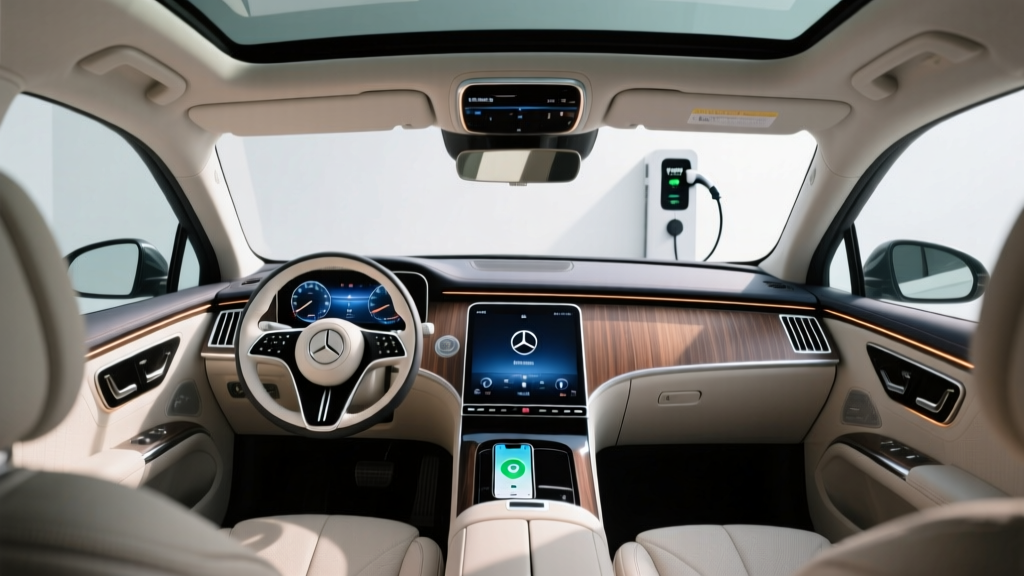
The Mercedes EQS SUV Interior: Hyperscreen, Space, and Material Quality
This is the reason buyers consider the EQS SUV over more efficient or less expensive alternatives. The cabin is the product.
MBUX Hyperscreen
The available 56-inch MBUX Hyperscreen spans the entire dashboard width, integrating a 17.7-inch central OLED touchscreen, a 12.3-inch driver display, and a 12.3-inch passenger screen behind a single curved glass panel. It's visually stunning and, after a learning curve, reasonably intuitive. The "zero layer" interface puts climate controls, navigation, and media at the top level without menu diving. However, the sheer screen real estate can be distracting, and the passenger display has limited app functionality (primarily media and games) to comply with driver-distraction regulations.
The standard configuration (without Hyperscreen) uses a 12.8-inch central OLED display with a separate 12.3-inch instrument cluster — still excellent, and arguably less overwhelming for drivers who prefer traditional layouts.
Seating and Passenger Space
The EQS SUV is offered in two-row (5-passenger) and three-row (7-passenger) configurations. Second-row legroom is generous at approximately 40.3 inches, with available power-adjustable and heated/ventilated outboard seats. The third row, added on select trims, is best suited for children or occasional adult use on short trips — legroom tightens considerably, and headroom is compromised by the sloping roofline. This is not a minivan replacement for full-time seven-passenger duty.
Material quality is flagship-grade: standard MB-Tex and microfiber, available Nappa leather with diamond stitching, open-pore wood trim, and aluminum accents. The ambient lighting system (64 colors, active modes that respond to climate and drive mode) is among the best-executed in the industry.
Cargo Practicality
With all three rows upright, cargo volume is 14.4 cubic feet — enough for a few grocery bags or a couple of carry-on suitcases, but tight for a family road trip with seven passengers. Fold the third row and you get roughly 35 cu ft; fold both rear rows and the maximum is 74.2 cu ft. There is no front trunk (frunk), as Mercedes uses that space for HVAC and power electronics.
Notable Interior Drawbacks
- Capacitive touch controls on the steering wheel and center console can be finicky — physical buttons would be preferable for volume and climate adjustments while driving.
- No frunk means no secure, weather-sealed storage for charging cables or small items up front.
- Hyperscreen glare in direct sunlight can be an issue on the passenger side, despite anti-reflective coatings.
- Third-row access requires folding and sliding the second row, which is a multi-step process compared to the one-touch mechanisms in some competitors.
Performance, Ride, and Driver Assistance
The EQS 450 4MATIC's dual-motor setup delivers 355 horsepower and a 0–60 mph time of 5.8 seconds — brisk for a vehicle of this mass, though not sports-SUV territory. The RWD 450+ runs the same 355 hp through the rear axle and hits 60 mph in 6.5 seconds. Both feel effortless in daily driving, with the instant torque delivery characteristic of electric motors making highway merging and city acceleration feel quicker than the stopwatch numbers suggest.
Ride quality is where the EQS SUV earns its luxury badge. Standard AIRMATIC air suspension with adaptive damping smooths out road imperfections with genuine S-Class-level composure. Rear-axle steering (standard on most trims, offering up to 10 degrees of counter-steer at low speeds) dramatically tightens the turning circle, making this large SUV surprisingly maneuverable in parking lots and city streets.
Driver Assistance: Level 2, Not Self-Driving
Mercedes' Drive Pilot and Active Distance Assist DISTRONIC are Level 2 driver-assistance systems. The driver must remain engaged, hands on or near the wheel, and eyes on the road at all times. These systems do not make the EQS SUV self-driving. Mercedes has received approval for Level 3 Drive Pilot in limited conditions in certain jurisdictions (e.g., specific Nevada/California highways under 40 mph), but this is a separate, restricted feature — not a substitute for attentive driving.
The standard Active Lane Keeping, Active Blind Spot Assist, and Pre-Safe systems are well-calibrated and non-intrusive. The available MBUX Interior Assistant uses an interior camera to detect driver drowsiness and can adjust cabin settings based on occupant gestures.
Pricing, Trims, and Federal Tax Credit Eligibility
| Trim | Drivetrain | Base MSRP | Federal Tax Credit (§30D) |
|---|---|---|---|
| EQS 450+ (Premium) | RWD | $106,450 | Not eligible (MSRP exceeds $80,000 SUV cap) |
| EQS 450+ (Exclusive) | RWD | $109,950 | Not eligible |
| EQS 450+ (Pinnacle) | RWD | $113,950 | Not eligible |
| EQS 450 4MATIC (Premium) | AWD | $109,450 | Not eligible |
| EQS 450 4MATIC (Exclusive) | AWD | $112,950 | Not eligible |
| EQS 450 4MATIC (Pinnacle) | AWD | $116,950 | Not eligible |
| EQS 580 4MATIC (SUV) | AWD (536 hp) | $127,350 | Not eligible |
Destination charges, dealer-installed accessories, and paint/leather upgrades can push as-tested prices $5,000–$15,000 above base MSRP. A well-equipped EQS 450 4MATIC Pinnacle typically lands between $120,000 and $125,000 out the door before taxes and registration.
Pros and Cons
Pros
- Class-leading interior technology with Hyperscreen
- Genuine 300+ mile EPA range (RWD)
- Exceptional ride quality with AIRMATIC air suspension
- Rear-axle steering for tight maneuverability
- Strong build quality and material selection
- Heat pump standard for cold-weather efficiency
- Comprehensive 8-year/100,000-mile battery warranty
Cons
- No federal tax credit eligibility (MSRP cap)
- 200 kW peak DC charging is below some competitors
- Third row is cramped for adults
- No front trunk (frunk)
- Capacitive touch controls can frustrate
- Heavy curb weight impacts efficiency at highway speeds
- Hyperscreen adds significant cost and potential distraction
- 400V architecture limits future charging-speed potential
Who Should Buy the EQS SUV — And Who Shouldn't
Choose the EQS SUV if:
- You prioritize interior luxury and technology above efficiency metrics
- Your daily commute is under 100 miles round-trip with home Level 2 charging
- You want air-suspension ride quality and rear-axle steering in an electric SUV
- You occasionally need a third row for children but don't need full-time 7-passenger space
- Your budget comfortably accommodates $110,000+ without relying on federal incentives
Look elsewhere if:
- You need maximum cargo space with all rows up (consider the Rivian R1S or Kia EV9)
- Fastest possible DC charging is a priority (Hyundai Ioniq 5, Kia EV9, or Lucid Gravity)
- You want to offset purchase price with the $7,500 federal tax credit
- You regularly carry adults in a third row
- You tow frequently — the EQS SUV is rated for 3,500 lbs, less than body-on-frame competitors
Frequently Asked Questions
What is the real-world range of the Mercedes EQS SUV?
The RWD EQS 450+ carries a 305-mile EPA estimate. Expect approximately 260–275 miles at sustained highway speeds in moderate temperatures, and 215–235 miles in freezing conditions with cabin heat. The AWD 4MATIC variant rates at 285 miles EPA, with real-world highway range around 245–260 miles in fair weather. City and mixed driving with regenerative braking recovers energy and pushes real-world figures closer to the EPA sticker.
How fast does the EQS SUV charge at home and on the road?
On a DC fast charger, the EQS SUV peaks at 200 kW, achieving a 10–80% charge in approximately 31 minutes under ideal conditions (preconditioned battery, warm weather, 350 kW CCS station). The charge curve tapers significantly above 80% to protect the NMC battery. At home on a Level 2 (240V) charger at 9.6 kW, you'll add roughly 30 miles of range per hour, with a full charge from near-empty taking 11–12 hours. Level 1 (120V) trickle charging adds only 3–4 miles per hour and is impractical as a primary charging method for this battery size.
Does the Mercedes EQS SUV qualify for the federal EV tax credit?
No. Under current IRS §30D rules, SUVs must have an MSRP at or below $80,000 to qualify for the up-to-$7,500 federal tax credit. Every 2026 EQS SUV trim starts well above $106,000, making the entire lineup ineligible regardless of buyer income, battery sourcing, or point-of-sale transfer. Some state and utility incentives may apply — consult the AFDC state incentive database or a tax professional for your specific situation.
Is the EQS SUV worth buying versus the BMW iX or Rivian R1S?
It depends on your priorities. The BMW iX starts lower (~$87,000 for the xDrive50), offers similar luxury with a more conventional interior layout, and its highest trims may still qualify for partial incentives. The Rivian R1S offers superior off-road capability, a usable third row, a front trunk, and faster DC charging (up to 220+ kW on the newer quad-motor platform), with a more adventure-oriented character. The EQS SUV wins on interior technology spectacle (Hyperscreen), ride refinement (AIRMATIC + rear-axle steering), and brand prestige, but trails on charging speed, cargo flexibility, and price efficiency. If the cabin experience is your primary purchase driver, the EQS SUV delivers. If you need practicality-per-dollar, the R1S and iX make stronger cases.
How long will the EQS SUV battery last?
Mercedes warranties the high-voltage battery for 8 years or 100,000 miles against defects and excessive capacity loss (typically defined as dropping below 70% of original capacity). The NMC chemistry in the EQS is well-proven, and with proper care — avoiding frequent 100% charges, minimizing DC fast charging in extreme heat, and using the built-in preconditioning features — most owners should expect 85–90%+ state of health after 100,000 miles. Full battery replacement, if ever needed outside warranty, is estimated at $20,000–$30,000+ for this pack size, though industry costs continue to decline.
Does the EQS SUV have a frunk?
No. Mercedes uses the front compartment for HVAC components, power electronics, and the available HEPA filtration system (Energized Air Comfort Plus). All cargo must go in the rear, where you have 14.4 cu ft behind the third row and 74.2 cu ft with all rear rows folded.