Quick Verdict: The Electric S-Class That Prioritizes Comfort Over Drama
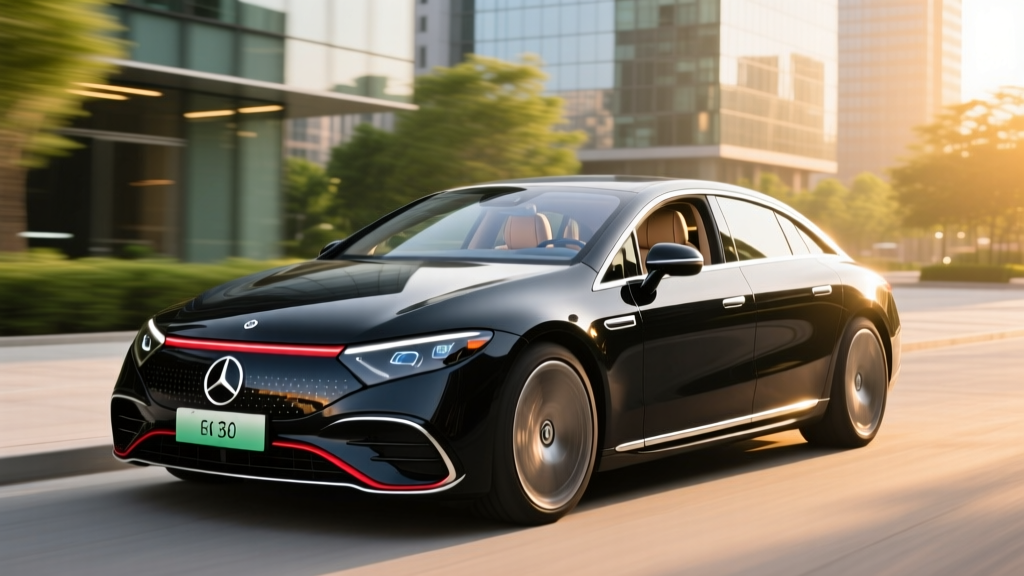
The Mercedes-Benz EQS 580 4MATIC is the closest thing to an electric S-Class you can buy today — a full-size luxury sedan built on a dedicated EV platform with a 108.4 kWh battery, dual-motor all-wheel drive, and a cabin that redefines what "quiet luxury" means at highway speed. With an EPA-estimated 371 miles of range and a 0-60 time of 4.1 seconds, the EQS 580 doesn't chase Tesla Plaid headlines. Instead, it delivers effortless acceleration, best-in-class aerodynamics (Cd 0.20), and a ride quality that absorbs road imperfections with the authority of a $120,000+ flagship sedan.
But the EQS 580 also carries a premium price, a complex infotainment learning curve, and real-world range that falls short of its EPA sticker on long highway trips. Here's the data-driven breakdown every prospective buyer needs before signing a lease or purchase agreement.
Range, Battery, and Real-World Efficiency
| Spec | Value |
|---|---|
| EPA Estimated Range | 371 miles |
| Usable Battery Capacity | 108.4 kWh (NMC chemistry) |
| MPGe (Combined) | 97 MPGe |
| Energy Consumption | 35 kWh / 100 miles |
| Drivetrain | Dual-motor AWD (4MATIC) |
| Thermal Management | Liquid-cooled with heat pump |
The EQS 580 uses an NMC (nickel-manganese-cobalt) lithium-ion pack — chosen for its high energy density, which enables the sedan's impressive range in a package that fits beneath the floor without compromising cabin space. NMC chemistry trades some cycle-life longevity compared to LFP (lithium iron phosphate), but Mercedes backs the pack with a robust warranty (see below). The battery sits in a structural aluminum housing that contributes to the vehicle's torsional rigidity and low center of gravity.
At 97 MPGe combined, the EQS 580 is remarkably efficient for a 5,800-pound luxury sedan. For context, that's roughly 3.5 miles per kWh in mixed driving — meaning a full charge delivers real-world distances comparable to much smaller EVs, thanks to the massive battery and that class-leading 0.20 drag coefficient.
Charging Speed: DC Fast Charge and Home Level 2
The EQS 580 supports DC fast charging at up to 200 kW peak via its CCS1 connector (or NACS with adapter on newer model years). Mercedes quotes a 10–80% charge time of approximately 31 minutes under optimal conditions — meaning battery preconditioned, moderate ambient temperature, and a charger capable of sustaining the full curve.
| Charging Level | Power (kW) | Speed / Time |
|---|---|---|
| Level 1 (120V household) | ~1.4 kW | ~3 miles per hour of charging |
| Level 2 (240V home/public) | Up to 9.6 kW (onboard charger) | ~25 miles per hour; 10–100% in ~11.5 hours |
| DC Fast Charge (CCS1/NACS) | Up to 200 kW peak | 10–80% in ~31 minutes; adds ~186 mi in 15 min |
Charging curve reality: The EQS 580 does not sustain 200 kW throughout the session. Peak power is available between roughly 10–30% state of charge (SoC), after which the curve tapers progressively. Between 50–80%, expect sustained rates closer to 100–130 kW. This taper protects the NMC cells from heat-induced degradation but means the final 30% of a charge session takes nearly as long as the first 50%. For road trips, the practical strategy is to charge from 10–80% and move on rather than waiting for a full top-off.
For home charging, the onboard 9.6 kW AC charger is adequate but not class-leading. A full overnight charge from 10% takes about 11–12 hours on a 48-amp Level 2 circuit (hardwired, 60-amp breaker). Most EQS owners will plug in nightly and rarely dip below 30%, making a 4–6 hour top-up the norm. A licensed electrician should evaluate your panel capacity before installation — the EQS's appetite for 9.6 kW may require a 200-amp panel upgrade in older homes.
Performance and Driving Dynamics
The EQS 580 4MATIC pairs two permanently excited synchronous motors for a combined output of 536 horsepower and 631 lb-ft of torque. The result is a 0–60 mph sprint in 4.1 seconds — not supercar territory, but effortlessly quick for a sedan that weighs nearly three tons. Power delivery is linear and silent, with no drama or gear-shift interruption.
The standard AIRMATIC air suspension with adaptive damping is the EQS's party trick. It reads road surfaces and adjusts damper firmness in milliseconds, producing a ride quality that isolates occupants from potholes, expansion joints, and highway seams with remarkable composure. Rear-axle steering (standard, up to 4.5° or optional 10°) shrinks the turning circle to as little as 35.8 feet — tighter than many compact sedans — making this 207-inch-long car surprisingly maneuverable in parking garages and city streets.
Regenerative braking offers multiple modes: D+ (coasting, no regen), D (mild regen), D– (moderate), and D Auto (predictive, using radar and navigation data to adjust regen based on traffic and upcoming curves). D Auto is the set-and-forget choice for most drivers, but the EQS does not offer true one-pedal driving to a complete stop — you'll still need the friction brake for final halts.
Interior, Technology, and Cargo
The EQS cabin is dominated by the optional MBUX Hyperscreen — a 56-inch curved glass panel spanning the entire dashboard width, housing three displays (12.3" instrument cluster, 17.7" central OLED touchscreen, 12.3" passenger display). The Hyperscreen's "zero layer" interface surfaces frequently used functions without menu diving, though the sheer volume of settings and submenus demands a learning investment. Wireless Apple CarPlay and Android Auto are standard.
Standard equipment on the EQS 580 includes:
- Heated and ventilated front seats with massage
- 64-color ambient lighting
- Burmester 3D surround sound (15 speakers)
- Wireless phone charging (front and rear)
- HEPA-filtered climate control with fragrancing
- Power rear sunshades
Cargo and passenger space:
| Dimension | Measurement |
|---|---|
| Cargo Volume (rear seats up) | 22.0 cu ft |
| Cargo Volume (rear seats folded) | 63.0 cu ft |
| Front Legroom | 41.7 inches |
| Rear Legroom | 41.5 inches |
| Front Headroom | 40.4 inches |
| Rear Headroom | 38.3 inches |
The liftback design (a single-piece hatch rather than a traditional sedan trunk) provides excellent cargo accessibility, though the 22 cu ft figure trails the Tesla Model S (28 cu ft) due to the EQS's more aggressive roofline. Rear headroom is adequate for most adults but tight for passengers over 6'2" — a trade-off of the aerodynamic silhouette.
Pricing, Trims, and Federal Tax Credit Eligibility
| Trim | Base MSRP | As-Tested (Typical Options) |
|---|---|---|
| EQS 450+ (RWD) | ~$105,550 | ~$115,000–$120,000 |
| EQS 450 4MATIC (AWD) | ~$108,550 | ~$118,000–$125,000 |
| EQS 580 4MATIC | ~$127,350 | ~$140,000–$155,000 |
| AMG EQS (Performance) | ~$149,900 | ~$160,000+ |
The EQS 580 4MATIC starts at approximately $127,350 (including destination), with well-optioned examples reaching $145,000–$155,000 once you add the Hyperscreen, Executive Rear Seat package, rear-axle steering upgrade, and Advanced Driver Assistance Package.
Federal Tax Credit (§30D) Status: The Mercedes EQS 580 does not qualify for the $7,500 federal EV tax credit under current IRS rules. The §30D credit imposes an MSRP cap of $55,000 for sedans (and $80,000 for SUVs/vans/pickups), and the EQS 580's $127,350 starting price far exceeds that threshold. Additionally, buyer income caps ($150,000 single / $300,000 joint) and critical-mineral/battery-component sourcing requirements further limit eligibility for luxury EVs in this price bracket. Always verify current-year rules at IRS.gov or consult a tax professional before making purchase decisions based on incentive assumptions.
Some states offer their own EV incentives that may apply regardless of MSRP — check your state's energy office or DMV for details, but these are separate from federal §30D.
Warranty and Battery Longevity
Mercedes-Benz provides the following coverage for the EQS 580:
- New Vehicle Limited Warranty: 4 years / 50,000 miles
- High-Voltage Battery Warranty: 8 years / 100,000 miles (whichever comes first), covering defects and capacity loss below 70% state of health
- Powertrain Warranty: 8 years / 100,000 miles (electric motors, power electronics)
- Corrosion Perforation: 4 years / 50,000 miles
- Roadside Assistance: 4 years / 50,000 miles
The 70% capacity retention threshold is standard for the industry, though some competitors (like Hyundai/Kia) guarantee 70% at 10 years/100,000 miles. NMC chemistry in the EQS should deliver well beyond 150,000 miles before approaching the 70% threshold under normal use — current degradation data from early EQS owners suggests roughly 5–8% capacity loss over the first 50,000 miles, which is consistent with modern liquid-cooled packs. Avoid habitual DC fast charging above 90% SoC and frequent deep discharges below 10% to maximize longevity.
Driver Assistance and Safety
Standard driver-assistance features include:
- Active Distance Assist DISTRONIC (adaptive cruise with stop-and-go)
- Active Steering Assist (lane centering)
- Active Lane Change Assist
- Active Emergency Stop Assist
- PRE-SAFE (collision anticipation with automatic braking)
- Surround-view camera with 360° display
The optional Driver Assistance Package (~$2,500) adds Active Lane Change Assist with automatic initiation, Route-Based Speed Adaptation, and Evasive Steering Assist. The system is competent and confidence-inspiring on highways but requires periodic steering-wheel torque input to confirm driver engagement — more frequent than GM's Super Cruise or Ford's BlueCruise hands-free systems.
The EQS has earned top marks from NHTSA and is an IIHS Top Safety Pick+ recipient, with standard automatic emergency braking scoring "Superior" in both vehicle-to-vehicle and vehicle-to-pedestrian tests.
Pros, Cons, and Who Should Buy
Pros
- Class-leading 371-mile EPA range in the luxury sedan segment
- Exceptional ride quality and cabin isolation from road noise
- Massive 108.4 kWh battery enables genuine 300+ mile road trips
- Rear-axle steering makes a large sedan surprisingly agile
- Liftback cargo design offers practical utility beyond traditional sedans
- Heat pump standard for efficient cold-weather cabin heating
Cons
- MSRP starts at $127K — no federal tax credit eligibility
- Hyperscreen is visually stunning but has a steep learning curve
- Real-world highway range falls 40–70 miles short of EPA estimate
- 200 kW peak DC charging trails Hyundai/Kia's 350 kW capability
- Rear headroom is tight for tall passengers due to roofline
- No true one-pedal driving to a full stop
- Depreciation steeper than equivalent ICE S-Class (early data)
- Executive commuters who prioritize ride comfort, cabin silence, and brand prestige over outright performance or value
- Frequent road-trippers who need 300+ real-world miles between charges and access to reliable DC fast-charging corridors
- Tech-forward luxury buyers willing to invest time in learning MBUX Hyperscreen's interface
- Not ideal for: Budget-conscious EV shoppers, those who need hands-free highway driving (look at GM Super Cruise), or buyers who want the fastest-charging EV in the segment
Competitor Comparison: EQS 580 vs. BMW i7 vs. Tesla Model S
| Spec | Mercedes EQS 580 | BMW i7 xDrive60 | Tesla Model S Long Range |
|---|---|---|---|
| EPA Range | 371 mi | 318 mi | 402 mi |
| Battery (kWh) | 108.4 (NMC) | 101.7 (NMC) | ~100 (NMC) |
| 0–60 mph | 4.1 sec | 4.5 sec | 3.1 sec |
| Horsepower | 536 hp | 536 hp | 670 hp |
| DC Fast Charge Peak | 200 kW | 195 kW | 250 kW |
| Base MSRP | $127,350 | $120,295 | $89,990 |
| Federal Tax Credit | No (MSRP cap) | No (MSRP cap) | No (MSRP cap) |
The EQS 580 leads in range and ride refinement but trails the Tesla Model S in charging speed, acceleration, and price. The BMW i7 offers a more traditional luxury-sedan silhouette with comparable tech but shorter range. If 400+ mile range and Supercharger access are non-negotiable, the Model S still wins on paper — but the EQS 580 delivers a more traditionally luxurious, Mercedes-like experience that neither competitor replicates.
Frequently Asked Questions
What is the real-world range of the Mercedes EQS 580?
Expect 300–330 miles on highway road trips at 70–80 mph in mild weather, and 250–280 miles in freezing temperatures. City and suburban driving at moderate speeds can approach or exceed the EPA's 371-mile estimate thanks to regenerative braking and lower average speeds.
How fast does the EQS 580 charge at home and on DC fast chargers?
On a home Level 2 charger (9.6 kW), the EQS 580 gains about 25 miles of range per hour of charging, with a full 10–100% session taking roughly 11.5 hours. On a DC fast charger, it peaks at 200 kW and charges from 10–80% in approximately 31 minutes — adding roughly 186 miles of range in 15 minutes under ideal conditions.
Does the Mercedes EQS 580 qualify for the federal EV tax credit?
No. The §30D federal tax credit caps eligible sedans at $55,000 MSRP, and the EQS 580 starts at approximately $127,350. Buyer income limits and battery-sourcing requirements add further restrictions. Check IRS.gov for current-year rules and consult a tax professional.
Is the EQS 580 worth buying over the Tesla Model S or BMW i7?
If you prioritize ride comfort, cabin quietness, and traditional Mercedes luxury over raw performance or the lowest price, the EQS 580 is the strongest choice in its class. The Model S offers longer range, faster charging, and lower pricing. The BMW i7 provides a more conventional sedan profile with similar luxury. Test-drive all three before deciding — the EQS's ride quality is difficult to appreciate from a spec sheet alone.
What is the biggest drawback of the EQS 580?
The price is the most obvious barrier, but the most common owner complaint involves the MBUX Hyperscreen's complexity and the lack of true one-pedal driving. Some owners also note that the aerodynamic roofline compromises rear headroom and that 200 kW DC charging, while adequate, trails newer competitors capable of 350 kW.
How long will the EQS 580 battery last?
Mercedes warranties the high-voltage battery for 8 years or 100,000 miles against capacity loss below 70%. Real-world data from early EQS owners suggests 5–8% degradation over the first 50,000 miles. With proper care (avoiding habitual 100% charges and deep discharges), the NMC pack should deliver 150,000–200,000+ miles before approaching the warranty threshold.
Can the EQS 580 tow?
No. The EQS sedan is not rated for towing. If you need an electric luxury vehicle with towing capability, consider the Mercedes EQS SUV (up to 3,500 lbs) or the Rivian R1S / BMW iX.