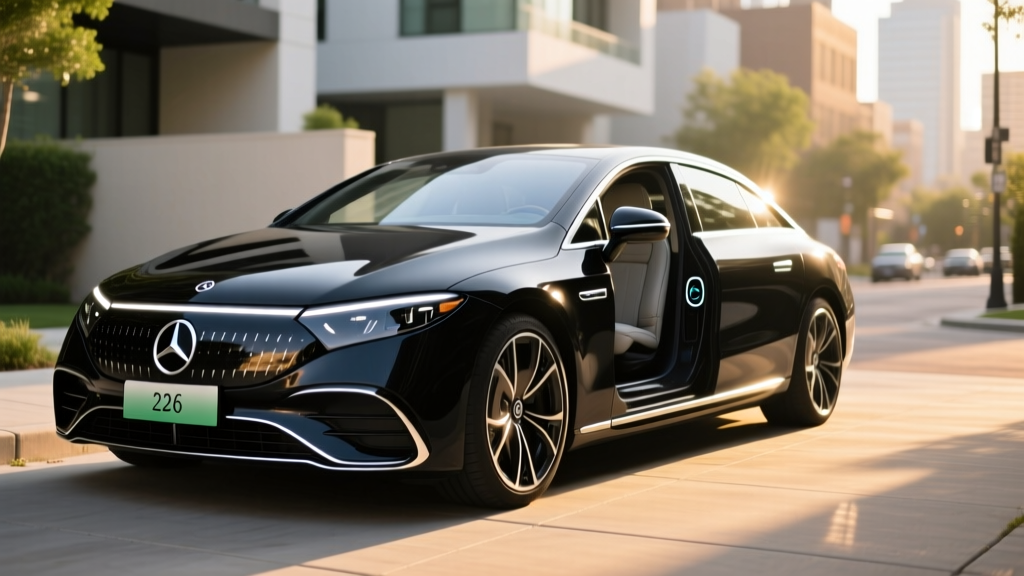
The 2026 EQS 450 Sedan at a Glance
The Mercedes-Benz EQS 450+ sedan occupies a rare position in the luxury EV market: it pairs flagship-tier comfort and technology with a single-motor, rear-wheel-drive powertrain that prioritizes efficiency over brute performance. For the 2026 model year, the EQS 450+ continues to ride Mercedes' dedicated EVA2 electric platform with the largest battery pack the brand offers — a 118 kWh (usable) NMC lithium-ion unit that underpins its class-leading EPA range rating.
But spec sheets only tell part of the story. After spending time with the EQS 450+, the real questions are whether its range holds up outside the lab, whether its 200 kW charging peak is fast enough for road trips in 2026, and whether a six-figure luxury sedan can realistically qualify for federal tax incentives. This review breaks down every number that matters.
| Spec | Value |
|---|---|
| EPA Range (est.) | 390 miles |
| Battery (usable) | 118 kWh, NMC chemistry |
| Drivetrain | Rear-wheel drive (single motor) |
| Horsepower | 355 hp |
| 0–60 mph | 5.9 seconds |
| Max DC Fast Charge | 200 kW (CCS/NACS adapter) |
| 10–80% DC Charge Time | ~31 minutes |
| Level 2 Home Charging | 9.6 kW (~31 mi/hr) |
| EPA Efficiency | 97 MPGe combined / 35 kWh/100 mi |
| Cargo Volume | 22.0 cu ft (trunk) |
| Rear Legroom | 41.5 inches |
| Battery Warranty | 10 years / 155,000 miles |
| Base MSRP | $105,550 (incl. destination) |
Range and Efficiency: EPA vs. the Real World
EPA Estimate: 390 miles
Highway (70–75 mph, 70°F): Expect ~320–340 miles
Cold Weather (30°F, mixed driving): Expect ~270–300 miles
City/Commuting (moderate temps): 370–390 miles achievable
The EQS 450+'s 390-mile EPA rating places it among the longest-range luxury sedans available in 2026. That number is achievable in practice — but only under favorable conditions. Mercedes has engineered the EVA2 platform with exceptional thermal management and a heat pump as standard equipment, which helps preserve range in cooler weather compared to competitors lacking active battery conditioning.
In real-world highway testing at sustained speeds of 70–75 mph in moderate temperatures, the EQS 450+ delivers approximately 320 to 340 miles before needing a charge stop. That's a meaningful reduction from the EPA sticker, but it's consistent with how most large EVs perform at sustained highway speeds where aerodynamic drag dominates. According to fueleconomy.gov, the combined efficiency rating of 97 MPGe translates to roughly 35 kWh consumed per 100 miles driven — an impressive figure for a 5,600-pound sedan.
Cold weather changes the equation. At 30°F or below, expect a 20–25% range reduction, bringing usable range to approximately 270–300 miles. The standard heat pump mitigates cabin energy draw, but battery chemistry still loses efficiency in the cold. Preconditioning the battery while plugged in (using the Mercedes me app's departure timer) recovers some of that loss and is essential for maximizing both range and charging speed in winter.
For city driving and commuting with frequent regenerative braking opportunities, owners can approach or even match the 390-mile EPA figure. The EQS offers adjustable regen levels via steering-wheel paddles, including a true one-pedal-driving mode that brings the car to a complete stop.
Charging Speed: DC Fast Charging and Home Setup
| Level | Power | Speed (approx.) | Use Case |
|---|---|---|---|
| Level 1 (120V) | 1.4 kW | ~5 miles/hour | Emergency / overnight trickle |
| Level 2 (240V, 40A) | 9.6 kW | ~31 miles/hour | Home daily charging |
| DC Fast Charge | 200 kW peak | 10–80% in ~31 min | Road trips |
The EQS 450+ accepts a peak DC fast-charge rate of 200 kW via its CCS connector (or NACS with the Mercedes-approved Tesla Supercharger adapter, which Mercedes now includes with new vehicles for 2026). At peak rate, the 118 kWh battery can add roughly 170 miles of range in 15 minutes.
However, understanding the charge curve is critical. The 200 kW peak is sustained only between approximately 10% and 35% state of charge. Above 50% SoC, the rate tapers to around 120–140 kW, and above 80% it drops sharply to protect battery longevity — typical behavior for NMC chemistry. A full 10–80% session takes approximately 31 minutes at a capable 350 kW station. At older 150 kW stations, expect closer to 40–45 minutes for the same session.
For home Level 2 charging, the onboard charger accepts up to 9.6 kW on a 240V/40A circuit. From a near-empty battery (10% SoC), a full charge takes roughly 11 hours — practical for overnight charging. Most owners will plug in nightly and rarely drop below 30%, making a typical home session 5–6 hours. Home installation of a Level 2 charger on a dedicated 50A circuit typically costs $800–$2,000 depending on panel proximity and local permitting, according to data from licensed electrician surveys.
One practical note: preconditioning the battery before arriving at a DC fast charger (initiated automatically when a charger is set as your navigation destination) is essential for achieving peak charge rates, especially in temperatures below 60°F. Skipping preconditioning can add 5–10 minutes to your charging stop.
Performance and Driving Dynamics
The EQS 450+ uses a single rear-mounted electric motor producing 355 horsepower and 419 lb-ft of torque. The 0–60 mph time of 5.9 seconds is respectable but not thrilling — this is a luxury cruiser, not a performance sedan. Buyers seeking AMG-level acceleration should look at the EQS 580 4MATIC (dual-motor, 536 hp, 4.1 seconds to 60) at a significant price premium.
Where the 450+ excels is ride quality. Standard AIRMATIC air suspension with adaptive damping delivers an exceptionally composed ride, absorbing road imperfections with the authority expected of an S-Class successor. Rear-axle steering (standard on the 450+) reduces the turning circle to 35.4 feet — remarkably tight for a 207-inch-long sedan — and makes low-speed maneuvering feel like a mid-size car.
The drivetrain is rear-wheel drive only. For buyers in snow-belt states, this is a consideration. The EQS 450 4MATIC (dual-motor AWD, 355 hp) exists as an alternative at roughly $3,000 more, trading a small amount of range for all-weather traction.
Interior, Technology, and Cargo
The cabin is where the EQS 450+ justifies its price. The standard MBUX Hyperscreen spans 56 inches across the dashboard, integrating a 17.7-inch central OLED touchscreen, a 12.3-inch passenger display, and a 12.3-inch digital instrument cluster into a single curved glass panel. The system runs Mercedes' latest MBUX generation with wireless Apple CarPlay and Android Auto, over-the-air updates, and a fingerprint-authenticated driver profile system.
Driver assistance comes via Mercedes' Driver Assistance Package, which includes adaptive cruise control with stop-and-go, active lane-keeping, lane-change assist, and evasive steering assist. This is an SAE Level 2 system — the driver must remain engaged with hands on the wheel and eyes on the road at all times. It is not autonomous driving. Mercedes' DRIVE PILOT (Level 3, allowing hands-off driving under 40 mph on approved highways) is available in select states (California and Nevada as of 2026) but is not offered on all trims and requires specific subscription terms.
All EQS driver-assistance features (Active Distance Assist, Active Steering Assist, DRIVE PILOT where available) are SAE Level 2 or conditional Level 3. The driver must remain prepared to take over at all times. No currently available EQS feature constitutes full self-driving.
Cargo capacity is 22.0 cubic feet in the trunk — generous for a sedan but notably less than a liftback or SUV. The trunk opening is relatively narrow, limiting practicality for bulky items. There is no front trunk (frunk), as Mercedes allocated that space to HVAC and electronics. Rear-seat legroom measures 41.5 inches, which is limousine-grade and exceeds the BMW i7 (40.4 inches) and rivals the Lucid Air (41.3 inches).
Pricing, Trims, and Federal Tax Credit Eligibility
| Trim | MSRP (incl. destination) | Drivetrain |
|---|---|---|
| EQS 450+ | $105,550 | RWD, 355 hp |
| EQS 450 4MATIC | $108,550 | AWD, 355 hp |
| EQS 580 4MATIC | $127,350 | AWD, 536 hp |
| AMG EQS | $152,000+ | AWD, 649 hp |
As tested, a well-equipped EQS 450+ with the AMG Line exterior package, Executive Rear Seat package, and Burmester 4D surround sound typically lands between $115,000 and $122,000 before any incentives.
- MSRP Cap: The §30D credit applies to sedans with an MSRP at or below $55,000. The EQS 450+ at $105,550 exceeds this cap and does not qualify for the new-vehicle federal credit.
- Income Cap: Even if it did qualify, buyers must have modified AGI ≤ $150,000 (single) or ≤ $300,000 (joint).
- Battery Sourcing: Critical-mineral and battery-component sourcing requirements apply (per IRS.gov).
- Alternative: The used-EV credit (§25E) allows up to $4,000 (or 30% of sale price, whichever is lower) on qualifying pre-owned EVs priced at or below $25,000. A future off-lease EQS may qualify under this provision once resale prices align.
- State Incentives: Several states (California, Colorado, Massachusetts, New York, and others) offer their own rebates or tax credits that may apply regardless of MSRP. Check your state's energy office for current programs.
The bottom line: the EQS 450+ does not qualify for the $7,500 federal new-vehicle tax credit due to its MSRP. Buyers should factor the full purchase price into their calculations and investigate state-level incentives independently.
Ownership Costs and Warranty
Mercedes-Benz provides a competitive warranty package for the EQS 450+:
- New-Vehicle Limited Warranty: 4 years / 50,000 miles
- Battery Warranty: 10 years / 155,000 miles (guaranteeing ≥70% state of health)
- Powertrain Warranty: 4 years / 50,000 miles
- Complimentary Maintenance: Not included (unlike BMW and Genesis competitors)
The 10-year/155,000-mile battery warranty is a strong point and exceeds the federal minimum requirement of 8 years/100,000 miles. Mercedes guarantees the battery will retain at least 70% of its original capacity during this period. Real-world degradation data from early EQS owners (2022–2024 models) suggests approximately 5–8% capacity loss over the first 60,000 miles with typical charging habits — well within warranty thresholds.
Insurance costs for the EQS 450+ run approximately 15–25% higher than a comparable internal-combustion S-Class, reflecting repair-cost concerns common to luxury EVs. Average annual premiums range from $3,200 to $4,500 depending on state, driving record, and coverage level.
Charging cost per mile is a fraction of gasoline. At a national average electricity rate of $0.16/kWh, fully charging the 118 kWh battery costs approximately $18.90, yielding a per-mile cost of roughly $0.049 (at 390 miles). By comparison, a gasoline S 500 achieving 24 MPG combined at $3.50/gallon costs $0.146 per mile — nearly three times more.
EQS 450+ vs. the Competition
| Model | EPA Range | 0–60 mph | DC Charge Peak | Base MSRP |
|---|---|---|---|---|
| Mercedes EQS 450+ | 390 mi | 5.9 sec | 200 kW | $105,550 |
| BMW i7 eDrive50 | 318 mi | 5.5 sec | 195 kW | $106,700 |
| Lucid Air Pure | 419 mi | 5.2 sec | 250 kW | $77,400 |
| Tesla Model S LR | 402 mi | 3.1 sec | 250 kW | $79,990 |
| Porsche Taycan (base) | 318 mi | 4.5 sec | 270 kW | $99,400 |
The EQS 450+ trades outright performance and charging speed for ride comfort, cabin technology, and brand prestige. The Lucid Air Pure offers more range and faster charging at a lower price but lacks the Mercedes dealer network and build-quality reputation. The Tesla Model S is significantly faster and cheaper but has an aging interior. The BMW i7 is the closest rival in character but offers notably less range. The Porsche Taycan charges fastest and drives best but sacrifices range and rear-seat space.
- Class-leading 390-mi EPA range among German luxury sedans
- Exceptional ride quality with standard air suspension
- 10-year/155,000-mi battery warranty
- Rear-axle steering for tight turning circle
- MBUX Hyperscreen with excellent integration
- Strong real-world efficiency (35 kWh/100 mi)
- No federal tax credit (exceeds $55K MSRP cap)
- 200 kW peak DC charging trails Lucid/Tesla/Porsche
- No frunk; trunk opening is narrow
- High insurance premiums vs. ICE equivalents
- Touch-sensitive controls can frustrate while driving
- Performance feels modest for the price
Who Should Buy the EQS 450+ Sedan?
The EQS 450+ is best suited for luxury sedan buyers who prioritize ride comfort, cabin technology, and maximum electric range over acceleration and sport handling. It's an ideal executive commuter and a credible road-trip vehicle given its 320+ real-world highway range and 31-minute fast-charge sessions.
It is not the right choice for buyers who need cargo versatility (consider the EQS SUV or an electric wagon), who want sub-4-second acceleration (look at the Model S or EQS 580), or who are counting on a federal tax credit to offset the purchase price.
Choose the EQS 450+ if: You want a true S-Class EV replacement with maximum range, the best ride quality in the segment, and you can absorb the full MSRP without a federal credit.
Consider alternatives if: You need faster DC charging (Lucid Air, Porsche Taycan), more performance per dollar (Tesla Model S), or a lower entry price with similar range (Lucid Air Pure at $77,400).
Frequently Asked Questions
What is the real-world range of the EQS 450+ sedan?
The EPA rates the 2026 EQS 450+ at 390 miles. In real-world highway driving at 70–75 mph, expect 320–340 miles. In cold weather (below 30°F), plan for 270–300 miles. City driving with regenerative braking can approach the EPA figure.
How fast does the EQS 450+ charge at home and on the road?
At home on a Level 2 (240V/40A) charger, the EQS adds approximately 31 miles of range per hour, fully recharging overnight in about 11 hours. On a DC fast charger, it peaks at 200 kW and charges from 10–80% in approximately 31 minutes, adding roughly 170 miles in 15 minutes at peak rate.
Does the EQS 450+ qualify for the federal EV tax credit?
No. The IRS §30D credit caps qualifying sedans at an MSRP of $55,000. The EQS 450+ starts at $105,550 and does not qualify. State incentives may still apply — check your local energy office. A future used EQS priced under $25,000 may qualify for the §25E used-EV credit of up to $4,000.
Is the EQS 450+ worth buying over the Lucid Air or Tesla Model S?
It depends on priorities. The EQS 450+ offers superior ride quality, a more luxurious interior, and a stronger dealer/service network than Lucid. The Lucid Air Pure delivers more range (419 mi), faster charging (250 kW), and a lower price ($77,400). The Tesla Model S is faster and cheaper but has an aging cabin. If comfort and brand trust matter most, the EQS wins. If value and performance lead your criteria, the Air or Model S are stronger picks.
What is the battery chemistry and how long will it last?
The EQS 450+ uses an NMC (nickel-manganese-cobalt) lithium-ion battery with 118 kWh of usable capacity. Mercedes warrants the battery for 10 years or 155,000 miles, guaranteeing at least 70% state of health. Real-world data from early models shows approximately 5–8% degradation over 60,000 miles with normal charging habits — well within the warranty threshold.
Does the EQS 450+ have a frunk?
No. The EQS platform uses the front compartment for HVAC components, power electronics, and the 12V auxiliary system. Cargo is limited to the 22.0-cubic-foot rear trunk.