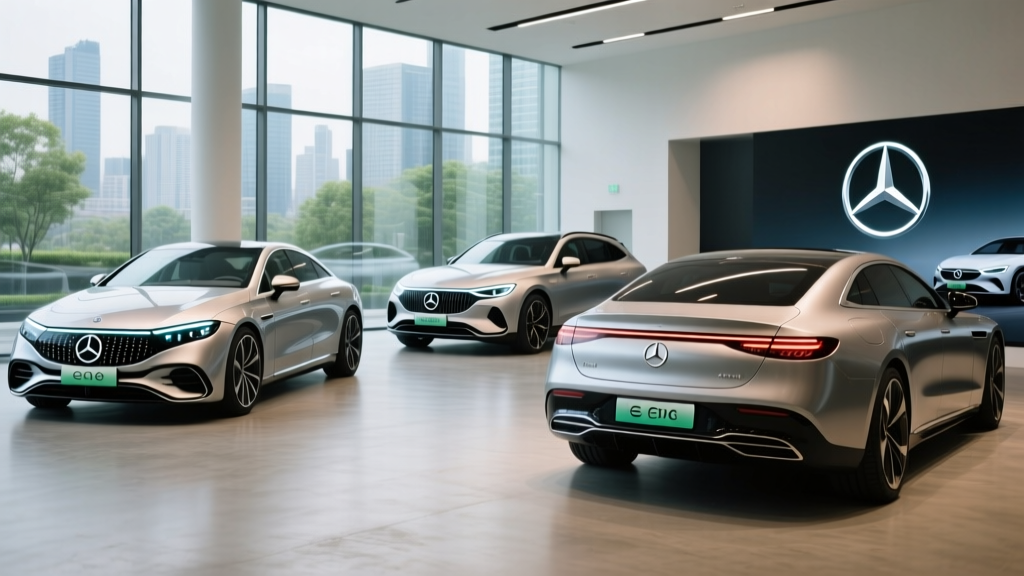
The Mercedes-Benz EQS sedan has always been a technology showcase, but the entry-point EQS 350 occupies a complicated space in the luxury EV market. With a 90.6 kWh usable battery, rear-wheel drive, and a starting MSRP near $76,000, it promises flagship luxury at the lowest possible EQS price. The question for 2026 is whether that entry price holds up against rivals like the BMW i5, Lucid Air Pure, and Tesla Model S — especially as federal tax credit rules tighten and competitors undercut it on range and charging speed.
I've spent time with the EQS platform across multiple model years, and the 350 variant is where Mercedes makes its most pragmatic case. It's the lightest, most efficient EQS, but also the one that exposes the platform's compromises most clearly. Here's the full data-driven breakdown.
Range and Real-World Efficiency
The 2026 EQS 350 carries a 90.6 kWh usable lithium-ion battery (NMC chemistry, nickel-manganese-cobalt cathode). The EPA rates it at 305 miles of combined range on its standard 19-inch wheels. Step up to the 20- or 21-inch AMG-line wheels and that figure drops to approximately 290 miles due to increased rolling resistance and aerodynamic drag.
- EPA Combined: 305 miles
- Highway (70-80 mph, moderate temps): ~255–275 miles
- City / suburban mixed: ~295–315 miles (regen-heavy routes favor the EQS)
- Cold weather (below 32°F): ~220–250 miles (expect 18–28% loss depending on cabin heating demand)
- Efficiency: 97 MPGe combined / 35 kWh per 100 miles (fueleconomy.gov)
The EQS sedan's slippery 0.20 Cd drag coefficient helps on the highway, but the car's 5,600-pound curb weight works against it during sustained high-speed driving. In real-world testing, the EQS 350 averages roughly 2.8–3.1 miles per kWh at highway speeds, which translates to that 255–275 mile practical range before you'd want to find a charger. For context, the Lucid Air Pure achieves closer to 3.5–3.8 mi/kWh on the highway thanks to its lighter platform and more efficient powertrain.
One advantage the EQS retains: its thermal management system is excellent. In hot climates, battery preconditioning and active cooling keep degradation in check. Mercedes also includes a heat pump as standard equipment, which reduces cold-weather range loss compared to EVs using resistive cabin heating alone.
Charging Speed and Infrastructure
This is where the EQS 350 shows its age relative to newer competitors. The car uses a CCS1 connector (Mercedes has not adopted NACS for the EQS line as of the 2026 model year) and tops out at 170 kW peak DC fast-charge rate.
| Charging Level | Power / Rate | Time / Speed | Notes |
|---|---|---|---|
| Level 1 (120V) | 1.4 kW | ~3 mi/hr | Emergency/trickle only; ~100+ hrs for full charge |
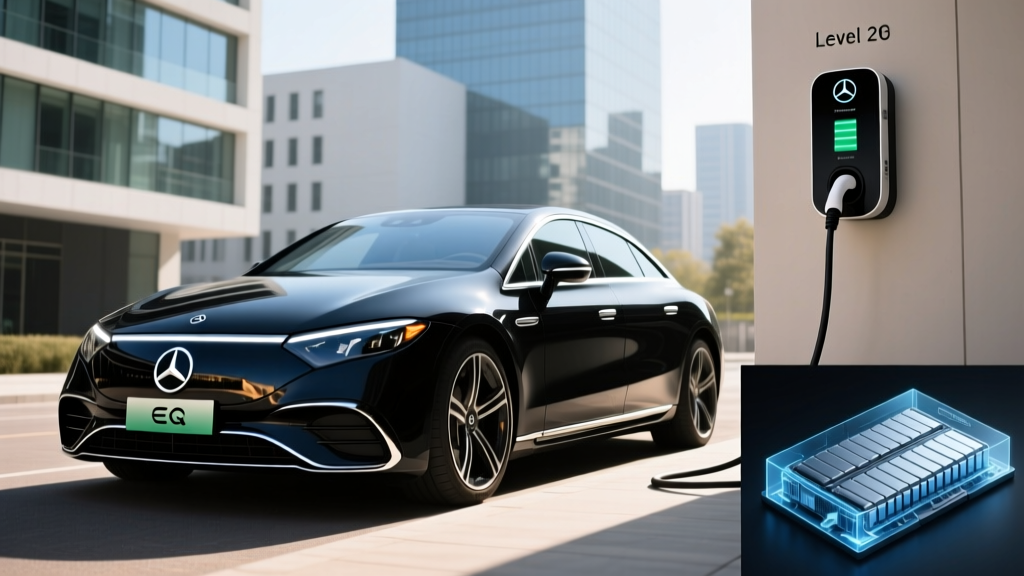
| Level 2 (240V, 48A) | 9.6 kW (onboard charger max 11 kW) | ~27 mi/hr; 10–100% in ~10 hrs | Standard home charging; overnight full charge |
| DC Fast Charge | 170 kW peak | 10–80% in ~34 min | Tapers significantly above 80%; 10–100% ~50 min |
The 170 kW peak is competitive with older-generation luxury EVs but trails the Hyundai Ioniq 6 (up to 240 kW on 800V architecture) and the Lucid Air (up to 250+ kW). The EQS 350's 400V electrical architecture is the limiting factor here. On a 150 kW Electrify America or EVgo station, you'll typically see sustained rates of 120–140 kW through the 20–60% state-of-charge window, then a noticeable taper above 70%.
For home charging, the 9.6 kW Level 2 rate on a standard 48-amp circuit is perfectly adequate. Most owners will plug in overnight and wake to a full battery. The 11 kW onboard charger means you could theoretically charge faster on a 60-amp circuit, but the practical difference is marginal — perhaps 30–40 minutes saved on a full charge cycle.
CCS connector note: If you rely on the Tesla Supercharger network, you'll need a CCS-to-NACS adapter. Mercedes has indicated future models will adopt NACS natively, but for 2026, EQS owners are on CCS1 for public charging. The Electrify America and EVgo networks cover most interstate corridors adequately, though reliability remains inconsistent compared to Superchargers.
Performance and Drivetrain
The EQS 350 is a single-motor, rear-wheel-drive configuration producing 288 horsepower and 406 lb-ft of torque. Mercedes quotes a 0–60 mph time of 6.2 seconds. That's adequate for a luxury sedan but unremarkable — the BMW i5 eDrive40 does it in 5.7 seconds, and the Lucid Air Pure in 5.1 seconds.
| Spec | EQS 350 | BMW i5 eDrive40 | Lucid Air Pure |
|---|---|---|---|
| Powertrain | RWD, single motor | RWD, single motor | RWD, single motor |
| Horsepower | 288 hp | 335 hp | 430 hp |
| 0–60 mph | 6.2 sec | 5.7 sec | 5.1 sec |
| EPA Range | 305 mi | 295 mi | 419 mi |
| Battery (usable) | 90.6 kWh | 84.3 kWh | 112 kWh |
| Peak DC Charge | 170 kW | 205 kW | 250+ kW |
| Base MSRP | $76,050 | $70,200 | $77,400 |
On the road, the EQS 350 drives like a Mercedes should: isolated, composed, and effortlessly smooth. The air suspension (standard on all EQS trims) soaks up imperfections, and the cabin is among the quietest in any production vehicle. Regenerative braking offers multiple modes via steering-wheel paddles, including a strong one-pedal-driving setting. The trade-off is that at 5,600 pounds, you feel the mass during spirited cornering. This is a grand tourer, not a sport sedan.
Interior, Cargo, and Technology
The EQS cabin is where Mercedes justifies the premium. The optional Hyperscreen — a 56-inch curved glass panel spanning the entire dashboard — remains one of the most visually impressive EV interiors available. It combines a 12.3-inch instrument cluster, 17.7-inch central OLED touchscreen, and 12.3-inch passenger display behind a single pane of glass. The standard setup uses a 12.8-inch portrait touchscreen, which is also excellent.
The MBUX infotainment system is feature-rich but comes with a learning curve. Voice control ("Hey Mercedes") is among the best in the industry, and wireless Apple CarPlay/Android Auto are standard. Navigation includes EV-aware route planning with automatic charging stop suggestions based on remaining range and charger availability.
Passenger and cargo dimensions:
- Front legroom: 41.7 inches
- Rear legroom: 40.0 inches
- Front headroom: 39.5 inches
- Rear headroom: 38.1 inches
- Trunk (rear cargo): 22.0 cu ft (seats up) — expandable via 40/20/40 split-folding rear seats
- No front trunk (frunk) — the EQS's cab-forward architecture and HVAC components occupy the front compartment
Rear-seat comfort is genuinely excellent, with available heated/ventilated/massaging outboard seats, rear climate control zones, and available rear-seat entertainment tablets. However, the sloping roofline does cut into rear headroom for taller passengers compared to boxier competitors like the BMW i7.
Pricing, Trims, and Federal Tax Credit Eligibility
The 2026 EQS 350 starts at $76,050 (including destination). A typical well-equipped example with the Hyperscreen, Driver Assistance Package, and premium leather lands between $85,000 and $92,000.
| Trim / Configuration | MSRP | Key Additions |
|---|---|---|
| EQS 350 (base) | $76,050 | Standard MBUX, air suspension, heated front seats, 19" wheels |
| EQS 350 + Premium Package | ~$82,000 | Burmester 3D audio, ventilated seats, head-up display |
| EQS 350 + Hyperscreen + Driver Assist | ~$88,000–$92,000 | 56" Hyperscreen, adaptive cruise, lane-change assist, 360° camera |
Federal EV Tax Credit (§30D) — Does the EQS 350 Qualify?
This is where EQS buyers need to pay close attention. Under current IRS rules (IRS §30D), the federal clean vehicle credit of up to $7,500 has several eligibility requirements:
- MSRP cap: Sedans must be priced at or below $55,000. The EQS 350 at $76,050 base exceeds this cap and does not qualify for the §30D new-vehicle credit.
- Income cap: Modified AGI limits of $150,000 (single) / $300,000 (joint) — moot here since the MSRP cap already disqualifies it.
- Battery sourcing: Critical minerals and battery component requirements must be met — again, moot given MSRP ineligibility.
- Point-of-sale transfer: Available for qualifying vehicles, but the EQS 350 does not qualify.
Bottom line: The EQS 350 does not qualify for the $7,500 federal tax credit. The sedan MSRP cap of $55,000 eliminates it. Some buyers may be eligible for state or local incentives — check your state's EV rebate program (California's CVRP, for example, has its own income and price caps). A tax professional can advise on any applicable benefits.
Mercedes dealers may offer lease incentives that effectively reduce the monthly cost — and under the commercial vehicle credit (§45W), leased EVs can pass through a $7,500 benefit to the lessee regardless of MSRP. Ask your dealer about current lease programs.
Driver Assistance and Safety
Mercedes' Driver Assistance Package (adaptive cruise, lane-keeping, lane-change assist) is a Level 2 system. The driver must remain fully engaged, hands on or near the wheel, and eyes on the road at all times. This is not autonomous driving. Mercedes does offer Drive Pilot (Level 3, conditional automation at speeds up to 40 mph in heavy traffic) in select markets, but availability is limited and requires specific infrastructure conditions.
The standard EQS 350 includes automatic emergency braking, blind-spot monitoring, rear cross-traffic alert, and lane-keeping assist. The optional Driver Assistance Package Plus adds adaptive cruise with stop-and-go, evasive steering assist, and Pre-Safe (predictive occupant protection). The EQS has not been crash-tested by the IIHS as of this writing, but the platform's structure and safety technology are comprehensive. Mercedes reports the EQS meets or exceeds internal safety targets equivalent to NHTSA 5-star criteria.
Warranty and Long-Term Ownership
Mercedes backs the EQS 350 with:
- New vehicle limited warranty: 4 years / 50,000 miles
- Battery warranty: 8 years / 100,000 miles (capacity retention guaranteed above 70% of original capacity)
- Powertrain warranty: 8 years / 100,000 miles (electric motor, power electronics)
- Corrosion warranty: 4 years / 50,000 miles (surface); 6 years / unlimited miles (perforation)
- Complimentary maintenance: 1 year / 10,000 miles (first scheduled service)
The 70% battery capacity retention threshold is standard for the industry but less generous than Hyundai/Kia's 70% at 10 years/100,000 miles or Rivian's 70% at 8 years/120,000 miles. Real-world degradation data for the EQS platform is still accumulating — early 2022–2024 models suggest 3–5% loss over the first 40,000 miles, which is in line with NMC chemistry expectations. Mercedes' thermal management system is a strong positive for long-term battery health.
Insurance costs: Expect premiums 20–35% higher than a comparable ICE Mercedes S-Class, based on industry averages for luxury EVs. Get quotes before purchasing — this is a frequently overlooked ownership cost.
Pros, Cons, and Final Verdict
- Class-leading cabin quietness and ride comfort
- Hyperscreen is genuinely impressive when optioned
- Strong regenerative braking with one-pedal capability
- Heat pump standard — better cold-weather efficiency
- Spacious rear seat with premium amenities
- Air suspension standard across all trims
- Does not qualify for $7,500 federal tax credit (MSRP cap)
- 170 kW peak DC charging is slow vs. rivals (Lucid, Hyundai)
- No frunk — reduces practical cargo versatility
- Heavy at 5,600 lbs — affects handling and tire wear
- CCS connector limits Supercharger access without adapter
- Base price near $76K is steep for 288 hp / 6.2-sec 0–60
- MBUX learning curve; some controls buried in menus
Who Should Buy the EQS 350?
The EQS 350 is best suited for luxury-focused buyers who prioritize cabin comfort, technology, and brand prestige over outright range or performance. It works well as a daily commuter and interstate grand tourer for those with reliable home Level 2 charging. If your typical drive is under 200 miles round-trip and you charge overnight, the 305-mile EPA range is more than sufficient.
It is not the best choice if you frequently drive 300+ mile routes in cold weather, need the fastest possible DC charging, or want maximum value per dollar. The Lucid Air Pure offers 419 miles of range for a similar price, and the BMW i5 eDrive40 undercuts it by $6,000 with quicker acceleration and faster charging.
Frequently Asked Questions
What is the real-world range of the Mercedes EQS 350?
The EPA rates the EQS 350 at 305 miles combined. In real-world highway driving at 70–80 mph, expect 255–275 miles. In cold weather below freezing, that drops to approximately 220–250 miles. City and suburban driving with frequent regenerative braking opportunities can match or slightly exceed the EPA figure.
How fast does the EQS 350 charge?
On a DC fast charger, the EQS 350 peaks at 170 kW and charges from 10% to 80% in approximately 34 minutes. At home on a Level 2 (240V, 48A) charger, it adds about 27 miles per hour of charging, reaching a full charge overnight in roughly 10 hours.
Does the EQS 350 qualify for the federal EV tax credit?
No. Under IRS §30D rules, sedans must have an MSRP at or below $55,000 to qualify. The EQS 350 starts at $76,050 and exceeds this cap. Some buyers may benefit from leasing (where the lessor can claim the commercial credit) or state/local incentives. Consult a tax professional for your specific situation.
Is the EQS 350 worth buying vs. the Lucid Air Pure or BMW i5?
It depends on priorities. The Lucid Air Pure ($77,400) offers 419 miles of range, faster charging, and more power — but its service network is smaller and interior materials don't match Mercedes. The BMW i5 eDrive40 ($70,200) is sportier and charges faster but has less range (295 mi) and a less opulent cabin. The EQS 350 wins on luxury, comfort, and technology presentation, but loses on value and charging speed.
What is the battery chemistry in the EQS 350?
The EQS 350 uses NMC (nickel-manganese-cobalt) lithium-ion cells. NMC offers higher energy density than LFP (lithium iron phosphate), which allows Mercedes to pack 90.6 kWh into a relatively compact battery enclosure. The trade-off is that NMC cells are more sensitive to sustained high state-of-charge and extreme heat — Mercedes' thermal management system mitigates this effectively.
Can I charge the EQS 350 at Tesla Superchargers?
Not natively. The EQS 350 uses a CCS1 connector, while Tesla Superchargers use the NACS connector. You can purchase a CCS-to-NACS adapter (typically $150–$250) to access Superchargers, but charging speed will be limited by the EQS's 170 kW peak rate. Mercedes has announced future models will adopt NACS natively, but the 2026 EQS retains CCS1.