The Short Answer on Jeep Electric Vehicles
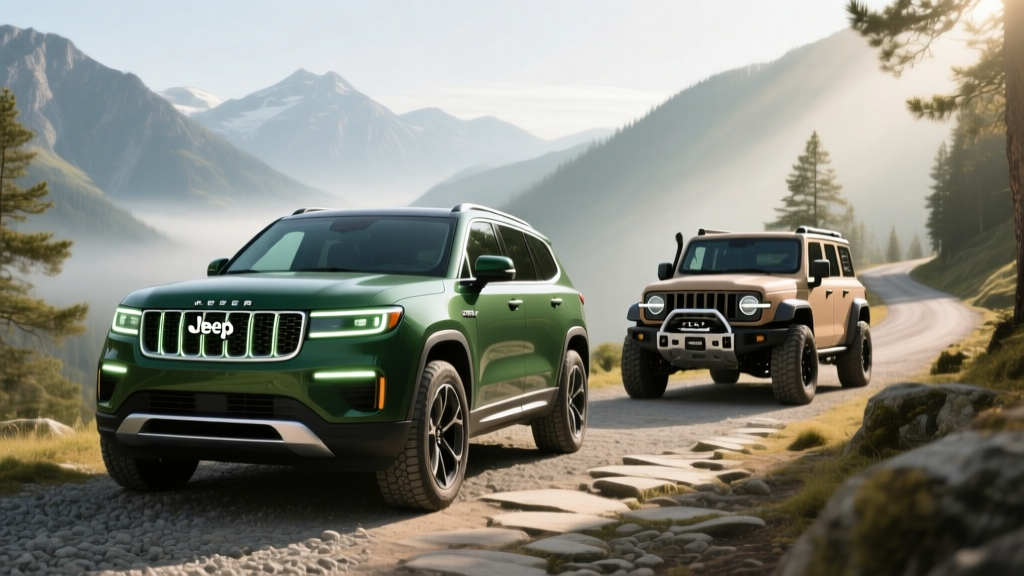
As of the 2026 model year, Jeep offers two fully electric vehicles in the U.S.: the Wagoneer S (a midsize performance SUV starting around $65,200) and the Recon (a boxy off-road-oriented SUV starting near $52,995). Both ride on Stellantis' STLA Large platform, use ~100 kWh battery packs, and target roughly 300+ miles of EPA range. The Grand Cherokee 4xe plug-in hybrid remains a bridge option with 26 miles of electric-only driving. If you want a true zero-tailpipe-emission Jeep today, the Wagoneer S and Recon are your choices — but neither qualifies for the full §30D federal tax credit due to battery-sourcing rules. Read on for the numbers that matter before you buy.
Jeep's Current Electric Lineup: Wagoneer S and Recon
Jeep's path to electrification has been slower than rivals like Hyundai, Kia, and Tesla, but the brand entered the BEV market with two distinct models aimed at very different buyers. Here is how they stack up on paper and in practice.
| Spec | 2026 Wagoneer S | 2026 Recon |
|---|---|---|
| Body Style | Midsize fastback SUV | Boxy off-road SUV |
| Drivetrain | Dual-motor AWD | Dual-motor AWD (Selec-Terrain) |
| Horsepower | 600 hp | ~400 hp (est.) |
| 0-60 mph | 3.4 seconds | ~5.5 seconds (est.) |
| Battery (usable) | ~100 kWh (NMC) | ~100 kWh (NMC) |
| EPA Range | ~300 mi (est.) | ~280 mi (est.) |
| Max DC Fast Charge | ~200 kW peak | ~175 kW peak |
| 10-80% DC Charge | ~27 min | ~30 min |
| Level 2 Charge Rate | 11.5 kW | 11.5 kW |
| Ground Clearance | ~7.5 in | ~10.5 in |
| Towing Capacity | ~3,500 lbs | ~5,000 lbs (est.) |
| Base MSRP | $65,200 | $52,995 |
| Battery Warranty | 8 yr / 100,000 mi | 8 yr / 100,000 mi |
Sources: Stellantis/Jeep press materials; EPA estimates are preliminary for Recon and subject to final certification at fueleconomy.gov.
Real-World Range: What the EPA Sticker Doesn't Tell You
The Wagoneer S targets roughly 300 miles of EPA combined range. That is a respectable number on paper, but real-world conditions tell a more nuanced story — especially for Jeep buyers who tend to drive in varied terrain and climate.
Wagoneer S Range Reality Check
EPA Combined: ~300 miles
Highway (70-80 mph, flat): Expect 250-270 miles
Cold Weather (below 32°F): Expect 200-230 miles (30-35% loss typical for NMC packs without aggressive heat-pump preconditioning)
Off-Road / Low-Speed Trail: Range drops less than highway, but accessory loads (heated seats, HVAC) still apply
The Recon's boxier shape and all-terrain tires create more aerodynamic drag, which is why its estimated range sits lower (~280 miles EPA). Highway driving at sustained speeds will reduce that to roughly 230-245 miles in moderate temperatures. If you plan to tow with the Recon, expect range to drop by 40-50% under load — a physics reality that applies to every EV on the market, not just Jeeps.
Charging-curve taper: Both models peak at their maximum DC charge rate only in the 10-40% state-of-charge window. Above 80%, charge speed drops sharply to protect the NMC battery cells. Plan your road trips around 10-80% sessions rather than trying to fill to 100% at a fast charger — the last 20% can take as long as the first 70%.
Charging at Home and on the Road
Charging access is the single biggest variable in EV satisfaction. Before you commit to a Jeep EV, honestly assess your situation.
| Charging Level | Power (kW) | Miles Added per Hour | Typical Use Case |
|---|---|---|---|
| Level 1 (120V outlet) | ~1.4 kW | ~3-4 mi/hr | Overnight top-up, emergencies |
| Level 2 (240V home) | 11.5 kW | ~32-38 mi/hr | Daily home charging, full overnight fill |
| DC Fast Charge | Up to 200 kW | ~180+ mi in 15 min | Road trips, quick stops |
Home charging is essential for most owners. Level 1 (a standard 120V household outlet) adds roughly 3-4 miles of range per hour — enough only if your daily commute is under 30 miles round-trip and you can leave the vehicle plugged in for 12+ hours overnight. For most buyers, a Level 2 home charger (240V, 48-amp circuit) is the practical minimum. It will fully recharge a ~100 kWh pack in about 9-10 hours.
Home install cost: Expect $800-$2,500 for a Level 2 charger installation if your electrical panel has capacity. If you need a panel upgrade (common in older homes with 100-amp service), add $1,500-$3,000. Always get a quote from a licensed electrician before purchasing the vehicle.
Public DC fast charging: Both Jeep EVs use the CCS1 connector standard. Jeep owners can access Electrify America, EVgo, ChargePoint, and other CCS networks. The Wagoneer S peaks at ~200 kW, meaning a 10-80% session takes roughly 27 minutes under ideal conditions. Real-world charger availability, stall uptime, and battery temperature can add 5-10 minutes to that figure.
Connector note: Stellantis has not announced a NACS (Tesla-style) transition for these models as of early 2026. If that changes, an adapter will likely be offered for Supercharger access.
Jeep EV vs Gas and Hybrid: Cost and Efficiency Comparison
The most common question from Jeep shoppers is whether going electric actually saves money. The answer depends heavily on your local electricity rates, driving habits, and whether you can charge at home.
| Metric | Wagoneer S (EV) | Grand Cherokee L (Gas V6) | Grand Cherokee 4xe (PHEV) |
|---|---|---|---|
| Base MSRP | $65,200 | $43,995 | $55,095 |
| EPA Efficiency | ~88 MPGe | 21 MPG combined | 56 MPGe / 23 MPG gas-only |
| Electric-Only Range | ~300 mi | 0 mi | 26 mi |
| Cost per Mile (fuel/energy)* | $0.04-$0.06 | $0.16-$0.20 | $0.06 (EV mode) / $0.18 (gas) |
| Annual Fuel/Energy (15k mi) | $600-$900 | $2,400-$3,000 | $900-$1,800 |
| Est. 5-Year Maintenance | $1,500-$2,000 | $3,500-$4,500 | $3,000-$4,000 |
| Federal Tax Credit (§30D) | Partial or $0** | $0 | $3,750 (if eligible)** |
*Based on $0.14/kWh home electricity and $3.50/gal gas. Public DC fast charging costs $0.30-$0.48/kWh, raising per-mile cost to $0.10-$0.15.
**Per IRS §30D rules, eligibility depends on MSRP caps ($80,000 for SUVs), buyer income limits ($300k MFJ / $150k single), and critical-mineral/battery-component sourcing requirements. Jeep EVs with non-U.S.-sourced battery components may not qualify for the full $7,500. Always verify current eligibility on irs.gov or consult a tax professional.
Estimated 5-Year Total Cost of Ownership (15,000 miles/year)
| Category | Wagoneer S (EV) | Grand Cherokee L (Gas) |
|---|---|---|
| Purchase (after credit) | $65,200 | $43,995 |
| Energy/Fuel (5 years) | $3,000-$4,500 | $12,000-$15,000 |
| Maintenance (5 years) | $1,500-$2,000 | $3,500-$4,500 |
| Insurance (5 years, avg) | $9,000-$11,000 | $7,000-$8,500 |
| Depreciation (est.) | $28,000-$33,000 | $18,000-$22,000 |
| Total 5-Year | $106,700-$115,700 | $84,495-$93,995 |
EV insurance premiums run 15-25% higher than comparable gas vehicles due to repair costs and battery replacement risk. Depreciation figures are estimates based on current EV resale trends and may shift as the market matures.
The bottom line: The Wagoneer S costs significantly more upfront and carries higher insurance and depreciation risk. Fuel and maintenance savings of $10,000-$14,000 over five years partially close the gap, but the EV does not reach cost parity with the gas Grand Cherokee L within a typical ownership cycle. The value proposition is performance (600 hp, 3.4-second 0-60), technology, and zero tailpipe emissions — not pure economics.
Federal Tax Credits and Incentives: What Jeep Buyers Actually Get
The federal EV tax credit under IRS §30D is the most misunderstood part of buying any EV. Here is the current reality for Jeep electric vehicles:
- MSRP Cap: SUVs must be under $80,000 MSRP — both the Wagoneer S and Recon qualify on price.
- Income Cap: Buyer AGI must not exceed $300,000 (married filing jointly), $225,000 (head of household), or $150,000 (single).
- Battery Sourcing: The credit splits into two halves — $3,750 for critical-minerals sourcing and $3,750 for battery-component assembly in North America or a free-trade-agreement country. As of 2026, many Stellantis battery packs source cells from suppliers that do not fully meet U.S. sourcing requirements.
- FEOC Restriction: Vehicles with battery components from a "foreign entity of concern" (primarily Chinese suppliers) are ineligible for the full credit.
- Point-of-Sale Transfer: If eligible, you can transfer the credit to the dealer at purchase, reducing your out-of-pocket cost immediately rather than waiting for tax filing.
Practical expectation: Do not assume you will receive $7,500. Depending on the specific battery supplier for your model year and trim, you may receive $3,750, $0, or a figure in between. Confirm eligibility with your dealer and cross-reference the fueleconomy.gov tax credit lookup tool before signing a purchase agreement.
Common Misconceptions About Jeep Electric Vehicles
| Myth | Fact |
|---|---|
| "Jeep EVs can't go off-road." | The Recon is designed with Selec-Terrain drive modes, ~10.5 inches of ground clearance, and available all-terrain tires. Electric motors deliver instant torque at zero RPM, which is actually advantageous for rock crawling. However, sustained off-road use with HVAC loads will reduce range faster than highway driving. |
| "I'll save money going electric." | Fuel and maintenance savings are real ($1,500-$2,500/year), but higher purchase price, insurance premiums, and faster depreciation can offset those gains over 5 years. The EV makes financial sense primarily if you have cheap home electricity, drive high annual miles, and plan to keep the vehicle 7+ years. |
| "The battery will need replacing in 5 years." | NMC batteries in modern EVs typically retain 85-90% capacity after 100,000 miles based on fleet data from similar platforms. Jeep covers the battery for 8 years / 100,000 miles with a capacity-retention threshold (typically 70%). Full replacement, if ever needed, costs $15,000-$22,000 out of warranty. |
| "I can charge anywhere in 15 minutes." | Peak DC fast-charge rates (175-200 kW) are only achievable under ideal conditions — battery preconditioned, low state of charge, functioning high-power stall. Real-world 10-80% sessions average 25-35 minutes. Plan for 30-40 minute stops on road trips. |
| "The Wrangler is available as a full EV." | As of 2026, the Wrangler is offered only as the 4xe plug-in hybrid (22 miles electric-only, 49 MPGe). A fully electric Wrangler has been discussed by Stellantis but is not on sale. If you need open-air Jeep capability with some electric range, the 4xe is the current option. |
Decision Framework: Which Jeep Electrified Vehicle Is Right for You?
Choose Based on Your Actual Driving Life
Choose the Wagoneer S if:
- You want performance-SUV acceleration (3.4s 0-60) with premium tech
- Your daily driving is under 200 miles and you can charge at home
- You rarely tow more than 3,500 lbs
- You value a quiet, refined on-road experience over trail capability
Choose the Recon if:
- You want genuine off-road capability with zero tailpipe emissions
- You need higher ground clearance and up to ~5,000 lbs towing
- You want removable doors/roof panels for open-air driving
- You accept slightly lower range (~280 mi) due to boxy aero and AT tires
Choose the Grand Cherokee 4xe (PHEV) if:
- You cannot install a Level 2 charger at home
- You take frequent long road trips and don't want to plan around DC chargers
- You want electric commuting (26 mi) with gas-engine range flexibility
- Your budget is closer to $50,000-$60,000 and you want a proven platform
Wait or look elsewhere if:
- You live in an apartment or condo without charging access and public infrastructure is sparse in your area
- You regularly tow over 5,000 lbs — no current Jeep EV handles heavy towing well
- You need a Wrangler with full EV capability — that model does not yet exist
- Your budget is under $45,000 — consider a used EV from another brand or the PHEV route
First-Time EV Buyer Essentials
If the Wagoneer S or Recon would be your first electric vehicle, these practical realities will shape your ownership experience more than any spec sheet:
1. Confirm home charging before you buy. A Level 2 (240V) home charger is not optional for convenient daily ownership. Budget $1,000-$3,000 for equipment and professional installation. If your home has a 200-amp electrical panel with available capacity, installation is straightforward. A 100-amp panel may require an upgrade.
2. Download charging apps before your first road trip. PlugShare, Electrify America, EVgo, and ChargePoint each cover different networks. No single app shows everything. Check station uptime reviews — a "150 kW" station with three broken stalls is useless.
3. Understand preconditioning. Both Jeep EVs can warm the battery before a DC fast-charge session if you set a charging stop in the navigation system. A cold battery charges much slower — preconditioning can shave 5-10 minutes off your stop.
4. Winter range loss is real and significant. NMC battery chemistry loses 25-35% range in sustained sub-freezing temperatures. If you live in the northern U.S. and commute 100+ miles daily in winter, the ~300-mile Wagoneer S becomes a ~200-mile vehicle. Plan accordingly.
5. Insurance will cost more. EV insurance premiums average 15-25% above equivalent gas vehicles. Get a quote from your insurer before purchase — it can add $1,500-$3,000 to your annual cost.
Frequently Asked Questions
Is there a fully electric Jeep Wrangler?
No. As of 2026, the Wrangler is available only as the 4xe plug-in hybrid (22 miles electric-only range, 49 MPGe combined). Stellantis has referenced a future electric Wrangler concept but has not announced production timing or specs. If you want open-air Jeep capability today, the Recon offers removable doors and roof panels.
How long does it take to charge a Jeep EV at home?
On a Level 2 (240V, 11.5 kW) home charger, a full 0-100% charge of the ~100 kWh battery takes approximately 9-10 hours. Most owners plug in overnight and wake to a full battery. On a standard 120V outlet (Level 1), a full charge would take 60+ hours — practical only for emergency top-ups.
Do Jeep electric vehicles qualify for the $7,500 federal tax credit?
Eligibility is uncertain and varies by model year and battery sourcing. Under current IRS §30D rules, the credit requires North American or FTA-country battery component assembly and critical-mineral sourcing. Stellantis has been working to localize its supply chain, but buyers should verify eligibility on fueleconomy.gov and with their dealer at the time of purchase. Do not assume the full $7,500 in your budget.
Can I tow with a Jeep electric vehicle?
Yes, but with significant range penalties. The Recon is estimated at ~5,000 lbs towing capacity; the Wagoneer S at ~3,500 lbs. Expect range to drop 40-50% when towing near maximum capacity at highway speeds. A 280-mile Recon becomes roughly a 140-160 mile vehicle under a heavy trailer. For frequent heavy towing, a PHEV or diesel may be more practical.
What happens if the battery degrades?
Jeep covers the high-voltage battery for 8 years or 100,000 miles with a capacity-retention guarantee (typically 70% of original capacity). Based on data from similar NMC packs on the STLA platform, most batteries retain 85-90% capacity at the 100,000-mile mark. If a battery falls below the warranty threshold, Stellantis will repair or replace it at no cost. Out-of-warranty replacement is estimated at $15,000-$22,000.
Are Jeep EVs good in snow and cold weather?
The dual-motor AWD system on both models provides strong traction, and instant electric torque helps in slippery conditions. However, cold weather (below 32°F) reduces range by 25-35%, and using the cabin heater draws significant energy from the pack. Preconditioning the cabin and battery while still plugged in at home mitigates some of this loss. For extreme cold climates, a heat pump (if equipped) improves efficiency over resistive heating.
This guide reflects 2026 model-year data available at the time of publication. Specifications, pricing, and tax-credit eligibility are subject to change. Always confirm final figures with your dealer and consult fueleconomy.gov and irs.gov for the latest official data.