If you've been searching for the EQS launch date and whether Mercedes-Benz's flagship electric sedan still holds up in 2026, you've landed in the right place. The Mercedes-Benz EQS first went on sale in the United States in late 2021 as a 2022 model, arriving in showrooms around October of that year. Since then, it has undergone meaningful updates — most notably a substantial battery and range refresh for the 2025 model year that carried forward into the current 2026 lineup.
Now in its fifth year on the market, the EQS remains Mercedes' most luxurious electric offering and one of the longest-range luxury sedans you can buy. But with intensifying competition from the Tesla Model S, Lucid Air, BMW i7, and the redesigned Porsche Taycan, the EQS has to earn its six-figure price tag on merit, not novelty. This review breaks down exactly what you're getting in 2026 — with real numbers, real-world caveats, and zero marketing fluff.
2026 Mercedes EQS: Quick Verdict
The 2026 EQS is a technology-dense, supremely comfortable long-range cruiser that excels at highway isolation and cabin silence. Its 118 kWh usable battery (NMC chemistry) delivers an EPA-estimated 390 miles in the EQS 450+ and 371 miles in the dual-motor EQS 580 4MATIC. DC fast charging peaks at 200 kW, achieving a 10–80% session in roughly 31 minutes. Pricing starts at $105,550 before destination, and federal tax credit eligibility is limited by IRS §30D rules. If you prioritize ride refinement, interior tech, and genuine cross-country range over sportiness, the EQS is a serious contender.
| Spec | EQS 450+ Sedan | EQS 580 4MATIC Sedan |
|---|---|---|
| EPA Range | 390 miles | 371 miles |
| Battery (usable) | 118 kWh, NMC | 118 kWh, NMC |
| Drivetrain | RWD, single motor | AWD, dual motor |
| Horsepower | 355 hp | 536 hp |
| 0–60 mph | 5.9 sec | 4.1 sec |
| Peak DC Charge Rate | 200 kW | 200 kW |
| 10–80% DC Time | ~31 min | ~31 min |
| Level 2 Charge Rate | 9.6 kW (~30 mi/hr) | 9.6 kW (~30 mi/hr) |
| MPGe (combined) | 95 MPGe | 89 MPGe |
| Efficiency | 35 kWh/100 mi | 38 kWh/100 mi |
| Base MSRP | $105,550 | $127,350 |
| Battery Warranty | 10 yr / 155,000 mi | 10 yr / 155,000 mi |
Range, Efficiency, and Real-World Expectations
The headline EPA number — 390 miles for the EQS 450+ — is legitimate and places this sedan among the longest-range EVs on the market. According to fueleconomy.gov, the 450+ achieves 95 MPGe combined, translating to roughly 35 kWh consumed per 100 miles of driving. That's respectable for a 5,800-pound luxury sedan.
EPA sticker: 390 miles (450+), 371 miles (580 4MATIC)
Highway cruising (70–75 mph): Expect ~310–330 miles in moderate temperatures. The EQS's slippery 0.20 Cd drag coefficient helps, but sustained high speed still cuts range by roughly 15–20%.
Cold weather (below 30°F): Plan for 260–290 miles. The EQS uses a heat pump (standard), which mitigates cabin-heating losses, but battery chemistry slows and resistance increases in freezing conditions.
City / mixed driving: You'll approach or even exceed the EPA estimate thanks to generous regenerative braking and low-speed efficiency.
The 118 kWh usable battery pack uses nickel-manganese-cobalt (NMC) chemistry, chosen for its high energy density. This is the right call for a flagship sedan where maximizing range per kilogram matters more than the extended cycle life that LFP (lithium iron phosphate) offers. Mercedes has improved the module design over the original 2022 pack, contributing to the range bump from the original 350-mile EPA rating.
Charging Speed: DC Fast and Home Level 2
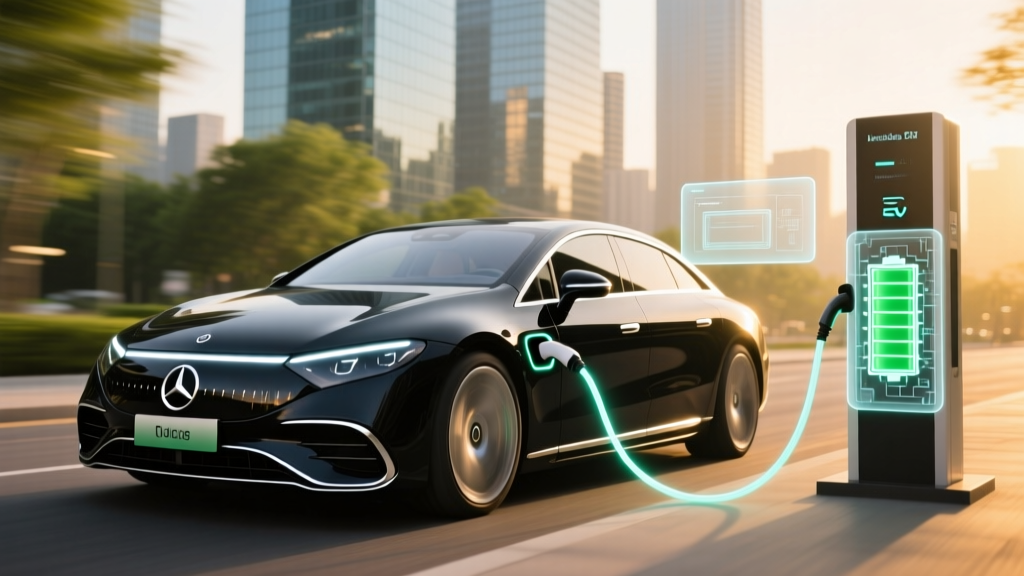
The EQS supports a peak DC fast-charge rate of 200 kW via its CCS1 connector (NACS adapter is available for Tesla Supercharger access). At peak, 200 kW can add roughly 180 miles of range in 15 minutes — but as with all EVs, peak rate is not sustained rate.
| Charging Level | Power (kW) | Speed (miles of range added) | Typical Use Case |
|---|---|---|---|
| Level 1 (120V household) | ~1.4 kW | ~4 mi/hr | Emergency / trickle top-off |
| Level 2 (240V home / public) | 9.6 kW | ~30 mi/hr | Overnight home charging; full charge in ~12 hr |
| DC Fast Charge (CCS1) | Up to 200 kW (peak) | ~180 mi in 15 min (peak) | Road trips; 10–80% in ~31 min |
Charging curve reality: The EQS holds close to 200 kW from roughly 10% to 40% state of charge, then tapers progressively. Between 40–60%, expect ~150 kW; from 60–80%, it drops to ~80–100 kW. Above 80%, charging slows dramatically to protect battery health — a final 80–100% top-off can take nearly as long as the 10–80% session. Always precondition the battery via the MBUX navigation system before arriving at a DC fast charger; the EQS will automatically warm or cool the pack to optimize charge acceptance.
For home Level 2 charging, the onboard 9.6 kW charger means a full 0–100% session takes roughly 12 hours. Most owners will plug in each evening and wake to a full battery. A 240V / 48-amp hardwired wallbox is the recommended home setup — expect $800–$1,500 for equipment plus $500–$2,000 for professional installation depending on your electrical panel. (Always consult a licensed electrician for final specifications.)
Performance and Driving Dynamics
The EQS 450+ sends 355 horsepower to the rear wheels through a single permanent-magnet motor. The 0–60 mph sprint takes 5.9 seconds — quick enough for confident highway merging, but this is a luxury cruiser, not a sport sedan. The 580 4MATIC adds a front motor for all-wheel drive and 536 hp, dropping the 0–60 to 4.1 seconds.
Ride quality is where the EQS justifies its price. Standard AIRMATIC air suspension with adaptive damping soaks up imperfections with genuine isolation. Rear-axle steering (standard, up to 10 degrees) shrinks the turning circle to a remarkable 35.8 feet — making this 17-foot sedan maneuver like a compact car in parking lots. The steering is precise but light, and body control is excellent, though the EQS never pretends to be an AMG.
One-pedal driving is available through the strongest regen setting, though Mercedes stops short of true one-pedal operation at a full stop — you'll still need the brake pedal for final halts. The blended braking feel is among the best in the luxury EV segment, with seamless transitions between regen and friction brakes.
Interior, Tech, and Cargo
The EQS cabin is dominated by the available MBUX Hyperscreen — a 56-inch curved glass panel spanning the entire dashboard, integrating a 12.3-inch instrument cluster, 17.7-inch central OLED touchscreen, and 12.3-inch passenger display. It's visually stunning and responsive, though the touch-capacitive climate controls embedded in the screen require more attention than physical buttons. The standard 12.8-inch central screen on lower trims is more conventional and arguably easier to use while driving.
Passenger space: Front legroom measures 41.7 inches; rear legroom is a generous 41.4 inches — limousine territory. Headroom is adequate front (40.4 in) and rear (38.3 in), though the sloping roofline cuts into space for taller passengers. Seats are heated, ventilated, and massaging across most trims.
Cargo volume: The trunk offers 22 cubic feet — massive for a sedan and larger than many compact SUVs, thanks to the hatchback-style liftgate. Fold the rear seats and you get up to 63 cubic feet. There is no front trunk (frunk); the space under the hood houses electronics and the HEPA filtration system.
Driver assistance comes via Mercedes' Drive Pilot system, which is an SAE Level 3 conditional automation system approved for limited highway use (up to 40 mph in heavy traffic, on approved roadways). This is a genuine step above Level 2 systems — under specific conditions, the car assumes driving responsibility and you may look away from the road. However, availability is limited to certain states and mapped highway sections. Outside those conditions, the EQS defaults to Level 2 driver assist (adaptive cruise, lane centering, automatic lane changes) that requires continuous driver supervision.
The standard driver-assistance suite is SAE Level 2 — you must remain engaged, eyes on the road, hands available. Drive Pilot is Level 3, meaning the vehicle handles all driving tasks in approved conditions (low-speed highway congestion), but it is not a full self-driving system and does not replace the driver in all scenarios.
Pricing, Trims, and Federal Tax Credit Eligibility
The 2026 EQS lineup includes three sedan trims and the EQS SUV (reviewed separately):
- EQS 450+ Sedan: $105,550 MSRP (+ $1,150 destination)
- EQS 450 4MATIC Sedan: $111,550 MSRP
- EQS 580 4MATIC Sedan: $127,350 MSRP
- AMG EQS (high-performance): $149,900 MSRP
Options like the Hyperscreen ($8,500), Executive Rear Seat package, and Burmester 4D surround sound can push a 580 4MATIC past $145,000 as-tested.
| Trim | Base MSRP | §30D Federal Credit | Effective Price (est.) |
|---|---|---|---|
| EQS 450+ | $105,550 | $0 (exceeds MSRP cap) | $105,550 |
| EQS 450 4MATIC | $111,550 | $0 (exceeds MSRP cap) | $111,550 |
| EQS 580 4MATIC | $127,350 | $0 (exceeds MSRP cap) | $127,350 |
| AMG EQS | $149,900 | $0 (exceeds MSRP cap) | $149,900 |
Federal tax credit reality: Under current IRS §30D rules, the new EV tax credit provides up to $7,500 — but sedans must have an MSRP at or below $55,000 to qualify (the cap is $80,000 for SUVs, vans, and trucks). Since every EQS sedan trim exceeds $55,000, none qualify for the federal purchase credit. Additionally, §30D imposes buyer income caps ($150,000 single / $300,000 joint MAGI) and battery critical-mineral sourcing requirements. Always verify current rules at irs.gov and consult a tax professional before relying on incentive calculations.
Some states offer their own rebates or tax incentives that are not subject to the federal MSRP cap — check your local DMV or energy office for specifics.
Warranty and Long-Term Ownership
Mercedes-Benz backs the EQS with a competitive warranty package:
- New vehicle limited warranty: 4 years / 50,000 miles
- High-voltage battery warranty: 10 years / 155,000 miles (capacity retention guaranteed above 70% of original capacity)
- Powertrain warranty: 6 years / 70,000 miles (for electric drive components)
- Corrosion protection: 6 years / unlimited miles
The 10-year/155,000-mile battery warranty is one of the more generous terms in the luxury segment and reflects Mercedes' confidence in the NMC pack's longevity. The 70% capacity retention threshold is industry-standard. Based on data from earlier EQS models now approaching 100,000 miles, degradation has been modest — typically 5–8% loss over the first three years for drivers who avoid repeated DC fast charging to 100% and who precondition regularly.
Should the battery need out-of-warranty replacement, current estimates place a full pack replacement at $22,000–$30,000 including labor. Individual module replacement (if only certain cells degrade) can be significantly less. Mercedes has committed to modular repair strategies to avoid full-pack swaps when possible.
Pros, Cons, and Competition
- Class-leading 390-mile EPA range (450+)
- Exceptional ride isolation and cabin quietness
- Hyperscreen is visually unmatched in the segment
- Rear-axle steering gives limo-like maneuverability
- 22 cu ft hatchback trunk — more cargo than most SUVs
- SAE Level 3 Drive Pilot (where available)
- 10-year/155,000-mile battery warranty
- Base price above $105K; no federal tax credit
- 200 kW peak DC charging trails Lucid Air and Porsche Taycan
- Heavy at ~5,800 lbs — felt in cornering and braking
- Touch-only climate controls are distracting while driving
- No frunk for additional cargo
- Drive Pilot Level 3 limited to specific states/roads
- Depreciation steeper than Tesla Model S in first 3 years
Key competitors to cross-shop:
- Lucid Air Grand Touring: 512-mile EPA range, faster 300+ kW charging, from ~$110K — the range and efficiency king.
- Tesla Model S Long Range: 402-mile EPA range, Supercharger network, from ~$80K — better value, less luxury.
- BMW i7 xDrive60: 318-mile EPA range, from ~$120K — similarly opulent, slightly less range, more traditional sedan styling.
- Porsche Taycan (2025+ refresh): Up to 340-mile range, 320 kW charging, from ~$100K — the driver's choice, less rear-seat space.
Who Should Buy the 2026 Mercedes EQS?
Choose the EQS if: You want a silent, ultra-comfortable long-distance cruiser with genuine 350+ real-world highway miles, cutting-edge interior tech, and a back seat that rivals an S-Class. It's ideal for executives, frequent road-trippers who value comfort over sportiness, and luxury buyers transitioning from an S-Class or E-Class who want EV running costs without sacrificing refinement.
Look elsewhere if: You want the absolute longest range (Lucid Air), the lowest price with Supercharger access (Tesla Model S), the sharpest handling (Porsche Taycan), or if you need federal tax credit eligibility (you'll need a luxury EV under $55K — essentially no one in this segment qualifies).
Frequently Asked Questions
When was the Mercedes EQS first launched?
The Mercedes-Benz EQS was officially unveiled in April 2021 and went on sale in the United States in October 2021 as a 2022 model year vehicle. The 2026 model represents the fifth year of production and includes the updated 118 kWh battery introduced for 2025.
What is the real-world range of the 2026 EQS?
The EPA rates the EQS 450+ at 390 miles and the 580 4MATIC at 371 miles. In real-world highway driving at 70–75 mph in moderate temperatures, expect roughly 310–330 miles. In freezing weather, plan for 260–290 miles. City driving with regenerative braking can match or slightly exceed the EPA figure.
How fast does the EQS charge at home and on the road?
At home on a 240V Level 2 charger (9.6 kW), the EQS adds roughly 30 miles of range per hour, fully recharging in about 12 hours. On a DC fast charger, it peaks at 200 kW and charges from 10–80% in approximately 31 minutes. Above 80%, charging slows significantly to protect battery health.
Does the 2026 EQS qualify for the federal EV tax credit?
No. Under current IRS §30D rules, new electric sedans must have an MSRP at or below $55,000 to qualify. All EQS sedan trims start above $105,000, making them ineligible. Buyer income caps and battery sourcing requirements also apply to qualifying vehicles. Check your state for additional incentive programs that may not have MSRP caps.
Is the Mercedes EQS worth buying over the Lucid Air or Tesla Model S?
It depends on priorities. The EQS wins on ride comfort, cabin isolation, interior materials, and rear-seat luxury. The Lucid Air wins on range (512 mi EPA) and charging speed. The Tesla Model S wins on value, Supercharger access, and performance per dollar. If luxury refinement is your top criterion, the EQS is the strongest choice. If range or price sensitivity is paramount, look to Lucid or Tesla.
What is the battery warranty on the EQS?
Mercedes-Benz provides a 10-year / 155,000-mile high-voltage battery warranty guaranteeing at least 70% of original capacity retention. The broader vehicle warranty is 4 years / 50,000 miles, and electric powertrain components are covered for 6 years / 70,000 miles.